
How DNA Databases Identified a Revolutionary War Soldier
Learn how forensic scientists used ancient DNA sequencing, GEDmatch, and FamilyTreeDNA to identify a Revolutionary War soldier 246 years after his death. This article explains the specific tools and techniques behind investigative genetic genealogy.
Updated:
The useful part of this case does not begin with a database hit. It begins with a failed extraction.
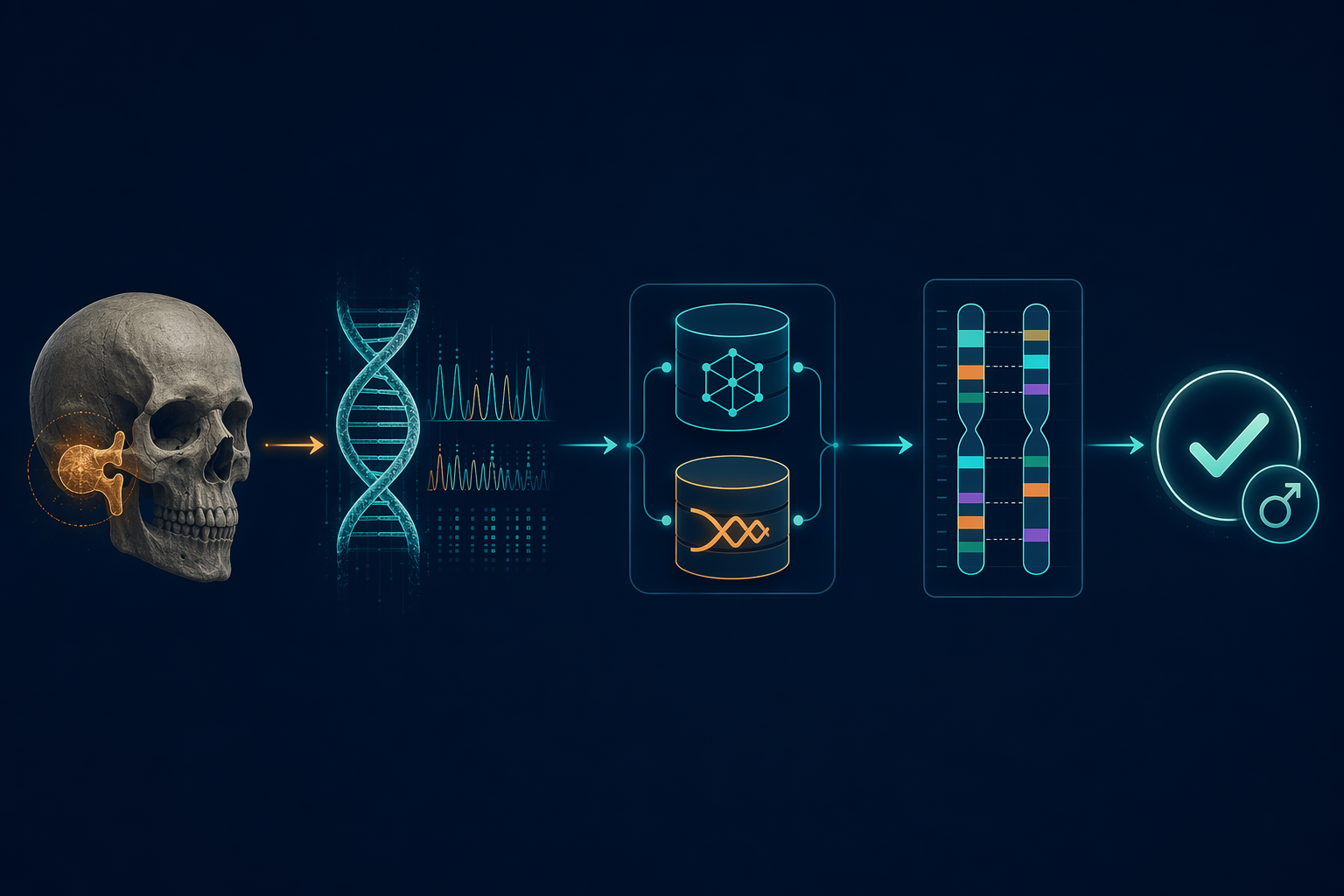
Private John Pumphrey, one of the Camden Fourteen, had been dead for nearly 246 years when scientists tried to recover enough DNA to give one unnamed Revolutionary War soldier his name back. A tooth, the usual kind of sample people imagine in old-remains work, did not produce what the team needed. The pivot came from a less romantic place: the dense petrous portion of the temporal bone at the base of the skull. Astrea Forensics used whole-genome sequencing adapted from paleogenomics to generate what were reported as the oldest autosomal DNA profiles ever uploaded to GEDmatch and FamilyTreeDNA in December 2024.[1]
That is why the phrase revolutionary war soldier identified by DNA history study needs some discipline. The identification was not a single search in a giant consumer-DNA index. It was a chain: a better bone sample, ancient-DNA-style sequencing, upload only to databases that permit forensic use, thousands of weak genetic matches, relationship mapping, participant intake, and finally a surname check using Y-DNA.
Why the Petrous Bone Changed the Case
Old DNA fails in ordinary ways before it fails in dramatic ones. Heat, water, soil chemistry, microbes, handling, and time break long DNA molecules into damaged fragments. A profile useful for investigative genealogy has to survive not as a museum object, but as data that can be compared against living people.
The petrous bone matters because it is unusually dense. Research on ancient and degraded remains has found that the petrous portion can yield up to 100 times more DNA than other skeletal elements.[2] That does not guarantee success; it changes the odds. In the Camden work, the first tooth extraction failed, while petrous bone sampling gave the team material that could move into sequencing.[1]
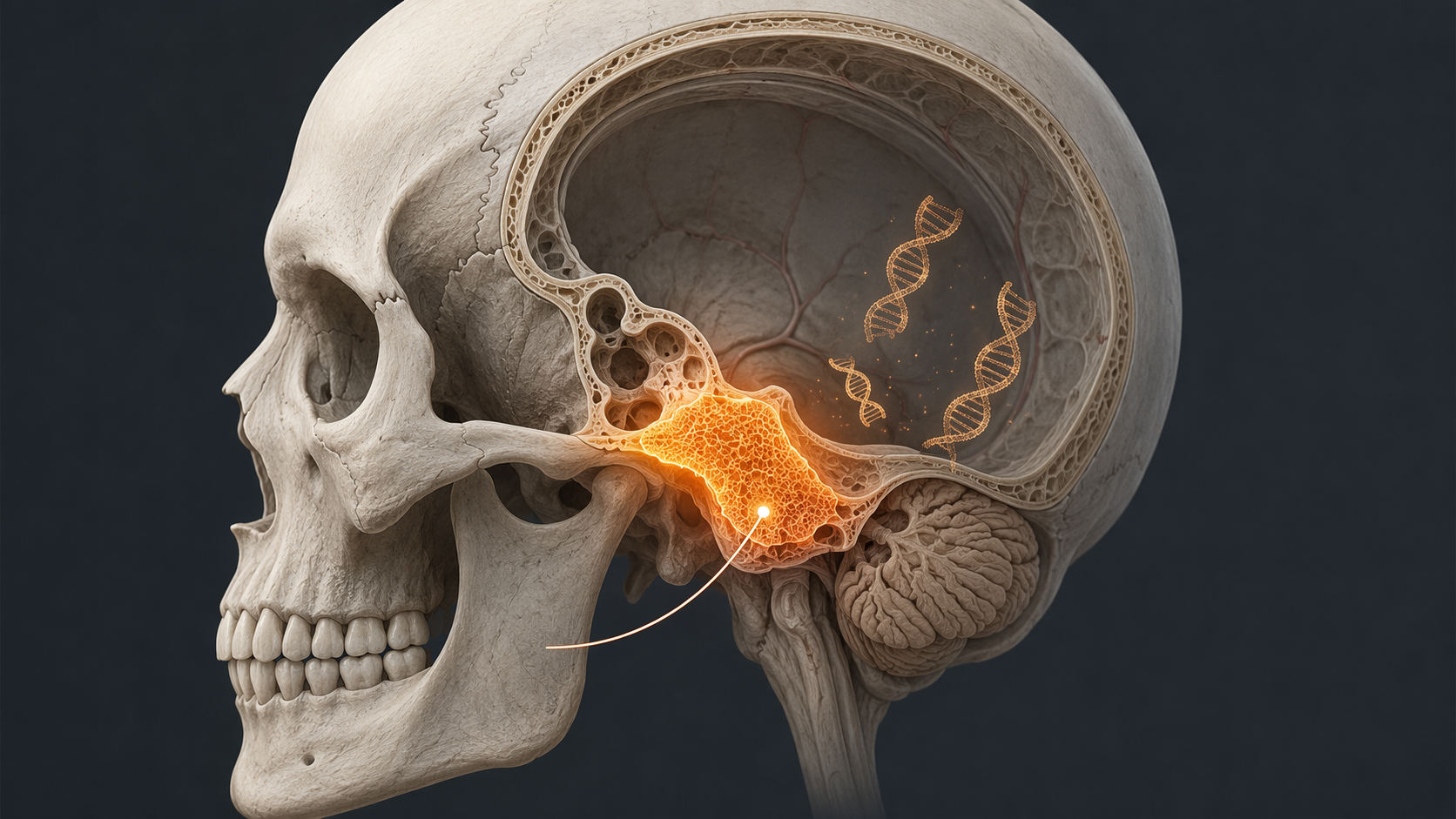
For a student, that detail is more than a lab anecdote. It explains why old-case identification is not simply a matter of deciding to “run DNA.” The sample choice determines whether the rest of the workflow is possible. If the DNA is too sparse or too damaged, no genealogy platform can rescue the case later.
Whole-genome sequencing adapted from paleogenomics was the next important shift. Standard forensic DNA testing often focuses on specific marker systems. Investigative genetic genealogy needs data that can be compared to the kind of autosomal files used by genealogy databases. For Pumphrey, the sequencing step had to produce enough comparable genetic information from eighteenth-century remains to create uploadable profiles for modern matching.[1]
| Workflow point | What had to work | Why it mattered |
|---|---|---|
| Sample recovery | Petrous bone sampling after tooth extraction failed | Improved the chance of recovering usable DNA from very old remains |
| Sequencing | Whole-genome sequencing adapted from paleogenomics | Created data that could be compared in genetic genealogy systems |
| Database access | Uploads to GEDmatch and FamilyTreeDNA | Used the public databases that permit forensic uploads |
| Relationship mapping | Centimorgan interpretation and family-tree reconstruction | Separated useful relatives from thousands of distant matches |
| Surname confirmation | Y-DNA analysis through FamilyTreeDNA services | Tested whether the paternal-line signal fit the Pumphrey name |
The Database Boundary Was Part of the Method
The next constraint is easy to miss because consumer DNA companies are often discussed as if they were interchangeable. They are not interchangeable in forensic genetic genealogy. AncestryDNA, 23andMe, and MyHeritage do not allow law-enforcement or forensic uploads. GEDmatch and FamilyTreeDNA are the two public databases that permit this kind of upload under their policies.[3]
That boundary affected the Pumphrey case directly. A profile sitting outside the permitted systems could not simply be pushed into every large consumer database. The investigators had to work with the match universe available through GEDmatch and FamilyTreeDNA, and with users whose participation and settings made them available for this type of comparison.[3]
This is also where privacy and consent enter the practical workflow. The issue is not an abstract footnote after the science is finished. Database rules decide which comparisons can be run in the first place. A method that depends on ignoring those rules is not reproducible; it is just a shortcut that may not be allowed the next time.
Twenty Thousand Matches Did Not Mean Twenty Thousand Answers
The uploaded profiles produced roughly 20,000 genetic matches to living relatives, but only about 150 were close enough to help investigators build a useful path toward identification.[4] That ratio is a good antidote to the database-hit myth. A match list is raw material. Most of it is too distant, too ambiguous, or too poorly documented to carry the case.
Investigative genetic genealogy uses shared DNA to estimate possible relationships. The measurement students need to recognize is the centimorgan, a unit used to express how much DNA two people share. More shared DNA usually means a closer relationship, but the same centimorgan range can fit multiple relationships. A match could fall into more than one possible slot on a family tree, especially when the common ancestor is several generations back.
Tools such as DNA Painter and the Shared Centimorgan Project help organize those possibilities. They do not name the unknown person by themselves. They help investigators ask better questions: Which relationship ranges are plausible? Which family lines could connect several matches? Which branches can be ruled out because the dates, locations, or inherited DNA do not fit?
The tedious part is the part that makes the conclusion stronger. FHD Forensics reported processing intake forms from 800 project participants and tracking DNA tests from dozens of potential relatives for the Camden burials work.[5] Intake matters because a genetic match without a usable pedigree, contact information, permissions, or follow-up testing may not move the case very far. Genealogy is not only a tree on a screen; it is a documentation problem.
In a recent case with a living parent-child comparison, one strong match can settle the matter quickly. Pumphrey had no direct descendants. He died at about 16 to 18 years old and had no children; the living relatives identified in reporting descend from his siblings and include fourth-great-nieces and fourth-great-nephews.[6] That pushes the work into distant-cousin territory, where weak signals must be combined across multiple branches.
How the Family Tree Narrowed Toward John Pumphrey
The Camden investigators were not trying to prove that an unknown soldier was related to one modern person. They were trying to find the historical person whose family network best explained the pattern of matches. That requires building backward from living matches to shared ancestors, then forward through descendants, siblings, and collateral lines until a plausible candidate appears in the right historical setting.
Pumphrey fit the pattern that emerged from the genetic and genealogical work. Reporting on the identification notes that investigators cross-checked autosomal DNA, X-chromosome evidence, and Y-chromosome evidence before announcing the name.[7] That convergence matters because each kind of DNA answers a slightly different question.
- Autosomal DNA helps find relatives across many ancestral lines, which makes it the main engine of broad genetic genealogy matching.
- X-chromosome evidence can support or limit certain inheritance paths because X inheritance follows different rules for males and females.
- Y-DNA follows the direct paternal line in males and can be especially useful when the question involves a surname passed through that same line.
The autosomal matches got the investigation into the right family neighborhood. The X-chromosome evidence added another inheritance check. The Y-DNA evidence then became unusually important because it could test the paternal-line surname hypothesis. CBS News reported that FamilyTreeDNA’s Y-DNA services were critical to confirming the Pumphrey surname.[7]
That distinction is worth keeping. Autosomal genealogy can suggest a family. Y-DNA can test whether a male unknown belongs on a direct paternal line associated with a surname. In this case, the surname confirmation was not decorative evidence added after the fact; it was one of the checks that made the identification defensible.
What This Case Teaches Better Than a Clean Diagram
A classroom diagram can make investigative genetic genealogy look linear: sample, sequence, match, identify. Pumphrey’s case is better because it shows the friction. The first sample did not solve the problem. The useful databases were limited by policy. The match list was large but mostly not decisive. The best candidates still needed family-tree work and follow-up testing. The final confidence came from convergence, not from one impressive number.
The funding picture belongs in that same practical frame. Sources describe each identification as costing tens of thousands of dollars, supported through grants, crowdfunding through Genealogy For Justice, and donations.[3][4][7] That means the method is reproducible under the right conditions, but not cheap, automatic, or evenly available to every historical or forensic project.
The age of the case is still remarkable. A teenager who died in the Revolutionary War, left no children, and was buried without a lasting name marker has now been connected to a documented family. But the lesson for forensic-science students is not that old cases yield when someone says “DNA database.” The lesson is that a name can emerge when lab sampling, sequencing strategy, database permission, centimorgan interpretation, documentary genealogy, participant management, and lineage testing all survive contact with the same evidence.
The remaining Camden identifications should be treated with that caution. Pumphrey’s identification shows that the toolkit can work on Revolutionary War remains under favorable enough conditions. It does not prove that every unknown soldier will be named. Sample quality, funding, database participation, available relatives, and future project decisions will decide how far the method can go.
References
- Scientists Extracted DNA From Unknown Revolutionary War Soldiers. The Quest to Identify Them Breathes New Life Into Not-So-Ancient History, Garden & Gun
- The petrous bone and ancient DNA: a brief review, PMC
- A Revolutionary War soldier was identified nearly 250 years after his death, NPR, June 23, 2026
- DNA Reveals the Identity of a Teenager Who Died in the Revolutionary War, Cracking a Nearly 250-Year-Old Cold Case, Smithsonian
- Camden Burials Identifications, FHD Forensics
- Revolutionary War soldier identified using DNA technology, USA Today, June 22, 2026
- Revolutionary War soldier identified as John Doe using technology, CBS News
Comments
Join the discussion with an anonymous comment.