
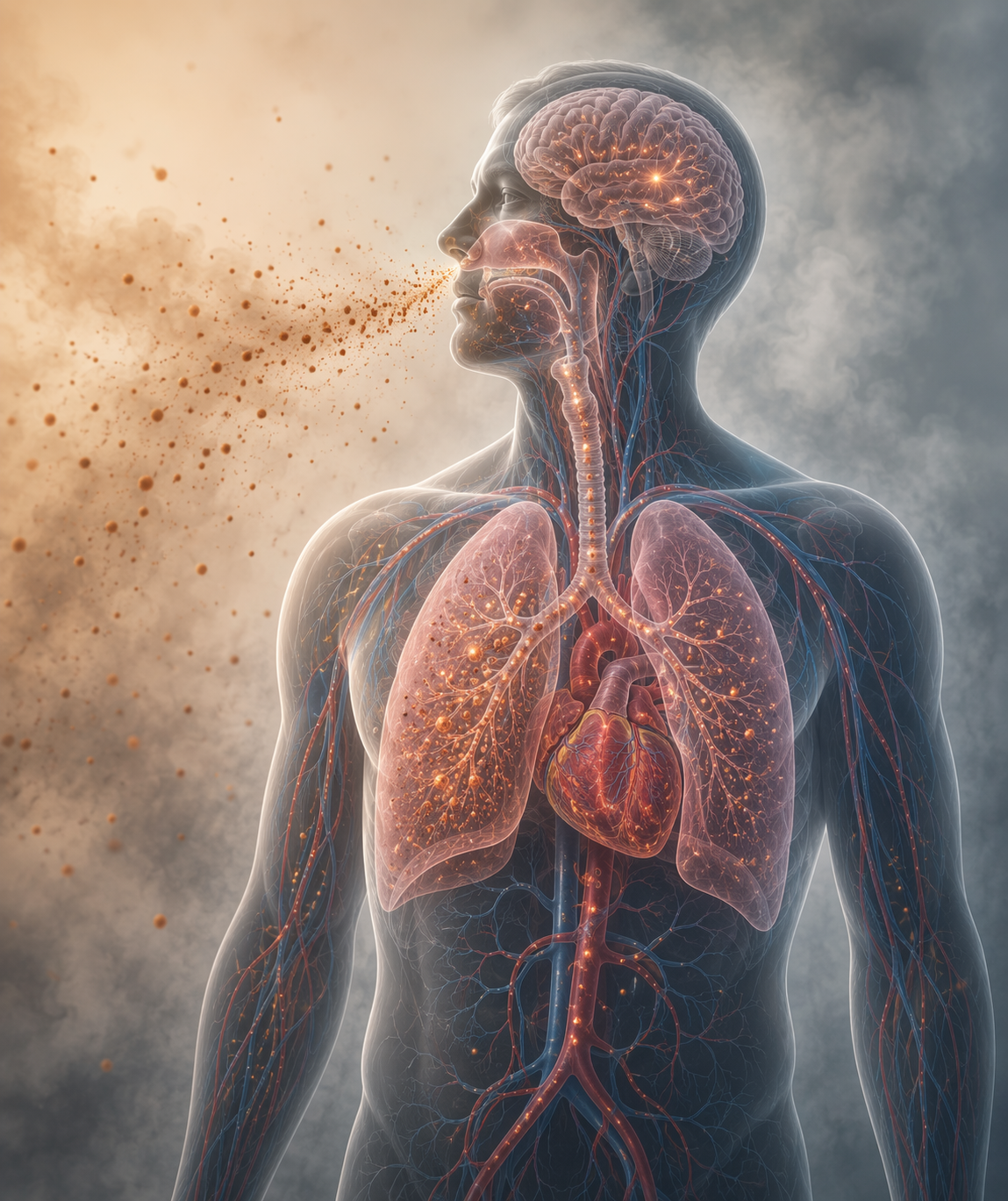
What the Latest Wildfire Smoke Health Effects Research Found
This article synthesizes major studies from 2024–2026 that transformed our understanding of wildfire smoke as a long-term, multi-system health threat — providing students and residents with a research-backed overview of mortality risks, persistent cardiovascular and neurological effects, and climate-driven amplification.
Updated:
The most important wildfire smoke health effects research from the last few years does not start with the color of the sky. It starts with a category problem. In 2024, Ma and colleagues estimated that long-term exposure to wildfire-related PM2.5 was associated with about 11,415 nonaccidental deaths per year in the contiguous United States, and the mortality signal was not limited to respiratory disease. Cardiovascular, endocrine, and mental disorder mortality were also significantly associated with long-term wildfire PM2.5 exposure.[1]
That finding is useful because it gives students and residents a different endpoint to track. A one-day air quality index can tell you something about immediate exposure. It cannot, by itself, answer whether smoke exposure has accumulated across seasons, whether the relevant risk window continues after visible smoke disappears, or whether the affected body system is even the one people were taught to watch first.
The 2024–2026 research window matters for that reason. Smoke did not suddenly become dangerous in 2024. What changed is that the evidence base became broader, longer in time scale, and more system-specific. The newer studies are asking questions that older public messaging often flattened: which deaths, which diagnoses, which exposure periods, which source of PM2.5, and which populations carry the risk after the fire is no longer a news event?
The mortality estimate changed the scale of the question
Ma et al. is the anchor study because it treats wildfire smoke as a long-term exposure rather than a short episode of bad air. The study estimated annual nonaccidental mortality associated with long-term wildfire PM2.5 exposure across the contiguous United States and reported roughly 11,415 deaths per year.[1] For exam purposes, the key phrase is associated with. This is epidemiological evidence, not a randomized experiment in which exposure is assigned.
Still, the study changes the burden calculation. A respiratory-only frame would lead you to look mainly for asthma attacks, COPD exacerbations, emergency visits, and short-term irritation. Ma et al. widened that frame by finding significant associations with cardiovascular, endocrine, and mental disorder mortality as well as nonaccidental mortality overall.[1] The practical implication is not that every smoky day causes every later diagnosis. It is that wildfire PM2.5 belongs in the same analytic space as other population-level chronic environmental exposures.
This is also where the difference between a public-health estimate and a personal prediction matters. A national annual mortality burden does not tell one resident what will happen to them after one smoke event. It does tell health departments, clinicians, and policy students that the exposure has a measurable population-level footprint across multiple causes of death. That is enough to change what counts as adequate evidence synthesis.
The risk window does not end when the air looks clear
The 2025 persistence-after-fire study by Wei and colleagues is the natural next piece because it moves from total burden to timing. The study found that health effects persisted up to 3 months after fires ended, including elevated risks of ischemic heart disease, hypertension, pneumonia, and COPD.[2] This is the study I would put next to a calendar, not next to a photograph of smoke.
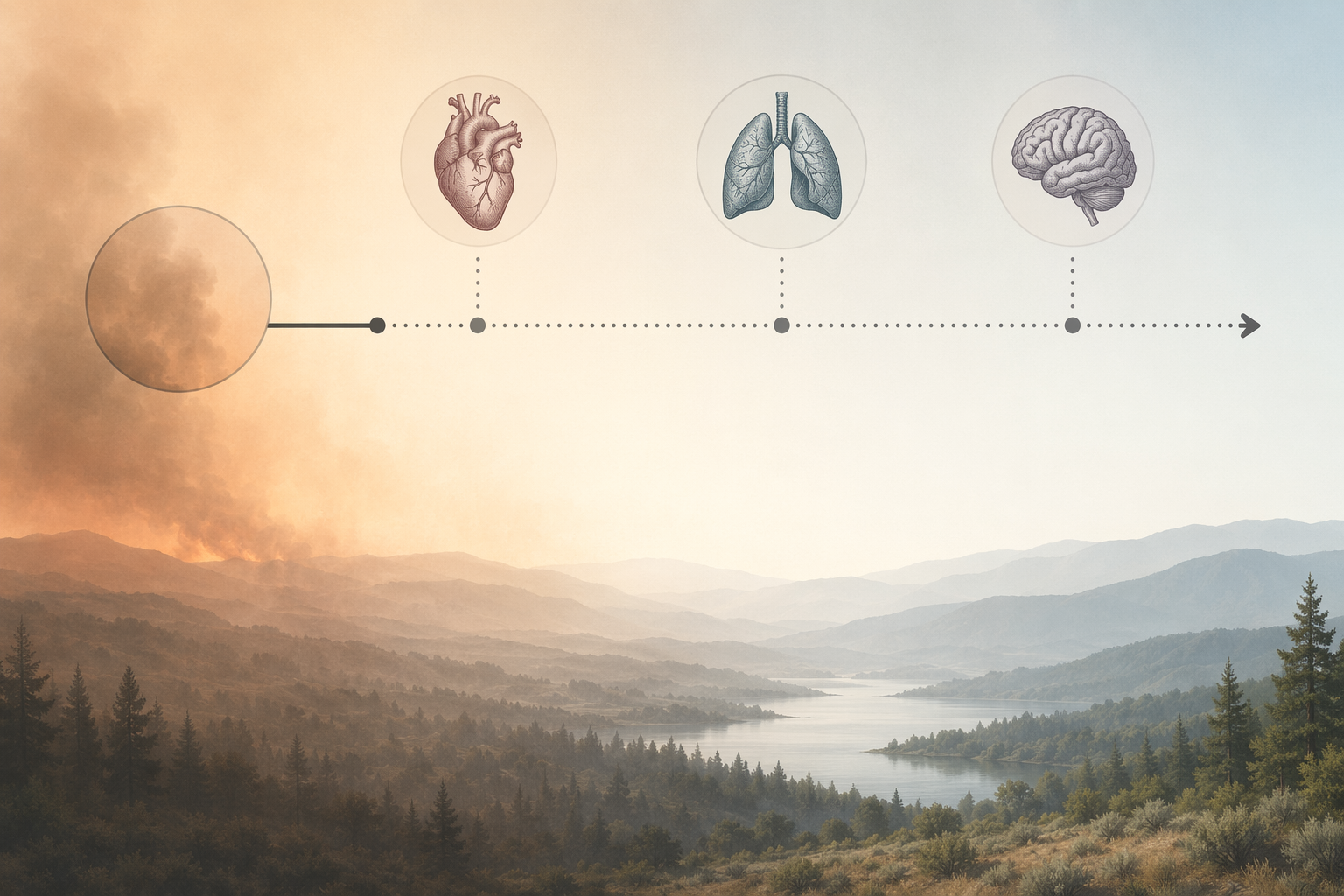
The finding is easy to misuse if it is phrased too loosely. It does not mean every person remains clinically ill for 3 months after every fire. It means the study detected elevated health risks in a post-fire window extending up to 3 months, including cardiovascular and respiratory outcomes.[2] That distinction matters for older adults with heart disease, people managing hypertension, and anyone trying to decide whether a smoky week is over as soon as the AQI map turns green.
It also sharpens the mechanism question. Pneumonia and COPD fit the older lung-centered model. Ischemic heart disease and hypertension push readers toward systemic pathways: inflammation, vascular stress, autonomic changes, and the possibility that inhaled particles can trigger consequences far from the airway. The study does not need to prove every intermediate step to make the timeline clinically relevant.
| Study focus | What it measured | Why it changes interpretation |
|---|---|---|
| Long-term national mortality | Estimated annual nonaccidental deaths associated with long-term wildfire PM2.5 exposure | Moves wildfire smoke from an episodic irritant frame to a population mortality-burden frame |
| Post-fire persistence | Health risks up to 3 months after fires ended | Makes visible smoke an inadequate endpoint for risk assessment |
| Repeated exposure | Mortality risk over a 3-year exposure window | Treats smoke seasons as cumulative rather than isolated events |
| Source-specific toxicity | Health risk per unit of wildfire PM2.5 compared with other PM2.5 sources | Challenges regulations that treat PM2.5 mass as interchangeable |
Repeated exposure makes smoke seasons cumulative
A separate 2025 PNAS study by Schwarz and colleagues adds a repeated-exposure lens. In coverage from UC Berkeley, the study is described as finding that repeated long-term exposure to wildfire smoke raised mortality risk by 7% over 3 years, with the greatest risks reported for adults ages 60–75 and for Black individuals.[3]
That 3-year frame is important because many practical decisions are still made one smoke event at a time. A student misses outdoor practice for a week. A worker changes a commute route. A family tapes a filter to a box fan. Those choices may be necessary, but the study design points toward a different exposure history: repeated smoke seasons, repeated inflammatory insults, repeated gaps in protection, and unequal ability to avoid exposure.
The subgroup findings should be read carefully. Greater risk among adults ages 60–75 is biologically plausible given baseline cardiovascular and respiratory vulnerability. Greater risk among Black individuals is not an invitation to treat race as a simple biological variable. It should push the reader to look for structural pathways: housing quality, occupational exposure, neighborhood pollution mixtures, healthcare access, evacuation options, and preexisting inequities that can shape both exposure and recovery. The study can identify disparity in risk; explaining every pathway behind that disparity requires more than the mortality model alone.
Neurological and developmental findings widen the evidence, but they need careful verbs
The newer wildfire smoke literature is not stopping at heart and lung outcomes. A 2025 JAMA Neurology study reported that wildfire smoke PM2.5 was a greater risk factor for dementia than PM2.5 from other sources.[4] That finding matters because dementia is not a short-term irritation outcome. It belongs to a longer disease process, which makes source-specific exposure assignment and confounding especially important.
The right conclusion is not that one bad smoke week causes dementia. The narrower, better-supported conclusion is that wildfire-derived PM2.5 showed a stronger association with dementia risk than PM2.5 from other sources in that study.[4] For students, this is where the verb does most of the scientific work. Associated with, linked to, and caused by are not interchangeable.
The prenatal evidence requires the same discipline. UC Davis reported in 2026 that exposure to intense wildfire smoke during pregnancy may be linked to a 6% higher likelihood of autism.[5] The phrase may be linked is not hedging for style; it marks the limits of observational evidence in a sensitive developmental outcome. Prenatal exposure studies must contend with socioeconomic conditions, geographic differences, healthcare access, co-exposures, stress, and diagnostic patterns. Those caveats do not erase the finding. They define how far the finding can travel.
For pregnant people reading a result like that, the most honest interpretation is probabilistic rather than deterministic. A reported 6% higher likelihood is not a forecast for an individual pregnancy.[5] It is a signal that intense smoke exposure during pregnancy deserves attention in environmental-health planning, clinical counseling, and future causal research.
The policy hinge is source-specific toxicity
The most policy-disruptive claim in this research cycle is not simply that PM2.5 is harmful. Air-quality science already knew that. The harder claim is that wildfire PM2.5 may be more harmful per unit mass than PM2.5 from other sources. Stanford researchers described wildfire smoke as approximately 10 times more harmful per unit concentration than fossil-fuel PM2.5, a source-specific toxicity finding that builds on earlier Nature Communications work by Aguilera and colleagues.[6][7]
This is the point where regulatory simplicity and biological specificity collide. Current EPA and WHO frameworks regulate PM2.5 largely by mass concentration, not by treating wildfire particles as a separate hazard category with its own risk coefficient. That approach is administratively cleaner, and it reflects the way particulate standards have historically been built. But if wildfire particles carry higher health risk per microgram than fossil-fuel particles, a single PM2.5 number can understate danger during smoke-dominated episodes.
The evidence does not hand regulators a finished replacement rule. Source apportionment is technically demanding, smoke chemistry changes with fuel and combustion conditions, and population exposure is uneven. But the research does make one thing difficult to defend: treating all PM2.5 as equally informative when the health literature is increasingly source-specific.
Climate change makes the exposure problem larger
The climate studies belong after the health-effects evidence, not before it. They explain why the health findings are becoming harder to treat as rare-event research. Law and colleagues estimated that climate change contributed to about 15,000 of 164,000 wildfire PM2.5 deaths from 2006–2020, with an associated economic burden of $160 billion.[8]
A separate 2025 analysis from Stanford ECHO Lab and Climate Central reported that per-person wildfire smoke exposure was 4 times higher in 2020–2024 than in 2006–2019.[9] That comparison gives the recent epidemiology its urgency. A health effect with modest individual-level risk can become a major public-health problem if exposure becomes more frequent, more widespread, or more prolonged.
Climate attribution is not the same as saying climate change caused every fire or every smoke plume. The narrower claim is stronger: climate change has contributed to wildfire smoke mortality over a defined historical period, and recent per-person exposure has risen sharply compared with the earlier baseline.[8][9] That is enough to make wildfire smoke a recurring exposure category rather than an occasional disaster footnote.
How to read the 2024–2026 evidence without overstating it
Most of the major studies in this roundup are observational. That means they can estimate associations across real populations and real exposure gradients, often at scales no experiment could ethically reproduce. It also means they remain vulnerable to confounding, exposure misclassification, migration patterns, healthcare access differences, socioeconomic conditions, and co-pollutant mixtures.
Those limitations should change the wording, not flatten the evidence. A useful exam answer would not say, “Wildfire smoke proves dementia, autism, hypertension, and mortality.” It would say that recent cohort and time-series evidence links wildfire PM2.5 with long-term nonaccidental mortality, post-fire cardiovascular and respiratory risks, repeated-exposure mortality increases, dementia risk, and prenatal developmental associations, with causality inferred cautiously rather than experimentally proven.
For residents, the same distinction has practical value. The end of visible smoke is not the same as the end of the relevant health window. A single AQI screenshot is not a cumulative exposure history. A general PM2.5 standard may not fully communicate source-specific risk during wildfire events. Background advice on symptoms and protection still matters, but the newer research is asking a different question: how should health risk be understood when smoke exposure is repeated, persistent, multi-system, and climate-amplified?
The answer supported by the latest wildfire smoke health effects research is narrower than a slogan and stronger than a warning label. Wildfire smoke should now be treated as a long-duration, multi-system exposure with evidence of source-specific toxicity and a growing climate-driven burden. The careful version of that sentence still leaves room for confounding, measurement limits, and policy uncertainty. It also makes “the smoke cleared” an inadequate endpoint for health analysis.
References
- Long-term exposure to wildland fire smoke PM2.5 and mortality in the contiguous United States, PNAS, Sept. 2024
- Wildfire smoke can harm heart and lungs even after the fire has ended, Harvard Gazette, June 2025
- Wildfire smoke raises risk of death after the air clears, UC Berkeley Public Health, Dec. 2025
- Wildfire Smoke Exposure and Dementia Risk, JAMA Neurology, 2025
- Exposure to intense wildfire smoke during pregnancy may be linked to increased likelihood of autism, UC Davis Health, Feb. 2026
- Assessing wildfire health risks, Stanford Report, Jan. 2025
- Wildfire smoke impacts respiratory health more than fine particles from other sources: observational evidence from Southern California, Nature Communications, 2021
- Climate change increased US wildfire smoke deaths, Communications Earth & Environment, May 2025
- Climate Change Worsens Wildfire Smoke, Climate Central, 2025
Comments
Join the discussion with an anonymous comment.