
How to Study The Odyssey's Historical Accuracy
Learn how to use spaced repetition and active recall to master the three historical eras layered within Homer's Odyssey. This guide provides a flashcard-based workflow to help you confidently discuss the poem's historical context for essays, exams, and class discussions.
Updated:
The question Nolan reopened
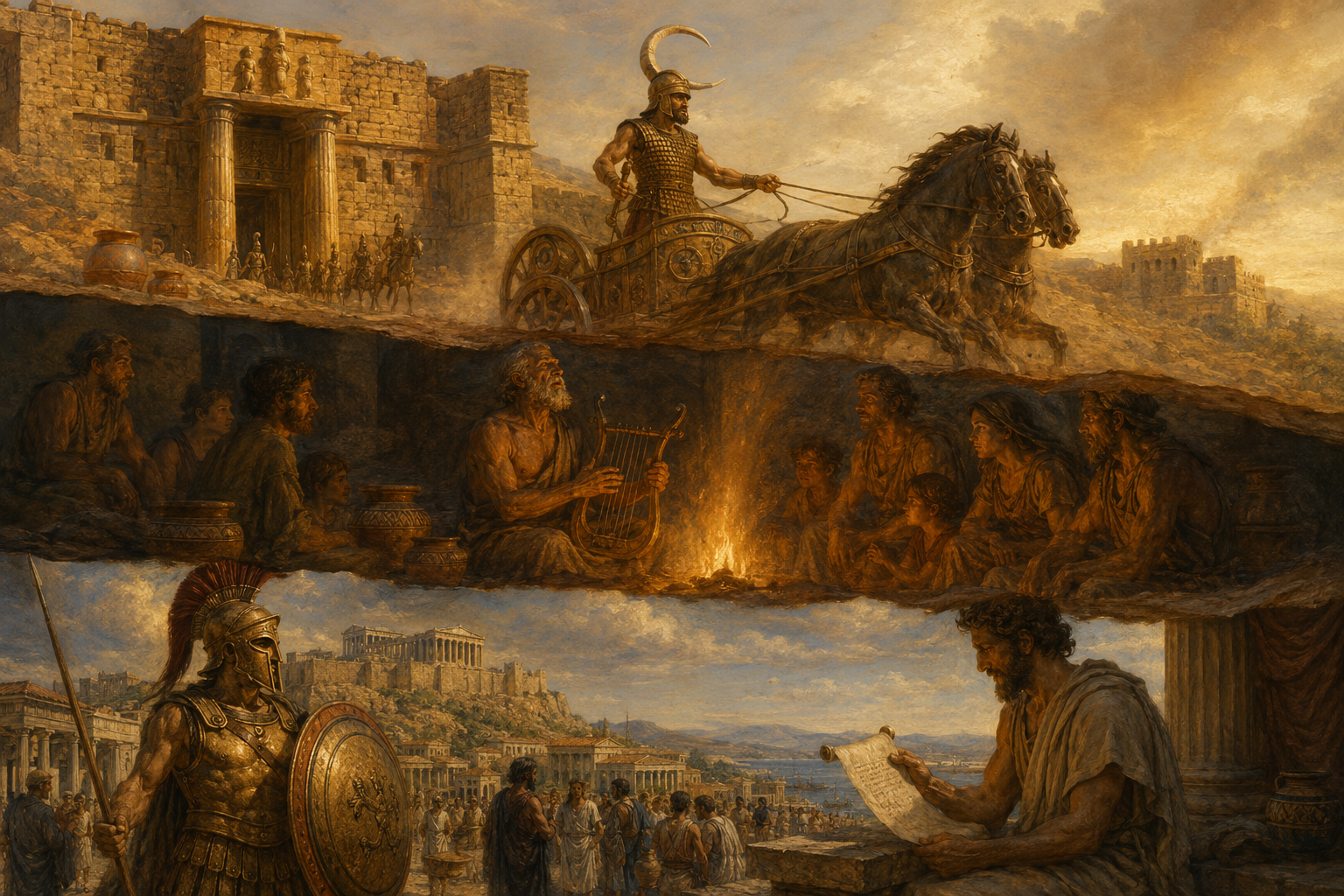
Nolan's new The Odyssey has revived the classroom question almost overnight, especially for students who need to talk about it in essays or discussion. The useful question is not whether Homer is simply "accurate" or "inaccurate"; it is how the poem layers Bronze Age memory, Dark Age oral transmission, and Archaic-period detail into one epic, which is the frame Georgetown and Berkeley are both using to discuss the film. [1][2][3]
That shift matters because the poem is not one historical snapshot. It is closer to a composite record, and the composite is the whole point.
The three layers students need to separate
The Bronze Age residue is the easiest layer to point to. The poem keeps objects and institutions from the Mycenaean world: boar's-tusk helmets, palace-centered elites, and a real fortified Troy at Hisarlik rather than a purely invented backdrop. [4][5]

Xenia works the same way. It is a literary engine in the poem, but it also reflects a real guest-friendship code with religious weight, so you should treat it as social history and storycraft at the same time. Oral tradition can preserve that sort of memory across long spans, even while changing it on the way to the written text. [4]
The Dark Age layer is the transmission stage, when stories move by voice, not by manuscript. That is why the poem can sound older than its writing date without being a clean time capsule.
The Archaic layer is where later equipment and habits slip in. The helmet debate makes this easiest to remember: the trailer leans on Corinthian helmets, while Homeric description points back to boar's-tusk helmets, so the visual argument in the film is already a shortcut into the poem's own anachronism problem. [1][4]
Turn the blend into flashcards
Once you see the layers, the study task gets simpler: make cards that force separation instead of rereading the whole plot. One card should ask what Homer says, another what archaeology supports, and a third what Nolan shows or changes.
| Homer says | Archaeology says | Nolan shows |
|---|---|---|
| Boar's-tusk helmets belong to the poem's older warrior world. [4] | Dendra-style boar's-tusk helmets are real Bronze Age finds. [4][5] | The trailer's Corinthian helmets point to a later visual register. [1] |
| Xenia governs how strangers are received. [4] | Guest-friendship had real social and religious weight. [4] | Hospitality scenes become easier to read if you know the code. |
| Troy, Ithaca, Mycenae, and Pylos are grounded in a real ancient landscape. [5] | Hisarlik is a real fortified site, not an invented city. [5] | Adaptation may compress geography, so treat the map as a clue, not proof. |
| The story survives through long oral retelling. | Cultural memory can preserve older episodes even when the final text is later. [4] | The film is a modern retelling, so it helps with memory, not chronology. |
To turn that table into active recall, hide the middle column first and say it from memory. Then hide the left column and ask whether the item belongs to Bronze Age memory, Dark Age transmission, or Archaic retelling. That extra step is what makes spaced repetition work instead of just feeling familiar.
Anki is the cleanest home for durable review because you can keep the cards in rotation and let the scheduler do the timing. RemNote is handy if your source notes live in PDFs or clipped articles. Quizlet can still help for a quick first pass, but since it removed spaced repetition in 2025, it is a weaker place to stop if you need the material to stick.
If you need one sentence for class, say that The Odyssey is not historically accurate to one period; it is historically layered, and the best study method is to test each layer separately until the differences feel automatic.
References
- Christopher Nolan's 'The Odyssey' Trailer Sparks Historical Inaccuracies Debate. Artnet News.
- Ask a Professor: Odyssey Epic Adaptation. Georgetown University.
- Watch: An Archaeologist's Guide to Christopher Nolan's The Odyssey. UC Berkeley News.
- The Odyssey: true story, historical accuracy and Christopher Nolan. HistoryExtra.
- Is the Odyssey a True Story? Encyclopaedia Britannica.
Comments
Join the discussion with an anonymous comment.