
ASVAB Planner
Know Tornado Watch vs Warning for ASVAB General Science
On a timed General Science question, tornado watch vs warning is not mainly a vocabulary puzzle. The test is usually checking whether you can match the alert to three things: who issues it, how urgent it is, and what action follows.
| Alert | What it means | Who issues it | Typical timing and area | What you do |
|---|---|---|---|---|
| Tornado Watch | Conditions are favorable for tornadoes | NOAA Storm Prediction Center | Usually issued hours ahead for a broad multi-county or multi-state area | Be Prepared |
| Tornado Warning | A tornado has been sighted or indicated by weather radar | Local National Weather Service Forecast Office | Shorter-term alert for a smaller area, often city-sized or small-county scale | Take Action Now |
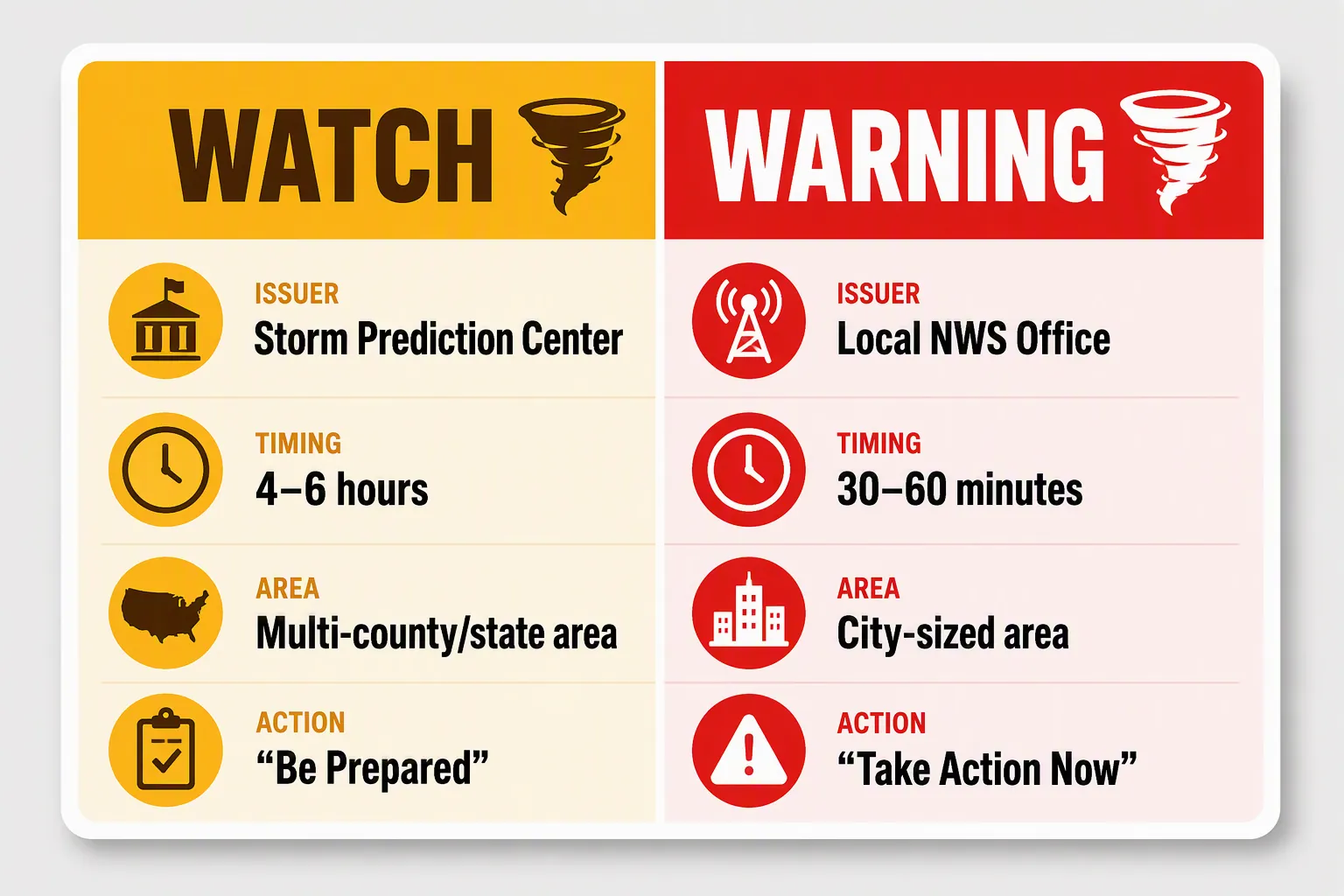
The National Weather Service gives the cleanest test wording: “A Tornado WATCH means Be Prepared. A Tornado WARNING means Take Action!”[1] Keep that sentence in your head before you start adding details.
- Word-length rule: Watch has 5 letters, so treat it as the less urgent alert. Warning has 7 letters, so treat it as the more urgent alert.
- The “-ing” rule: warning ends in “-ing,” and “-ing” can remind you that something is happening now or has been detected.
- Ingredients rule: a watch means the ingredients are present; a warning means the tornado threat is occurring or has been detected.
The Three Layers That Usually Decide the Answer
For a student, the safest way to study this is not to memorize one sentence and stop. Memorize the distinction in layers. If a question gives you only “conditions are favorable,” you choose watch. If it gives you “radar indicated” or “spotted,” you choose warning. If it asks about the issuing agency, the answer may not be the same for both alerts.
Layer 1: Meaning
A tornado watch means the atmosphere is capable of producing tornadoes. It does not mean a tornado has already been seen. That is why “watch” pairs with preparation: monitor updates, know where shelter is, and be ready to move.
A tornado warning means the threat has crossed a line. A tornado has been sighted or weather radar indicates one, so the action changes from getting ready to taking shelter immediately.[2]
Layer 2: Issuer, Timing, and Area
This is the layer students often skip, and it is the one that can separate two answer choices. Tornado watches are issued by NOAA’s Storm Prediction Center. Tornado warnings are issued by local National Weather Service Forecast Offices.[3]
The scale is different too. A watch usually covers a broad region and can last several hours; standard descriptions treat watches as broad multi-county or multi-state alerts commonly lasting 4–6 hours. A warning is narrower and shorter, often covering an area around the size of a city or small county and lasting about 30–60 minutes.[4]
That timing matters on a test because the stem may never say “watch” or “warning.” It may say “large area,” “several hours ahead,” or “conditions are favorable.” Those point to watch. It may say “local office,” “radar indicated,” “take shelter,” or “short-term alert.” Those point to warning.
Layer 3: Action
For a watch, the correct action is preparation. You are not ignoring it, and you are not treating it like an all-clear. You are making sure you can receive warnings, identifying shelter, and staying alert.
For a warning, the correct action is immediate shelter. On an exam, do not soften that into “continue monitoring conditions.” A warning means the danger is close enough and confirmed enough that shelter is the answer.

Why “Conditions Favorable” Is Not the Same as “Tornado Detected”
Many wrong answers come from treating both alerts as general bad-weather notices. They are not equal in the alert ladder. A watch says the setup is dangerous enough to pay attention. A warning says the tornado threat has been identified in a specific place.
The National Severe Storms Laboratory explains that the United States observes about 1,200 tornadoes in a typical year, but that figure should be read as an observed reporting figure, not a perfect timeless average, because tornado detection and reporting have changed over time.[5] For ASVAB purposes, that number is less useful than the alert contrast. The exam is more likely to ask what an alert means than to ask you to recite a national tornado count.
The same restraint applies to lead time. One educational source citing NWS information gives an average tornado warning lead time of about 13 minutes, while other summaries have used slightly different figures for earlier periods.[4] The test-friendly conclusion is narrower and safer: warnings are short-fuse alerts, not several-hours-ahead planning notices.
The NWS Alert Ladder, Without Letting It Take Over
A basic watch-versus-warning question does not require you to become a severe-weather forecaster. Still, it helps to know where the two terms sit in the alert sequence. The simplified ladder is:
- Convective Outlook: broad severe-weather potential.
- Tornado Watch: conditions are favorable; be prepared.
- PDS Tornado Watch: a Particularly Dangerous Situation watch for a higher-confidence, higher-impact setup.
- Tornado Warning: tornado sighted or radar indicated; take shelter.
- PDS Tornado Warning: a Particularly Dangerous Situation warning for an especially serious confirmed or strongly indicated threat.
- Tornado Emergency: the highest tier, used for an extreme threat to life and property.
The National Weather Service also uses watch, warning, and advisory terminology more broadly across weather hazards, with “warning” carrying the meaning that hazardous weather is occurring, imminent, or likely.[6] For tornadoes, keep the narrower test version: watch prepares; warning shelters.
Impact Based Warning tags can add more detail to tornado warnings. The tags include Radar Indicated, Observed, Considerable, and Catastrophic, and they were added across 2012–2016.[2] If a question stem says “radar indicated,” do not overthink it. That is warning language.
ASVAB-Style Practice Questions
Use these as retrieval practice, not as a full weather lesson. Read the clue, identify the layer, then choose.
Question 1
A weather alert says atmospheric conditions are favorable for tornado development across several counties later in the day. Which alert is being described?
- A. Tornado Emergency
- B. Tornado Warning
- C. Tornado Watch
- D. Flash Flood Warning
Answer: C. “Conditions are favorable” and “several counties” point to a tornado watch. The trap is B, because students see “tornado” and choose the more urgent-sounding word.
Question 2
A local National Weather Service Forecast Office issues an alert after radar indicates rotation capable of producing a tornado near a town. What should people in the warned area do?
- A. Continue normal activity unless clouds become visible
- B. Take shelter immediately
- C. Wait for the Storm Prediction Center to issue a watch
- D. Prepare supplies for possible storms several hours later
Answer: B. The clue is “radar indicates,” plus the local NWS office. That is warning territory, so the action is shelter now.
Question 3
Which agency issues tornado watches?
- A. Local National Weather Service Forecast Offices
- B. NOAA Storm Prediction Center
- C. Local police departments
- D. The Federal Emergency Management Agency
Answer: B. This is the agency distinction worth memorizing: Storm Prediction Center for watches, local NWS Forecast Offices for warnings.
Question 4
A student says, “A tornado watch means a tornado has already been seen.” What is wrong with that statement?
- A. It confuses a watch with a warning
- B. It confuses a tornado with a hurricane
- C. It describes a convective outlook
- D. It describes normal weather
Answer: A. A watch is about favorable conditions. A warning is the alert tied to a sighted or radar-indicated tornado.
More ASVAB General Science Topics
If you are building a General Science review set, keep this tornado alert distinction next to other earth science and weather topics. The same test habit applies to hurricane science study tips for the ASVAB General Science subtest and the Earthquake Preparedness Study Guide for the ASVAB General Science: learn the tested contrast, not just the broad topic.
For broader study planning, use the ASVAB Exam Prep Guide to decide how much time this kind of single-fact science item deserves compared with arithmetic, word knowledge, and mechanical comprehension.
Last-Minute Test Cues
- If the stem says “conditions are favorable,” choose tornado watch.
- If the stem says “sighted,” “observed,” or “radar indicated,” choose tornado warning.
- If the stem asks who issues watches, choose NOAA Storm Prediction Center.
- If the stem asks who issues warnings, choose local National Weather Service Forecast Offices.
- If the stem asks for action: watch = be prepared; warning = take shelter now.
You do not need a full meteorology course for this item. You need the alert’s authority and action: SPC watch, local NWS warning; prepare for watch, shelter for warning.
References
- NWS Social Media — Tornado Safety. NWS Social Media.
- National Weather Service — Understand Tornado Alerts. National Weather Service.
- NSSL/NOAA — Severe Weather 101: Tornado Forecasting. NSSL/NOAA.
- Illinois Extension — What is the difference between a tornado watch and warning?. Illinois Extension. 2021-06-25.
- NSSL/NOAA — Severe Weather 101: Tornado Basics. NSSL/NOAA.
- NWS — Watch/Warning/Advisory Definitions. National Weather Service.
Fill in this timeline
This is a skeleton schedule, not a performance claim — for section-by-section strategy to fill in each slot, read the exam hub. For evidence that a similar timeline worked, compare against real outcome logs.
How to Read the '1 in 4 NFL Players CTE' Study
- When to Do HIIT for Better Memory and Exam Focus
- Can NYT Strands Daily Actually Build Vocabulary?
- A Sleep-First Routine to Stop Falling Asleep While Studying
- Does Air Quality Affect Study Focus? Yes — by How Much?
Compare each outcome's duration against this planner's single-day length manually.