
ASVAB Exam Hub
Hurricane Science Study Tips for the ASVAB General Science Subtest
Focus your ASVAB General Science prep on the hurricane and meteorology content most likely to appear: atmospheric layers, the Saffir-Simpson scale, formation conditions, and storm surge basics, all backed by official NOAA and test-prep sources.
- SAT
- ACT
- GRE
- MCAT
- ASVAB
- digital-sat
- adaptive-testing
- registration-fee
- content-outline
- score-target
Hurricane preparedness study tips for the ASVAB are not about boarding windows or packing bottled water. For this exam, “preparedness” means knowing which storm and atmosphere facts can realistically show up in General Science, then drilling them hard enough that you do not lose time sorting them out under pressure.
That pressure is real. The CAT-ASVAB General Science subtest gives you 15 questions in 12 minutes, while the paper-and-pencil version gives you 25 questions in 11 minutes.[1] A hurricane item is not likely to decide your whole future by itself, but a missed earth-science question can still hurt when you are trying to qualify for a better line score.
The clean way to study this slice is to separate the sources. NOAA is the stronger source for hurricane facts, especially the Saffir-Simpson wind scale and what that scale does not measure. Test-prep sources are useful for ASVAB format, common General Science patterns, and atmosphere review, but they should not be treated as official Department of Defense topic weights. If someone tells you earth science is an exact published percentage of General Science, be careful: the available materials support an estimate, not a DoD-issued breakdown.
For the full test plan around this module, keep the main ASVAB hub open: ASVAB exam prep guide. This article is the hurricane-and-meteorology pass, not the whole General Science strategy.
What To Know Before You Start Drilling
| Topic | What the ASVAB-style question may test | Study priority |
|---|---|---|
| Atmospheric layers | Layer order, altitude bands, and what happens in each layer | High |
| Saffir-Simpson scale | Wind thresholds, Category 3 as major hurricane, and what the scale excludes | High |
| Atmospheric composition | Main gases in Earth’s atmosphere | Medium |
| Hurricane formation | Warm tropical water, low pressure, Coriolis effect, and seasonal peak | Medium |
| Storm surge and SLOSH | Storm surge as water pushed inland; SLOSH as a surge model name | Medium-low |
The point is not to become a hurricane specialist. The point is to recognize the exam-shaped facts quickly: layer names, category thresholds, gas percentages, formation conditions, and the storm-surge distinction that trips up people who assume every hurricane danger is part of the wind category.
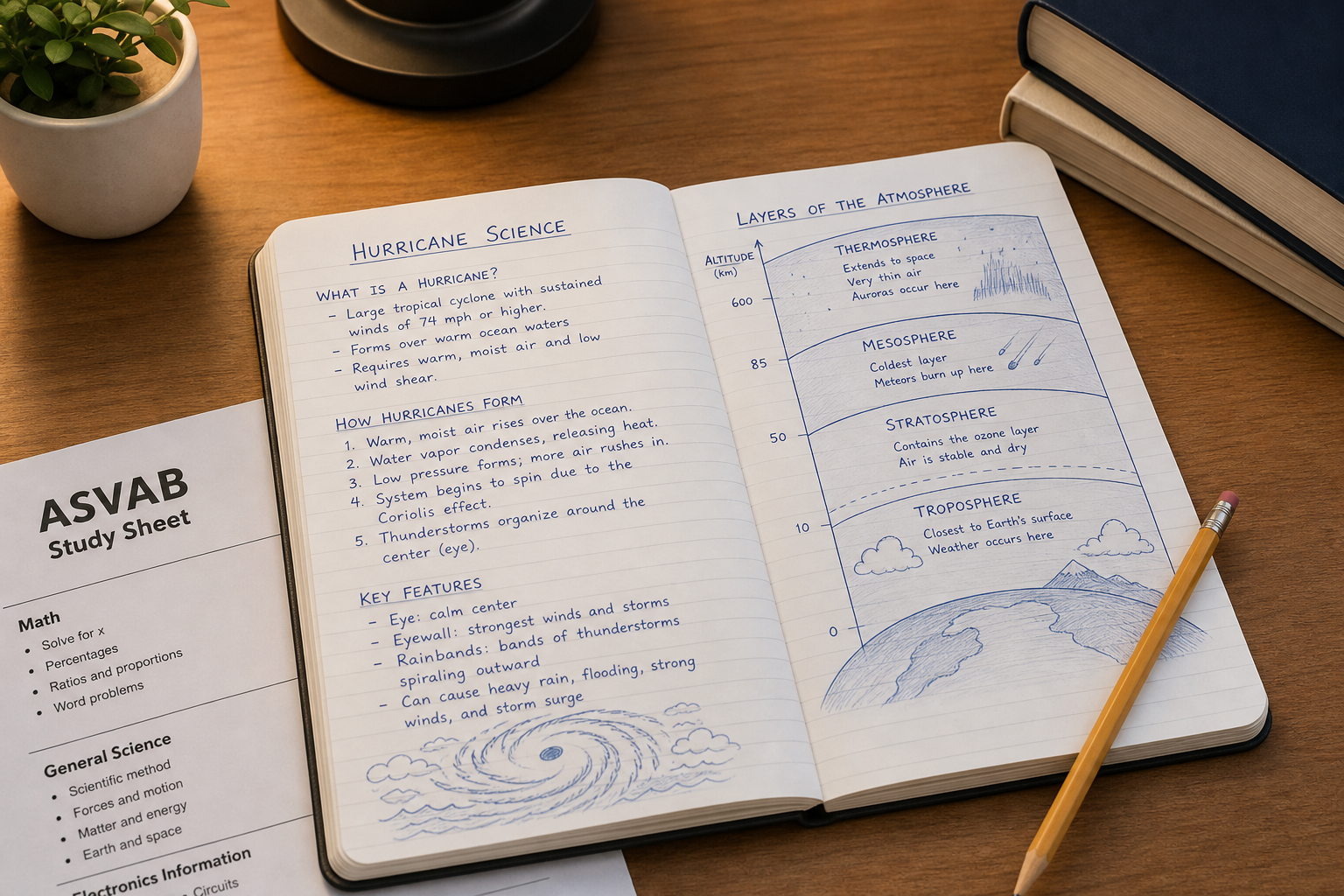
Atmospheric Layers: The Recall Set Most Worth Locking Down
Atmospheric layers are prime General Science material because they are compact, ordered, and easy to confuse. The ASVAB Test Practice mnemonic “The Sun Manages Temperature Extremes” maps to troposphere, stratosphere, mesosphere, and thermosphere.[2] Use it if it helps, but do not stop at the first letters. The question will usually care about the layer’s job.
| Layer | Approximate altitude | ASVAB-useful fact |
|---|---|---|
| Troposphere | 0-7 miles | Weather happens here |
| Stratosphere | 7-30 miles | Ozone layer association |
| Mesosphere | 30-53 miles | Meteors burn up here |
| Thermosphere | 53-350+ miles | ISS/satellite association in common prep material |
Under time pressure, the most expensive mix-up is usually troposphere versus stratosphere. Troposphere equals weather. Stratosphere equals ozone. If a question asks where hurricanes form and where day-to-day weather occurs, the answer is the troposphere. If it asks where the ozone layer is concentrated, move up one layer to the stratosphere.
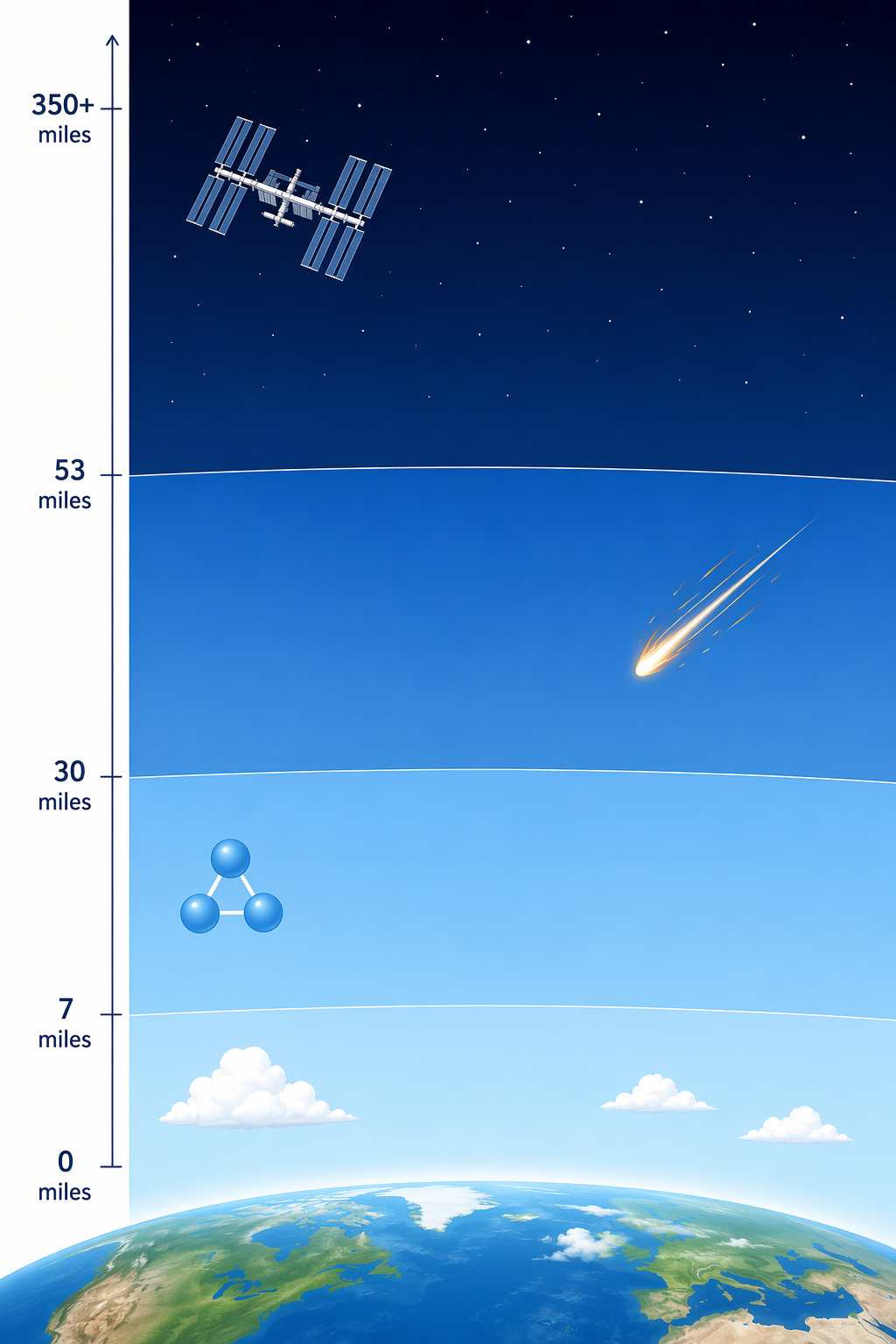
Do not overbuild this. You do not need a graduate-level temperature profile for each layer. For an ASVAB pass, drill the order from Earth upward, the altitude ranges used in your prep material, and the one identifying feature attached to each layer.[2]
Atmospheric Composition: Four Numbers, One Likely Trap
Earth’s atmosphere is mostly nitrogen, not oxygen. The commonly tested breakdown in ASVAB prep is about 78% nitrogen, 21% oxygen, 0.93% argon, and 0.04% carbon dioxide.[2] The trap is obvious: oxygen feels like it should be first because humans need it. On the test, nitrogen is first.
- Most abundant gas: nitrogen
- Second most abundant gas: oxygen
- Small but common answer choice: argon
- Very small but scientifically important: carbon dioxide
A quick active-recall drill is enough here. Cover the right side of the list and ask yourself: first gas, second gas, approximate nitrogen percentage, approximate oxygen percentage. If you can answer those in a few seconds, move on.
Saffir-Simpson: Learn The Thresholds, Then Learn The Warning Label
The Saffir-Simpson Hurricane Wind Scale is a NOAA-backed fact set, and it is one of the cleanest hurricane items to memorize. It classifies hurricanes by sustained wind speed: Category 1 is 74-95 mph, Category 2 is 96-110 mph, Category 3 is 111-129 mph, Category 4 is 130-156 mph, and Category 5 is 157 mph or higher.[3]
| Category | Sustained wind speed | ASVAB note |
|---|---|---|
| Category 1 | 74-95 mph | Hurricane starts at 74 mph |
| Category 2 | 96-110 mph | Still not classified as major |
| Category 3 | 111-129 mph | Major hurricane begins here |
| Category 4 | 130-156 mph | Severe wind category |
| Category 5 | 157 mph or higher | Top category on the scale |
The number to tattoo onto your study sheet is 111 mph. Category 3 is where NOAA’s scale reaches “major hurricane” status.[3] A test item may not ask you to reproduce every range. It may simply ask which category starts major-hurricane classification or whether a storm with a given wind speed is Category 2 or Category 3.
Now the warning label: the Saffir-Simpson scale does not account for storm surge, rainfall flooding, or tornadoes.[3] That distinction matters because many hurricane casualties and damages are tied to water, but the category number is a wind scale. If an answer choice says a Category 4 rating directly measures storm surge height, reject it.
Hurricane Formation: Keep The Mechanism Short
For ASVAB purposes, hurricane formation is a short chain, not a documentary. Hurricanes need warm tropical water at or above about 80°F, a low-pressure system, and the Coriolis effect to help organize rotation.[2] Warm ocean water supplies energy. Low pressure supports rising air and storm development. The Coriolis effect helps the system rotate rather than simply rise and collapse in place.
The August-October peak belongs in that same logic. Tropical waters are warmest during that part of hurricane season, so the energy source is more favorable.[2] Do not turn that into a memorization project about every named storm month. For a General Science question, the useful link is warm water timing, not storm history.
- Warm ocean water: about 80°F or higher
- Pressure pattern: low pressure
- Rotation factor: Coriolis effect
- Seasonal peak: August-October because tropical waters are warmest
Storm Surge And SLOSH: Know The Distinction, Not The Whole Course
Storm surge is the rise of water pushed toward shore by a storm. It is central to hurricane danger, but it is not what the Saffir-Simpson category measures. NOAA’s own scale page makes that boundary explicit: the wind category does not account for storm surge or rainfall flooding.[3]
SLOSH stands for Sea, Lake, and Overland Surges from Hurricanes. For this module, treat SLOSH as a name-recognition item connected to storm-surge modeling. You do not need to detour into a FEMA course or learn emergency-management operations unless another exam specifically requires it.
A likely distinction question would be simple: Saffir-Simpson classifies hurricane wind speed; storm surge concerns abnormal water rise; SLOSH is associated with modeling surge. Those are separate boxes. Keep them separate.
A Fast Study Pass That Does Not Eat The Whole Evening
Give this module one focused pass before you go back to mixed General Science. The mistake is spending three hours reading hurricane-preparedness pages and then still missing “Which atmospheric layer contains weather?” on a timed drill.
- Make a one-page fact sheet with layer order, gas composition, Saffir-Simpson thresholds, formation conditions, and the storm-surge distinction.
- Drill active recall, not rereading: cover the answers and recite the layer facts, wind thresholds, and gas percentages.
- Mix in a few General Science questions so you practice switching from biology or chemistry back into earth science.
- Send missed items back into your full ASVAB plan instead of expanding this into general meteorology.
If your bigger issue is consistency across subtests, a study tool can help organize the work. Use app comparisons only after the fact sheet is built; they are support systems, not substitutes for knowing that weather is in the troposphere and Category 3 starts at 111 mph. For broader tool selection, see best ASVAB study apps for 2026 and ASVAB study apps that boost AFQT score.
Where To Stop
Stop before this turns into a hurricane-safety article. Evacuation kits, household checklists, famous storm case histories, and climate-change context may matter in real life, but they are not the highest-return material for this ASVAB General Science module.
The honest boundary is narrow: the DoD does not publish a precise earth-science weighting for General Science, and test-prep estimates should stay labeled as estimates. What you can control is smaller and cleaner. Capture the likely meteorology points, verify the hurricane facts against NOAA where NOAA is the source, and move back into the full ASVAB study plan.
References
- ASVAB General Science Practice Test, Mometrix, updated 2026
- ASVAB Meteorology: Atmospheric Layers, ASVAB Test Practice
- Saffir-Simpson Hurricane Wind Scale, NOAA National Hurricane Center
Related exhibits & inventory
Verified outcomes
No verified outcomes on file for this exam yet
See Methodology for how outcome evidence is disclosed once logged.
Planners
No planner filed for this exam yet
A downloadable timeline template for this exam hasn't been published yet.
Tool verdicts
AI-tool cautions
No AI tools tested for this exam yet
No hands-on AI-accuracy logs have been filed for this exam.
Questions about this plan
Ask a question about a specific section, timeline, or citation in this plan — or flag something that needs correcting.
Comments
Join the discussion with an anonymous comment.