
Does NYT Connections Actually Build Vocabulary and Focus?
“I used NYT Connections daily to build vocabulary and focus” contains three different claims, and they do not deserve the same verdict. One of them is useful. One is plausible but easy to oversell. One is the kind of brain-training leap that makes a pleasant five-minute ritual start impersonating a study plan.
| Claim inside the sentence | Evidence verdict | What you can reasonably count it for | What you should not count it for |
|---|---|---|---|
| Connections builds vocabulary | Partially supported | Reinforcing words, meanings, categories, and associations you already partly know, especially if you look up misses afterward | Replacing a deliberate GRE, SAT, or ACT vocabulary plan |
| Connections builds focus | Supported only as a daily consistency habit | Creating a low-friction morning warm-up, a start cue, and a brief exercise in checking possible categories | Proving transferable attention gains on official test sections |
| Connections trains the brain | Unsupported as a broad outcome claim | Enjoyment, routine, and short bursts of semantic problem-solving | Long-term cognitive improvement, score gains, or general brain-health effects |
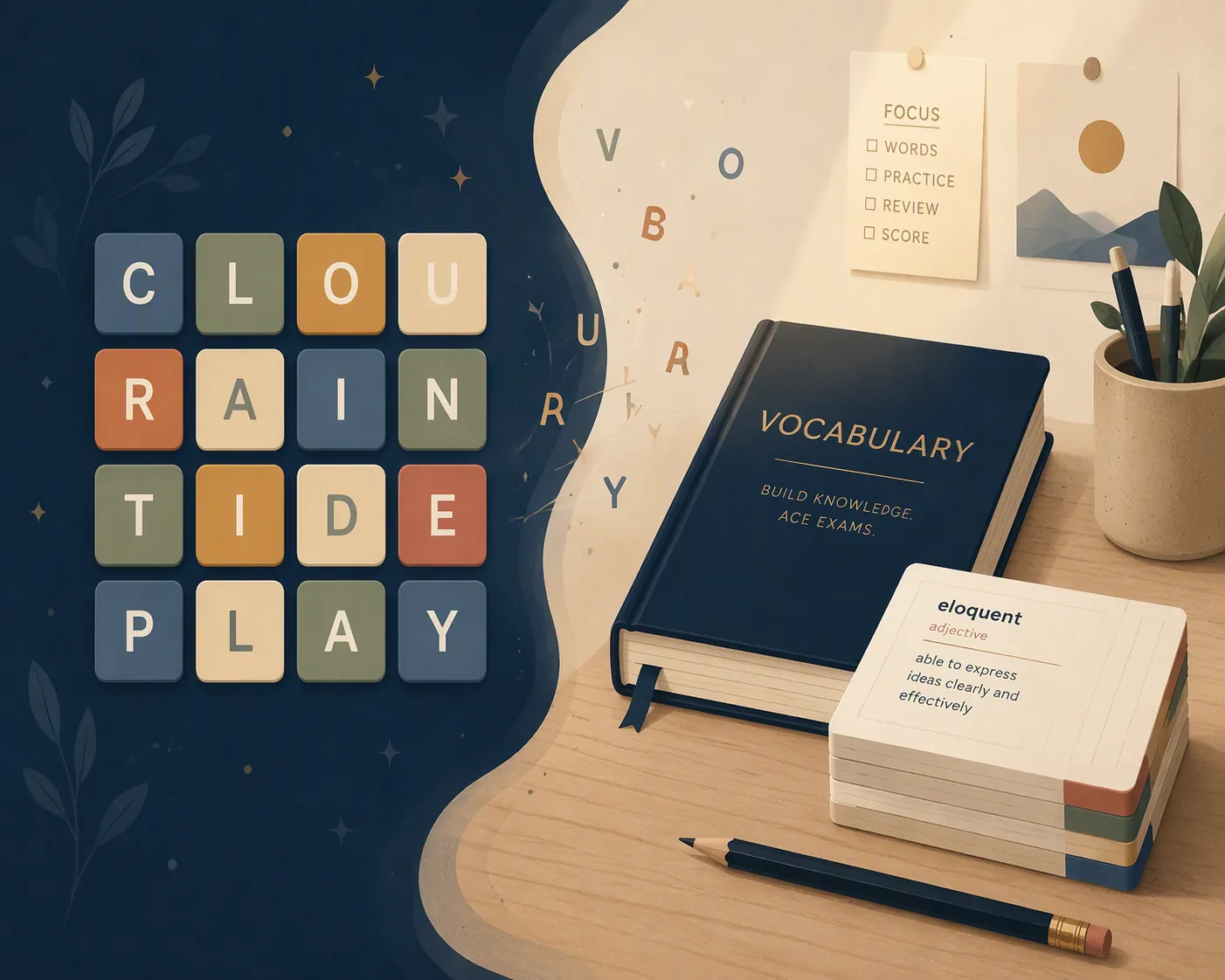
The confusion starts because the game really does feel study-adjacent. NYT’s official rules give you 16 words and ask you to sort them into four groups of four, with exactly one solution, four mistakes allowed, and categories that move from yellow to purple in difficulty.[1] That setup makes you retrieve meanings, test possible relationships, reject tempting traps, and stop before the puzzle eats the whole morning. It is finite, clever, and low-stakes. No wonder students reach for it before they reach for a GRE word list.
This is a synthesis, not a Connections-specific outcomes study. The evidence is moderate for vocabulary reinforcement mechanisms and limited for focus claims, especially any claim about transferable attention.
Connections also became big enough that these claims now travel socially, not just privately. The game launched on June 12, 2023, is edited by Wyna Liu, and is described as the second-most-played New York Times game.[2] Northeastern, citing New York Times figures reported via Axios, noted 2.3 billion Connections plays in 2023, compared with 4.8 billion Wordle plays.[3] Popularity does not establish a learning effect, but it does explain why a daily puzzle habit can start to feel like a shared form of discipline.
One practical detail matters for students: Liu has explicitly allowed lookups. In an Atlantic interview, she said, “look stuff up!” and added, “Anything that helps you enjoy the experience of the game is not only fair, but good.”[4] That permission changes the educational value of the game. A puzzle you can investigate after a miss is more useful than a purity test where unknown words simply stay unknown.
Vocabulary: reinforcement, not curriculum
The best version of the vocabulary claim is modest: Connections can reinforce word knowledge that is already near the surface. It asks you to notice that several words share a meaning, belong to the same phrase family, or can be read in a second way. That is not nothing. A student who has seen a word before but cannot quite place it may get a useful nudge from the puzzle’s forced comparison.
There is a real cognitive mechanism underneath that nudge. Muraki and Pexman, writing in The Conversation, explain Connections through semantic memory: players need flexible access to meanings, associations, and category structures, and the game’s red herrings work because semantically related words can pull you toward the wrong grouping.[5] That maps neatly onto what a lot of verbal study feels like. You do not merely need to “know” a word; you need to keep near-neighbors from stealing the answer.
Retrieval practice gives the claim a second piece of support, though not a direct proof about Connections itself. In controlled vocabulary research summarized by The Learning Scientists, retrieval practice outperformed restudy on vocabulary tests.[6] That finding supports a familiar study principle: trying to pull a meaning from memory can strengthen later access more than simply rereading the word. A Connections grid occasionally creates that moment. You see a word, try to place it, test a category, get feedback, and either confirm or revise your association.
The useful routine is therefore not just “play the puzzle.” It is: play, look up anything shaky, write down the missed category, and revisit it later. If a word appears in an exam-prep flashcard deck, retrieval practice is the engine that helps you keep it. If Connections gives you a common word used in an unexpected phrase, the same engine can still help—but it is reinforcing a different vocabulary target.
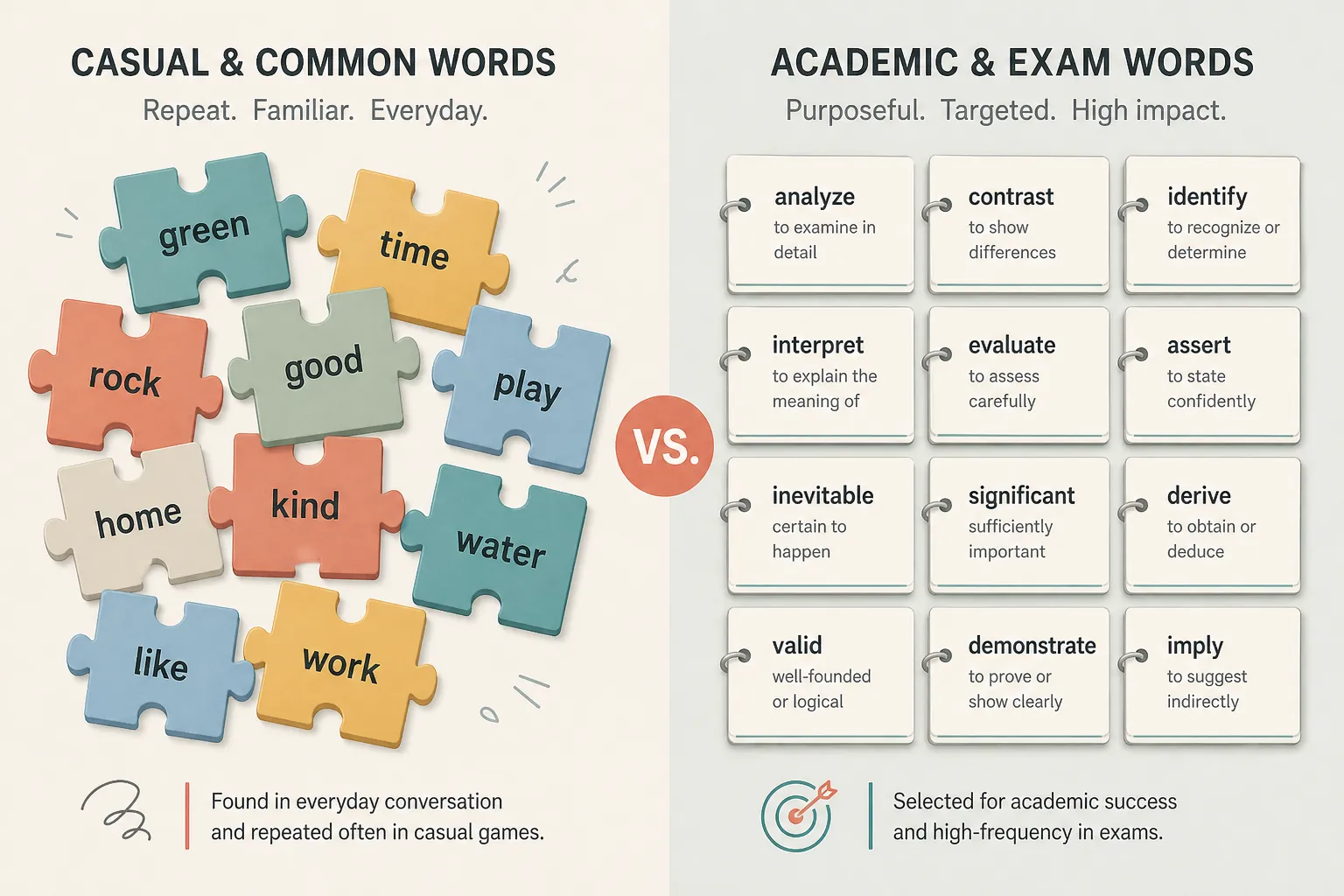
That difference is where the vocabulary claim has to narrow. A third-party WordsRated analysis of NYT Connections reported 15,374 total words and 7,122 unique words, with 42% of words appearing in two or more puzzles. It also found that over 80% of groups were synonyms, definitions, or idioms.[7] Those numbers are useful, but they are not official NYT figures, and they do not measure learning. They do show why a daily Connections habit is a poor substitute for targeted exam vocabulary: the pool is built for playable ambiguity and satisfying categories, not for coverage of high-frequency test words.
For GRE Verbal in particular, that distinction matters. GRE vocabulary study is usually built around a focused high-frequency list rather than whatever words happen to appear in a daily puzzle. Magoosh and Vince Kotchian both route students toward deliberate GRE word-list work on roughly the 1,000-word scale, not casual exposure to general wordplay.[8][9] A common-word-dominant puzzle can still sharpen associations, but it cannot be treated as if it were sampling from the vocabulary distribution your test is likely to reward.
This is the spot where test-takers tend to bargain with themselves. “I did Connections” becomes “I studied vocab” because both activities involve words and both feel mentally active. But the score consequence is different. Connections may help you remember that a familiar word can sit in an idiom, a homophone trap, or a synonym set. GRE Text Completion and Sentence Equivalence ask whether you can select the exact word that fits a sentence’s logic under time pressure. The overlap exists, but it is not large enough to carry the curriculum.
If you want the longer data version of that gap, StudyMethod’s Connections vocabulary corpus analysis is the place to go. The practical verdict here is simpler: count Connections as reinforcement only after the real list exists. If there is no flashcard deck, no review schedule, and no official-style verbal practice, the puzzle is not supplementing your plan. It is replacing the part you were avoiding.
Focus: a good start cue is not the same as attention training
The focus claim deserves a fairer hearing than the broad brain-training claim. A daily puzzle can make it easier to start. That matters for students because the hardest study step is often not deep comprehension; it is sitting down without negotiating for another 20 minutes.
NYT’s own stats-and-streaks announcement says most players solve Connections between 9 and 11 a.m.[10] That is habit evidence, not a learning outcome. Still, it is relevant. A brief morning puzzle can become a stable cue: coffee, grid, one round of mental sorting, then the actual study block. In that narrow sense, Connections can help focus because it reduces friction at the beginning of a session.
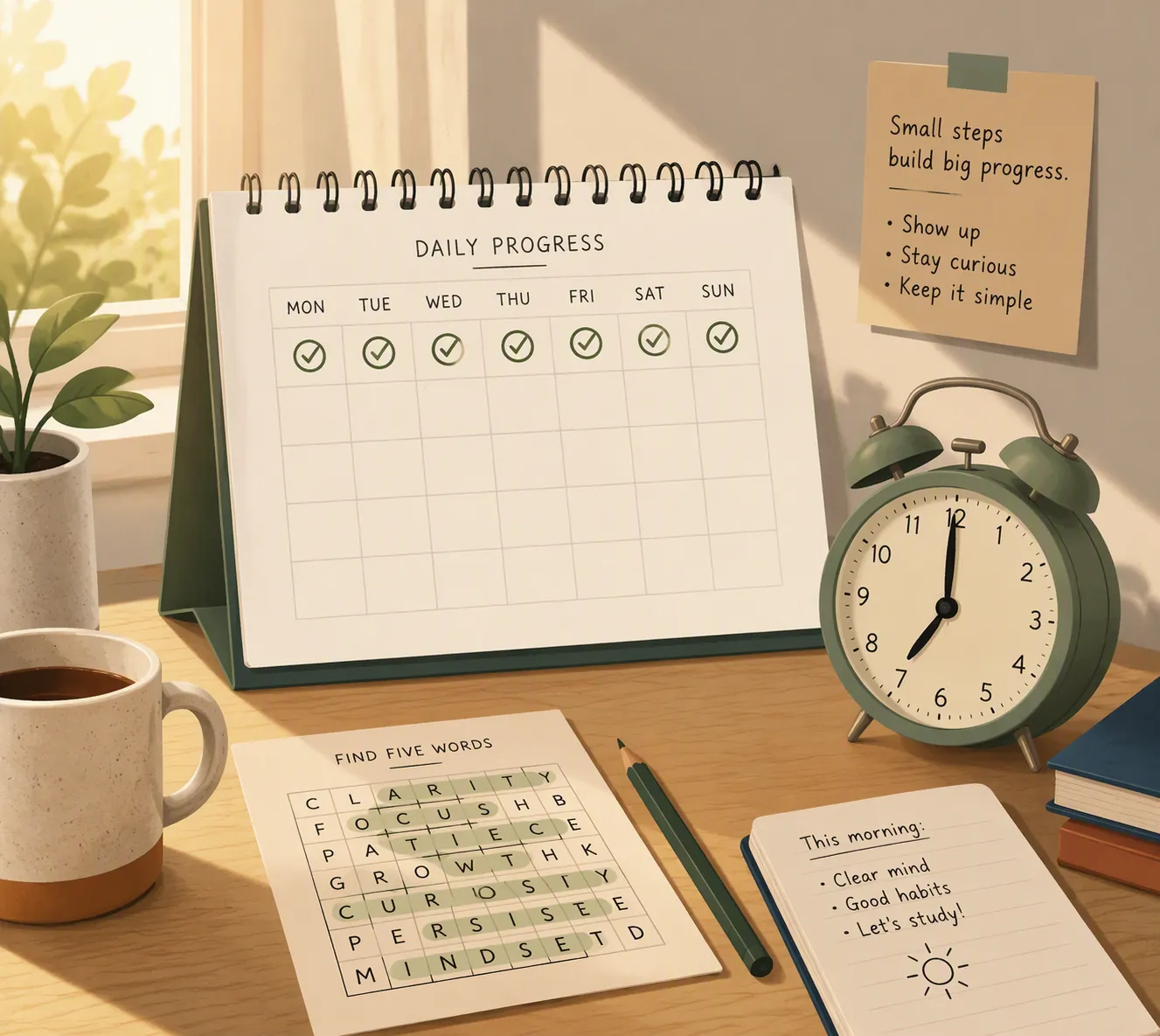
Streak mechanics make the habit case stronger, though the evidence comes from a different product. Duolingo reports that learners who reach a 7-day streak are 3.6 times more likely to finish a course.[11] That does not prove anything about NYT Games or exam scores. It does support a more general point: visible continuity and loss aversion can keep people returning to a daily behavior. If Connections is the small action that gets you to open the study app, the habit has value.
The game also asks for executive control while you play. You hold multiple possible categories in mind, resist an obvious trap, revise after feedback, and stop after a limited number of mistakes. Northeastern quotes Professor Susanne Jaeggi saying that games like Connections engage executive functions and can “help teach the brain to resist distractions.”[3] That is a plausible mechanism for why the puzzle feels focusing.
But mechanism is not outcome. Feeling more alert after a puzzle does not show that you will maintain attention through a dense GRE Reading Comprehension passage, a paired SAT evidence question, or a full ACT English section. Houston Methodist’s Dr. Tanu Garg makes the broader caution explicit: word games and puzzles are not conclusively proven to improve brain health over time.[12] The same caution applies here. Connections may be a warm-up. It is not evidence-backed attention training for test day.
A useful boundary is time. If the puzzle takes five minutes and leads directly into planned work, it is functioning as a start ritual. If it expands into yesterday’s puzzle, group-chat debate, archive browsing, and a vague feeling of having already studied, it has crossed into dressed-up procrastination. The game did not cause the problem. The promotion did.
Students who want a broader framework for that distinction can use StudyMethod’s executive-function study techniques guide. For this article, the focus verdict stays deliberately narrow: Connections can support consistency and task initiation; it has not been shown to improve transferable attention.
Brain training: the unsupported part of the claim
The phrase “build vocabulary and focus” is already a little slippery. The phrase “train your brain” is worse. It turns enjoyment, pattern recognition, semantic memory, and habit into one oversized promise. Connections was designed as a game. NYT’s public rules describe gameplay, mistakes, groups, and difficulty; they do not claim score gains, long-term cognitive improvement, or exam-transfer benefits.[1]
That does not make the game empty. A crossword clue can teach you something. A spelling game can expose a gap. A category puzzle can make a hidden association memorable. But those are local learning moments. They are not the same as evidence that repeated play broadly improves attention, reasoning, or verbal test performance.
For an exam student, the unsupported claim is also the most expensive one, because it lets enjoyable effort crowd out accountable work. A streak is visible. A solved grid is satisfying. A missed GRE question, reviewed slowly, is less charming. The less charming task is usually the one with clearer score relevance.
How GRE, SAT, and ACT students should actually use it
For GRE students, the safest use of Connections is as a five-minute warm-up before real Verbal work. Open the puzzle, solve or stop quickly, look up unknowns, and then move immediately to the day’s vocabulary deck, Text Completion set, Sentence Equivalence review, or Reading Comprehension passage. The puzzle earns its place only if it hands you off to the work that the test actually scores.
- Use it to practice flexible categorization: “What else could these words mean?” is a useful verbal habit.
- Use it to trigger lookups: if a category depends on a word or phrase you only half know, write it down.
- Use it as a start cue: puzzle first, then the scheduled GRE task, with no archive wandering.
- Do not use it as the day’s vocabulary quota unless you also reviewed a deliberate high-frequency list.
- Do not count a streak as evidence of Verbal improvement; count reviewed words and corrected official-style questions.
StudyMethod’s earlier NYT Connections vocabulary-study verdict and Connections study-method guide cover the warm-up use case in more detail. The same principle applies here: the puzzle is an opener, not the main set.
SAT and ACT students should be even more cautious about the vocabulary label. Modern SAT and ACT verbal work is less about memorizing obscure standalone words than about reading in context, grammar, rhetorical function, and evidence. A daily Connections habit may help you enjoy language and notice associations, but your prep should still route through exam-specific reading, grammar, and vocabulary-in-context practice. SAT readers comparing word-study tools can start with StudyMethod’s SAT vocab flash-card comparison.
If your main interest is focus rather than vocabulary, treat the puzzle like a logged warm-up experiment. Decide in advance what should happen after the grid. If your next 25 minutes become real study more often with Connections than without it, the ritual is doing useful work. If the puzzle becomes the study session, cut it or move it after the score-bearing task. StudyMethod’s HIIT study-break focus log is a useful model for keeping that kind of claim honest.
The clean boundary is this: Connections is allowed in the study system if it creates consistency, prompts lookups, and hands you into structured work. For GRE students, that means a high-frequency vocabulary list, official-style Verbal practice, and error review through the GRE exam hub. For SAT and ACT students, it means routing the habit into the SAT exam hub or ACT exam hub instead of letting a solved grid stand in for review. Enjoy the purple trap. Look things up. Then do the part that changes the score.
References
- Connections, The New York Times Help Center.
- The New York Times Connections, Wikipedia.
- Are Connections, Wordle and other NYT brain games good for you?, Northeastern Global News, April 30, 2024.
- Connections’ Wyna Liu on Puzzles and Controversy, The Atlantic, November 2024.
- NYT Connections: tips to improve your game through the science of semantic memory, The Conversation.
- Retrieval Practice and Vocabulary Learning, The Learning Scientists, August 4, 2017.
- NYT Connections Statistics, WordsRated.
- Best and Worst GRE Word Lists, Magoosh.
- My Favorite Way to Learn Vocabulary for the GRE, Vince Kotchian.
- Introducing Connections Stats and Streaks, The New York Times Company.
- How Duolingo’s streak builds habit, Duolingo Blog.
- Are Word Games & Puzzles Good for Your Brain?, Houston Methodist, October 2022.
Related case links
Did a similar plan work for you?
Share whether a comparable timeline and starting point produced a similar result — this is verification discussion, not general commentary.
Comments
Join the discussion with an anonymous comment.