
GRE Exam Hub
Use NYT Connections as a Vocabulary Study Method for Exams
Learn how to turn the NYT Connections puzzle into a deliberate vocabulary study method for GRE, SAT, and ACT prep. This guide explains the cognitive science of semantic categorization, how to build custom puzzles from exam word lists using free tools, and the limitations you need to know.
- gre
- mcat
- asvab
- sat
- act
- digital-adaptive
- official-material
- section-strategy
- test-date-timeline
Last reviewed: July 28, 2026. Routed for GRE, SAT, and ACT verbal prep. Evidence level: moderate. The NYT Connections puzzle can be turned into a useful vocabulary practice study method, but the evidence supports a narrow claim: use the format for deliberate semantic categorization with exam-specific words. It is not a directly proven score-raising intervention, and passively playing the daily puzzle is not the same thing as studying for a verbal section.
The failure point is familiar: you know twenty definitions, you have seen the cards, you can nod along when capricious appears on the screen — and then the test asks you to choose between near-synonyms, or to infer which word belongs in a sentence with a particular tone. Recognition is suddenly too flimsy. The word has a definition, yes, but it also has neighbors, opposites, register, emotional color, and preferred company.
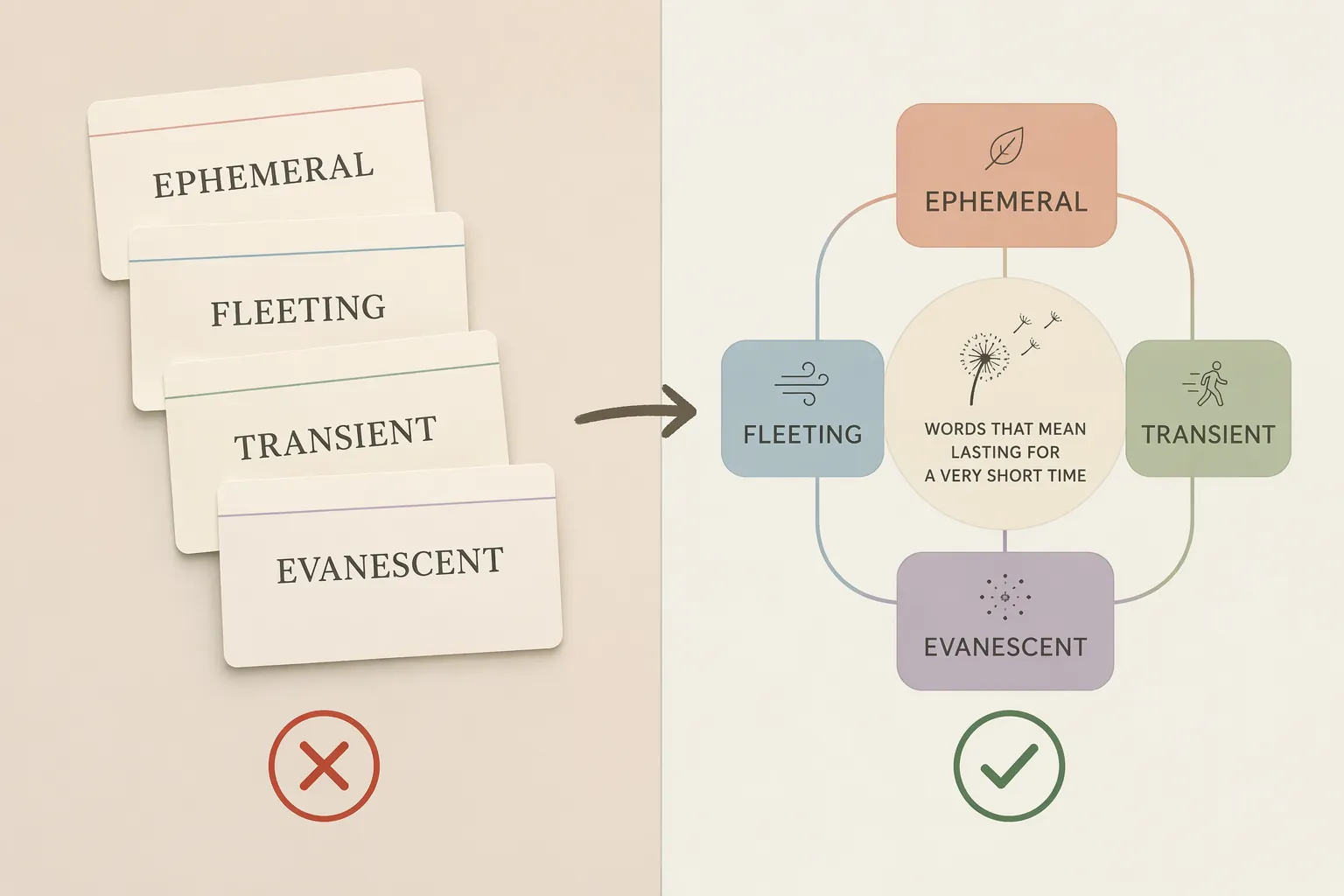
That is where the Connections format becomes interesting for exam vocabulary. A good puzzle does not reward you for reciting one isolated gloss. It asks you to notice that four words share a relation while twelve distractors are sitting nearby. That is closer to the verbal problem many students actually have: not “What does this word mean?” but “Which meaning, beside which other words, under pressure?”
What Connections trains — and what it does not
Connections is a semantic categorization game: sixteen words or phrases, four hidden groups, four items per group. The useful part for vocabulary study is not the color reveal or the streak. It is the act of retrieving possible relations, testing them against alternatives, and rejecting tempting but wrong associations.
Cognitive scientists Yasaman Muraki and Penny Pexman explain the game through semantic memory. In their account, easier Connections categories often draw on synonym retrieval; other categories ask players to identify shared features; harder categories may depend on completing multi-word phrases or recognizing indirect associations.[1] That matters because vocabulary knowledge is not stored as a tidy drawer of definitions. It is a network. The more usable links you can form — synonym, contrast, intensity, tone, context — the less brittle a word becomes.
The bridge to exams has to be made carefully. Muraki and Pexman are not claiming that Connections raises GRE, SAT, or ACT verbal scores. Their article explains the cognitive work inside the game. The test-prep use comes from pairing that cognitive work with exam vocabulary lists and exam-style review.
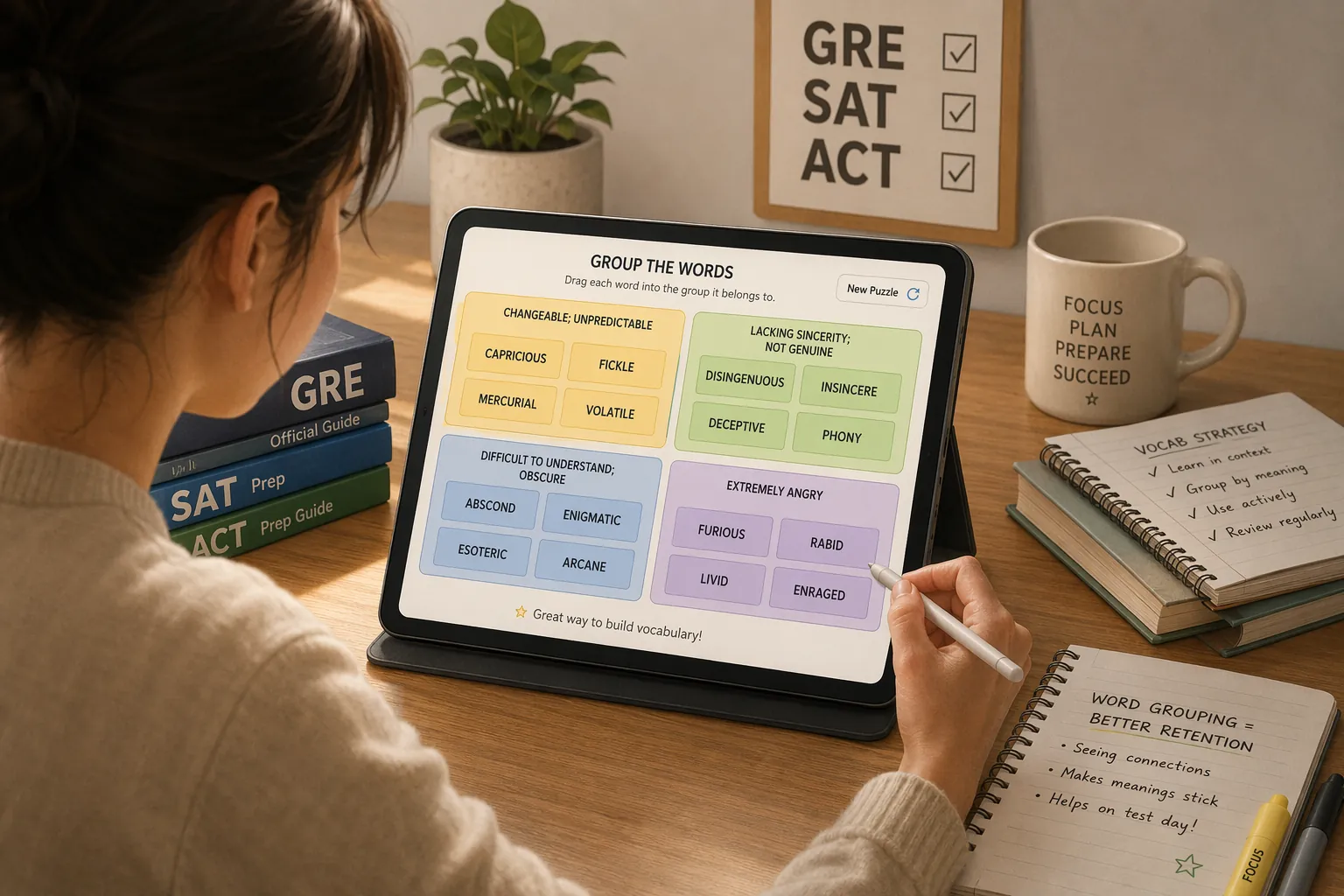
Erica Meltzer’s critique of definition-only GRE study names the missing skill directly: students need to know words “in relation to other words,” because exam vocabulary often turns on synonym families rather than isolated dictionary entries.[2] Achievable makes a similar practical recommendation with word clusters such as “capricious/fickle/temperamental/mercurial,” a set that behaves almost like a ready-made Connections group.[3] Vince Kotchian also warns that spaced repetition can fail when students recognize cards without developing flexible recall, and he recommends learning synonyms together.[4]
That is the defensible claim: Connections-style practice is useful when it makes you retrieve semantic relationships among the words you are actually responsible for knowing.
Daily NYT play is the appetizer, not the study plan
Playing the daily NYT Connections puzzle can sharpen your appetite for association. It can also teach you to tolerate ambiguity, revisit assumptions, and stop grabbing the first plausible group. Those are not useless habits.
But the daily puzzle is not built around your GRE, SAT, or ACT word list. It may ask about pop culture, phrases, homophones, brand names, or deliberately playful lateral categories. That kind of cleverness can be enjoyable and occasionally mentally useful, but it is not direct vocabulary prep unless the words and relationships overlap with the exam work you need to do.
For exam prep, the move is simple: borrow the format, replace the word bank, and make the review less cute.
The custom Connections workflow for exam vocabulary
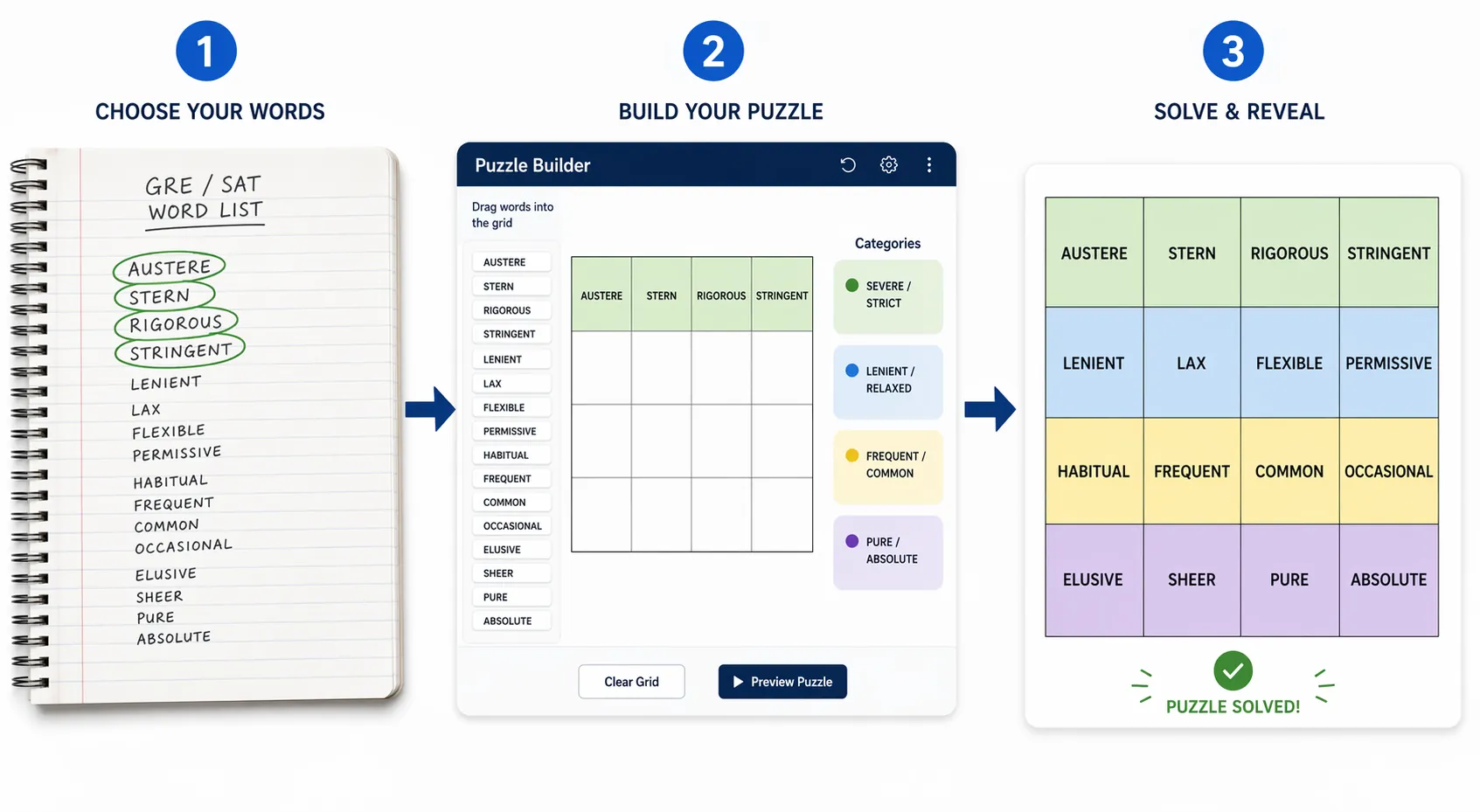
A custom puzzle is where the method starts earning its time. Reason Test Prep’s “4 pile method” already asks students to sort vocabulary actively rather than stare at a single list, which is very close to the mental operation Connections demands.[5] The puzzle format simply adds constraint: four groups, four words each, distractors visible, no answer key until after retrieval.
| Stage | What you do | What it trains |
|---|---|---|
| 1. Choose the source list | Use only words from your GRE, SAT, or ACT materials. | Exam relevance |
| 2. Build semantic groups | Cluster words by synonym family, tone, intensity, or usage pattern. | Relationship-based vocabulary knowledge |
| 3. Create a 4x4 puzzle | Enter four groups of four words into a custom Connections builder. | Controlled retrieval under constraint |
| 4. Solve cold | Attempt the puzzle without notes, definitions, or a word bank key. | Active recall, not recognition |
| 5. Review misses by relation | Explain why each missed word belonged with its group and why the decoys were tempting. | Transfer to sentence completion and reading |
Start with the exam list, not the puzzle idea
Do not begin by asking, “What would make a fun group?” Begin with the words you must learn this week. Pull them from your assigned prep book, class list, missed questions, or personal error log. For GRE students, that usually means high-frequency vocabulary and synonym families. For SAT and ACT students, it may mean academic vocabulary, transition words, tone words, and words that regularly appear in reading passages or grammar-style contexts.
This source-list rule prevents the main waste pattern: spending thirty minutes making an elegant puzzle that teaches you nothing your test is likely to reward.
Group by meaning behavior, not by surface resemblance
The cleanest vocabulary categories are synonym clusters: ephemeral, fleeting, transient, evanescent; obdurate, stubborn, intransigent, recalcitrant; laconic, terse, concise, pithy. These are hypothetical examples, not claims about a particular official exam. The point is to make the student ask, “Which words live in the same semantic neighborhood?”
Near-synonyms are better than perfect synonyms because exams rarely reward cartoonishly identical meanings. A strong group can include slight differences in tone or intensity, as long as review forces those differences into the open. Laconic and terse may both involve few words, but terse can carry a sharper social edge. If the puzzle makes you notice that, it has done more than a flashcard.
Useful category dimensions include:
- Synonym family: four words with closely related meanings.
- Tone: words that imply praise, criticism, neutrality, suspicion, or restraint.
- Intensity: mild, moderate, and extreme versions of a related idea.
- Function in argument: concede, contrast, intensify, qualify, undermine.
- Common confusion set: words students repeatedly mix up, grouped because they need discrimination rather than because they are interchangeable.
The last category is risky but valuable. A confusion-set puzzle should be labeled clearly during review, because the relationship is “commonly confused,” not “same meaning.” If a student walks away thinking equivocal and equivalent belong together semantically, the puzzle has made the problem worse.
Make the puzzle with a free custom builder
Teachers are already adapting Connections-style puzzles for classroom review, which is useful evidence of feasibility even if it is not exam-score evidence. TCEA describes making Connections games for classroom use, including vocabulary and test review.[6] WeAreTeachers also walks educators through custom Connections puzzle creation and names tools such as Swellgarfo, Connections+, and Custom Connections.[7]
For a student, the tool is not the important part. The quality of the groups is the important part. A beautiful interface cannot rescue a sloppy category where two words belong, one sort of belongs, and one was shoved in because the grid needed sixteen items.
Solve it under retrieval pressure
The solve should be cold. No notes. No definitions open. No peeking at the original list. If you built the puzzle yourself, wait long enough that the categories are not sitting in short-term memory; better yet, trade puzzles with another student using the same exam list.
As you solve, write down two things before submitting a group: the category name and the reason each word belongs. “These four mean stubborn” is a start. “These four all describe resistance to persuasion, but recalcitrant often sounds behaviorally defiant” is better. The sentence you write is where vocabulary becomes test-usable.
This is also where the method differs from passive flashcard review. A flashcard lets you look at mercurial and think, “I know that.” A Connections-style grid asks whether mercurial belongs with capricious, volatile, and fickle — and whether another tempting word is merely adjacent or actually equivalent. That is a more demanding act of recall.
Review the misses by relation
The review should not be a victory screen. It should be a small autopsy.
- If you missed the whole group, rewrite the category name in plainer language.
- If you included a decoy, explain exactly what made it tempting.
- If two near-synonyms are not interchangeable, write one contrast sentence.
- If a word was unknown, add it back to spaced repetition with its cluster, not alone.
- If the category was poorly built, fix the puzzle instead of blaming the solver.
A useful review note might look like this: “I grouped obdurate with hostile because both felt negative, but the real relation was resistance to persuasion: obdurate, intransigent, recalcitrant, stubborn. Hostile is emotional opposition; obdurate is refusal to yield.” That note is doing verbal work. It is not decorating the mistake.
A sample weekly use pattern
This method fits best as a short recurring drill, not a marathon. A reasonable pattern is:
| Day | Task | Time use |
|---|---|---|
| Day 1 | Study the week’s exam words with definitions, examples, and pronunciation if needed. | Build basic familiarity. |
| Day 2 | Create or receive one custom Connections puzzle from those words. | Force semantic grouping. |
| Day 3 | Solve cold and review misses by relation. | Turn recognition into retrieval. |
| Day 4 | Write sentence completions or contrast sentences for missed words. | Add context. |
| Day 5 | Return to reading passages or official verbal questions. | Test transfer. |
The exact calendar can change. The principle should not: categorization practice has to touch the words before the test does, and then those words have to reappear in sentences and passages.
Where the method gets overpraised
Vocabulary games are easy to oversell because they feel less punishing than lists. PrepScholar’s review of GRE vocabulary games is a useful counterweight: games can help with memorization and synonym pairing, but many lack the deep context needed for reading comprehension and should supplement, not replace, broader GRE verbal prep.[8]
That caveat is even more important for SAT and ACT students, whose verbal performance depends heavily on reading dense passages, tracking claims, interpreting evidence, and noticing how words operate in context. A Connections grid can help you know that four words are related. It cannot teach you how an author’s concession changes the function of a paragraph.
There is also a construction problem. Not every exam word fits neatly into a four-word group. Some words are too broad, too domain-specific, too dependent on usage, or too easily distorted by forced clustering. If you have to torture a category into existence, do something else with those words: write contrast sentences, find passage examples, or add them to a conventional recall deck.
Commercial vocabulary platforms sometimes make broader claims about game-based learning, including active recall and engagement benefits. Wordela, for example, frames word games as supporting vocabulary play through mechanisms such as active recall and emotional engagement.[9] Those ideas are plausible and compatible with this method, but a vendor article should not carry the evidence burden for an exam-prep decision.
How to keep it exam-first
Use the NYT Connections puzzle as a model for one specific skill: semantic categorization. Build custom puzzles from your real exam vocabulary. Solve without notes. Review by explaining why words belong together and why tempting alternatives do not. Then move back into sentence completions, passage reading, grammar questions, and official-style practice.
For GRE prep, place this inside a full GRE study plan that includes text completion, sentence equivalence, reading comprehension, and official materials. For SAT prep, connect vocabulary clusters to SAT reading and writing practice. For ACT prep, treat it as a support drill within broader ACT English and Reading preparation.
The disciplined version is worth using. The passive version is just another pleasant way to avoid the harder work.
References
- NYT Connections: Tips to improve your game through the science of semantic memory — The Conversation, 2024.
- GRE vocab and the limits of memorizing definitions — The Critical Reader.
- Master GRE vocabulary: 5 proven study strategies — Achievable.
- How to Memorize GRE Vocabulary Fast (2026) — Vince Kotchian.
- How to Effectively Study Vocabulary for the GRE — Reason Test Prep.
- Make Connections Games for the Classroom — TCEA TechNotes.
- Make Your Own Custom 'Connections' Puzzles for Students — WeAreTeachers.
- The 4 Best GRE Vocabulary Games — PrepScholar.
- Word Games Aren't Just for Fun: The Science Behind Vocabulary Play — Wordela, 2025.
Related exhibits & inventory
Verified outcomes
Planners
No planner filed for this exam yet
A downloadable timeline template for this exam hasn't been published yet.
Tool verdicts
AI-tool cautions
No AI tools tested for this exam yet
No hands-on AI-accuracy logs have been filed for this exam.
Questions about this plan
Ask a question about a specific section, timeline, or citation in this plan — or flag something that needs correcting.
Comments
Join the discussion with an anonymous comment.