
SAT, ACT, GRE, MCAT, ASVAB Exam Hub
Match Executive Function Study Techniques to Your Exam
Executive function weaknesses show up differently on each high-stakes exam. Get an exam-by-exam map of working memory, inhibition, and cognitive flexibility bottlenecks on the SAT, ACT, GRE, MCAT, and ASVAB, each paired with structure-based study techniques and the official extended-time accommodations eligible students can request — with no score-gain promises the evidence can't support.
- gre
- mcat
- asvab
- sat
- act
- digital-adaptive
- official-material
- section-strategy
- test-date-timeline
The problem usually does not sound academic at first. It sounds like: “I know the math, but I lose the thread halfway through the word problem.” “I can answer the Reading question when we pause, but not inside the clock.” “I planned to start three weeks ago.” “When the test switches sections, my brain stays stuck on the last one.” Those are not personality flaws. They are the places where planning, working memory, inhibition, and switching demands collide with a fixed exam date.
Last reviewed in Q3 2026. Before submitting an accommodation request or building a final timing plan, recheck the current College Board and ETS pages directly; official timing and documentation rules can change by test cycle. The College Board extended-time figures and ETS GRE accommodation details below are official facts from the cited pages, while the study techniques are structure-based prep recommendations, not guarantees of a score increase.[1][2]

The evidence is useful, but it has guardrails
Executive-function research helps explain why some students can learn content but still fail to execute under test conditions. In a 2019 review and meta-analysis of primary education studies, overall executive function and academic performance were correlated at r = .365 across 21 samples with 7,947 participants, and working memory was the strongest executive-function predictor at r = .370.[3] That matters for standardized exams because reading comprehension, quantitative reasoning, multi-step math, and passage-based science questions all make students hold information in mind while deciding what to ignore.
The same evidence does not justify “use this technique and raise your SAT by X points” claims. Jacob and Parkinson describe the executive-function and achievement relationship as moderate, around r ≈ .30 across 67 K–12 studies, and they note that only 8 of 30 covariate-adjusted associations remained statistically significant, with effect sizes dropping by more than half after controls.[4] Diamond’s review gives broader context, including the finding, via Duckworth and Seligman, that executive functions accounted for more than twice the variation in final grades than IQ, including in college.[5] Still, a 2026 scoping review of higher-education executive-function research cautions that the college-level evidence base is thinner and often relies heavily on self-report.[6]
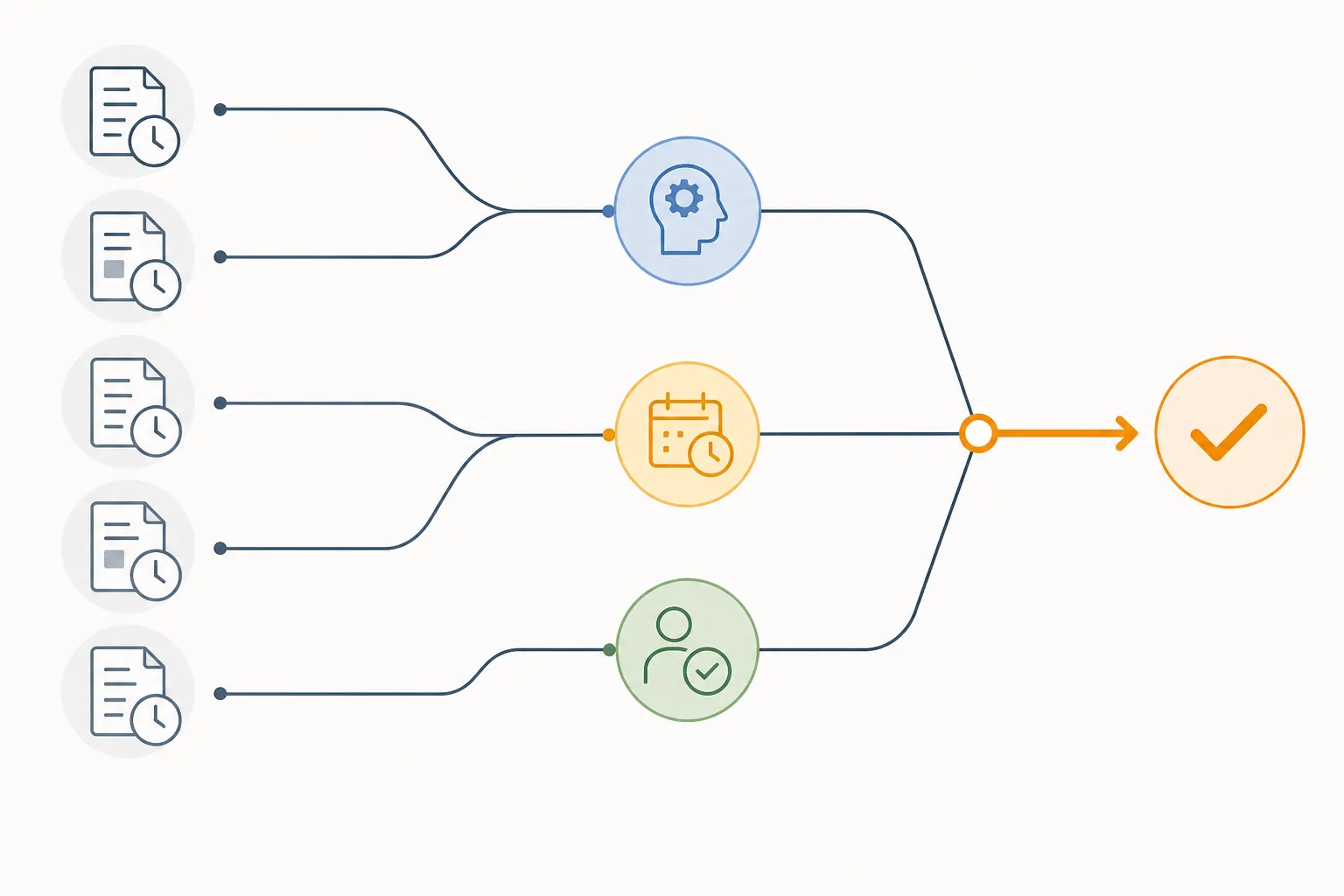
So the right use of the research is modest and practical: if an exam loads working memory, inhibition, and cognitive flexibility, then prep should remove as much invisible self-management as possible. The calendar should remember. The timer should define the work. The practice section should teach the switch. The accommodation request, when appropriate, should match the actual disability-related testing barrier.
Map the executive-function bottleneck to the exam in front of you
A student preparing for the SAT does not need the same external structure as a GRE student writing under graduate-admissions pressure or an ASVAB student trying to keep many content areas from blurring together. Start with the test, then locate the executive-function demand that keeps breaking the plan.
| Exam | Where EF weakness often shows up | Structure-based study technique that fits |
|---|---|---|
| SAT | Working memory during Reading and Writing passages; inhibition during tempting wrong answers; switching from verbal to math work on a digital test. | Practice full timed modules or sections under current official timing; use one written calendar with exact start times; review missed questions by error type instead of rereading everything. |
| ACT | Fast pacing, section-to-section reset, and difficulty stopping one question before it consumes the next several. | Use short timed section sets, prewrite skip rules, and schedule review blocks that separate content weakness from pacing weakness. |
| GRE | Working memory in dense verbal prompts and quantitative comparisons; cognitive flexibility between verbal, quant, and writing tasks; stamina across a computer-delivered graduate exam. | Build a repeated timed-section routine; rehearse scratch-work formats; request official accommodations early if disability-related conditions apply. |
| MCAT | Long-form passage comprehension, science reasoning, self-interruption control, and recovery after difficult passages. | Use passage sets with strict start and stop points; alternate content review with retrieval practice; train a reset routine between passages. |
| ASVAB | Many domains, uneven background knowledge, and trouble deciding which weak area gets the next study block. | Use a rotating calendar by subtest area; keep a visible error log; protect basic-skill review from being displaced by whichever topic feels urgent. |
SAT: make the timing real before test day
On the digital SAT, the College Board lists standard testing time as 2 hours 14 minutes: 64 minutes for Reading and Writing and 70 minutes for Math. With 50% extended time, the total is 3 hours 22 minutes, divided into 96 minutes for Reading and Writing and 106 minutes for Math. With 100% extended time, the total is 4 hours 28 minutes, divided into 128 minutes for Reading and Writing and 140 minutes for Math.[1]
Those numbers should change the prep plan. A student who loses the thread in Reading and Writing should not only “study grammar.” They need repeated practice inside the actual section shape: passage, question, answer choice inhibition, next question, next passage. The working-memory load is not just remembering a rule; it is holding the sentence, the question target, and the tempting wrong answer in mind long enough to choose.
For SAT prep, write four calendar blocks before choosing materials: one Reading and Writing timed block, one Math timed block, one missed-question review block, and one shorter retrieval block for formulas, grammar rules, or question types. If the student already uses Bluebook or Khan Academy, the next step is not more browsing; it is realistic timed practice. For a fuller SAT route, use Study for the SAT in 2026 Using the Score-Gap Method and How Khan Academy SAT Practice Works with Bluebook as the test-specific practice layer.
ACT: protect the stop rule
For EF-weak students, the ACT problem often looks like speed, but the hidden failure is stopping. One hard question eats time, then the next page becomes a recovery task instead of an exam task. The study technique is a visible skip rule, not a vague promise to “move faster.” Before a timed set begins, write the rule at the top of the page: when to mark, when to guess, when to return, and what counts as a question that is no longer worth the next minute.
Separate the review afterward. Do not mix “I did not know the content” with “I stayed too long.” Those are different bottlenecks. The first needs content retrieval. The second needs inhibition practice under a clock. If disability-related testing conditions may apply, use the current official ACT accommodation route rather than assuming the SAT or GRE rules transfer.
GRE: build the accommodation timeline into prep, not around it
ETS lists GRE accommodations that include 25%, 50%, and 100% extended testing time, with documentation required for 100% extended time; extra breaks that do not count as testing time are also listed. ETS says documentation review takes approximately six weeks. The cited ETS page reflects the July 2025–June 2026 GRE bulletin, so confirm the current bulletin before relying on these details for a 2026 test date.[2]
A GRE calendar that ignores that review window is not a calendar; it is a hope with dates around it. If a student has documentation and a real testing-condition barrier, the accommodation task belongs in the first week of prep: open the ETS page, identify the documentation requirement, decide who must supply records, and place the submission target on the same calendar as timed verbal and quantitative practice.
For working memory, GRE quantitative practice should include a consistent scratch-work format. Quantitative comparison, multi-step algebra, and word problems punish students who try to hold the whole problem mentally. For cognitive flexibility, verbal and quant should sometimes be practiced near each other, not always on separate days, because the exam asks for recovery after a mental switch.
MCAT: treat passage recovery as a skill
The MCAT can expose the student who understands a topic in isolation but gets dragged under by passage density. The EF bottleneck is often not “no discipline.” It is holding the passage claim, the figure, the question stem, and the answer choices together while suppressing panic after a confusing paragraph.
The external structure should be passage-sized. Use a timed passage set with a written reset action between passages: breathe, clear scratch paper, write the next passage number, move. That reset is small, but it prevents one bad passage from becoming a full-section failure. Content review still matters, but for this profile it needs to alternate with active retrieval and timed passage work, not sit in a long rereading queue.
ASVAB: stop letting the loudest weak area choose the plan
ASVAB prep can become chaotic because the exam spans multiple skill areas. A student studies the topic that felt worst yesterday, then avoids the basic area that would produce the clearest gain in readiness. That is a planning problem before it is a motivation problem.
Use a rotating calendar by subtest area and keep an error log with only three labels: content not known, careless or rushed, and forgot how to start. The label tells the next study block what to do. For the broader test route, use the ASVAB Exam Prep Guide instead of rebuilding the whole plan from scratch.
External structure lowers the amount of executive function the student must supply
“Use a planner” is weak advice when it means buying a notebook and feeling guilty in it. External structure becomes useful only when it removes a decision the student would otherwise have to make at the worst possible time.

The minimum version is one calendar with four or more specific study days and times, each with a goal attached. Smart Kids with Learning Disabilities recommends identifying at least four specific study days and times and writing goals in a calendar; Gow School also emphasizes active study methods such as retrieval instead of passive rereading.[7][8] That advice sounds simple because the visible product is simple. The hidden change is that the student no longer has to decide at 7:30 p.m. whether tonight is a study night, which subject comes first, or what “study” means.
| Bottleneck | What to externalize | What it prevents |
|---|---|---|
| Working memory | Scratch-work templates, passage notes, formula cards, written problem steps | Trying to hold the whole question, rule, and plan internally |
| Inhibition | Phone out of reach, written skip rules, timer-defined starts and stops | Losing the block to distraction or one overlong question |
| Cognitive flexibility | Section-switch drills, reset routines, mixed practice near test day | Carrying the last task into the next one |
| Planning and initiation | One calendar, mini-deadlines, preselected practice sets | Waiting to feel ready before beginning |
Mini-deadlines matter because large goals create too much internal negotiation. “Finish SAT prep” is not executable. “Tuesday, 7:30–8:10: Reading and Writing timed set; Thursday, 7:30–8:00: review only questions missed for grammar; Saturday, 10:00: Math module practice” is executable. If the student struggles with self-control around distractions, the system has to carry some of that load too. The related guide Willpower for Studying Is a System, Not a Muscle is the better place to handle the inhibition side in more detail.
A good calendar also prevents adults from turning every missed block into a character debate. If the block is visible, the fix can be concrete: shorten it, move it earlier, change the task, remove the phone, or make the first five minutes easier to start. For school-year structure beyond exam prep, use What a Back-to-School Study Routine Actually Needs as the calendar layer.
Extended time is an accommodation question, not a motivational shortcut
Extended time belongs in the plan when a documented disability causes slower work under testing conditions. The College Board explicitly says extended time should be requested only when a disability causes a student to work more slowly than other students, and it notes that for some students with ADHD, a reduced-distraction setting in a small group may be more appropriate than extended time.[1]
That nuance matters. A student who knows the work but cannot finish because reading, writing, calculation, or processing is disability-related and slower may need an extended-time request. A student who finishes but loses focus because every movement in the room pulls attention may need a different accommodation discussion. A student who has not practiced under realistic timing may need timed practice before anyone can tell which barrier is real.
For the GRE, the timing issue also has an administrative clock: ETS says documentation review takes approximately six weeks.[2] That is not a footnote to handle later. It is a prep task with a deadline, especially for students whose executive-function weakness already makes late paperwork likely.
If the testing barrier overlaps with reading disability, use the sibling route How to Study With Dyslexia When Your Exam Date Is Set. The accommodation path should follow the documented functional limitation, not the label someone says first.
A practical route for the next study session
- Name the exam first: SAT, ACT, GRE, MCAT, or ASVAB. Do not start with a generic productivity system.
- Choose the dominant bottleneck: working memory, inhibition, switching, planning, or initiation. Pick the one that most often ruins the study block or timed section.
- Put four study blocks into one calendar, with exact start times and task names. At least one block should be realistic timed practice, not content review.
- Add one mini-deadline before the next missed deadline can happen: documentation request, practice test, error-log review, or accommodation page check.
- If disability-related slower work or testing conditions may apply, open the official accommodation page now and verify the current rules before the test date gets close.
Executive-function-aware prep can make exam work more executable and can make the accommodation question more accurate. It cannot promise a score increase. The useful goal is narrower and more defensible: fewer invisible decisions, more realistic timed practice, and an official support path started early enough to matter.
References
- Extended Time – Accommodations. College Board.
- Disability Accommodations for the GRE General Test. ETS. July 2025–June 2026 bulletin.
- The Relationship Between Executive Functions and Academic Performance in Primary Education: Review and Meta-Analysis. Frontiers in Psychology. 2019.
- The Potential for School-Based Interventions that Target Executive Function to Improve Academic Achievement. Policy Analysis for California Education.
- Want to Optimize Executive Functions and Academic Outcomes? Simple, Just Nourish the Human Spirit. PMC.
- The global condition of higher education students' executive function research: a scoping review. Frontiers in Psychology. 2026.
- EF Study Skills: Test Prep. Smart Kids with Learning Disabilities.
- Study Tips for Students Struggling with Executive Function Disorder. The Gow School.
Related exhibits & inventory
Verified outcomes
No verified outcomes on file for this exam yet
See Methodology for how outcome evidence is disclosed once logged.
Planners
No planner filed for this exam yet
A downloadable timeline template for this exam hasn't been published yet.
Tool verdicts
AI-tool cautions
No AI tools tested for this exam yet
No hands-on AI-accuracy logs have been filed for this exam.
Questions about this plan
Ask a question about a specific section, timeline, or citation in this plan — or flag something that needs correcting.
Comments
Join the discussion with an anonymous comment.