
ASVAB Exam Hub
Do Military Fellowship Cuts Affect Your ASVAB Benefits?
Worried the Pentagon's 2026 fellowship cuts will affect your ASVAB path to college funding? We break down what actually changed and why your GI Bill, Tuition Assistance, and ROTC scholarships remain untouched.
- SAT
- ACT
- GRE
- MCAT
- ASVAB
- digital-sat
- adaptive-testing
- registration-fee
- content-outline
- score-target
Last reviewed: July 23, 2026. If you are asking how military fellowship cuts affect student applications, the practical answer for an ASVAB test-taker is this: the 2026 Pentagon cuts did not cancel your Post-9/11 GI Bill path, Tuition Assistance, ROTC scholarships, or ordinary enlistment-to-college funding route. The cuts were aimed at Senior Service College fellowship slots, a senior-officer graduate education program, not the benefits most new enlisted service members are trying to earn.
That distinction matters because the headlines named schools parents recognize: Harvard, MIT, Yale, and other elite universities. But the program being cut was narrow. A Feb. 27, 2026 Pentagon memo eliminated 93 Senior Service College fellowship slots across 22 institutions, with reporting estimating fewer than 80 students per year at the 15 affected universities.[1]
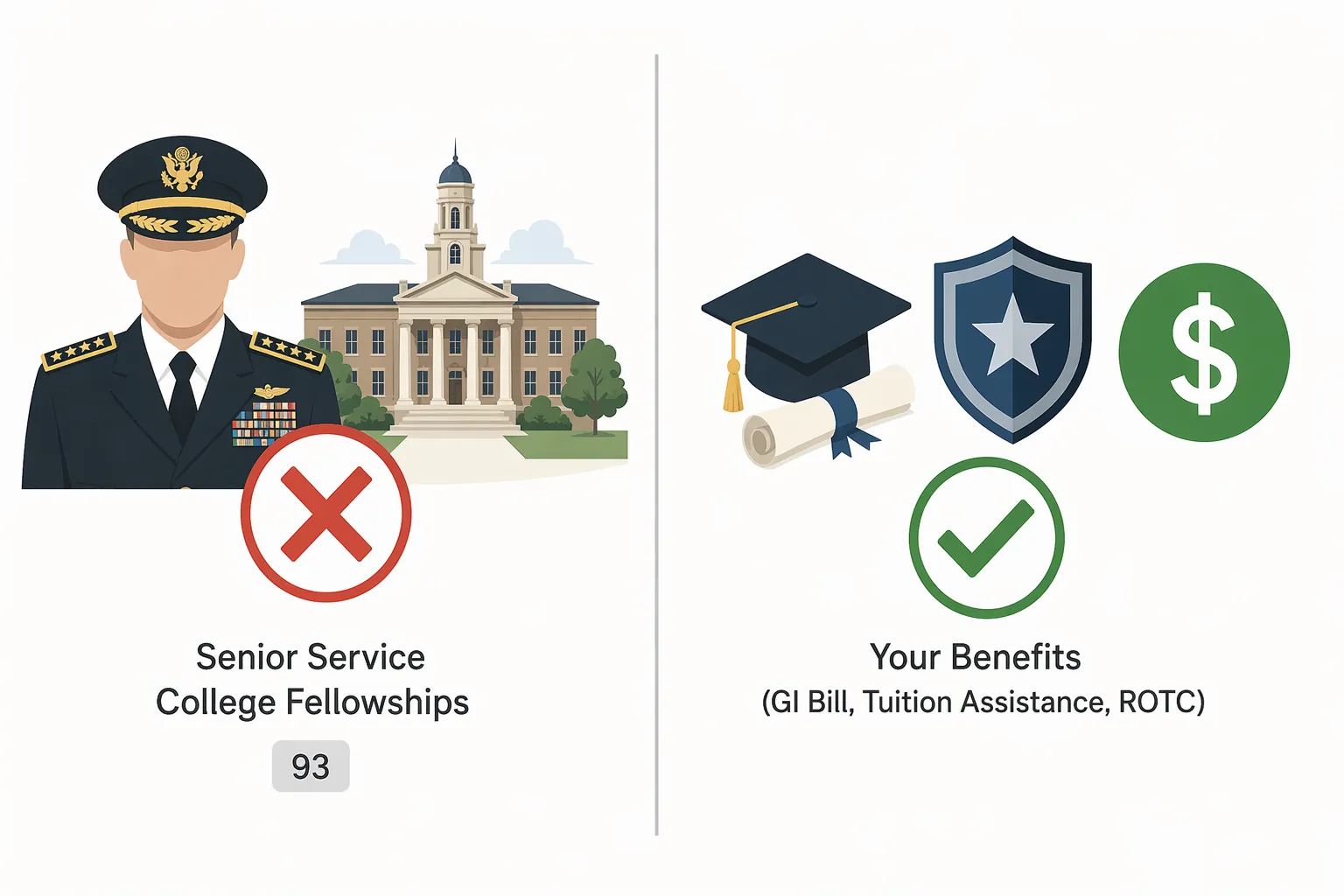
What Was Cut, And What Was Not
A Senior Service College fellowship is not an enlistment benefit. It is part of advanced professional education for selected senior officers, often tied to graduate-level study and leadership development. That is a different point in a military career from taking the ASVAB, signing an enlistment contract, completing training, and later using earned education benefits.
The clearest reassurance comes from the rollout language reported from inside the Defense Department. The internal DoD plan stated: “There is no impact to ROTC programs, tuition assistance and voluntary education programs, grant programs, professional degrees (i.e., medical, dental, law, or business degrees).”[2]
| Question | Practical Answer |
|---|---|
| Did the cuts affect ASVAB testing? | No. The ASVAB is an enlistment qualification and placement test, not a Senior Service College fellowship. |
| Did the cuts cancel Tuition Assistance? | No. Tuition Assistance and voluntary education programs were explicitly carved out in the reported DoD rollout language.[2] |
| Did the cuts cancel ROTC scholarships? | No. ROTC programs were explicitly listed as unaffected.[2] |
| Did the cuts cancel the Post-9/11 GI Bill? | No. The GI Bill is administered by the Department of Veterans Affairs, not by this DoD fellowship program. |
| Did some senior-officer graduate education slots change? | Yes. The reported cut involved 93 Senior Service College fellowship slots across 22 institutions.[1] |
Why The Scale Is Not Even Close
The easiest way to get misled here is to let a famous university name stand in for the whole military education system. A cut to 93 senior-officer fellowship slots is real for the officers and schools involved, but it is not the same universe as the education benefits used by enlisted service members at scale.
Associated Press reporting through Military.com found that about 350 service members used Tuition Assistance at the targeted schools in 2024, while more than 50,000 studied at American Public University System alone. More than 230,000 active-duty personnel use Tuition Assistance annually.[3]

That does not mean every school partnership question is settled. It does mean a high school senior studying ASVAB arithmetic reasoning should not read “Pentagon cuts elite fellowships” as “my future TA or GI Bill money disappeared.” Those are different programs, owned through different channels, serving different populations.
Tuition Assistance Still Exists Under The Same Student Planning Logic
For enlisted students, Tuition Assistance is usually the benefit to understand while still serving. Military.com’s Tuition Assistance overview describes the current annual cap as $4,500, while Forbes reported that the cap had recently increased from $4,000.[4][5]
That cap is not the same thing as a promise that every course, school, degree plan, or service branch approval process will work the way a student hopes. TA still has service rules, command approval requirements, school eligibility requirements, and timing issues. But the 2026 Senior Service College fellowship cuts are not evidence that TA itself was eliminated. The reported DoD rollout language said the opposite.[2]
So the planning sequence for a prospective enlistee remains familiar: qualify through the ASVAB and other accession requirements, choose a job and service path carefully, learn your branch’s education rules after joining, and verify any tuition plan before enrolling. The fellowship cuts do not add a new ASVAB step or remove the need to qualify in the first place.
The GI Bill Boundary Is Even Cleaner
The Post-9/11 GI Bill is not administered by the Pentagon fellowship program. It is a Department of Veterans Affairs benefit. That is a crucial boundary for anyone worried that a DoD decision about senior-officer fellowships automatically changes a veteran education benefit.
Available reporting does not show the 2026 fellowship cuts touching Post-9/11 GI Bill eligibility or payment rules. Military.com’s education-benefit reporting also notes that 2026–27 Post-9/11 GI Bill rates continue at up to about $29,000 per year for private schools.[4]
For a student making an enlistment decision, that means the correct place to verify GI Bill eligibility is still official VA and military guidance, not a headline about a senior-officer graduate fellowship. The headline may be politically important. It is not, by itself, a GI Bill notice.
ROTC Was Also Carved Out
ROTC sits in a different lane from both enlistment and Senior Service College fellowships, but it belongs in this clarification because students often group all “military college money” together. The reported rollout language specifically said ROTC programs were not affected.[2]
That does not make this an ROTC scholarship guide. ROTC has its own application rules, service obligations, medical standards, campus availability, and selection process. The narrow point is that the 2026 fellowship cuts are not evidence that ROTC scholarships were canceled.
Why The Headlines Felt Bigger Than The Policy
The confusion did not come from nowhere. Public messaging around elite universities was broader and louder than the actual benefit carve-outs students needed to see. Reporting also described leaked Army email traffic reviewing more than 33 schools, while the Army later said no decisions beyond Harvard had been made at that point.[6]
That gap matters. A public video or political statement can make a family think “the military is leaving these universities.” An internal policy document may say “ROTC, Tuition Assistance, voluntary education, grants, and professional degrees are not affected.” Those two impressions are not equally useful to a student trying to decide whether to keep studying for the ASVAB.
Other reporting described the Pentagon canceling nearly 100 military fellowships at Ivy League and elite universities, which reinforced the same problem: the number and school names were easy to repeat, while the program boundary was easier to miss.[7]
There was also discussion of possible new partner institutions. GBH reported on a potential list of 21 institutions, including Liberty University, Hillsdale College, The Citadel, Pepperdine, the University of Florida, and Arizona State, while also reporting that most listed schools said they had not been contacted by the Defense Department.[8]
That is worth watching if you are tracking defense-university partnerships. It is not a reason to assume ordinary enlistment education benefits are gone.
What This Means For Your Application Decisions
If you are applying to college as a civilian student, applying for ROTC, preparing for the ASVAB, or planning to enlist first and study later, do not treat the 93 fellowship cuts as a signal to abandon your education plan. Treat them as a separate senior-officer program change unless an official source tells you otherwise.
- If your plan is enlistment first, keep preparing for the ASVAB and confirm benefit rules with your service branch before you commit to a school or program.
- If your plan depends on Tuition Assistance, verify current branch rules, annual caps, course approval steps, and school eligibility before enrolling.
- If your plan depends on the Post-9/11 GI Bill, verify eligibility and payment rates through VA sources because the GI Bill is not controlled by the fellowship cuts.
- If your plan is ROTC, follow ROTC scholarship and campus-program guidance rather than reading senior-officer fellowship news as an ROTC policy update.
- If you see new reports about additional school reviews, look for the exact program named before changing your application or enlistment plan.
The remaining uncertainty is mostly about future DoD university partnerships and the exact number of graduate fellowship applicants affected in a given year. The available public material does not provide a precise annual count of active-duty graduate applicants affected by the cuts. It does provide enough to separate those fellowship changes from the benefits most ASVAB-track students are asking about.
For now, the practical move is boring but important: keep studying, keep documents straight, and verify benefits from official military or VA sources when money decisions become real. If you want an ASVAB-related study piece while you keep moving, StudyMethod’s ASVAB General Science earthquake preparedness guide is a useful place to stay in test-prep mode while the policy headlines sort themselves out.
References
- Pentagon Cancels Fellowships at 13 ‘Elite’ U.S. Colleges, Inside Higher Ed, Mar. 2, 2026.
- Hegseth Is Waging War on University Partnerships. His Targets Are Unclear, Inside Higher Ed, Mar. 6, 2026.
- Pentagon’s Break With Ivy League Leaves Colleges Bracing, Military.com/AP, Mar. 6, 2026.
- Military Tuition Assistance (TA) Overview, Military.com.
- It’s Time For An Increase In The Military’s Tuition Assistance Program, Forbes, Oct. 1, 2024.
- Military Students Face Uncertainty As Pentagon Reviews More Universities, Business Insider, Feb. 2026.
- Pentagon Cancels Nearly 100 Military Fellowships at Ivy League and Elite Universities, Insight Into Academia.
- Pentagon’s potential new partner list reporting, GBH.
Related exhibits & inventory
Verified outcomes
No verified outcomes on file for this exam yet
See Methodology for how outcome evidence is disclosed once logged.
Planners
No planner filed for this exam yet
A downloadable timeline template for this exam hasn't been published yet.
Tool verdicts
AI-tool cautions
No AI tools tested for this exam yet
No hands-on AI-accuracy logs have been filed for this exam.
Questions about this plan
Ask a question about a specific section, timeline, or citation in this plan — or flag something that needs correcting.
Comments
Join the discussion with an anonymous comment.