
SAT, GRE, ACT, ASVAB Exam Hub
Is NYT Connections Actually Vocabulary Practice?
Connections is often framed as vocabulary practice, but analyzed play data shows it is mostly synonym-and-idiom retrieval from a general-interest word pool. This breakdown shows where a 10-15 minute daily round earns a warm-up or reward slot in a SAT, GRE, ACT, or ASVAB word plan — and why it can't replace building word breadth.
- gre
- mcat
- asvab
- sat
- act
- digital-adaptive
- official-material
- section-strategy
- test-date-timeline
If you spend 10–15 minutes on Connections every day, what box in your vocabulary plan does that actually fill? For an SAT, GRE, ACT, or ASVAB student, that is the useful question behind “nyt connections hints for vocabulary practice.” Not whether the game feels verbal. Not whether it is popular. The question is whether the activity trains a tested vocabulary skill strongly enough to deserve daily time.
The best available answer is narrower than the way people often talk about it: Connections is mostly synonym-and-idiom retrieval from a general-interest word pool. That can be a legitimate warm-up, reset, reward, or hint-loop drill. It is not, by itself, a vocabulary curriculum for a score-driven student.
A quick evidence label matters here. The main play-data source for this article is WordsRated’s January 2026 third-party analysis, which says it analyzed the full Connections archive plus more than 60,000 shared results from Reddit’s r/NYTConnections community. That is not the same thing as NYT-published effectiveness research, and it does not show score gains on any exam. It is still useful for a different job: identifying what kind of verbal practice the game actually gives you during an ordinary round. [1]
What the game is asking your vocabulary to do
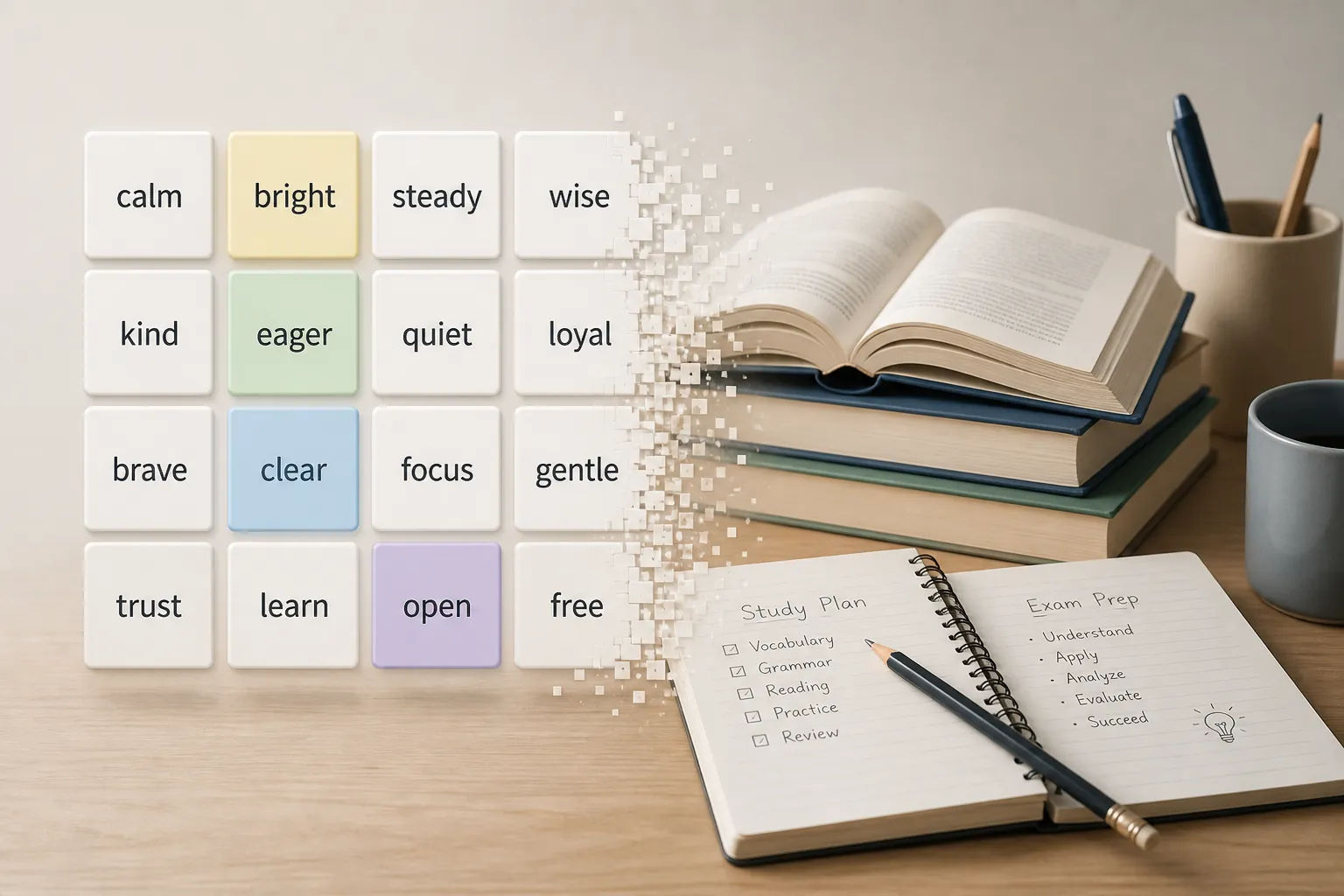
Connections gives you 16 words and asks you to sort them into four groups of four. There is one correct solution, and the completed groups are color-coded by difficulty from yellow through green, blue, and purple. The NYT Help Center also identifies the game’s word list as Oxford Dictionary-curated, which is important for test prep: the pool is curated for a general-interest puzzle, not for SAT, GRE, ACT, or ASVAB coverage. [2]
That structure rewards a specific kind of vocabulary behavior. You scan for obvious synonyms, then for looser semantic neighborhoods, then for idioms, phrases, alternate meanings, and traps. A strong player is not simply someone who knows more words. A strong player can hold several possible meanings in mind without locking in too early.
That is why Connections can feel surprisingly close to exam vocabulary work. SAT Words in Context and ACT reading questions often test whether you can choose the meaning that fits the sentence, not recite a dictionary entry. GRE Text Completion and Sentence Equivalence reward semantic fit, tone, and precision. ASVAB Word Knowledge is more direct, but it still benefits from fast recognition of synonyms and meanings. The resemblance is real. The replacement claim is where the evidence runs out.
The category mix: mostly synonyms, definitions, idioms, and usage
WordsRated’s category breakdown is the load-bearing number. In its January 2026 analysis, 43.5% of Connections groups were definition/synonym categories, and 38.2% were idiom, usage, or tone categories. Together, those two buckets make up more than 80% of all groups in the analyzed archive. [1]
| Connections group type | Share in WordsRated analysis | What that usually trains |
|---|---|---|
| Definition/synonym | 43.5% | Retrieving familiar meanings and near-equivalents |
| Idiom/usage/tone | 38.2% | Recognizing phrases, register, connotation, and contextual associations |
| Other category types | Remaining share | Shared features, wordplay, names, pop culture, or more puzzle-specific associations |
That mix gives the game a fair label: synonym-and-idiom retrieval practice. It asks you to recover relationships among words you often already know. It is less often asking you to learn a new academic word, attach it to a precise definition, and review it later until it becomes usable on a timed test.
This distinction matters most for students who are short on time. If a student has six weeks before the SAT and is weak on vocabulary-in-context questions, Connections may help start the verbal-study session with flexible meaning retrieval. It does not supply the targeted breadth that comes from exam-specific word work, passage review, and missed-question analysis. The same applies to GRE students building high-utility academic vocabulary and ASVAB students who need direct Word Knowledge growth.
The archive numbers point in the same direction. WordsRated reports 15,374 total word appearances, 7,122 unique words, and a 42% word reappearance rate, with BALL appearing 25 times as the most common word in its analysis. [1] Repetition is not a flaw in a puzzle. It is often part of what makes a word flexible: BALL can be an object, an event, a verb, a name fragment, or part of a phrase. For exam prep, though, repeated general words are not the same as planned coverage of the vocabulary range your test is likely to reward.
Why the hard puzzles feel vocabulary-rich
Connections gets interesting when the first obvious category is wrong. TODAY, relaying NYT’s own 2024 games data, reported that the most difficult Connections puzzle of 2024 was the June 20 puzzle, failed by about 47% of solvers. The most common wrong grouping that year was “bolt, nail, nut, screw.” [3]
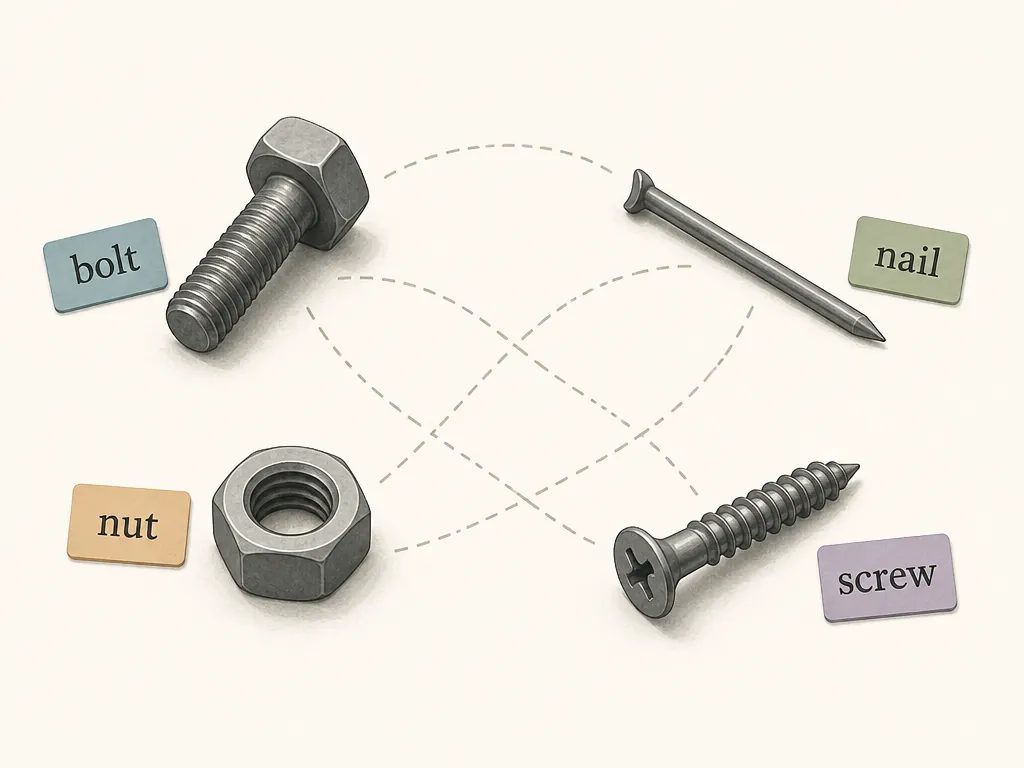
That wrong group is a tidy example of why the game can feel like vocabulary practice even when it is not teaching many new words. The words are easy. The trap is not. A student sees four hardware nouns and has to decide whether the game is rewarding the obvious shared feature or asking for another layer: secondary meanings, idiomatic uses, verbs, sounds, proper nouns, or another hidden pattern.
That kind of inhibition is useful. On exams, students also have to resist a tempting first meaning when the context points elsewhere. A word like “qualify,” “temper,” “channel,” or “arrest” can punish the student who grabs the most familiar meaning and stops reading. Connections creates that same small pressure, just in puzzle form.
But notice what the pressure depends on: meanings and associations already available to the player. If the word, phrase, or cultural reference is outside the student’s knowledge, the puzzle may become guesswork. Guesswork can be entertaining. It is not a reliable substitute for building the missing word knowledge directly.
The solve data says “manageable daily retrieval,” not “intensive instruction”
WordsRated reports a 57.0% zero-mistake solve rate, a 9.1% average failure rate, and 4.65 average guesses per puzzle in its Reddit-results analysis. [1] Those numbers describe an activity many regular players can complete successfully, often with a little friction but without full breakdown.
That is good for a warm-up. It is also why the game can become dangerous in a study plan. A clean solve feels productive, and it often is productive in a small way: you retrieved meanings, tested associations, and noticed at least one trap. But the feeling of verbal sharpness is not evidence that you expanded the word base your exam will draw from.
The general popularity of the game should not carry the argument. TechCrunch reported in August 2023 that Connections had become the New York Times’ most-played game after Wordle, with NYT Games head Jonathan Knight saying the game had “millions” of players and that around nine in ten players finished. [4] Scale explains why so many students encounter it. Scale does not tell us whether it moves SAT, GRE, ACT, or ASVAB scores.
What vocabulary theory can support — and what it cannot
The strongest theoretical case for Connections is vocabulary depth. The Conversation describes Connections-style solving as drawing on different stored aspects of semantic memory, including synonyms, shared features, idioms, and wordplay. [5] Binder and colleagues, in a 2016 study, found that vocabulary depth explained unique variance in reading comprehension beyond vocabulary breadth. [6]
That supports a careful claim: a puzzle that makes you retrieve alternate meanings, connotations, and phrase-level associations plausibly exercises part of the semantic knowledge involved in reading and verbal reasoning. It does not support the stronger claim that playing Connections improves official test scores. No published study cited here links Connections play to SAT, GRE, ACT, or ASVAB score gains.
For a test-taker, the difference is practical. A transfer claim should not be treated like an outcome result. “This resembles a skill used on the test” is not the same as “this raises your score.” The first can justify a small supporting slot. The second would require evidence the game does not currently have.
Where Connections fits for SAT, GRE, ACT, and ASVAB students
The useful placement is small and specific. Connections belongs before, after, or inside real vocabulary work — not instead of it.
| Placement | What you do | When it makes sense |
|---|---|---|
| Warm-up | Play one round before flashcards, reading passages, or official-style verbal questions. | Useful when starting is the hard part and you need a low-friction verbal ramp. |
| Reward | Play after finishing a planned word-breadth block or missed-question review. | Useful when the game helps consistency without replacing the higher-yield work. |
| Hint-loop drill | Use hints as context clues, pause before the answer, and write why a group might work. | Useful when you want the puzzle to behave more like controlled retrieval practice. |
| Not recommended as the main block | Do not count a daily solve as your whole vocabulary session. | Especially risky when you are behind on exam-specific words or official question practice. |
For SAT students, the cleanest connection is Words in Context. The game can help you practice flexible meaning retrieval, but SAT preparation still has to include reading in context, evidence-based answer elimination, and review of why a tempting meaning failed. For a fuller mapping between the puzzle mechanic and SAT-style vocabulary decisions, use the site’s Connections SAT vocabulary categorization guide.
For GRE students, the overlap is more about semantic precision than word coverage. Text Completion and Sentence Equivalence often require a student to track tone, contrast, and near-synonym differences. Connections can wake up that habit. It will not build the academic and high-register vocabulary base that GRE students usually need from deliberate review.
For ACT students, the value is similar to SAT prep but usually less central: vocabulary appears through reading context and answer choices rather than as a standalone memorization task. A puzzle can be a useful entry point into verbal focus, but passage practice has to do the heavy lifting.
For ASVAB students, the risk of overvaluing the game is higher. Word Knowledge rewards direct synonym and meaning recognition, so Connections can feel especially relevant. But because the game’s pool is general-interest and puzzle-curated, it should sit beside a focused ASVAB word plan, not replace one. If you are building an ASVAB schedule from scratch, start with the ASVAB exam prep guide and then decide whether a daily puzzle still fits.
How to use hints without turning this into an answer-page habit
Daily hint pages are everywhere, and they are fine if you use them as hints. They become low-value when they collapse the productive part of the puzzle: generating and testing a category before seeing the answer. For vocabulary practice, the useful moment is the pause between “I see a possible group” and “I am willing to spend a mistake on it.”
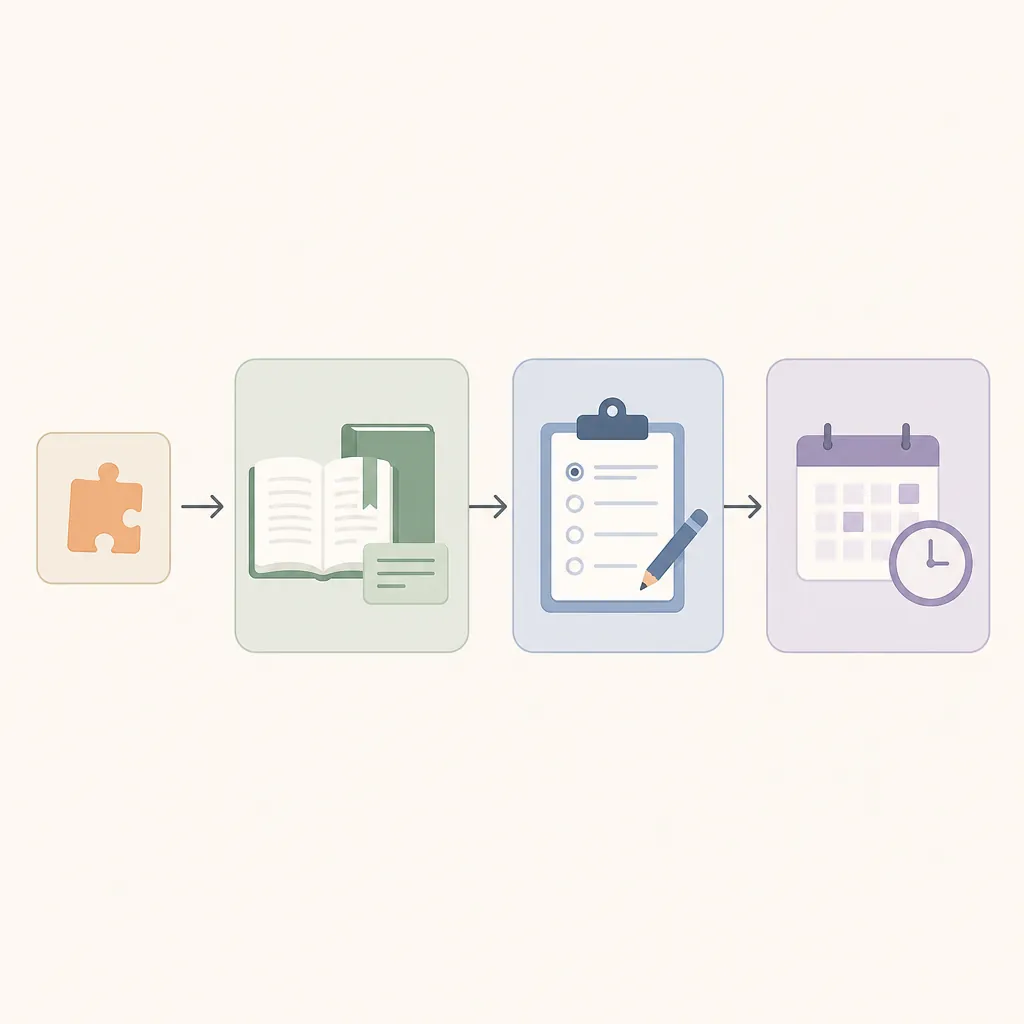
A simple hint-loop version works better than answer-checking:
- Look for a definition or synonym group first, and say the shared meaning out loud or write it in a few words.
- Before submitting, name the strongest trap category. If four words look too obviously related, assume the puzzle may be asking for another relation.
- Use a hint only after you have a proposed category and a reason for it.
- After the solve, write down one word whose second meaning, idiomatic use, or tone mattered.
- Stop after one round. Move to the scheduled vocabulary or passage task.
That is close to the site’s dedicated Connections hints-as-context-clues drill, which treats hints as a way to practice inference rather than a shortcut to today’s grid. If you want a broader custom-puzzle workflow, use the companion Connections vocabulary study method.
The planning judgment
Connections earns a place when the time box is honest. One daily puzzle can help a student start studying, retrieve familiar meanings, notice idioms, and practice not grabbing the first obvious category. The play data supports that modest role: most groups are definition/synonym or idiom/usage/tone groups, and the ordinary solve profile looks like manageable retrieval practice rather than intensive instruction. [1]
The moment it displaces the main work, the label changes. If the real plan still builds word breadth through exam-specific vocabulary, official-style questions, reading practice, and review, Connections can sit beside it as a warm-up or reward. If the puzzle becomes the plan, it is no longer vocabulary practice in the way a score-driven SAT, GRE, ACT, or ASVAB student needs.
References
- NYT Connections Statistics, WordsRated, Jan 2026
- Connections, NYT Help Center
- See New York Times' hardest Connections, Wordle and more games of 2024: EXCLUSIVE, TODAY, Jan 2025
- Connections is The New York Times’ most played game after Wordle, TechCrunch, Aug 28 2023
- NYT Connections: Tips to improve your game through the science of semantic memory, The Conversation
- Beyond breadth: The contributions of vocabulary depth to reading comprehension among skilled readers, Binder et al., 2016
Related exhibits & inventory
Verified outcomes
No verified outcomes on file for this exam yet
See Methodology for how outcome evidence is disclosed once logged.
Planners
No planner filed for this exam yet
A downloadable timeline template for this exam hasn't been published yet.
Tool verdicts
AI-tool cautions
No AI tools tested for this exam yet
No hands-on AI-accuracy logs have been filed for this exam.
Questions about this plan
Ask a question about a specific section, timeline, or citation in this plan — or flag something that needs correcting.
Comments
Join the discussion with an anonymous comment.