
Exam Countdown Study Planner Template: A 30-Day Strategy to Prep Smarter
Why a Countdown Planner Beats a Generic Weekly Schedule
A recurring weekly study schedule works well when you have consistent obligations — the same classes, the same assignments, the same rhythm every seven days. But an exam is a fixed deadline, not a repeating event. The closer that date gets, the more your planning needs to shift from "what do I do every Tuesday" to "what do I do with the 30 days I have left." That is the difference a countdown planner makes.
A countdown planner uses backward planning: you start with the exam date and work backward, allocating topics and review sessions to each remaining day. This approach does two things a generic weekly schedule cannot. First, it creates visual urgency. Seeing "14 days to go" on your planner is a different psychological signal than seeing "Week 3" on a repeating grid. That countdown keeps the deadline front and center, which reduces the tendency to push studying to "next week." Second, it eliminates the daily decision of what to study. When your planner already says "Day 22: Chapter 5 — Active Recall Practice," you spend zero mental energy figuring out where to start.
This is not to say weekly schedules have no place. If you prefer a recurring format for managing ongoing coursework, the site's Weekly Study Planner Template for Students is a solid option. But for exam-specific preparation, a countdown planner built around backward planning gives you a structure that adapts as the deadline approaches — something a repeating weekly grid simply cannot do.
The Science Behind the 30-Day Countdown: Why Spaced Practice Works
The 30-day countdown framework is not arbitrary. It is built on the spacing effect, a well-documented phenomenon in cognitive science. Research from the University of California San Diego notes that the spacing effect has been demonstrated in over 200 studies spanning more than a century. The core finding is straightforward: distributing study sessions over time leads to significantly better long-term retention than cramming the same total hours into a few consecutive days.
A 2006 meta-analysis by Cepeda et al., published in Psychological Bulletin, demonstrated that with equal total study time, recall efficiency was higher with spaced learning than with massed learning. A 2022 review in PMC/NCBI further notes that spaced repetition can double the efficiency of massed instruction. The Decision Lab explains that the spacing effect is part of a family of memory effects — including the lag effect and the testing effect — that together make distributed practice one of the most reliable strategies for improving recall.
A 30-day countdown plan naturally enforces spaced practice. By breaking your preparation into three distinct phases, you revisit material multiple times with gaps in between — exactly the pattern that the research shows works. You are not studying the same thing every day; you are cycling through content at intervals that align with how memory consolidation actually works.
Template Overview: What Your Countdown Planner Needs
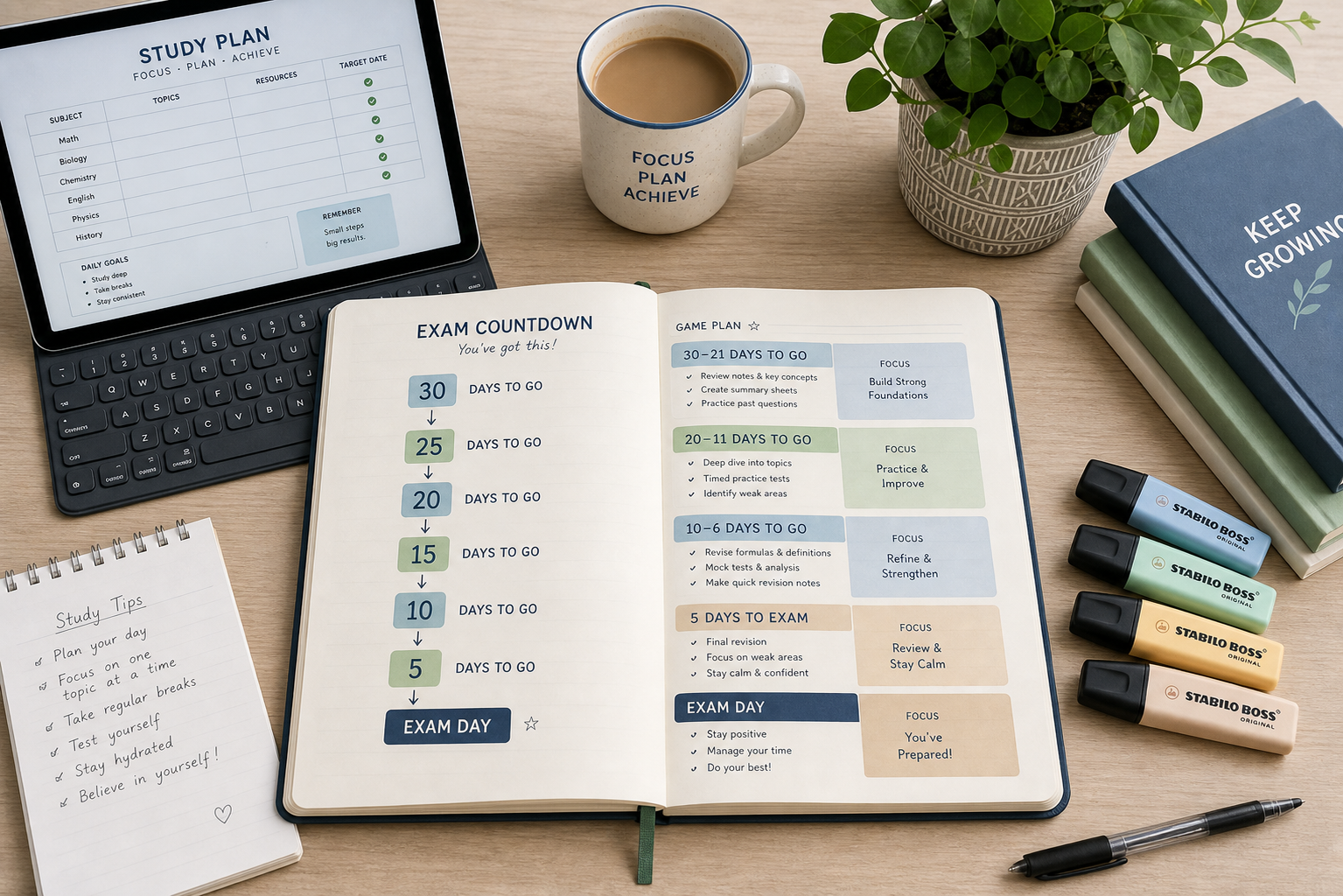
A well-designed exam countdown planner has three essential components that work together to keep you on track: a visual countdown column, daily topic targets, and dedicated review blocks.
- Visual countdown column: This is the backbone of the planner. Each row represents one day, labeled from "30 days to go" down to "Exam Day." The decreasing number provides a constant, unambiguous reminder of how much time remains. It turns an abstract deadline into a concrete, day-by-day count.
- Daily topic targets: Next to each countdown day, you assign a specific topic, chapter, or skill to study. The target should be concrete — "Chapter 5: Cellular Respiration" rather than "Biology review." This eliminates the "what should I study today" question before it arises.
- Dedicated review blocks: Every few days, the planner should include a block labeled "Review" or "Consolidation." These are not empty days — they are scheduled opportunities to revisit material from earlier in the countdown, reinforcing it through active recall or self-testing.
The template should also include a column for estimated study hours per day and a checkbox or status marker (e.g., "Done," "Partial," "Skipped") so you can track your actual progress against the plan. This feedback loop is critical: if you consistently miss your targets, you can adjust the plan before it is too late.
The Three-Phase 30-Day Framework: Foundation, Deep Practice, Final Review
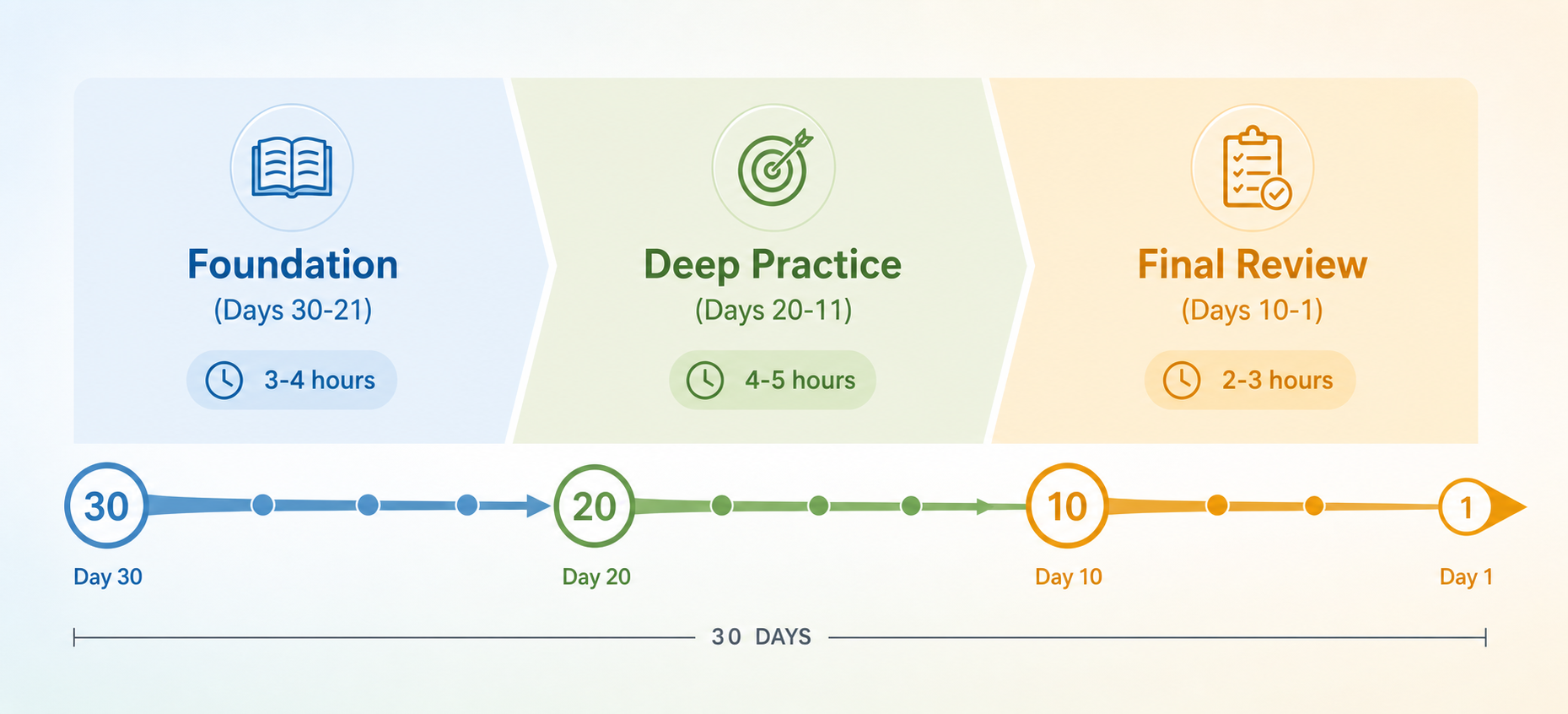
The most effective countdown plans do not treat all 30 days the same. Instead, they divide the preparation into three distinct phases, each with a different goal, intensity level, and study approach. The framework below is adapted from the 30-Day Exam Study Plan Template from StudyPlannerHub.
| Phase | Days | Daily Hours | Primary Goal | Key Activities |
|---|---|---|---|---|
| Foundation | 30 – 21 | 3 – 4 hours | Initial learning and understanding | Read textbooks, watch lectures, create summary notes, build concept maps |
| Deep Practice | 20 – 11 | 4 – 5 hours | Application and problem-solving | Practice problems, past papers, flashcards, active recall sessions |
| Final Review | 10 – 1 | 2 – 3 hours | Consolidation and confidence | Self-testing, blank page recall, review weak areas, simulate exam conditions |
Phase 1 (Days 30–21) is about building a solid foundation. You spend 3 to 4 hours per day on initial learning: reading through material, watching lectures, and creating study aids like summary notes or concept maps. The goal is understanding, not memorization. At this stage, you should aim to cover roughly 75% of the material for the first time, leaving the remaining 25% for topics you know will require extra attention.
Phase 2 (Days 20–11) is where the real learning happens. You increase to 4 to 5 hours per day and shift from passive reading to active practice. This means working through practice problems, completing past exam papers, using flashcards for active recall, and applying the Feynman Technique (explaining a concept in simple terms as if teaching someone else). The emphasis is on retrieval — pulling information out of your memory rather than putting it in.
Phase 3 (Days 10–1) is consolidation. You drop back to 2 to 3 hours per day to avoid burnout and focus on reinforcing what you already know. This phase relies heavily on self-testing: blank page recall (writing everything you remember about a topic without notes), reviewing flashcards, and simulating exam conditions with timed practice. The last few days should include at least one full-length practice test under realistic conditions.
How to Customize the Template for Your Exams
The 30-day framework is a starting point, not a rigid prescription. Real exams come with different scopes, difficulty levels, and scheduling constraints. Here is how to adapt the template to fit your situation.
Multiple Exams in the Same Period
If you have two or three exams within the same 30-day window, you have two options. The first is to split each day: allocate the morning to Exam A and the afternoon to Exam B, keeping the total daily hours within your capacity. The second is to dedicate blocks of consecutive days to each exam — for example, Days 30–21 to Exam A, Days 20–11 to Exam B, and Days 10–1 to a combined review of both. The block approach works better when the exams cover very different subjects, because it reduces context-switching.
High-Stakes Exams (GRE, MCAT, Bar Exam)
Exams like the GRE and MCAT require significantly more preparation than a typical college final. A 30-day countdown may be too short for the initial content acquisition phase. In these cases, extend the Foundation phase to 60 or 90 days and use the 30-day countdown only for the Deep Practice and Final Review phases. The GRE Prep Hub and MCAT Study Prep Hub on this site provide exam-specific planning resources, including recommended tools and study schedules.
Varying Difficulty Levels
Not all topics within an exam are equally hard. When customizing your template, flag the topics you find most challenging and allocate more time to them in the Deep Practice phase. A simple system: mark each topic as Easy, Medium, or Hard during the Foundation phase, then schedule Hard topics for the earlier part of Deep Practice (Days 20–16) when you have the most energy and time. Easier topics can be pushed toward the end of Deep Practice or into the Final Review phase.
Common Mistakes That Derail a Countdown Plan (And How to Avoid Them)
Even the best template will fail if you fall into predictable traps. Here are the most common mistakes students make with countdown planners and how to avoid them.
- Starting too late. A 30-day countdown works best when you have at least 30 days. If you start with 10 days left, the phased structure collapses — you skip Foundation and jump straight into panic mode. If you have less than 30 days, use a compressed version: 2 days of rapid foundation, 5 days of intense practice, and 3 days of review. It is not ideal, but it is better than unstructured cramming.
- Skipping the review phase. Many students spend all their time on Foundation and Deep Practice, then run out of steam before the Final Review phase. This is a critical error. The review phase is where consolidation happens — without it, much of what you learned in the first 20 days will not be accessible during the exam. Treat the review days as non-negotiable.
- Over-scheduling and burning out. The Deep Practice phase calls for 4 to 5 hours per day, but that does not mean 5 hours of non-stop work. Schedule breaks, use the Pomodoro Technique (25 minutes of focused work, 5 minutes of rest), and include at least one full rest day per week. Brainscape's study planner templates explicitly include rest days for long-haul exams like the MCAT — follow that example.
- Failing to account for rest days. Your brain needs time to consolidate information. Rest days are not wasted days — they are part of the learning process. Schedule them in advance and treat them as seriously as study days. A common pattern is to rest on Day 7 of each phase (Days 24, 17, 10, and 3 in the 30-day framework).
Where to Get Your Exam Countdown Study Planner Template
You can build your own countdown planner using the framework above, or you can start with a pre-made template. Here are the most accessible options, all free and available without requiring account creation.
- Google Sheets (Brainscape): Brainscape's Academy offers free customizable Google Sheets study planners, including exam countdown templates with 2-week, 3-week, 1-month, and 3-month countdowns. The templates break days into 15-minute intervals and allow you to specify start time, time intervals, and week start date. To use them, open the template and select File > Make a copy to create your editable version.
- Notion: Notion offers a highly customizable student study planner template that works across devices. You can adapt it to a countdown format by adding a database with a date property and a formula that calculates "Days until Exam." Notion's flexibility makes it ideal for students who want to combine their planner with notes, task lists, and resource links in one place.
- Printable PDF: If you prefer a physical planner, you can create a printable PDF using the three-phase framework above. Draw a table with columns for Day, Countdown, Topic Target, Hours Planned, and Status. Print one page per phase (10 days per page) and keep it visible on your desk. The act of checking off completed days can be surprisingly motivating.
The key is to choose the format that matches your work style. A digital template (Google Sheets or Notion) is easier to adjust on the fly. A printable PDF is better if you want to avoid screen time and keep your plan physically visible. Either way, the structure — countdown + daily targets + review blocks — is what makes the plan effective, not the specific tool you use to track it.
Fill in this timeline
This is a skeleton schedule, not a performance claim — for section-by-section strategy to fill in each slot, read the exam hub. For evidence that a similar timeline worked, compare against real outcome logs.