
ASTRONOMY Exam Hub
How to Measure a Partial Lunar Eclipse for Astronomy Class
Astronomy students can turn the August 27-28, 2026 deep partial lunar eclipse into a real measurement project: Danjon color ratings, brightness estimates, and crater timings. Learn what to measure, which methods need a telescope, and how to label partial-eclipse results correctly.
- gre
- mcat
- asvab
- sat
- act
- digital-adaptive
- official-material
- section-strategy
- test-date-timeline
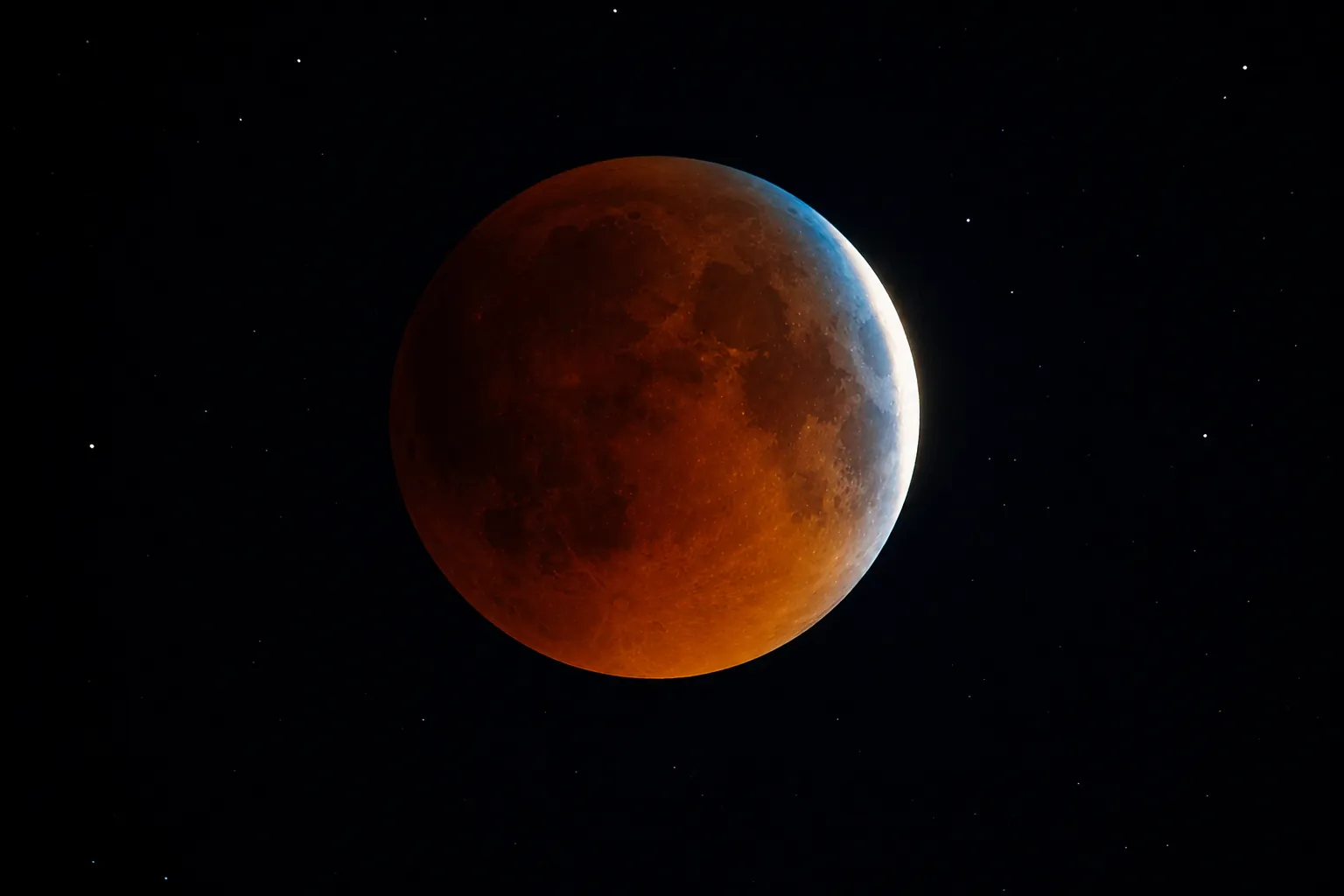
The August 27–28, 2026 lunar eclipse is awkward in a useful way: at maximum, 96.2% of the Moon is obscured, but the event is still technically partial, not total.[1] That makes it a good astronomy-class measurement problem. It is deep enough to show color, dimming, and a moving umbral edge, but not deep enough to let a student report a normal total-eclipse Danjon rating without a warning label.
If you only need a when-and-where viewing plan, use the companion Blood Moon Observation Tips for Astronomy Students. This article is for the version of the assignment where the final product is a record someone else could inspect: time, equipment, method, result, and the explicit note that the measurement came from a deep partial eclipse.
What you can actually measure
Greatest eclipse occurs at 04:12 UTC on August 28, 2026, which is 12:12 a.m. EDT.[2] The strongest observations should be clustered around that time, because the Moon is then closest to total immersion in Earth’s umbra. Far from maximum, the same methods become weaker: the Moon is less darkened, color is less representative of the deepest eclipse state, and the shadow boundary is not sampling the same near-total condition.
| Project | Minimum equipment | Output | Best used when |
|---|---|---|---|
| Danjon color rating | Unaided eye or binoculars | L0–L4 estimate, labeled as partial-eclipse observation | Near greatest eclipse |
| Visual-brightness estimate | Unaided eye or binoculars; comparison stars if visible | Estimated lunar brightness with method notes | Near greatest eclipse, when the sky darkens enough to compare |
| Crater-contact timing | 60–200 mm telescope, stopwatch, published crater predictions | Entry and exit times for named craters crossing the umbral edge | During predicted contacts before and after greatest eclipse |
A binoculars-only student is not being given a consolation project. Color and brightness estimates are legitimate observations if they are plainly labeled and made at a recorded time. The telescope project adds a different kind of evidence: timing the umbral edge as it reaches known lunar features. That part should not be attempted from memory or from a photograph found later online.
Start the log before the Moon looks dramatic
Set up the record before the deepest phase, not after the Moon has already become interesting. The first lines of the log should include the date, observing location, time standard, sky condition, and equipment. “12:08 a.m. EDT, 10×50 binoculars, thin haze, Moon low above trees” is more useful than “the Moon looked red.” If more than one student is observing, each person should write an independent estimate before talking.
- Use one time standard throughout the report. UTC is safest for comparison; local time is fine if the time zone is stated.
- Record the observation method beside the result: unaided eye, binoculars, telescope aperture, eyepiece, or camera used only as a check.
- Mark which entries are direct observations and which are later interpretations.
- Do not average several students’ color ratings until the individual ratings have been preserved.
The orbital mechanics behind why an eclipse has umbral and penumbral stages belong in a separate study guide, not in the observing log. If you need to review those ideas, use the Moon phases study guide or the 2026 solar eclipse astronomy guide. For this project, the useful question is narrower: what did the Moon look like at a known point in the eclipse, and how was that judgment made?
Color: use the Danjon scale, then admit what it cannot do here
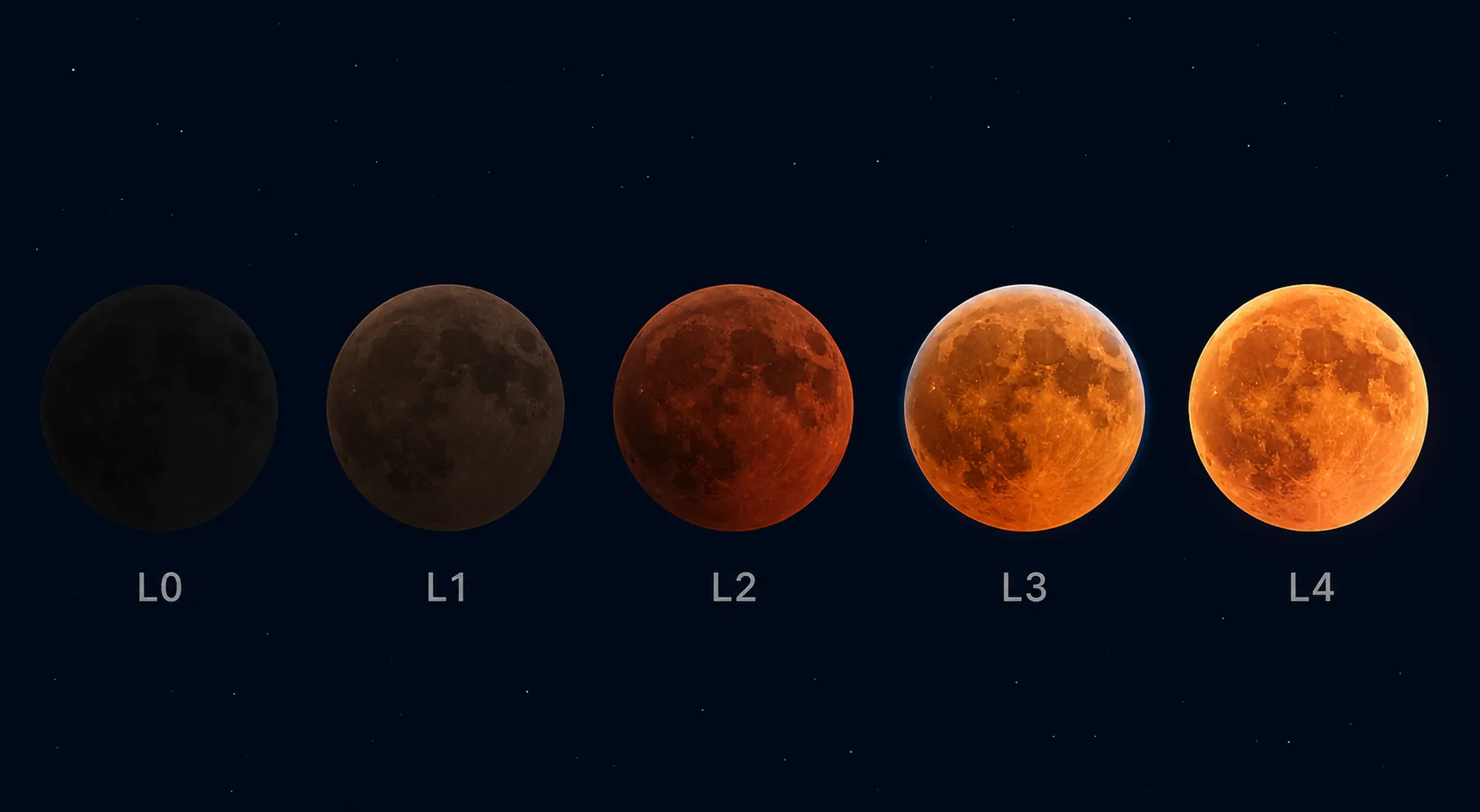
The Danjon scale is the simplest way to turn eclipse color into a shareable classroom datum. Developed by André Danjon in 1921, it rates lunar-eclipse appearance from L0 to L4, moving from a very dark eclipse to a bright copper or orange one.[3] During this event, the scale can be used as a disciplined description near greatest eclipse, but the report must say that the Moon was not totally eclipsed.
| Danjon value | Usual description |
|---|---|
| L0 | Very dark eclipse; Moon nearly invisible, especially at mid-eclipse |
| L1 | Dark gray or brownish eclipse; lunar details difficult to see |
| L2 | Deep red or rust-colored eclipse; central shadow very dark, outer edge brighter |
| L3 | Brick-red eclipse; umbral edge may look bright or yellowish |
| L4 | Bright copper-red or orange eclipse; outer umbra bright, sometimes with a bluish rim |
A near-total partial eclipse can show reds, oranges, and copper tones because sunlight has passed through Earth’s atmosphere before reaching the Moon. Shorter blue wavelengths are scattered more strongly, while redder light is bent into the shadow; the same basic scattering idea explains familiar sky-color questions, reviewed in Why Is the Sky Blue and the Sun Yellow?. The deep phase may also show a turquoise or bluish band near the umbral edge, a feature associated with absorption by ozone in Earth’s stratosphere.[2][4]
The scale is useful because it forces a choice, not because it removes judgment. Different observers can disagree honestly, especially when the Moon has a bright uneclipsed sliver. That sliver can make the eclipsed portion seem darker by contrast, and binoculars can change the impression again by separating subtle regions that the unaided eye blends together.
The cleanest approach is to make two entries close together: one unaided-eye Danjon estimate and one binocular estimate. A report might say, “At 04:10 UTC, unaided-eye estimate L3; with 10×50 binoculars, umbral interior looked closer to L2, with brighter copper outer region. Partial eclipse; bright lunar sliver still visible.” That is a defensible record because it separates the instrument, the time, the estimate, and the limitation.
Danjon values also vary because Earth’s atmosphere varies. Sky & Telescope notes very dark eclipses in December 1963 and December 1992, the latter following the Mount Pinatubo eruption, as examples of how atmospheric conditions can suppress the usual bright copper look.[2] For the 2026 event, that history is a warning against grading the eclipse against a single expected color.
Brightness: make the estimate small, honest, and time-stamped
A visual-brightness estimate asks a slightly different question from the Danjon scale. Instead of choosing a color class, the observer estimates how bright the eclipsed Moon appears. This can be done by comparison with visible stars or planets when the sky has darkened enough, though the remaining bright lunar sliver in a partial eclipse complicates the judgment.
There is a useful comparison point, but it is not a target score. During the May 15–16, 2022 total lunar eclipse, the Brazilian REA network measured a visual magnitude of -0.8 ± 0.3 at mid-eclipse.[2] That number shows the kind of result an organized visual program can report; it does not tell a 2026 observer what the Moon “should” be, because this event is partial and the uneclipsed portion remains visible.
For a class submission, the important move is to preserve the method. If comparison stars are used, name them or identify the chart. If the estimate is made by unaided impression, say so. If thin clouds pass through, record that beside the value rather than hiding it in a paragraph later. A rough estimate with conditions attached is better evidence than a polished number with no observing trail.
- Good: “04:13 UTC, unaided eye, Moon brighter than nearby comparison stars; estimate uncertain because thin cloud crossed Moon.”
- Better: “04:13 UTC, binocular check after unaided estimate; bright sliver excluded mentally, umbral portion judged separately.”
- Weak: “The eclipse was about as bright as a total lunar eclipse,” with no time, comparison, or partial-eclipse label.
One more visual clue belongs in the log if it happens: stars may return to view as the Moon darkens near greatest eclipse.[2][4] Treat that as an observation, not as a guaranteed threshold. The materials support the general point that the sky darkens during deep eclipse; they do not justify a rigid rule that a certain percentage of coverage always makes the penumbral or umbral effect visible to every observer.
Crater timings: the telescope project
The most exacting student project for this eclipse is crater-contact timing: recording when the umbral edge reaches or leaves named lunar craters. Sky & Telescope published crater entry and exit predictions for the August 2026 eclipse and describes the method as suitable for observers using roughly 60–200 mm aperture telescopes, with timing precision to about five seconds.[2]
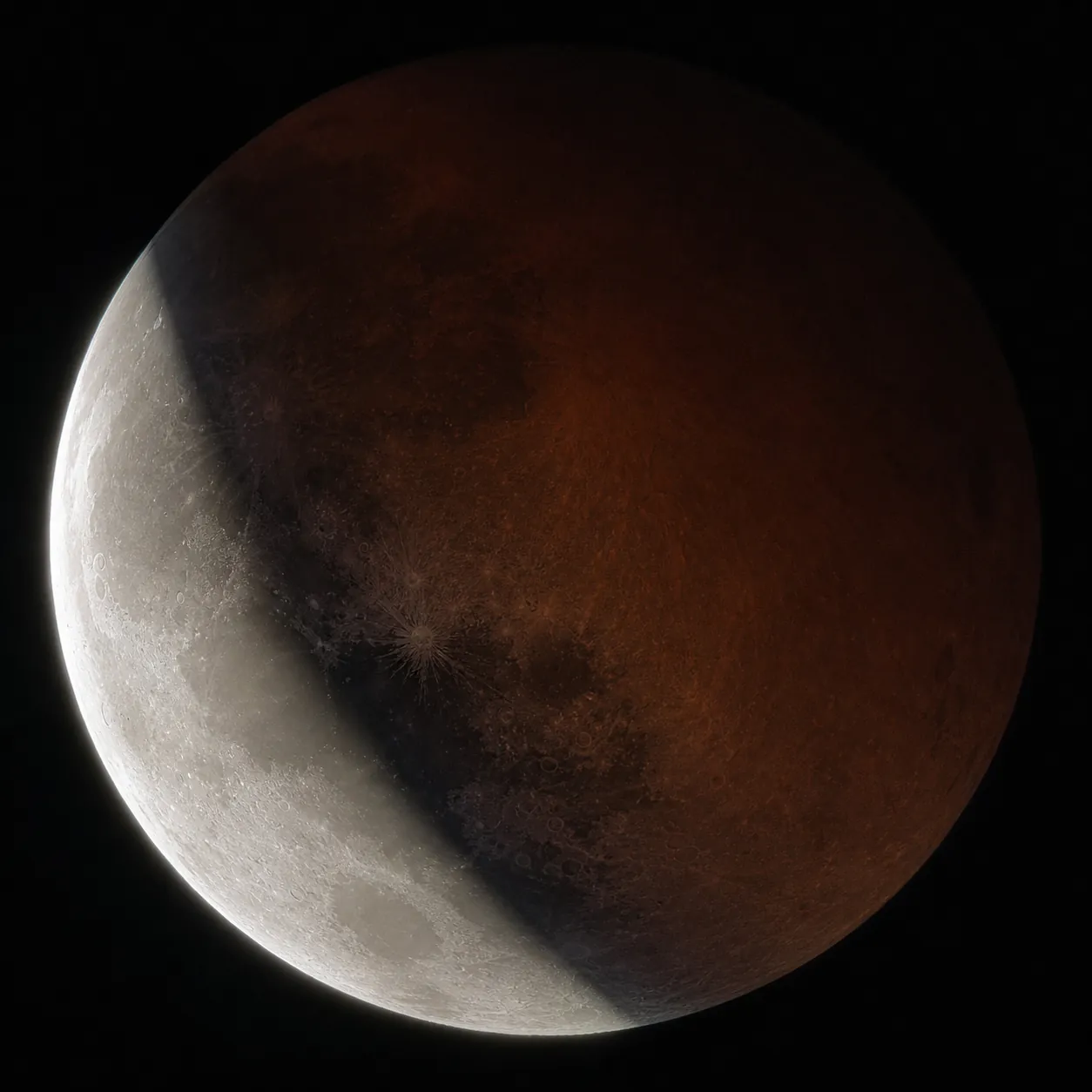
This is where a stopwatch earns its place. The observer is not timing the whole eclipse. The observer is watching a predicted crater and recording the instant when the shadow boundary appears to touch it on entry or release it on exit. A small telescope can do this because the Moon supplies fixed landmarks, and the moving umbral edge supplies the clock event.
- Before the eclipse, print or copy the predicted crater-contact list and mark which contacts occur while the Moon is visible from your site.
- Practice identifying the listed craters before the contact time. Searching at the predicted minute is usually too late.
- Use a clock synchronized to a reliable time source, and write down whether your recorded times are UTC or local time.
- Call out or write the contact time as the umbral edge reaches the crater. If two observers are present, one can watch and one can record.
- After the event, keep the raw times. Do not adjust them to match the prediction.
The judgment at the eyepiece will not always feel clean. The edge of Earth’s shadow is not a black knife line. Seeing, crater brightness, lunar topography, and the observer’s reaction time all affect the call. That is why the report should include uncertainty notes: “contact gradual,” “crater hard to hold in view,” “time called by observer A, written by observer B,” or “missed first contact; exit only.”
Why these timings are worth doing
Crater timings have a serious history because they test the apparent size of Earth’s umbra. Earlier Sky & Telescope observing programs found that Earth’s umbra measured larger than pure geometry predicted: 2.1% larger from 697 timings in July 1982, and 1.7% larger from 298 timings six months later.[2] A single class observation will not reproduce those studies by itself, but it can use the same kind of observable event: a named lunar feature crossing a predicted shadow boundary.
That distinction matters. A student with a 70 mm refractor and a careful log is not doing professional photometry. The student is producing a timed observation that can be compared with a prediction and with other observers’ reports. The value is in the match between a specific crater, a specific time, and a stated uncertainty.
How to label the result so it survives grading
The easiest way to weaken this project is to oversell it. The August 2026 event is deep, but it remains partial. Danjon ratings and crater-contact methods are normally associated with total lunar eclipses, so the correct label is not a formality. It tells the reader how much of the usual method is being borrowed and where the comparison may break.
| If you observed | Report it as | Do not report it as |
|---|---|---|
| Color near maximum with unaided eye | Danjon-style L estimate during a 96.2%-obscured partial eclipse | A standard total-eclipse Danjon value |
| Brightness near maximum | Visual-brightness estimate with method and sky conditions | A definitive measure of the eclipse’s darkness |
| Crater contact through a telescope | Timed umbral contact for a named crater, using published predictions | Proof by itself of the umbra’s enlargement |
A strong final record can be short. It should include the observing date, the time of each entry, equipment, method, result, and a note such as “deep partial lunar eclipse; Moon not fully immersed in umbra.” If the assignment also asks for reflection, keep it tied to evidence: explain why the color rating was uncertain, why binoculars changed the estimate, or why a crater contact was easier on exit than entry.
This is the same habit that makes a meteor-shower count useful for exam review: the observation becomes study material only after it is structured. The site’s meteor-shower log guide uses that pattern for a different sky event; here, the same discipline keeps an eclipse report from becoming copied vocabulary with a dramatic adjective attached.
As of this August 25, 2026 planning snapshot, the immediate opportunity is the deep partial eclipse on August 27–28. The next chance named in the observing materials for applying the full method during a total lunar eclipse is December 31, 2028–January 1, 2029.[2] The 2026 data can still be worth keeping, as long as the label stays honest.
References
- Lunar Eclipse on August 27–28, 2026 — Where and When to See, timeanddate.com
- Gauge the Darkness and Color of the August 2026 Lunar Eclipse, Sky & Telescope
- The Ultimate Guide to Observing Lunar Eclipses, Celestron
- How to watch a total lunar eclipse, EarthSky
Related exhibits & inventory
Verified outcomes
No verified outcomes on file for this exam yet
See Methodology for how outcome evidence is disclosed once logged.
Planners
No planner filed for this exam yet
A downloadable timeline template for this exam hasn't been published yet.
Tool verdicts
AI-tool cautions
No AI tools tested for this exam yet
No hands-on AI-accuracy logs have been filed for this exam.
Questions about this plan
Ask a question about a specific section, timeline, or citation in this plan — or flag something that needs correcting.
Comments
Join the discussion with an anonymous comment.