
DSST Exam Hub
How a Meteor Shower Log Boosts Astronomy Exam Scores
Learn how each field in a meteor shower viewing log maps to astronomy exam topics like radiant points, parent comets, and meteoroid speeds, turning a required lab activity into effective exam review.
- gre
- mcat
- asvab
- sat
- act
- digital-adaptive
- official-material
- section-strategy
- test-date-timeline
A meteor shower viewing log for astronomy exam prep looks suspiciously like busywork until you stop reading the blanks as chores. Date and time, radiant, direction faced, magnitude, speed, train, cloud cover: those are not random lab-form demands. They are the same vocabulary that shows up when an exam asks why a meteor shower appears to come from one point in the sky, why some showers are faster than others, or why a sand-grain-sized particle can make a visible streak.
That does not mean one cold observing session guarantees a higher score. It means the form can become a review sheet if you know what each field is testing you to notice.
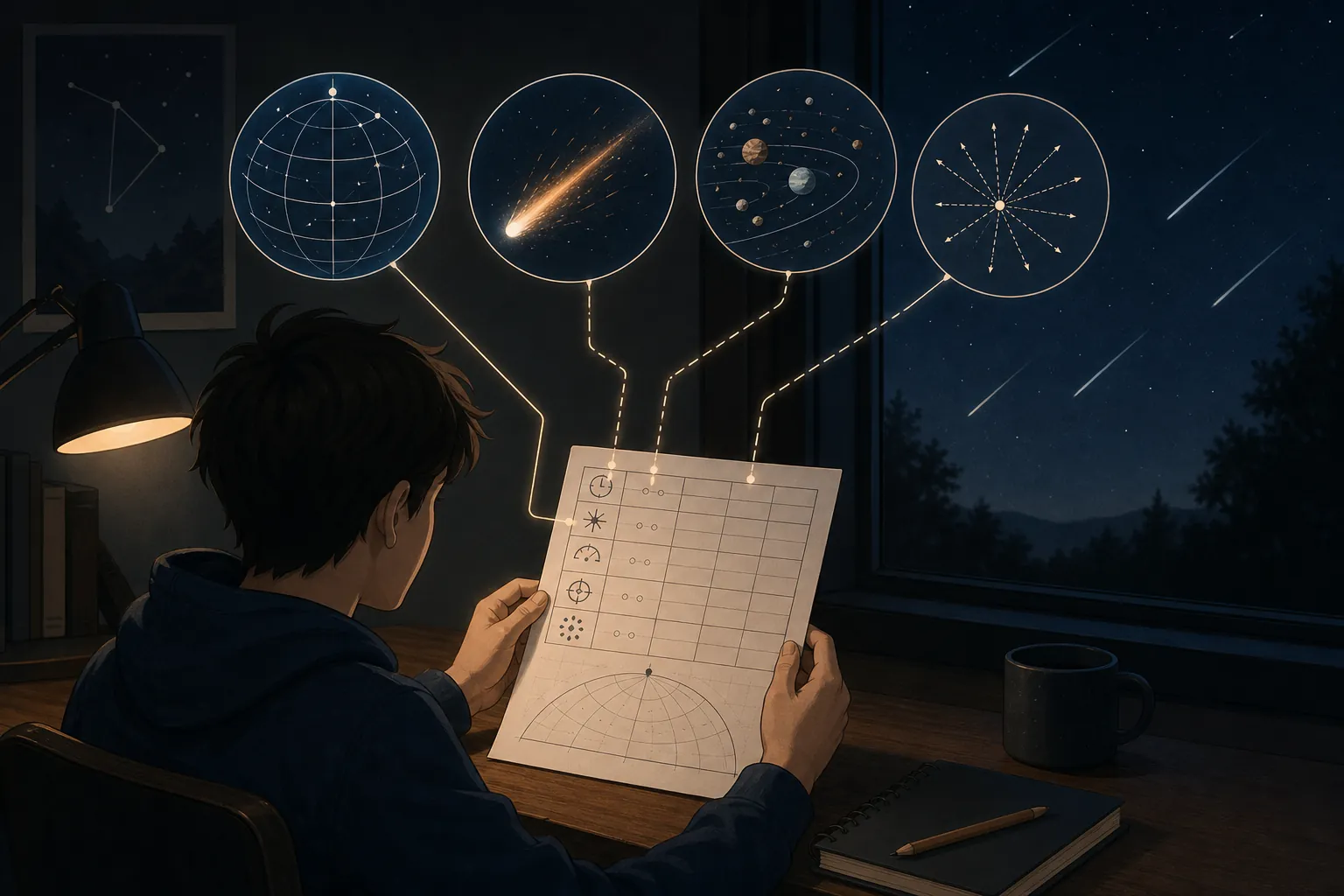
Why this log overlaps with exam material
The cleanest public blueprint here is the DSST Astronomy exam. Its content outline assigns 20% of the 100-question exam to Planetary Systems, a category that includes Solar System objects and the debris populations behind meteor showers. The same outline assigns 10% to celestial coordinate systems and 15% to the science of light, both of which a careful meteor log touches repeatedly.[1]
That is not a claim that DSST is every student’s exam. A campus Astronomy 101 or Astronomy 101L final may emphasize different chapters, and CLEP Natural Sciences contains a smaller astronomy component rather than a dedicated astronomy test. Still, the overlap is not imaginary. A standard visual meteor form asks students to record sky position, observing conditions, brightness, shower membership, apparent speed, color, and train presence. Those are not hobby-only details; they are ways of forcing the observer to connect geometry, matter, motion, and light.
The American Meteor Society’s Basic Visual Meteor Observing Form asks for date and time in UT, observing location, cloud cover, direction faced, altitude, sky transparency or seeing, and per-meteor entries for time, magnitude, shower membership, color, speed, and train presence.[2] The Astronomical League’s Meteor Observing Program also treats logged observing time as serious work, requiring at least 12 hours across sessions of at least 1 hour each.[3] Those programs are designed for amateur observers, not as official exam-prep products. The useful connection is field overlap: the same blanks that help an observer produce a disciplined report can also cue the concepts a student is likely to meet in a test question.
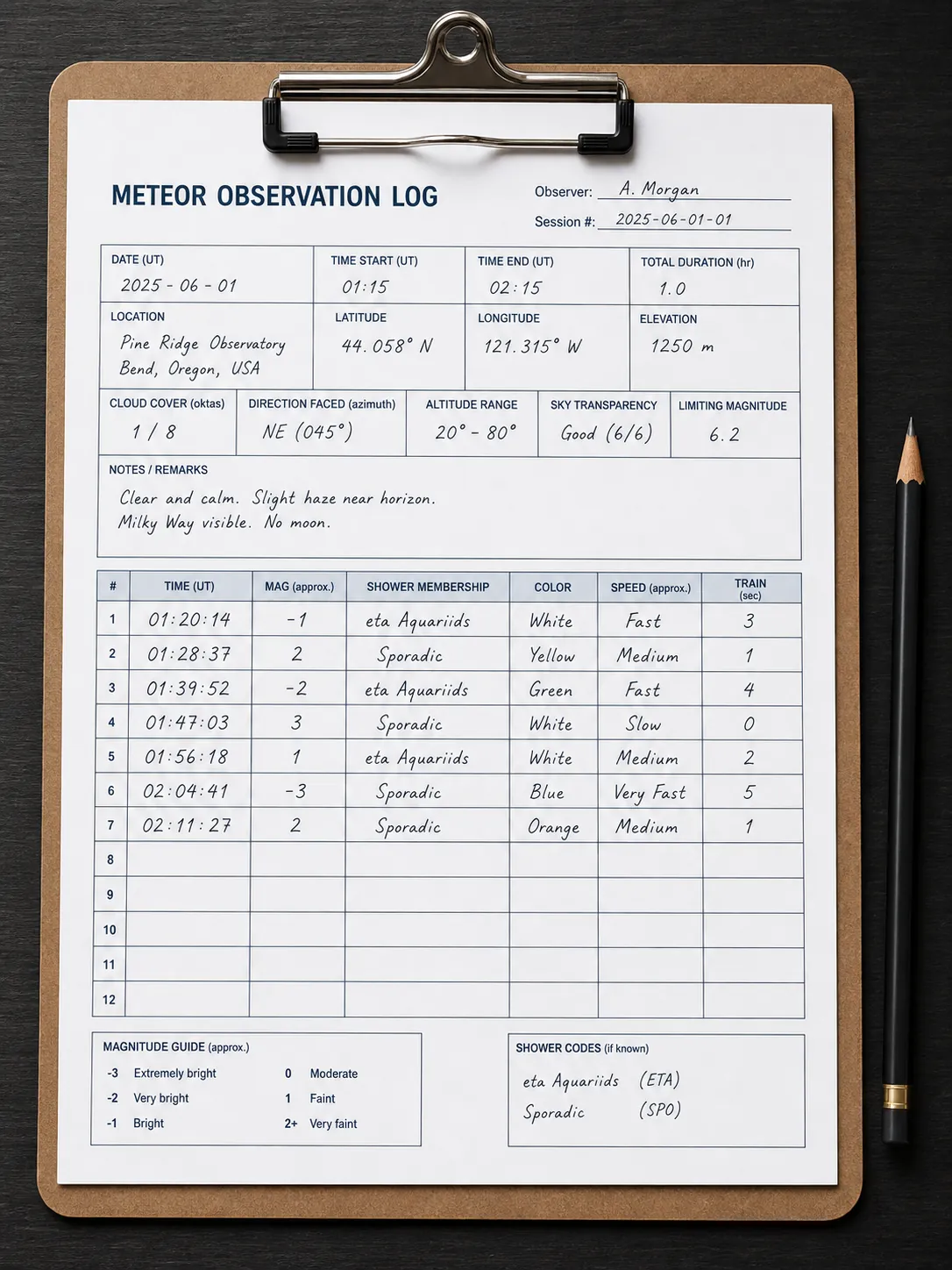
Read each blank as a study prompt
The first few fields look administrative. They are not the glamorous part of the log, and they are easy to rush through in the first ten minutes of a lab. They also carry a surprising amount of exam content.
| Log field | What you record | Exam concept it can reinforce |
|---|---|---|
| Date and time in UT | The observing interval converted to Universal Time | Time standards, Earth rotation, and why observers need a shared clock |
| Location | Latitude, longitude, and elevation | Observer position on Earth and local sky geometry |
| Cloud cover | Approximate percentage of sky blocked | Data quality, selection effects, and why a non-detection is not always physical |
| Direction faced and altitude | Where you looked and how high above the horizon | Celestial coordinates, horizon coordinates, radiant geometry, and field of view |
| Transparency or seeing | How clear or steady the sky appeared | Atmospheric effects on astronomical observation |
| Meteor time | When each meteor appeared | Rates, shower activity, and the difference between an event and a trend |
| Magnitude | How bright the meteor appeared | Brightness scales, light production, and observational limits |
| Shower membership | Whether the meteor belongs to a named shower or is sporadic | Radiants, parent bodies, and orbital debris streams |
| Color | Visible color, if confidently seen | Emission, heating, composition clues, and limits of naked-eye inference |
| Speed | Apparent speed category or estimate | Relative velocity, orbital intersection geometry, and kinetic energy |
| Train presence | Whether a lingering trail remained | Ablation, ionization, and atmospheric interaction |
Date, time, and location are not just setup
Universal Time is one of those requirements students often copy from a phone app and immediately forget. On an exam, though, time conversion is tied to Earth’s rotation and the practical reason astronomers use a common clock. If observers in different longitudes all report “1:00 a.m.” without a standard reference, their records cannot be compared cleanly. Writing UT is a small act of coordinate discipline.
Location does similar work. Latitude, longitude, and elevation are not decorative metadata. They define the observer’s horizon and determine what part of the sky is available. A student who writes the location carefully is already rehearsing the idea that the sky is observed from a specific rotating point on Earth, not from a generic diagram floating outside the planet.
Cloud cover and transparency explain weak data
A thin, hazy sky can make a shower look unimpressive even when the shower itself is active. That matters for lab reports and for exam reasoning. Cloud cover and transparency teach the difference between an astronomical cause and an observing-condition cause. If your log shows few meteors during a bright, cloudy interval, the safest interpretation is not “the shower stopped.” It is “the observation was limited.”
This is also where a log becomes more useful than memory. Tired observers remember the spectacular meteor. They forget the fifteen minutes of passing cloud that made the count unreliable. A field for sky conditions keeps the later analysis honest.
Direction and altitude turn the radiant into geometry
The word “radiant” is easy to memorize badly. Students write “Perseus” or “Gemini” and treat the constellation as if it were the source of the meteors. It is not. A shower radiant is the apparent point in the sky from which meteors seem to diverge because Earth is moving through a stream of particles traveling on related paths.
Direction faced and altitude force that idea out of the vocabulary list and into the sky. If you face too low, too near the horizon, or in a section blocked by trees and buildings, your count and apparent paths change. If you plot meteor tracks backward and several converge near the expected radiant, shower membership becomes an argument from geometry rather than a guess from the calendar.
For a student reviewing celestial coordinates, this is where horizon coordinates and equatorial coordinates can meet. The radiant may be described by right ascension and declination, while the observer actually faces a direction and altitude from a local site. The log sits between the diagram and the field.
Magnitude, color, and trains point to light production
Magnitude asks for brightness, not size. That distinction saves students from one of the most common meteor misconceptions. A bright meteor does not automatically mean a large rock was flying overhead, and a meteor shower is not a hailstorm of boulders. Most visible meteors come from very small particles, often described as sand-grain-sized and less than about 1–2 grams.[4][5]
The reason such small particles can be visible is velocity. When a meteoroid enters the atmosphere, its kinetic energy is converted through atmospheric interaction into heat, ionization, and light. The visible streak is the meteor. If any surviving fragment reaches the ground, that surviving object is a meteorite. Before atmospheric entry, the object is a meteoroid. A log that asks for brightness and train presence is quietly reviewing that vocabulary chain.
Train presence is especially useful because it makes ablation harder to ignore. A persistent train is not the solid object hanging in the air. It is the luminous or ionized aftermath of the atmospheric passage. If your instructor asks why a meteor can leave a trail, the answer belongs to atmospheric interaction, not to the object dragging smoke like a campfire coal.
Color can be tempting to overinterpret. Record it if you see it confidently, but do not build a whole composition claim from one sleepy naked-eye impression. For exam prep, color is most useful as a prompt to remember that meteor light comes from energetic interaction with the atmosphere and material, not from the meteoroid shining like a tiny lamp before it arrives.
Speed is where the physics sneaks in
The American Meteor Society gives meteor speeds ranging from about 11 km/s for slow sporadic meteors to about 72 km/s for Leonids.[4] That range is large enough to matter in a comparison question. A faster meteoroid carries much more kinetic energy than a slower one of the same mass, because kinetic energy depends on the square of velocity.
You do not need to turn every lab night into a physics problem set. But when a log asks whether a meteor was slow, medium, or fast, the field is not just descriptive. It is training you to connect apparent motion with orbital encounter speed, atmospheric entry, brightness, and shower identity.
Shower membership is the row that ties the form together
The per-meteor row that asks for shower membership is easy to treat as a yes-or-no label. It should be the row where several earlier fields converge. Does the meteor’s path trace back toward the radiant? Does the speed match the shower’s usual character? Did it appear during the expected activity window? Was it simply a sporadic meteor crossing the same sky?
That last possibility matters. A meteor seen during the Perseids is not automatically a Perseid. A meteor seen near the Geminids is not automatically a Geminid. Shower membership is an inference from direction, timing, and behavior. For exam purposes, that is a better mental habit than memorizing one constellation name per month.
If your course asks for a full meteor-shower schedule, use a timing guide such as How to Watch Meteor Showers Without Sacrificing Study Time to decide which shower fits your exam calendar. The log itself is better used for interpretation than for collecting a long seasonal list.
Geminids and Perseids make a better comparison than a calendar dump
If you only have room in your review notes for one concrete comparison, use the Geminids and Perseids. They are familiar enough to appear in course examples, but different enough to test whether you understand parent bodies, speed, and shower strength instead of only names.
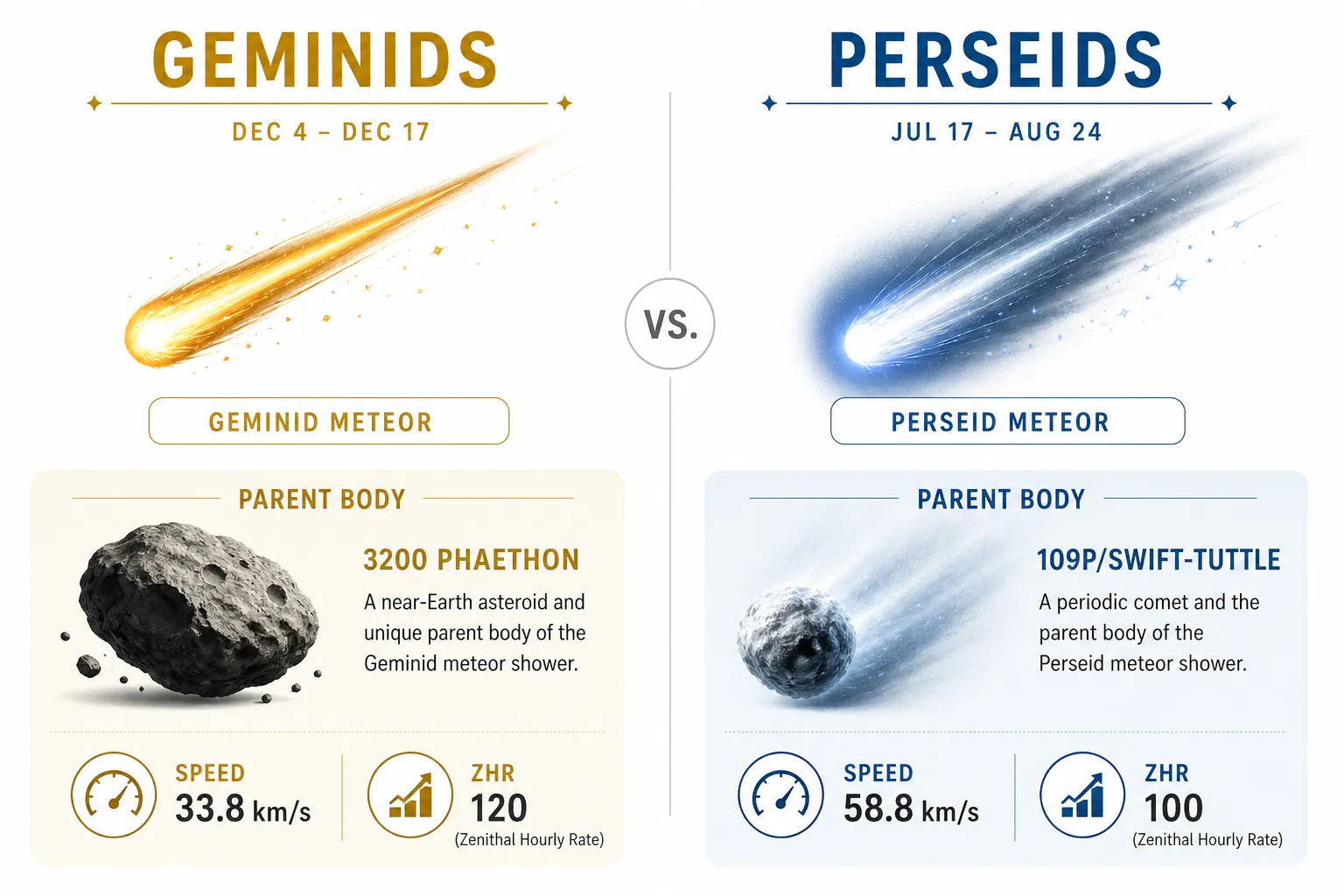
| Shower | Typical ZHR | Speed | Parent body | Exam value |
|---|---|---|---|---|
| Geminids | 120 | 33.8 km/s | Asteroid 3200 Phaethon | Shows that a major meteor shower can be associated with an asteroid-like parent body |
| Perseids | 100 | 58.8 km/s | Comet 109P/Swift-Tuttle | Shows the classic comet-debris-stream model and faster encounter speed |
NASA lists the Geminids with a zenithal hourly rate of 120, a speed of 33.8 km/s, and parent body 3200 Phaethon, while the Perseids are listed with a zenithal hourly rate of 100, a speed of 58.8 km/s, and parent body 109P/Swift-Tuttle.[6] The American Meteor Society’s 2026 meteor shower table also supports those shower identifications and values for practical planning.[7]
ZHR deserves a careful reading. It is not a promise that you personally will see that many meteors in one hour from a suburban sidewalk while the Moon is bright and half the sky is blocked. It is a standardized rate used for comparison under idealized conditions. On an exam, that distinction can be the difference between understanding a measurement and treating it as a guarantee.
The parent-body contrast is just as useful. The Perseids fit the familiar comet-origin story: Earth crosses debris associated with comet 109P/Swift-Tuttle. The Geminids complicate the lazy version of that story because their parent body is 3200 Phaethon, an asteroid-associated source. If a question asks whether all major meteor showers come from comets, the Geminids are the reason the answer needs care.
The speed contrast does exam work too. The Perseids are faster than the Geminids in the NASA values above. If two particles had the same mass, the faster one would carry more kinetic energy. That does not mean every Perseid must look brighter than every Geminid; brightness also depends on particle size, composition, entry path, and observing conditions. The log’s job is to keep those variables visible instead of letting one number do all the explaining.
A two-hour session can still be exam review if it is selective
Many college lab assignments ask for a shorter session than amateur observing programs require. That is fine. The goal for exam prep is not to imitate a full observing certification. It is to make the required time do double duty.
- Before observing, write the expected radiant, parent body, and general speed for the shower you plan to watch.
- During observing, mark sky conditions honestly, especially clouds, Moon interference, blocked horizons, and breaks in attention.
- For each meteor, record the path first, then decide whether shower membership is justified.
- After observing, choose one strong row from the log and explain how its speed, brightness, train, and radiant direction support or weaken the shower identification.
- Turn mistakes into flashcards: meteoroid versus meteor versus meteorite, radiant versus parent body, ZHR versus actual observed count.
That last step is where the observation stops being paperwork. One well-explained row can review more than a page of copied definitions. A faint, fast meteor that traces back toward the radiant and leaves a brief train asks you to think about apparent path, shower membership, atmospheric entry, and light production in the same breath.
If you are planning around a specific shower in 2026, check peak timing and Moon conditions close to the date rather than relying only on a long-range note. Moon phase predictions are reliable for planning, but practical visibility still depends on the shower’s actual peak timing, local weather, horizon, and schedule. For the August shower most students recognize first, a dedicated timing page such as Best Time to View the Perseids 2026 for Astronomy Students is the better place to handle date decisions.
What not to overclaim from the log
A meteor shower log is not an official DSST study guide. The American Meteor Society and Astronomical League forms were built for observing practice, not for course-credit exams. A local Astronomy 101 final may care more about stellar evolution, telescopes, or cosmology than your lab night suggests. The field overlap is a useful inference, not a guaranteed score increase.
It is also possible to complete the form neatly and learn very little. Copying “radiant: Perseus” into a blank does not prove that you understand why the radiant is apparent, how Earth intersects a debris stream, or why a meteor’s brightness is not a direct size label. The form helps only when each entry is treated as evidence for a concept.
Used that way, the log becomes a compact review of coordinates, Solar System debris, relative velocity, magnitude, atmospheric ablation, and observational uncertainty. The student standing outside with the clipboard still has to be cold, tired, and accurate. But the blanks are no longer empty chores. Each one points to something an astronomy exam can reasonably ask.
References
- Astronomy, GetCollegeCredit
- Visual Observing, American Meteor Society
- Meteor Observing Program, Astronomical League
- Meteor FAQ, American Meteor Society
- What Is a Meteor Shower?, NASA Space Place
- Meteor Showers, NASA Science
- Meteor Shower Calendar, American Meteor Society
Related exhibits & inventory
Verified outcomes
No verified outcomes on file for this exam yet
See Methodology for how outcome evidence is disclosed once logged.
Planners
No planner filed for this exam yet
A downloadable timeline template for this exam hasn't been published yet.
Tool verdicts
AI-tool cautions
No AI tools tested for this exam yet
No hands-on AI-accuracy logs have been filed for this exam.
Questions about this plan
Ask a question about a specific section, timeline, or citation in this plan — or flag something that needs correcting.
Comments
Join the discussion with an anonymous comment.