GRE Exam Hub
Lessons from Hank Green's ChatGPT apology for student researchers
Hank Green's public credibility failure over undisclosed ChatGPT use offers student researchers a clear case study in verification ethics. This article translates the controversy into a labeled, verification-first research workflow that protects students from similar pitfalls.
- gre
- mcat
- asvab
- sat
- act
- digital-adaptive
- official-material
- section-strategy
- test-date-timeline
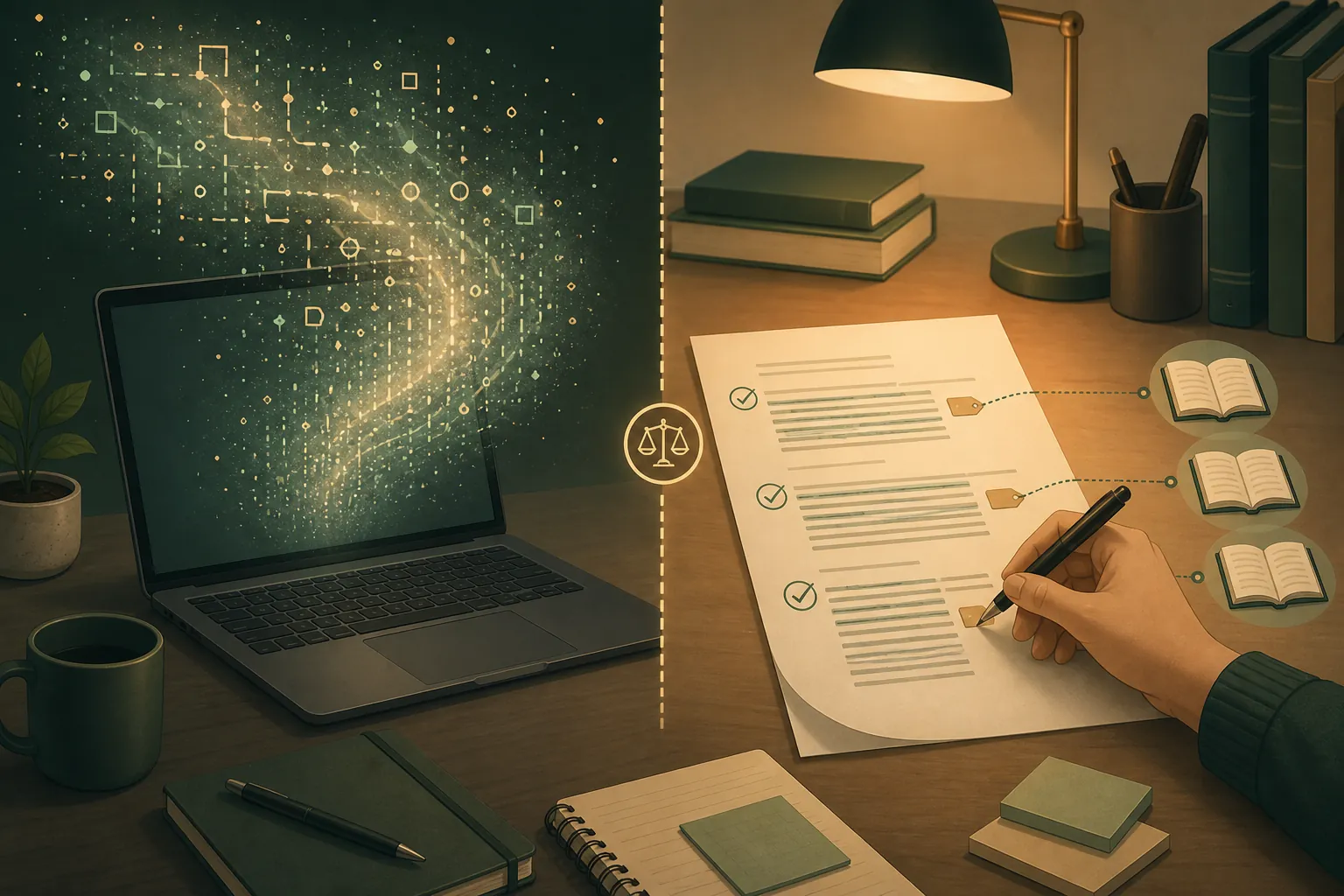
Evidence label, as of August 2, 2026: the Hank Green ChatGPT controversy is best treated as a late-July public research-process failure, not as a settled story about long-term consequences. Reports disagree on whether the “Ask Hank Anything” episode with Soupytime was uploaded on July 29 or July 30, so the safer date is late July 2026. What is clearer is the sequence that followed: viewers circulated a clip of Green saying “I appreciate the pushback,” questioned several fact-check cards, surfaced his later-deleted July 31 X post describing AI research as “a bad habit at a time when I’ve overcommitted myself,” and then responded to a Reddit apology in which he said he was “mortified,” admitted he had been “relying too heavily on AI as a research aid,” and announced pauses to hankschannel, SMUSH, and 4x3.[1][2][3][4]
That distinction matters for student researchers. The problem was not simply that ChatGPT entered the process. A student can use ChatGPT to brainstorm search terms, pressure-test an outline, or practice counterarguments without committing an academic integrity violation, if the class or exam context allows it. The credibility break happens when readers, teachers, or viewers can no longer tell which claims came from AI suggestion, which claims were verified against real sources, and which judgments the writer is prepared to defend.
That is the practical lesson behind the Hank Green ChatGPT apology for student researchers: if a claim survives into your final draft, you need a trail. Not a vague memory that ChatGPT “helped with research.” Not a browser tab you might be able to find later. A visible record that separates AI output from cited evidence and from your own reasoning.
The Boundary Line Viewers Could Not See
The viral moment was awkward partly because it sounded like a prompt response. In the clip, Green says “I appreciate the pushback,” a phrase many viewers immediately associated with AI-generated politeness. Later reporting noted that the line was not in his script and was ad-libbed, which makes the episode more useful for students rather than less: suspicion can attach to phrasing even when that exact phrase was not generated by AI.[2][3]
Audiences have reasons for that kind of pattern-matching, even when they overread a single phrase. Juzek and Ward identified 21 “focal words” that appeared unusually often in ChatGPT-influenced text, and separate Florida State University coverage of related research highlighted a 1,375% rise in the word “delve” in PubMed abstracts from 2020 to 2024.[5][6] That does not prove any individual sentence is AI-written. It does mean readers now notice certain textures: over-smooth concessions, strangely balanced transitions, and words that feel statistically common in machine-assisted prose.
The more serious issue was not tone. Viewers also pointed to an unusual number of fact-check cards in the episode, including cards around claims involving cat saliva, mantis shrimp vision, and artificial sweeteners.[2][4] A fact-check card is supposed to reassure the audience that someone checked the bridge between claim and evidence. When the card itself says a claim could not be verified, the bridge becomes the story.
For a student, the equivalent is the sentence in an essay that sounds confident but cannot be traced. In a timed SAT or ACT-style essay, that may look like a sweeping historical example you cannot support. In GRE Analytical Writing, it may be an invented-sounding institutional claim. In MCAT CARS practice, it may be a paraphrase that quietly changes what the passage actually said. The weakness is not that AI touched the draft. The weakness is that nobody can audit the handoff.
Four Uses Students Keep Mixing Together
Most student AI debates become useless because they use one verb — “used” — for very different actions. A student who asks ChatGPT for possible objections to an essay prompt has not done the same thing as a student who pastes in an uncited paragraph and submits it. A cleaner workflow starts by naming the use.
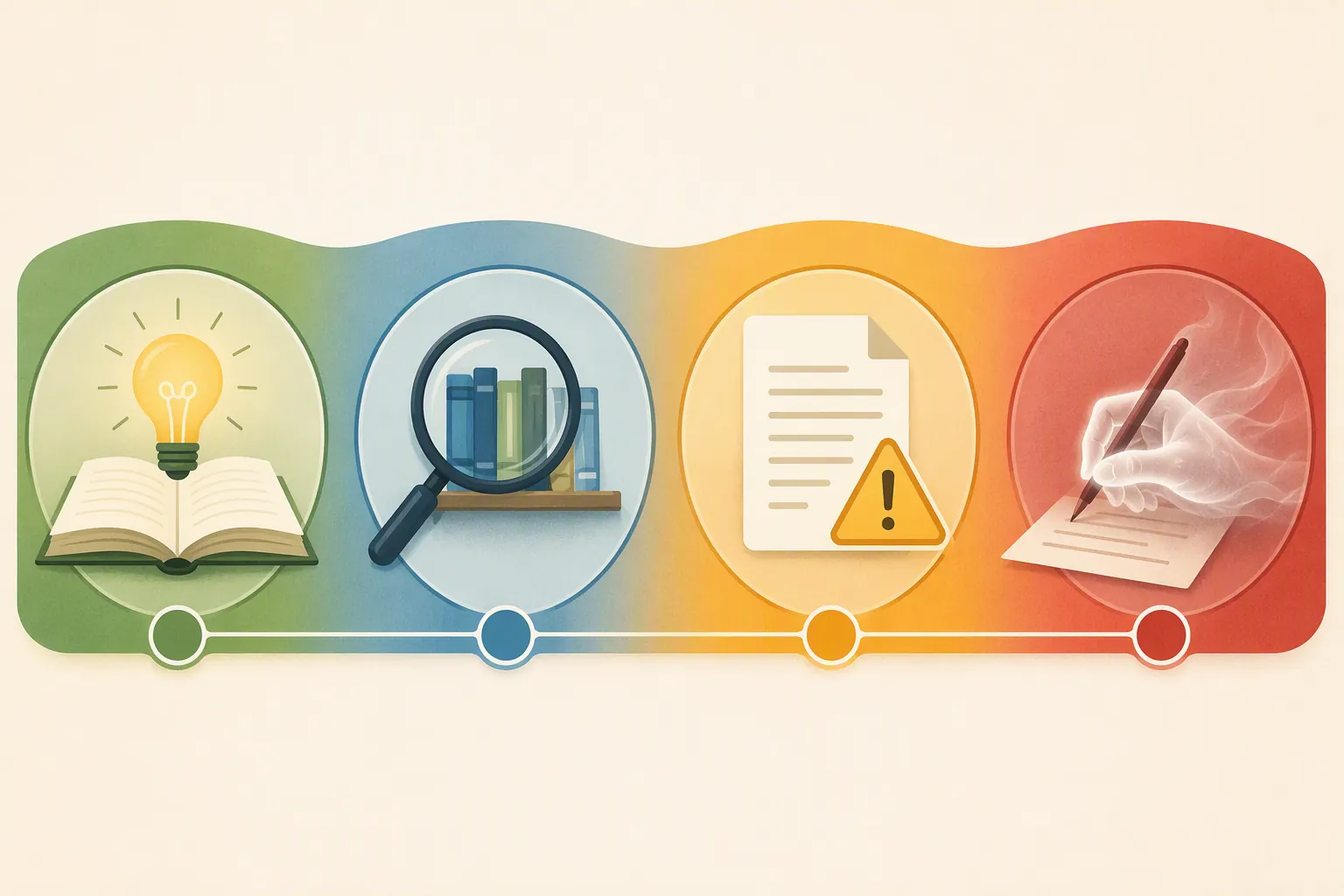
| AI use | What it can do | What must not happen |
|---|---|---|
| Brainstorming aid | Generate angles, objections, search terms, practice prompts, or possible structures | Let the tool decide your thesis or replace your judgment |
| Source-finder | Suggest authors, keywords, institutions, or databases to check | Cite a source because ChatGPT named it |
| Fact-generator | Offer a claim that may be worth investigating | Treat the claim as true before verifying it elsewhere |
| Ghostwriter | Produce prose that can tempt a student under deadline pressure | Submit language you cannot explain, revise, or defend as your own |
Brainstorming is usually the least fragile use, though policies still matter. If you ask for five possible ways to analyze a prompt, then choose one, reject two, and combine others with your own reading, you are still doing intellectual work. The danger begins when the brainstormed categories harden into claims without evidence.
Source-finding is more delicate. ChatGPT can help you think of search language, but it is not a library catalog, a database record, or a citation manager. Treat every suggested title, author, journal, statistic, and quote as unverified until you can open the source yourself and confirm that it says what the tool implied.
Fact-generation is where many students accidentally copy the Hank Green problem into schoolwork. The tool gives a plausible explanation; the student rewrites it; the paragraph now sounds researched; nobody has checked whether the claim is true. In a private study session, that may waste ten minutes. In a submitted essay, lab report, scholarship application, or public video, it creates repair work for everyone downstream.
Ghostwriting is different again. Even if every fact in a generated paragraph happens to be accurate, the voice problem remains. Teachers evaluate not only whether a conclusion is correct but whether the student can reason toward it. For timed-essay preparation, that is why AI-polished paragraphs can be a trap: they may look cleaner than the writing the student can produce under actual test conditions. If you are working on exam writing, use AI to diagnose and drill, not to manufacture a voice you cannot reproduce. For a fuller boundary between legitimate prep and cheating, see Can students use ChatGPT for exam prep?.
Why Hidden AI Help Is So Fragile
Hidden AI help fails in three ordinary ways: the prose sounds borrowed, the claims cannot be verified quickly, and the writer becomes defensive because they do not know which parts are theirs. None of those failures requires malicious intent. They are exactly what happens when a deadline-bound person lets a private shortcut become part of public work without labeling it.
The reliability data justify caution. In a 2024 JMIR study comparing chatbot-generated bibliographic references, reported hallucination rates were 39.6% for GPT-3.5, 28.6% for GPT-4, and 91.4% for Bard; precision was only 9.4% to 13.4%.[7] Those figures do not mean every answer from every model is useless. They do mean a student cannot responsibly convert chatbot output into a citation just because it looks formatted.
The problem has already moved into the scholarly record. A 2026 Lancet/Columbia analysis described by STAT found fake references in published papers rising sixfold, from 1 in 2,828 papers in 2023 to 1 in 458 in 2025, across a corpus of more than 2 million papers.[8] CNET reported Cornell and UCLA researchers’ estimate of 146,900 AI-generated fake citations across arXiv, bioRxiv, SSRN, and PubMed Central.[9] Nature, in a paywalled report description, said tens of thousands of 2025 publications may contain invalid references and noted that arXiv planned to ban repeat offenders.[10]
Students are not operating outside that world; they are swimming in a smaller version of it. UK survey reporting said about 88% of students used generative AI for assessments in 2025, and about 18% included AI text directly in their work.[11] Pew reported that about 26% of U.S. teens had used ChatGPT for schoolwork in 2025, double the 2023 share.[12] College Board research said 74% of U.S. faculty reported students using AI for essays.[13] Turnitin reported that 76% of students believed their institution would detect AI use, while 53% feared being accused.[14]
That fear is real, but it can push students toward the worst possible habit: concealment. Disclosure research is uncomfortable but useful here. University of Arizona researchers, in 13 experiments with more than 5,000 participants, found that disclosing AI use lowered perceived trustworthiness, but quiet use produced the steepest trust decline if uncovered.[15] Trusting News found that 94% of audiences wanted AI use disclosed and that more detailed disclosures repaired more trust.[16] Upfront honesty may cost something. Being caught without a trail costs more.
A Verification Trail You Can Actually Show
The fix is not a confession ritual. It is a workflow. If a teacher, professor, writing-center tutor, debate coach, scholarship reviewer, or audience member asks where a claim came from, you should be able to answer without reconstructing your entire night.
| Column | What you record | Example label |
|---|---|---|
| AI suggestion | The claim, source idea, counterargument, or phrasing the tool proposed | AI suggested: caffeine improves alertness during study sessions |
| Verification source | The real source you opened and could cite | Checked against: course reading, database article, official report, assigned passage |
| Decision | Accept, revise, or discard | Revise: source supports short-term alertness, not better grades |
| Final wording | Your sentence in your own voice | Final: Caffeine may help a tired student stay alert, but that is different from proving long-term learning gains |
| Disclosure note | How you will describe AI help if the context requires it | Used ChatGPT to generate possible angles; all claims checked against assigned sources |
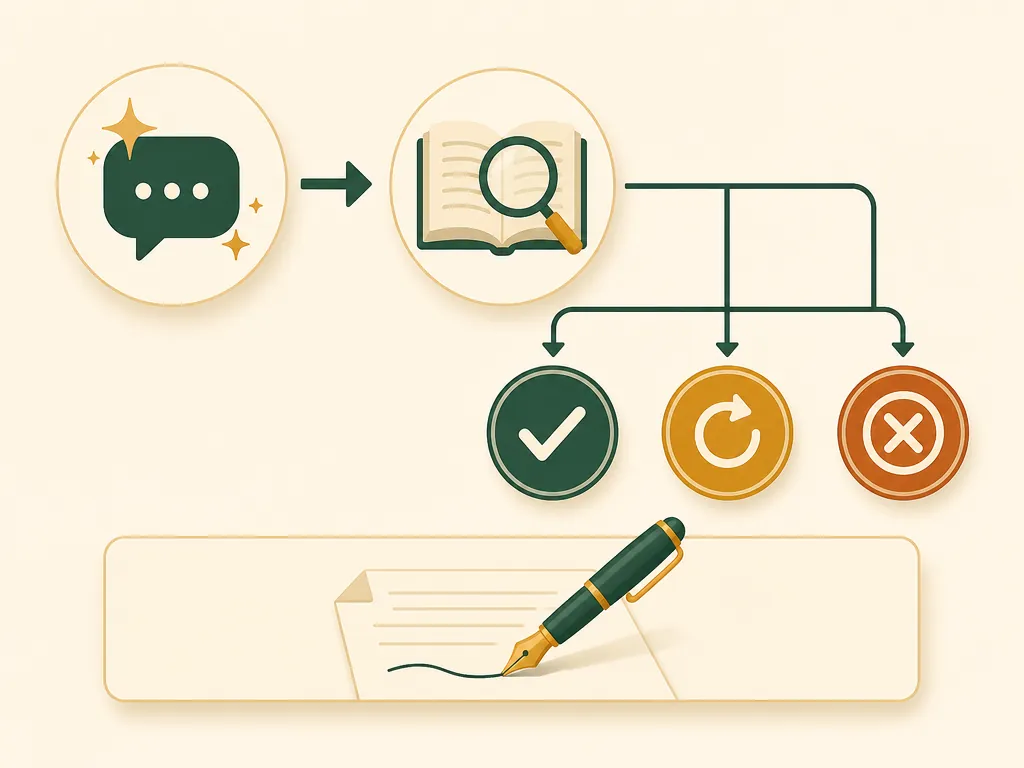
You can keep this trail in a notes document, spreadsheet, comment thread, research log, or draft margin. The format matters less than the habit: every AI-suggested claim gets labeled, checked against a source you can cite, and accepted, revised, or discarded before it enters final prose.
Step 1: Label the AI Output Before You Like It
The moment ChatGPT gives you a useful-looking claim, mark it as AI-suggested. Do this before you decide whether it is good. Students often lose the trail because they paste a promising sentence into the draft, revise it twice, and forget that the original idea came from a tool that may have guessed.
Use blunt labels: “AI claim,” “AI source lead,” “AI wording,” “AI counterargument,” or “AI outline idea.” Those labels are not moral judgments. They are handles. Later, when you are tired, they keep you from confusing a machine-generated lead with verified evidence.
Step 2: Verify Against a Source You Can Cite
Do not ask the chatbot to verify itself. Open the assigned text, official report, scholarly article, database record, news source, or class-approved material. If the source is unavailable, the claim is not ready. If the source says something narrower than the AI claim, narrow your sentence. If the source contradicts the AI claim, discard or rewrite it.
A hypothetical research-log entry might look like this: “AI suggested that many universities ban all ChatGPT use. Checked syllabus and university policy page. Actual rule: AI use allowed for brainstorming if disclosed, prohibited for generating final text. Decision: revise.” The useful part is not the template; it is the correction. Your final sentence should match the evidence you actually found, not the broader claim that first sounded convenient.
This habit transfers directly into exam reasoning. GRE Issue essays reward defensible generalizations, not inflated certainty. SAT and ACT-style essays reward examples that stay under control. MCAT CARS rewards attention to what the passage author actually argues. For practice seeing how evidence-labeled case material can feed an argument, compare the site’s Apalachee GRE issue case and Florida legal-process case study.
Step 3: Decide, Do Not Drift
Every checked claim needs one of three outcomes: accept, revise, or discard. Do not leave it in the draft as “probably fine.” That is how unverifiable material survives until someone else catches it.
- Accept when the source directly supports the claim and you understand the context.
- Revise when the source supports a narrower, weaker, or differently framed version.
- Discard when you cannot find the source, cannot open it, cannot understand it, or cannot make it fit honestly.
The discard option is what deadline pressure tries to delete. Keep it. A clean paragraph with one fewer claim is safer than a crowded paragraph that includes a sentence you would dread being asked about.
Step 4: Rewrite in the Voice You Can Defend
After verification, close the chatbot window or move the generated text out of sight. Write the final paragraph yourself. That does not mean making it less polished on purpose. It means choosing the emphasis, transitions, limits, and examples in a way that matches how you actually reason.
A good test is whether you can explain the paragraph aloud. If you cannot define a term, defend a transition, or say why a source belongs there, the prose is not ready. Timed-essay prep especially depends on this. A sentence that sounds impressive in a take-home draft can become a liability when the next prompt asks you to think in real time. For more on building a voice that still works under pressure, see Anne Lamott and good writing for exam prep.
Step 5: Disclose Material Help in the Right Place
Disclosure is not one universal sentence. Follow the strictest relevant rule: your teacher’s policy, exam-prep assignment instructions, publication standard, scholarship application language, lab policy, or school honor code. If the rule says no AI, do not use it. If the rule allows limited AI, say what kind of help you used.
| Context | Disclosure that is usually more defensible |
|---|---|
| Class essay with AI allowed for brainstorming | I used ChatGPT to generate possible objections and search terms; I verified all claims against assigned sources and wrote the final draft myself. |
| Research project with AI used to find leads | I used ChatGPT as a source-finding aid. Citations were checked against the original sources before inclusion. |
| Exam-prep practice | I used ChatGPT for feedback and drill generation, not for final timed-response text. |
| Public article, video script, or newsletter | AI assistance materially shaped research or drafting; claims were independently checked before publication. |
The wording can be shorter or more formal depending on the assignment. What matters is that the disclosure matches the work. “I used AI” is often too vague; “I used ChatGPT to identify possible counterarguments, then verified evidence through the assigned readings” gives a reviewer something concrete to evaluate.
What This Looks Like the Night Before a Deadline
Suppose you have an argument essay due tomorrow. You ask ChatGPT for objections to your thesis. It gives you six. You paste all six into your notes, label them “AI objections,” and choose two that actually fit the prompt. Then you check your assigned reading and realize one objection depends on a claim the reading never makes. You discard it. The other objection is useful but too broad, so you revise it.
Now your draft has a paragraph that says, in your own words, “A critic might object that the policy helps only students who already have strong support systems. The assigned report does not prove that claim across all schools, but it does show why access varies by context.” That sentence is less flashy than the first chatbot version. It is also much easier to defend.
The same pattern works for GRE Analytical Writing. Ask for possible assumptions in an argument prompt, but then verify each assumption against the prompt’s exact language. It works for SAT or ACT essay preparation when you use AI to generate practice prompts, then write the timed response yourself. It works for MCAT CARS when you ask for a paraphrase only after you have already tried to summarize the passage, then check whether the paraphrase smuggled in claims the author did not make.
If you want to build that habit outside a single AI assignment, use critical thinking exercises for study skills as a companion practice. The same discipline also applies before you paste research into any tool: protect accounts, drafts, and personal information first. The practical setup belongs in secure ChatGPT account habits for exam prep.
AI Detectors Are Not the Safety Net
Students who are afraid of being accused often ask the wrong final question: “Will this pass an AI detector?” The better question is, “Can I show how I made this?” Detection tools, school policies, and instructor expectations vary. This article does not rely on broad claims about detector false positives because the student’s strongest protection is not a score from a third-party scanner. It is a process record that existed before anyone challenged the work.
That record does not make every use acceptable. Some classes and exams ban AI assistance entirely. Some allow brainstorming but not drafting. Some require formal disclosure. Some instructors may still distrust AI-assisted work even when disclosed. The point of a verification trail is not to win every policy argument; it is to avoid being trapped by your own missing documentation.
Hank Green’s case is useful because it removes the fantasy that credibility failures happen only to lazy students. A knowledgeable, productive person can still let AI-suggested material, rushed verification, and public trust collide. His apology mattered because it named reliance on AI as a research aid and announced process changes. Whether the audience accepts that is separate from the lesson students can use immediately.
Using ChatGPT for research help is not automatically the credibility failure. Losing the ability to distinguish AI suggestion, verified evidence, and personal judgment is. The durable student rule is plain: label the AI help, verify every claim against a source you can cite, disclose material use according to the context, and write the final version in a voice you can stand behind before anyone asks.
References
- Famous Science YouTuber Admits He Has Unhealthy Relationship With AI After Facing Backlash Over Recent Video, Kotaku
- Hank Green faces major backlash after admitting he used ChatGPT to research YouTube script, Dexerto
- Hank Green admits using ChatGPT after accidentally reading AI prompt feedback left in his script, The Express Tribune
- YouTuber Hank Green faces backlash after admitting AI use in research for Ask Hank Anything episode, Times of India
- ChatGPT as a Textual Doppelgänger: Measuring Model Influence in Scientific Writing, arXiv, 2024
- Why does ChatGPT ‘delve’ so much? FSU researchers uncover why ChatGPT overuses certain words, FSU News, February 17, 2025
- Hallucination Rates and Reference Accuracy of ChatGPT and Bard for Systematic Reviews: Comparative Analysis, JMIR, 2024
- Lancet study finds steep rise in fraudulent citations in academic papers, STAT, May 7, 2026
- AI Is Making Up Citations in Scientific Papers, CNET
- AI-generated fake citations are a growing problem in scientific papers, Nature, 2026
- Student AI use surges to 88%, University World News, 2025
- About a quarter of U.S. teens have used ChatGPT for schoolwork – double the share in 2023, Pew Research Center, January 15, 2025
- New College Board Research: Faculty Express Near-Universal Concern Student AI Use Undermines Learning, College Board
- What 2025 generative AI trends reveal about student behavior, Turnitin
- Being honest about using AI at work makes people trust you less, research finds, University of Arizona
- New research: How AI disclosures in news help and also hurt trust with audiences, Trusting News
Related exhibits & inventory
Verified outcomes
Planners
No planner filed for this exam yet
A downloadable timeline template for this exam hasn't been published yet.
Tool verdicts
AI-tool cautions
No AI tools tested for this exam yet
No hands-on AI-accuracy logs have been filed for this exam.
Questions about this plan
Ask a question about a specific section, timeline, or citation in this plan — or flag something that needs correcting.
Comments
Join the discussion with an anonymous comment.