
ALL Exam Hub
Do Critical Thinking Exercises Improve Study Skills?
Critical thinking exercises do improve study skills — the mixed-meta evidence puts achievement gains at g ≈ 0.88 and thinking-skill gains at g ≈ 0.84. The evidence also points to which drills and timeframes work best, and flags which exam-score claims the numbers can't support.
- gre
- mcat
- asvab
- sat
- act
- digital-adaptive
- official-material
- section-strategy
- test-date-timeline
Yes: critical thinking exercises for students can improve study skills when they are treated as repeated exam practice, not as a vague “life skill” warm-up. The strongest evidence here is a 2024 mixed-meta analysis that found large average effects for both critical thinking skills, g ≈ 0.84 across 32 studies, and academic achievement, g ≈ 0.88 across 37 studies; the same analysis found larger effects for programs lasting 9 or more weeks, g ≈ 0.96, than for 1–8-week programs, g ≈ 0.44.[1]
That is a useful answer, but it is not a license to write “add 20 minutes of critical thinking and your SAT, GRE, MCAT, ACT, or ASVAB score will rise by a specific amount.” None of the sources here converts those effect sizes into exam score points. The safer reading is narrower and more practical: sustained critical thinking training appears trainable and transferable to academic performance, and the drills most worth borrowing are the ones that make you inspect claims, evidence, assumptions, and answer choices while you study.

What the strongest evidence actually measured
The Batdı et al. mixed-meta analysis matters because it separates two outcomes that often get blurred together. One outcome was improvement on critical thinking skills. The other was academic achievement. For a test-prep student, that distinction is the whole point: a drill can make you sound more thoughtful in discussion and still fail to change how you perform on graded work. In this review, both categories moved in a large positive direction.[1]
| Evidence question | Reported result | What an exam-bound student can safely take from it |
|---|---|---|
| Do critical thinking skills improve after training? | g ≈ 0.84 across 32 studies [1] | Critical thinking appears trainable, not just an innate trait. |
| Does training transfer to academic achievement? | g ≈ 0.88 across 37 studies [1] | The evidence supports academic-transfer claims, though not a specific standardized-test point gain. |
| Does duration matter? | 9+ weeks: g ≈ 0.96; 1–8 weeks: g ≈ 0.44 [1] | This looks more like a repeated-practice habit than a one-week cram tactic. |
| Is there school-level relevance? | High-school-level achievement effect g ≈ 0.90 [1] | The evidence is not limited to college settings, but it still should not be treated as direct SAT or ACT score conversion. |
The duration finding is the most operational number in the set. If your exam is next Saturday, a few claim-checking drills may still improve how you review missed questions, but the larger evidence does not point to a miracle week. If your test is 9 or more weeks away, the evidence fits a different plan: make critical thinking a small recurring part of normal prep, the same way you would schedule retrieval practice or spaced vocabulary.

There are boundaries. The studies in the mixed-meta analysis are largely classroom-based, and many are not U.S. standardized-test settings. That does not make the evidence irrelevant to exam prep; academic achievement is closer to the target than a classroom attitude survey would be. It does mean the transfer claim is argued from the evidence, not proven directly in every named testing program.
The drill worth starting with: evaluate a claim before you chase the answer
The cleanest exercise is not a debate prompt or a logic puzzle. It is a short claim-evaluation task: read a claim, judge whether the available evidence supports it, and explain why. Motz and Fyfe reported that students who did brief multiple-choice claim-evaluation activities scored about three times higher than controls on an open-ended critical thinking measure.[2] That is not an SAT, MCAT, GRE, ACT, or ASVAB score result. It is still the kind of activity that maps neatly onto real missed-question review.
A useful version takes 3–5 minutes per difficult question:
- Write the claim you accepted when you chose your answer.
- Underline the exact passage line, rule, graph feature, equation setup, or vocabulary clue that should have controlled the decision.
- Name the evidence you overweighted, ignored, or invented.
- Rewrite the rule for next time in one sentence.
- Create one similar hypothetical question stem and state what would make the claim true or false.
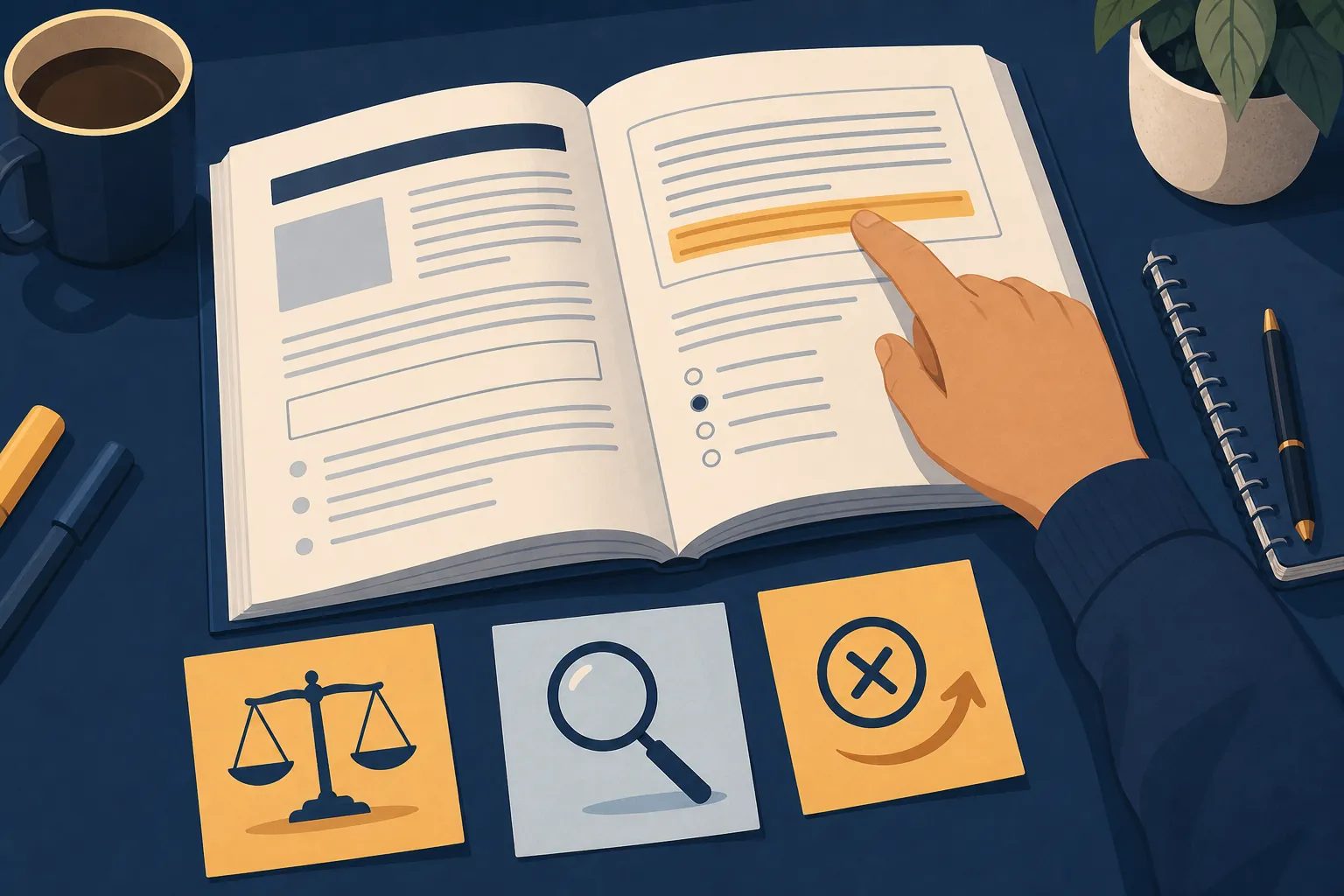
This is where the exercise stops being decorative. A student reviewing a reading passage does not just mark “careless.” The review asks: what claim did I accept about the author’s position? Which phrase narrowed that claim? Which answer choice sounded reasonable but had no evidence? The same structure works for quantitative questions when the false claim is something like “these two quantities are proportional” or “this word problem is asking for the final total.”
Pair the drill with active processing, not passive review
Critical thinking drills fit best inside study methods that already force a student to produce, test, and revise an answer. Active learning evidence is useful here even though it comes mainly from STEM course settings: a 2014 PNAS meta-analysis of 225 studies found that active learning increased exam performance by 0.47 standard deviations, roughly 6%, and reduced failure rates from 33.8% under traditional lecturing to 21.8% under active learning.[3] The bridge to individual exam prep is not “take a classroom method and copy it exactly.” It is that performance improves when learners have to do something with the material before they see the explanation.
That points to a simple hierarchy for test prep. First, retrieve an answer without looking. Then explain why it is right. Then evaluate the claim your answer depends on. Then schedule the item again. Dunlosky et al.’s review of learning techniques rated distributed practice highly and self-explanation as a useful technique, while giving low utility ratings to highlighting and rereading.[4] The retrieval-practice-to-critical-thinking link is indirect, but the study behavior is compatible: you are replacing recognition with judgment.
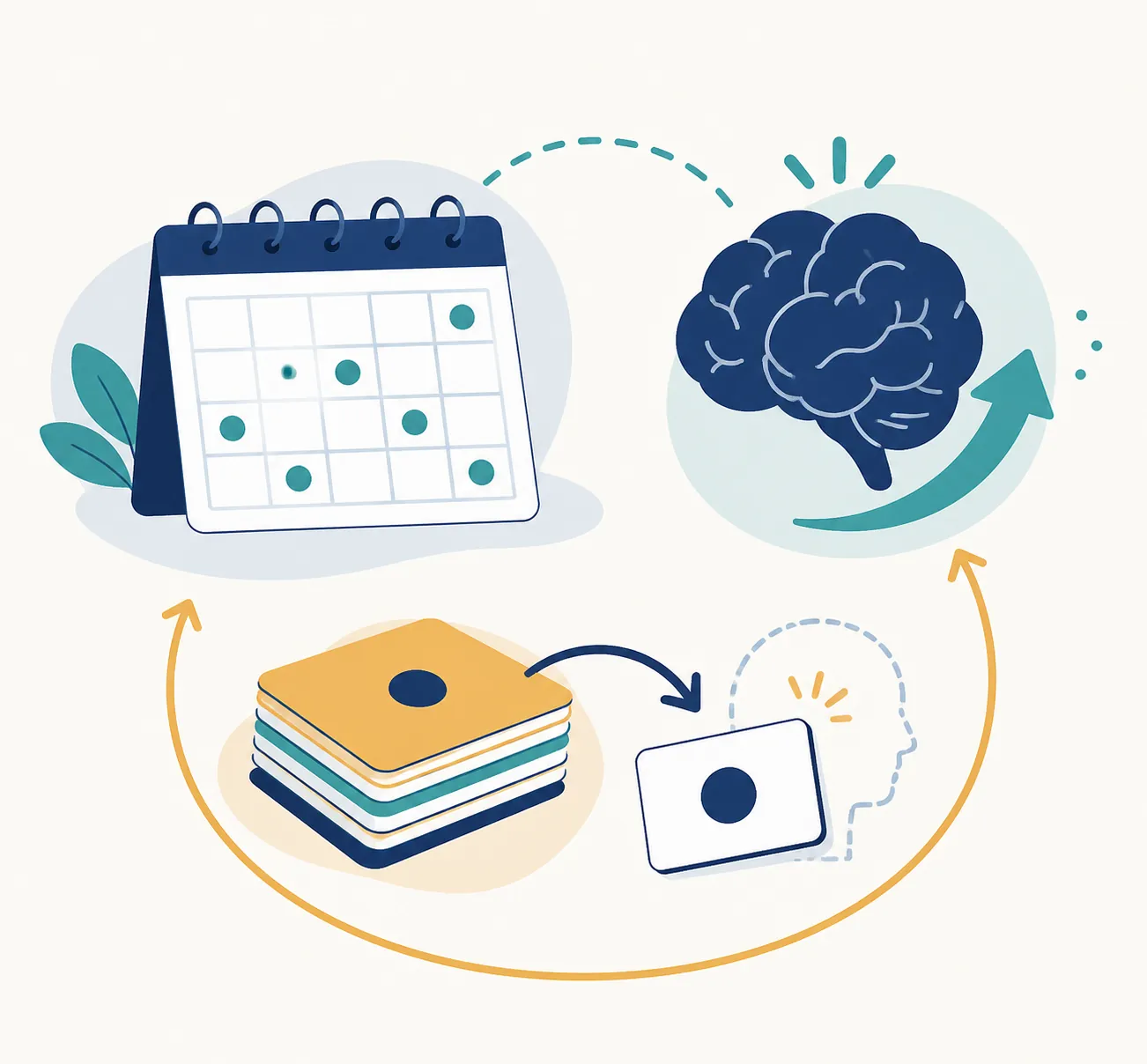
A missed-question log should therefore have more than “topic” and “correct answer.” Add columns for claim, evidence, error type, and next retrieval date. If you already use spaced cards, the same logic applies: one side should not only ask for a fact; it can ask you to choose which claim follows from a short condition. For GRE vocabulary, that might sit next to a spaced repetition system. For a budget plan, it can live in a plain notebook or free spreadsheet; the tool matters less than whether you revisit the claim under retrieval conditions.
What this looks like by exam section
The exam connection is a synthesis judgment, not direct score evidence. The studies above do not say “this drill raises MCAT CARS by a stated number of points.” They do support the reasoning behaviors that these sections repeatedly demand: identify a claim, judge evidence, reject attractive but unsupported choices, and revise the rule after an error.
| Exam area | Reasoning demand | Critical thinking review question |
|---|---|---|
| GRE Analytical Writing | Judge the assumptions and support behind a position. | Which claim am I defending, and what evidence would make it stronger or weaker? |
| MCAT CARS | Track an author’s argument and reject choices that go beyond the passage. | Which line actually supports this answer, and which answer imported outside knowledge? |
| SAT/ACT Reading | Match answer choices to textual evidence under time pressure. | Which word or sentence narrowed the claim enough to eliminate the tempting answer? |
| ASVAB Paragraph Comprehension and Arithmetic Reasoning | Separate stated information from assumptions in verbal and word-problem formats. | What did the question prove, and what did I assume without proof? |
For GRE Analytical Writing, the drill is closest to argument repair: state the claim, expose the assumption, and decide what evidence would change the conclusion. For MCAT prep, especially if you are already working through a 12-week MCAT study plan, the drill belongs in the review block after passages, not as a separate philosophy exercise. For SAT and ACT Reading, it is an antidote to answer choices that are true-sounding but unsupported. For ASVAB PC and AR, it helps separate what the paragraph or word problem states from the extra step you supplied too quickly.
A 15–20 minute version that can survive a real prep schedule
The practical mistake is to add a new curriculum on top of an already crowded plan. A better version replaces part of low-yield review. If you normally spend 20 minutes rereading explanations, spend most of that time producing and checking your own reasoning first.
- Choose two missed or uncertain questions from today’s practice.
- Before reading the explanation again, write the claim your answer depended on.
- Find the evidence that confirms or breaks that claim.
- Write one corrected rule in plain language.
- Schedule a quick retrieval check for the same reasoning pattern later in the week.
For example, a hypothetical SAT Reading review might produce: “I accepted the claim that the author admired the policy. The evidence only showed that the author understood why people supported it. Next time, separate explanation from approval.” A hypothetical ASVAB Arithmetic Reasoning review might produce: “I treated the percent change as if it applied to the original amount twice. Next time, identify the base before calculating.” The exact subject changes; the review habit stays the same.
This also keeps puzzle-style activities in their place. A logic game may be enjoyable. A debate prompt may be useful in a class. For exam prep, the better test is whether the activity improves how you handle actual passages, problems, explanations, and answer choices. If it cannot be attached to missed-question review or retrieval, it is probably enrichment rather than study-skill work.
Why metacognition belongs in the same loop
A 16-week intervention by Rivas, Saiz, and Ossa gives one concrete example of critical thinking being taught through metacognitive strategy work. In a sample of 89 first-year students at a Spanish university, critical thinking scores rose from 25.14 to 32.63 after the program.[5] That is one intervention case, not a universal estimate, but it illustrates the mechanism exam students need: monitor the quality of your thinking while you are still able to revise it.
A Stanford Graduate School of Education report on Holmes and Wieman’s work gives another useful shape to the drill. Students practiced iterative decision-making about scientific evidence, and those students became about 12 times more likely to improve the quality of their own data.[6] Again, that is not a standardized-test score. It is a good model for review: make a decision, inspect the evidence, improve the decision, and repeat.
That loop is close to what strong self-explanation looks like. A student does not merely say, “I get it now.” The student explains why the correct answer follows, why the wrong answer fails, and what feature would have changed the answer. This is the same verification-by-explanation habit that shows up in serious math study, where a solution is not finished until the student can defend each step; it is also why explanation-based study habits are usually more useful than copying a finished solution.
The common study-skills failure is not lack of effort
Howard and Sarbaum’s economics-course work is useful because it names the gap many test-takers recognize after a bad practice test: students often study without examining what they are thinking about while they study. In their survey of about 285 students, only about 8% reported always reading the textbook, and fewer than 0.5% named “what you think about while you study” as the key factor in learning.[7]
The same paper also points to broader study-skills evidence: Credé and Kuncel’s 2008 meta-analysis, with N = 72,431 and k = 344, found that study-skill inventories predicted college performance even beyond high school grades and test scores.[7] That does not isolate critical thinking drills by itself. It does support the larger exam-prep point: how a student studies can carry measurable performance information beyond raw prior ability.
So the target is not motivation theater. It is the student who has already done practice questions and still keeps missing the same category of trap. The critical thinking exercise is the moment between “the answer key says B” and “I’ll try another set,” where the student has to identify the bad claim that made the wrong answer look acceptable.
What to expect, and what not to expect
Expect better reasoning review, cleaner explanations, and fewer repeated errors when the drill is used consistently. Expect the effect to need time; the 9+ week advantage in the mixed-meta analysis is too large to ignore.[1] If you are building a plan from scratch, put the drill beside retrieval and spaced review, not after them as an optional add-on.
Do not expect a credible source to promise a specific score-point increase from the g values. That boundary matters for the same reason controlled-trial boundaries matter in other score claims: if the study did not measure that exact outcome, a prep claim should not pretend it did. The responsible exam-prep claim is that critical thinking exercises have strong academic-transfer evidence and fit the reasoning demands of major exams; the unearned claim is that they guarantee a named score result.
If you have 15–20 minutes a day, use it on brief claim-evaluation drills inside real prep: missed reading questions, flawed quantitative setups, weak essay assumptions, science-passage evidence, and answer choices you almost picked. Pair that with self-explanation, retrieval, and distributed practice. That is the evidence-safe version: repeated reasoning work aimed at better study behavior, not a poster on the wall and not a score promise the research does not make.
References
- Evaluation of the effectiveness of critical thinking training on critical thinking skills and academic achievement by using mixed-meta method — Review of Education, 2024.
- Simple Activities Can Improve Critical Thinking — Reboot Foundation.
- Active learning increases student performance in science, engineering, and mathematics — PNAS, 2014.
- Improving Students’ Learning With Effective Learning Techniques: Promising Directions From Cognitive and Educational Psychology — Psychological Science in the Public Interest, 2013.
- Metacognitive Strategies and Development of Critical Thinking in Higher Education — Frontiers in Psychology, 2022.
- Research shows how to improve students' critical thinking about scientific evidence — Stanford Graduate School of Education.
- Addressing Study Skills, Learning Theory and Critical Thinking Skills in Principles of Economics Courses — Frontiers in Education, 2022.
Related exhibits & inventory
Verified outcomes
No verified outcomes on file for this exam yet
See Methodology for how outcome evidence is disclosed once logged.
Planners
No planner filed for this exam yet
A downloadable timeline template for this exam hasn't been published yet.
Tool verdicts
AI-tool cautions
No AI tools tested for this exam yet
No hands-on AI-accuracy logs have been filed for this exam.
Questions about this plan
Ask a question about a specific section, timeline, or citation in this plan — or flag something that needs correcting.
Comments
Join the discussion with an anonymous comment.