
GRE Exam Hub
Florida's Double Execution as a Procedural Case Study
This case study traces each stage of Florida's capital punishment legal pipeline—trial, direct appeal, state post-conviction, federal habeas, clemency, warrant, and execution—using the July 28, 2026 Duckett-Occhicone double execution as a concrete example. Readers gain a step-by-step procedural blueprint useful for GRE Analytical Writing, SAT/ACT Reading analysis, and understanding how statutory changes accelerate the timeline from sentence to execution.
- gre
- mcat
- asvab
- sat
- act
- digital-adaptive
- official-material
- section-strategy
- test-date-timeline
On July 28, 2026, the U.S. Supreme Court let Florida proceed with the executions of James Duckett and Dominick Occhicone, clearing the way for the state’s first same-day double execution since 1964.[1][2] Duckett had been sentenced to death in 1988 after an 8-4 jury recommendation; Occhicone had been sentenced in 1987 after a 7-5 recommendation.[2] Those two fractions are not background color. They are the doorway into the legal process: old death sentences, newer jury rules, narrowed retroactivity, accelerated warrants, and last-stage litigation all reached the same endpoint on the same day.
A useful legal-process case study of Florida’s double execution should not begin by asking whether the event was dramatic. It was. The better first question is procedural: which institution acted, under what authority, at which point in the chain, and what kind of challenge remained available afterward?

The Two Cases Entered 2026 From Different Jury Votes
Duckett and Occhicone were not sentenced under Florida’s current capital-sentencing rule. Their cases came from the pre-Hurst era, when Florida allowed judges to impose death sentences after nonunanimous jury recommendations. Hurst v. Florida later held that Florida’s capital sentencing scheme violated the Sixth Amendment because the judge, rather than the jury, made the critical findings necessary to impose death.[4]
That holding changed the legal landscape, but it did not automatically reopen every old case. That is the distinction readers need to keep straight. A new constitutional rule can reshape future procedure without giving every prisoner sentenced under the old procedure a new sentencing hearing. The legal word for that fight is retroactivity, and the Duckett-Occhicone pairing makes it unusually concrete.
Florida later moved away from the unanimity requirement that had followed Hurst. In 2023, the state changed its law to permit a death recommendation when at least 8 of 12 jurors vote for death.[5] Measured against that current threshold, Duckett’s 8-4 recommendation sits at the line. Occhicone’s 7-5 recommendation falls below it. But that comparison is an analytical aid, not a self-executing remedy. It helps explain why the cases feel asymmetrical; it does not, by itself, tell a court that an older judgment must be undone.
| Case | Original Death Sentence | Jury Recommendation | Why the Vote Matters Procedurally |
|---|---|---|---|
| James Duckett | 1988 | 8-4 | Matches Florida's current minimum death-recommendation threshold, but was imposed under an older sentencing framework. |
| Dominick Occhicone | 1987 | 7-5 | Falls below Florida's current 8-juror threshold, but retroactivity limits determine whether that difference can reopen the sentence. |
The Pipeline Is Easier to Read as Eight Stages
Capital litigation is often described as if it were one long appeal. That phrasing blurs important differences. Direct appeal, state post-conviction, and federal habeas are not interchangeable layers. Each asks a different institution to review a different kind of alleged error under different limits. A basic capital appeals framework commonly separates review into direct appeal, state post-conviction review, and federal habeas review.[6]
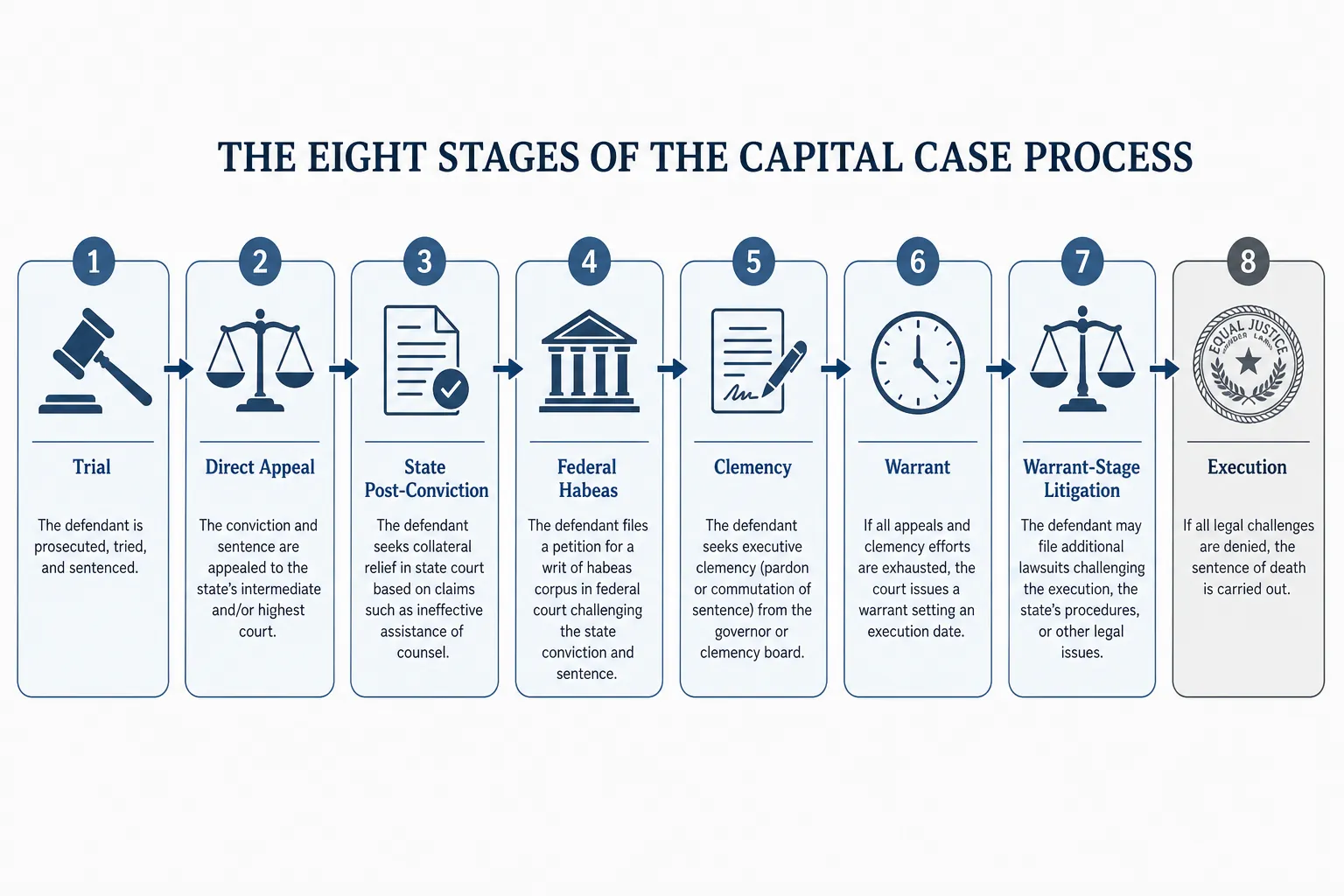
- Trial and penalty phase: the jury hears evidence, guilt is decided, and a death recommendation is made under the sentencing law then in force.
- Direct appeal: the state supreme court reviews trial and sentencing errors on the record created in court.
- State post-conviction: the prisoner raises claims that often depend on evidence outside the trial record, such as ineffective assistance of counsel.
- Federal habeas: a federal court reviews federal constitutional claims after state remedies have been exhausted, under strict procedural and deference rules.
- Clemency: the executive branch considers mercy or commutation outside the ordinary judicial appeal structure.
- Death warrant: the governor sets the execution process in motion for a specific prisoner and time period.
- Warrant-stage litigation: lawyers seek stays or other relief based on remaining claims, new evidence arguments, execution-protocol objections, or constitutional challenges.
- Execution: if courts and the executive branch do not stop the process, the sentence is carried out.
For reading-analysis purposes, the middle of that list is where most mistakes happen. A court’s refusal to grant relief at one stage does not prove that no serious claim existed. It may mean the claim was procedurally barred, too late, already decided, insufficient under a deferential standard, or outside the narrow function of that court at that moment.
Trial and Direct Appeal: The Record Comes First
At trial, the state must prove guilt, and in a capital case the process then moves to a penalty phase. The jury’s recommendation becomes part of the record. In Duckett’s and Occhicone’s cases, the striking feature now is that both recommendations were nonunanimous, and one was below the death-recommendation threshold Florida would later adopt in 2023.[2][5]
Direct appeal works from the trial record. That matters because some claims are visible from the record, while others are not. If a lawyer argues that the trial judge made a legal error in jury instructions, evidentiary rulings, or sentencing procedure, that issue may fit direct review. If the later claim depends on what trial counsel failed to investigate outside the record, it usually belongs somewhere else.
This is the first major sorting rule in the pipeline: direct appeal is not a general re-investigation. It is record-based review. That is why later stages exist, and also why later stages come with their own procedural traps.
State Post-Conviction and Federal Habeas Do Different Jobs
State post-conviction review is where many capital defendants raise claims that were not fully available on direct appeal. Ineffective assistance of counsel is the familiar example, but the category is broader than that. It can include claims that require affidavits, expert materials, investigative records, or other evidence outside the trial transcript.
Federal habeas is narrower than many nonlawyers expect. A federal habeas petition is not a second trial and not simply a federal court’s fresh view of the whole case. It asks whether the state prisoner is being held in violation of federal law, and it operates after state remedies have been pursued. The review is shaped by procedural-default rules, exhaustion requirements, and deferential standards for claims already adjudicated in state court.[6]
The practical consequence is severe: the later a claim appears, the more the argument must explain not only why it is valid, but why the court is allowed to hear it now. That is why capital litigation often seems to contain two arguments at once. One argument is about the underlying constitutional or factual problem. The other is about the gatekeeping rule that decides whether any court may reach that problem.
Hurst Made the Jury-Vote Problem Visible, but Retroactivity Limited Its Reach
Hurst is the reason the old jury votes matter so much in a 2026 reading of these cases. The Supreme Court’s 2016 decision did not say that juries merely advise judges in a capital case. It required jury fact-finding for the facts necessary to impose death.[4] Florida then had to decide which already-sentenced prisoners could benefit from the changed rule and which judgments would remain final.
Post-Hurst resentencing data gives the retroactivity fight real weight. A Florida Abolitionist account marking a decade since Hurst reported 145 resentencings, with most resulting in life sentences rather than renewed death sentences.[7] That number does not prove that Duckett or Occhicone was legally entitled to relief. It does show why retroactivity is not a technicality in the thin sense. Whether a prisoner gets through that door can change the punishment.
Occhicone’s 7-5 recommendation is the sharper reading problem. If seven jurors voted for death, then five did not. Under Florida’s 2023 threshold, that would not be enough for a death recommendation going forward.[5] But a case study has to separate present comparison from legal consequence. The existence of a newer rule supplies an argument; retroactivity doctrine decides whether that argument can disturb an older final sentence.
Clemency Sits Outside the Courtroom Track
Clemency is easy to misread because it happens late and can affect the same outcome as litigation: life or death. But it is not another appeal. It belongs to the executive branch. A court asks whether a legal rule has been violated and whether relief is available under that rule. Clemency can consider mercy, age, doubt, proportionality, institutional judgment, or reasons that do not fit neatly into a judicial remedy.
That distinction matters in the Duckett-Occhicone timeline because the denial of judicial relief and the denial of clemency are different acts by different institutions. Collapsing them into a single phrase like “the system rejected the claims” loses the point. The legal pipeline is built from separate decisions, not one undifferentiated refusal.
The Warrant Stage Changed the Tempo
By 2026, Florida’s warrant stage had become unusually important because the calendar itself had changed. The 2025 Timely Justice Act compressed the warrant period, requiring executions to be scheduled within 30 days after the governor signs a death warrant.[1] In a case file, that kind of change appears as dates. In practice, it changes what defense lawyers can investigate, draft, file, and preserve.
Duckett’s final stretch shows the pressure. A stay was lifted on July 8, 2026, and the execution date was July 28, leaving a 20-day window for final litigation before the scheduled execution.[1] That window included efforts connected to DNA-testing litigation, Eighth Amendment arguments, execution-risk claims, and emergency applications asking the U.S. Supreme Court to intervene.[1][2]

A short deadline is not automatically unconstitutional. That would be too broad a conclusion. The narrower and more useful point is that compressed warrant periods alter the defense function. Lawyers must identify viable claims, obtain records, consult experts, prepare pleadings, respond to the state, and seek appellate or emergency review while the execution date remains fixed and close.
The Billy Kearse example shows the same problem without requiring any abstraction. In March 2026, Kearse faced a 33-day warrant period while his lead counsel’s father was in hospice; the court granted only a 48-hour extension.[8] The point is not that every deadline extension must be granted. The point is that a statutory timetable lands on an actual defense team, with actual caregiving, staffing, investigation, and drafting constraints.
Warrant-Stage Claims Are Late, but Not Necessarily Frivolous
The warrant stage is where readers most often confuse timing with merit. A last-minute claim may be weak, barred, or repetitive. It may also involve information that became available late, a newly urgent execution-protocol issue, or a claim that could not matter in the same way until an execution date existed. Courts can deny relief for procedural reasons without announcing that the underlying concern is imaginary.
Duckett’s final litigation included innocence-related and DNA-testing arguments, while Occhicone’s litigation included Eighth Amendment concerns tied to his age and condition.[2] Those claims did not stop the executions. For a procedural case study, the important distinction is between “the claim was presented and rejected under governing standards” and “there was nothing to review.” The first is a legal outcome. The second is a much stronger factual judgment and cannot be assumed just because a stay was denied.
Execution-protocol arguments require the same discipline. Reports on the 2026 litigation described claims about risks in Florida’s lethal-injection process, including arguments that looked to problems identified from Florida Department of Corrections records.[1] Because that material depends on litigants’ and advocacy-based analysis rather than an official state concession that the protocol was unlawful, the label matters. A careful reader should not upgrade an allegation into an admitted violation, but should also not erase the allegation simply because the execution went forward.
The Supreme Court’s Role Was Emergency Review, Not a Full Retrial
When the U.S. Supreme Court appears at the end of an execution timeline, it is tempting to treat its action as the final answer to every factual and moral dispute in the case. That overreads the event. On July 28, 2026, the Court denied the applications that would have stopped the Duckett and Occhicone executions, allowing Florida to proceed.[1] Emergency denial of a stay is an enormously consequential act, but it is still an act within a particular procedural posture.
The Court at that point was not conducting a new penalty phase. It was deciding whether the applicants had satisfied the standards for emergency intervention at the end of a long state and federal process. That is why the same sentence can be both true and incomplete: the Supreme Court let the executions proceed, and the deeper case history still has to be read through decades of earlier proceedings.
Reliability Context Belongs in the Analysis, but It Has to Be Labeled
Florida’s death-penalty system carries a reliability context that cannot be ignored. The Death Penalty Information Center’s Florida state profile lists 30 death-row exonerations in the state, the most of any state.[5] That figure does not say that every current claim of innocence is valid. It does make innocence-related litigation in Florida harder to dismiss as merely theoretical.
The Hurst resentencing numbers serve a different purpose. The reported 145 resentencings, with most resulting in life, concern the effect of changed sentencing law on people who obtained resentencing.[7] They do not measure exoneration. They do not prove innocence. They show that sentencing procedure can change outcomes even when the conviction itself remains in place.
Keeping those categories separate is not pedantry. Exoneration data, resentencing data, jury-vote thresholds, and warrant deadlines measure different things. If a reader blends them together, the argument becomes louder but less accurate. If the reader separates them, the legal process becomes visible.
What the Double Execution Shows
The Duckett-Occhicone double execution is best read as the endpoint of a traceable procedural sequence. The cases began with late-1980s death sentences and nonunanimous jury recommendations. They moved through ordinary review, post-conviction litigation, federal habeas limits, clemency, warrants, emergency litigation, and Supreme Court stay applications. By July 28, 2026, Florida had permission to carry out both sentences on the same day.[1][2]
The case study is especially useful because its pressure points are visible. Duckett’s 8-4 recommendation can be compared with Florida’s current 8-juror threshold. Occhicone’s 7-5 recommendation falls below that threshold but still ran into retroactivity limits. Duckett’s 20-day final window shows how the warrant stage compresses litigation. Kearse’s earlier 33-day warrant example shows that calendar compression affects counsel as well as clients.[1][2][5][8]
For an exam reader, the lesson is not to memorize every filing. The lesson is to track the chain: old sentencing rule, later constitutional change, limited retroactivity, current statutory threshold, clemency outside the courts, accelerated warrant, emergency claims, stay denial, execution. Once that chain is visible, the same-day event stops looking like a single isolated headline and becomes a procedural endpoint of Florida’s post-Hurst trajectory.
References
- Supreme Court lets rare double execution move forward in Florida, Courthouse News.
- Florida Sets Two Executions for the Same Day..., Death Penalty Information Center.
- Florida double execution of James Duckett, Dominick Occhicone on same day: Recap, Tallahassee Democrat.
- Hurst v. Florida | 577 U.S. 92 (2016), Justia.
- Florida | State Profile, Death Penalty Information Center.
- Death Penalty Appeals Process, Capital Punishment in Context.
- Marking a Decade Since Hurst v. Florida, Florida Abolitionist / Substack.
- Scheduled Execution of Billy Kearse Renews Constitutional Alarms About Pace of Executions in Florida, Death Penalty Information Center.
Related exhibits & inventory
Verified outcomes
Planners
No planner filed for this exam yet
A downloadable timeline template for this exam hasn't been published yet.
Tool verdicts
AI-tool cautions
No AI tools tested for this exam yet
No hands-on AI-accuracy logs have been filed for this exam.
Questions about this plan
Ask a question about a specific section, timeline, or citation in this plan — or flag something that needs correcting.
Comments
Join the discussion with an anonymous comment.