
GRE Exam Hub
A Practical Review of Anne Lamott's Good Writing for Student Writers
This review evaluates whether Anne Lamott's new Good Writing book helps student writers improve timed essays and academic writing. It explains why the 36-rule editing checklist works for second-draft polish, but won't teach essay structure.
- gre
- mcat
- asvab
- sat
- act
- digital-adaptive
- official-material
- section-strategy
- test-date-timeline
If you have a timed essay due, the first question is not whether Anne Lamott is charming, famous, humane, or funny. The question is whether her new writing book gives you anything you can do to the draft in front of you before the clock runs out.
On that narrow, practical question, Good Writing: 36 Ways to Improve Your Sentences is much more useful than a student might expect from the author of Bird by Bird. Published by Penguin Avery on March 17, 2026, and co-written by Anne Lamott and Neal Allen, the book is built around 36 rules for improving sentences, explicitly framed as rules for second drafts.[1] That phrase matters. A book of second-draft rules does not promise to teach you how to invent an argument, organize a GRE Issue essay, or rescue a paper that has no paragraph structure. It promises something smaller and more testable: once you have words on the page, it can help you make those words less weak, padded, passive, and nervous.

That makes the book unusually relevant for student writers. Most students do not need another vague instruction to “write better.” They need to know what to check after they have produced a clumsy but complete draft: weak verbs, inflated phrases, passive constructions, unnecessary explanation, a conclusion that trails off because time ran out. Good Writing is not a complete writing course, but it is one of the rare craft books that can be turned into an editing pass.
What Kind of Help This Book Actually Offers
Lamott’s older writing classic, Bird by Bird, is beloved for process, courage, attention, and permission to write badly at first. That is not nothing. A frozen student staring at a blank page may need permission more than polish. But Bird by Bird is not arranged like a checklist you can run after a 27-minute draft. Good Writing is much closer to that.
The book’s form is simple: Allen states and explains a rule; Lamott responds with commentary, encouragement, and examples from a working writer’s emotional weather. Early reviewers have noticed this call-and-response structure. Woman Around Town describes the effect as making readers feel as if they have personal coaches, while ECONOGAL calls the structure “absolute genius,” crediting Allen’s systematic approach and Lamott’s commentary as complementary.[2][3]
For student writers, that pairing has a real advantage. Allen supplies the kind of rule that can go on a revision checklist. Lamott reduces the shame that often stops revision from happening at all. A student who already feels behind does not always need a stricter voice. Sometimes the useful combination is: here is the rule, and no, you are not a fraud because the first version was bad.
There is a cost. Because each rule is followed by conversation, reflection, and personality, the book is less dense than a bare handbook. A student who wants only compact instruction may find some pages slower than necessary. But a pure rulebook often fails at the exact point where anxious writers fail: it assumes the student will calmly apply the rule. Good Writing spends more time making that application feel possible.
The Best Student Use Is a Second-Draft Pass
The smartest way for a student to use this book is not to read a chapter, then try to compose a perfect sentence from scratch. That is how timed essays die. The better sequence is uglier and more reliable: draft first, then revise with a short list of rules in mind.
| Drafting moment | What the student should do | Where Good Writing helps |
|---|---|---|
| First draft | Get the argument, examples, and basic paragraphs onto the page. | Mostly emotional permission: do not demand elegance yet. |
| Short revision pass | Circle weak verbs, bloated phrases, passive constructions, and over-explained claims. | This is the book's strongest use case. |
| Final minute or final read | Fix the ending, remove one or two needless phrases, and make the last sentence complete. | Rules such as “omit needless words” and “finish the damn thing” are most useful here. |
That order is especially important for timed writing. In a GRE-style Issue essay, the student cannot spend ten minutes deciding whether the opening sentence has literary snap. The essay needs a position, reasons, examples, and enough development to be readable. Sentence-level revision comes after the draft exists. The book’s own second-draft framing supports that order.[1]
The most student-friendly rules are not obscure. They are the old, durable ones students often know in theory and ignore under pressure: use strong verbs, omit needless words, keep it active, trust your voice, show then tell, know when to break the rules, and finish the damn thing. These rules are identified across the Creative Penn interview and early reviews of the book.[1][2][3][4]
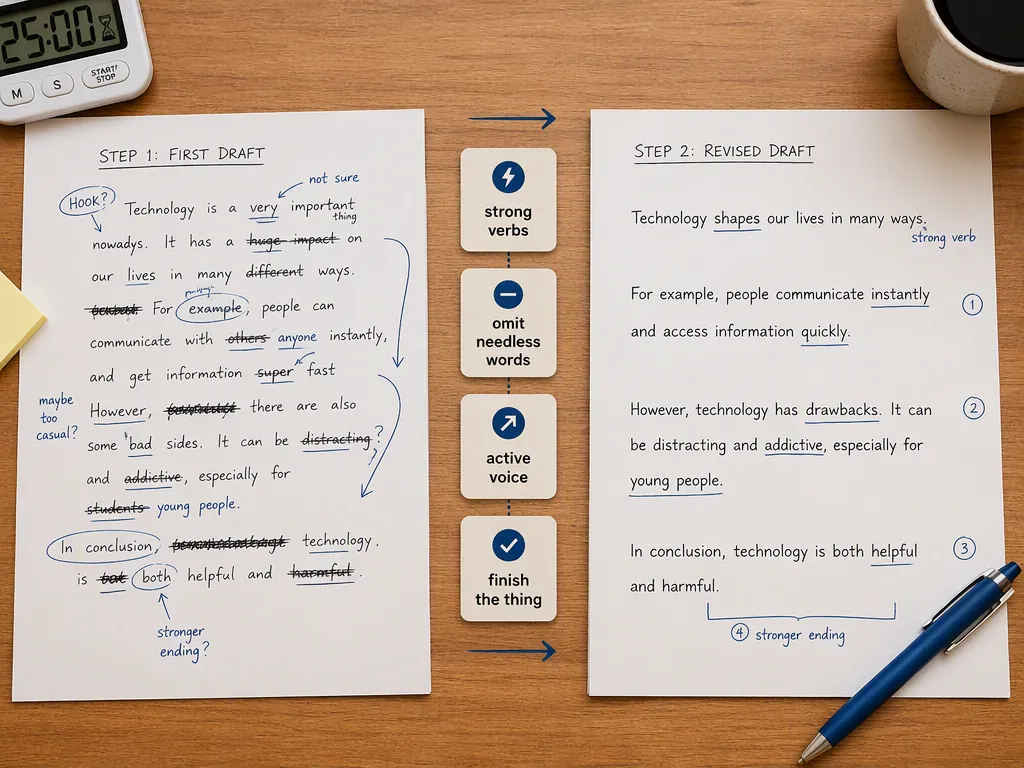
Use Strong Verbs
Rule 1, “Use strong verbs,” is positioned as the book’s most important rule; Allen and Lamott connect stronger verbs with less dependence on adjectives and adverbs.[1][2] For student writing, this is not decorative advice. It changes the labor of the sentence.
A cautious student often writes a sentence like this: “The policy is very important because it has a big effect on students.” The problem is not only that the sentence is bland. The weak verb “has” forces the sentence to lean on “very,” “important,” and “big.” A stronger verb makes the sentence do more work: “The policy reshapes how students choose courses.” That hypothetical revision is still plain, but it now contains an action.
In a timed essay, this rule is easy to operationalize. During the revision pass, look for forms of “is,” “are,” “has,” “have,” “makes,” “does,” and “gets.” Not every one must be replaced. Some should stay. But the search itself forces the student to ask whether the sentence has an engine.
Omit Needless Words
Rule 2, “Omit needless words,” echoes Strunk and White, but the student use is more immediate than reverent. Padded student prose usually comes from fear: fear the claim is too simple, fear the teacher will think the writer did not try, fear a short sentence looks unsophisticated.
The revision move is mechanical. Cut phrases that announce thinking instead of doing it: “it is important to note that,” “in today’s society,” “this clearly shows that,” “due to the fact that,” “there are many different ways in which.” If the sentence still makes sense after the phrase disappears, the phrase was not carrying weight.
This matters most in essays with strict time or word limits. An admissions essay can lose force when the writer spends 80 words warming up before saying the thing. A GRE response can become harder to score when every claim is buried under throat-clearing. Cutting needless words is not about making prose cute. It is about giving the reader less fog to move through.
Keep It Active
Rule 3, “Keep it active,” is another rule students can apply quickly.[1] Passive voice is not always wrong, and a mature writer should not treat it as a crime scene. But in timed essays, passive constructions often hide who is doing what: “Mistakes were made,” “changes were implemented,” “the problem was addressed.” Those sentences sound formal while avoiding responsibility.
The student’s check is simple: find the action and find the actor. “The school implemented the policy” is clearer than “the policy was implemented.” “The researcher revised the method” is clearer than “the method was revised,” unless the actor truly does not matter. Active voice gives the essay a visible chain of cause and consequence, which is exactly what weak analytical writing often lacks.
Trust Your Voice
Rule 8, “Trust your voice,” is easy to misunderstand.[1] It does not mean writing the way you text your friends, and it does not excuse sloppy reasoning. For students, trusting your voice usually means not disguising every claim in academic costume.
The admissions essay version is familiar: a student writes three introductions, each more polished and less alive than the last. The academic-paper version is just as common: “The implications of this phenomenon are multifaceted in nature” replaces “This problem affects students in several ways.” The second sentence may not be brilliant, but it is at least available to the reader.
Lamott’s presence helps here. A stricter handbook can tell students to be clear; Lamott is better at making clarity feel less embarrassing. That is useful for students who mistake stiffness for seriousness.
Show Then Tell
Rule 26, “Show then tell,” is more useful for student writers than the usual “show, don’t tell.”[1] The familiar version can paralyze students because it sounds like explanation is forbidden. In essays, explanation is not forbidden. It is the point.
The better sequence is example first, interpretation second. In a literature paper, quote or describe the textual moment, then explain what it reveals. In a GRE Issue essay, give the policy example, then connect it back to the claim. In an admissions essay, show the moment of decision, then tell the reader why it changed your priorities. “Show then tell” gives students permission to use evidence without pretending the evidence explains itself.
Know When to Break the Rules
Rule 34, “Know when to break the rules,” is where Good Writing separates itself from a stricter handbook approach.[1] This is helpful, but only if students understand the order. You do not break rules because you are tired of them. You break them when the sentence becomes clearer, sharper, or more honest by doing so.
A fragment can work in a personal essay. A passive construction can work when the actor is unknown or irrelevant. A repeated word can work when the repetition is deliberate. The rule is not “anything goes.” The rule is that editing requires judgment, and judgment improves only when the writer has something concrete to judge.
Finish the Damn Thing
Rule 36, “Finish the damn thing,” may be the least elegant and most necessary rule for timed writing.[1] Students who care about writing often lose points not because they know too little, but because they keep polishing the opening while the conclusion remains a sentence fragment in their head.
In an exam setting, a finished plain essay usually beats an elegant half-essay. The last paragraph does not need to sing. It needs to close the argument the student actually made. For scholarship and admissions drafts, the same rule applies differently: stop collecting alternate openings and complete the version you can revise. A complete draft can be improved. A perfect imagined draft cannot.
Where It Fits Beside Other Writing Books
Students who already own a writing book may wonder whether this one adds anything. The answer depends on what kind of help the older book provides.
Compared with The Elements of Style, Good Writing is less rigid and more readable. It borrows some familiar territory, especially around needless words and active prose, but it is not trying to be a compact reference. It is trying to be read, absorbed, and used with some mercy.
Compared with Stephen King’s On Writing, Lamott and Allen are less memoir-driven here. King’s book gives students a powerful sense of a writer’s life and discipline. Good Writing gives them more sentence-level prompts.
Compared with Bird by Bird, this new book is the more practical choice for students who already have a draft. That does not make Bird by Bird obsolete. It means the two books answer different student problems. Bird by Bird helps a writer face the page. Good Writing helps a writer return to the page with a pen.
The Early Reception Is Encouraging, Not Settled
As of Q3 2026, the book is still new. The most substantial public materials are the Creative Penn interview and a small set of early reviews, not a long-established critical record. That matters because it would be easy to overstate the evidence. General craft reviewers have responded warmly, but there does not yet appear to be a student-facing exam-prep review testing the book directly against GRE, SAT, ACT, admissions, or academic-writing situations.
The available reviews are still useful. ECONOGAL calls the book “one of the best craft-related books to cross my desk in years,” and praises the Allen-Lamott structure.[2] Woman Around Town emphasizes the feeling of being coached by both authors.[3] This Awful-Awesome Life also treats the book as practical writing guidance rather than merely literary reflection.[4] Those are encouraging signs, but they are not the same as evidence that test scores improve after using the book.
That distinction is important. Adoption is not effectiveness. A student can enjoy a craft book and still write a poorly organized essay. A reviewer can praise a book’s warmth and still leave unanswered whether the rules hold up under a 30-minute exam clock. The strongest claim this review can make is narrower: the rules are highly adaptable to second-draft student editing, especially for students who already know how to produce a basic essay.
What the Book Will Not Teach
The limitation is not hidden. Because Good Writing is a sentence-level book, it does not replace instruction in essay architecture. If a student cannot write a thesis, build a paragraph, use evidence, or answer the prompt, stronger verbs will not solve the main problem.
For GRE Analytical Writing, the book is most useful after the student understands the task and has practiced building an argument. For SAT or ACT essay contexts, where applicable, it can help with clarity and polish, but it does not teach the test’s scoring logic. For admissions essays, it can improve voice, concision, and finish, but it will not decide which story the student should tell. For academic papers, it can clean up prose, but it will not supply research, citation practice, or disciplinary structure.
Absolute beginners may also find the book premature. If a student is still learning what a paragraph is supposed to do, a 36-rule sentence checklist can become another source of pressure. The book works better when the student already has enough control to write a rough essay and enough patience to revise it.
Who Should Read It
- Read it if you can already finish essays but your sentences sound padded, vague, passive, or overly cautious.
- Read it if you are preparing for GRE-style analytical writing and want a short second-draft checklist after each practice essay.
- Read it if you are revising admissions or scholarship essays and need help sounding clear without sounding manufactured.
- Read it if you like humane writing advice but still want rules you can apply to individual sentences.
- Do not rely on it as your main guide if you need to learn essay structure, prompt analysis, paragraph development, or exam-specific scoring strategy.
The practical verdict is therefore specific rather than grand. Good Writing is probably Lamott’s most useful book for student writers who need to revise sentences under pressure. Its value begins after a draft exists. Use it to polish timed essays, tighten admissions drafts, and clean up academic prose. Do not ask it to teach the whole architecture of an argument.
References
- Good Writing And Finding Your Voice With Neal Allen And Anne Lamott, The Creative Penn, March 23, 2026.
- Good Writing Book Review, ECONOGAL, July 16, 2026.
- Neal Allen and Anne Lamott Give Great Advice in Good Writing: 36 Ways to Improve Your Sentences, Woman Around Town, 2026.
- Good Writing by Neal Allen and Anne La Mott: A Review by Fran Joyce, This Awful-Awesome Life.
Related exhibits & inventory
Verified outcomes
Planners
No planner filed for this exam yet
A downloadable timeline template for this exam hasn't been published yet.
Tool verdicts
AI-tool cautions
No AI tools tested for this exam yet
No hands-on AI-accuracy logs have been filed for this exam.
Questions about this plan
Ask a question about a specific section, timeline, or citation in this plan — or flag something that needs correcting.
Comments
Join the discussion with an anonymous comment.