Can Students Use ChatGPT for Exam Prep Without Cheating?
Accuracy Warning — ChatGPT
ChatGPT is unreliable for math problem-solving and score estimates; verify explanations and predictions against official exam material.
- Accuracy:
- Moderate
- Tested:
- Post-official-practice concept explanations, math accuracy, and score estimates for SAT prep
- Last tested:
- 2026-08-01
Yes, students can use ChatGPT for SAT, ACT, GRE, MCAT, or ASVAB prep without cheating — if the AI stays outside the secured test and outside the first attempt at official practice. The safe version is narrow: take official practice first, review what you missed, then use ChatGPT to re-explain the concept or make low-stakes drills. The unsafe version is also narrow: using AI, unauthorized devices, or outside communication during the exam or any secured testing activity can put your score at risk. For the SAT specifically, a 2026 PrepGraph guide summarizes College Board testing rules as prohibiting communication with AI services or unauthorized devices during the test, with penalties that can include score cancellation; that rule claim should still be checked against the current official College Board page before test day because testing policies change [1].
Last reviewed: Q3 2026. That date matters. AI models change, test-owner policies change, and school policies are still uneven. So the useful answer to the ChatGPT controversy for student AI use is not “AI is allowed” or “AI is cheating.” It is three separate questions: what the exam rules allow, whether the tool improves independent test performance, and whether the answer it gives you is accurate enough to trust.

The exam rule boundary is simpler than the campus debate
During the actual exam, do not use ChatGPT. Do not use another AI tool. Do not use an unauthorized phone, watch, browser, messaging app, shared document, or outside person. That conservative rule covers the part that can damage you fastest: a score hold, investigation, cancellation, or integrity record.
For ACT, GRE, MCAT, and ASVAB candidates, the exact wording belongs to each test owner, not to a blog post and not to a school rumor. Check the current ACT, ETS, AAMC, or military testing instructions for your exam. But the practical boundary is not mysterious: secured testing conditions are not the place to communicate with an outside tool.
Prep is different. If you ask ChatGPT after a practice session, “Explain why the comma before ‘and’ is wrong in this sentence,” that is not the same act as asking it for an exam answer. If you ask it to create five extra non-official drills on a grammar rule you already missed, that is not the same as feeding it live test content. The timing of the AI use is not a technicality; it is the line that protects both integrity and learning.
Practice can feel better while the test result gets worse
The strongest warning here is not that ChatGPT can be used to cheat. Everyone already knows a student can misuse it. The more useful warning is that ChatGPT can make a practice session look productive while weakening the skill the real test measures.
A University of Pennsylvania-linked experiment reported by The Hechinger Report found that students using ChatGPT solved 48% more practice problems correctly, but then scored 17% worse on the actual test. A tutor-tuned version produced 127% more correct practice answers, but no test-score gain. The study was a July 2024 preprint, conducted with about 1,000 high school students in Turkey, so it should not be treated as a universal law for every exam, model, or student population. Still, the pattern is exactly the one test-takers need to respect: help during practice did not reliably transfer to independent performance [2].

That result should make any deadline-driven student slow down. A clean explanation can create the feeling that the concept is now owned. But test readiness means you can reproduce the move when the prompt is unfamiliar, the clock is running, and no chatbot is sitting beside the question. If the tool supplies too much of the choosing, translating, setting up, or checking, the practice score can become fake confidence.
This is why the safest use of ChatGPT comes after the attempt, not during it. The attempt reveals whether you can do the work unaided. The AI explanation can then help repair the weak point. Reverse that order, and you may only be measuring how well you can follow a polished explanation.
Students already draw a sharper line than adults often assume
The controversy sometimes gets flattened into a story where students want shortcuts and adults want purity. The survey evidence is less cartoonish. Pew reported in January 2025 that 54% of U.S. teens said using ChatGPT to research new topics was acceptable, while only 18% said using it to write essays was acceptable; 42% said essay-writing use was unacceptable [3].
RAND reported in March 2026 that only about one-third of students said their school had a schoolwide AI policy. In the same report, about 80% of students did not consider using AI to understand an assignment to be cheating, while 45% considered using AI to get direct answers to be cheating. RAND’s panel spans ages 12 to 29, so those figures should not be read as college-only data [4].
That distinction maps well onto exam prep. “Explain this missed concept” is one category. “Give me the answer” is another. A student trying to protect a score should keep those categories separated even if a school policy is vague.
A defensible workflow: official practice, then AI explanation
The process below is deliberately boring. That is its strength. It keeps the test owner’s material as the source of truth, keeps your unaided attempt visible, and uses ChatGPT only where it is least likely to inflate your readiness.
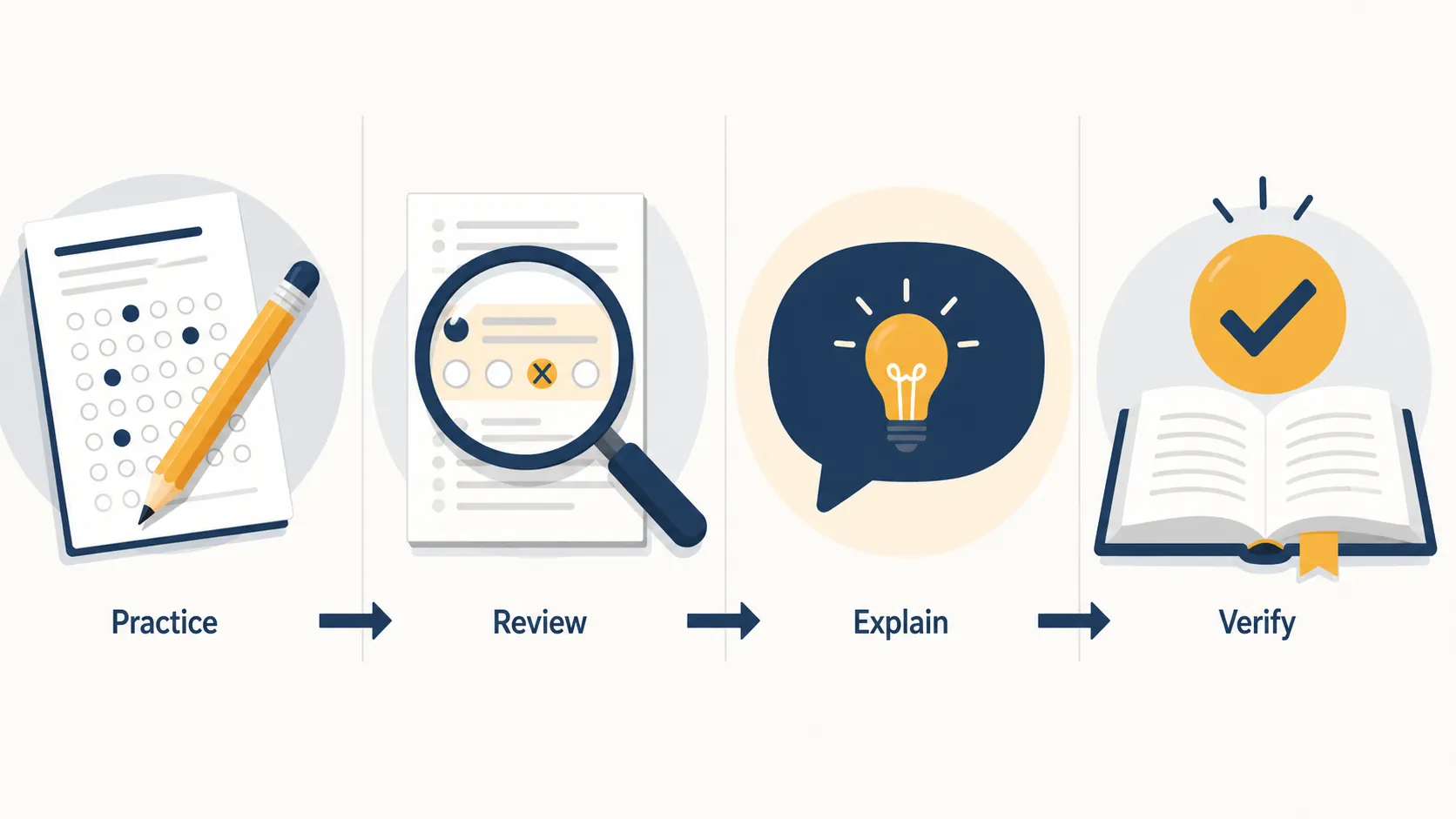
| Stage | What to do | What ChatGPT may do | What ChatGPT should not do |
|---|---|---|---|
| 1. Official practice first | Use the official practice test, official question set, or trusted exam-specific source before opening AI. | Nothing yet. | Do not preview, solve, or hint at the question before you attempt it. |
| 2. Review missed questions | Mark the exact question type, concept, and reason you missed it. | Help categorize the skill after you have already checked the official explanation. | Do not replace your error log with a chatbot’s diagnosis. |
| 3. Ask for re-explanation | Ask for the concept behind the missed question in plain language. | Explain the rule, show a similar low-stakes example, or give a short drill. | Do not ask it to certify that the official answer is wrong unless you verify elsewhere. |
| 4. Verify | Compare the explanation with official explanations, a trusted prep book, or a reliable course source. | Rewrite the explanation in a simpler form if it matches trusted sources. | Do not treat its first answer as authoritative. |
| 5. Re-test unaided | Redo a similar problem later without AI and under time pressure. | Generate extra practice only after you understand the official pattern. | Do not count AI-guided success as a real score predictor. |
Start with official practice because that is what your score is trying to predict
For the SAT, that means Bluebook and official College Board-linked practice. For other exams, it means the closest official or test-owner-aligned material you can access. For the MCAT, start from AAMC-style practice before asking AI to explain a biochemistry or CARS mistake. For the GRE, start from ETS-aligned material before letting a model invent verbal drills. For the ASVAB, start from the skills and format you actually need rather than a generic “make me a military aptitude test” request.
The reason is not brand loyalty. Official practice preserves the shape of the exam: wording, trap style, pacing, content emphasis, and scoring conditions. ChatGPT can imitate those features unevenly, but imitation is not the same as calibration.
Review the miss before asking for help
Before you paste or paraphrase anything into ChatGPT, write down what happened. Did you choose the wrong grammar rule? Misread the graph? Forget a formula? Run out of time? Fall for an answer choice that sounded right? That short diagnosis matters because ChatGPT is much better as a second explanation than as the judge of what your exam problem really tested.
A useful request after review sounds like this: “I missed a practice question about subject-verb agreement involving a phrase between the subject and verb. Explain the rule, give one simple example, and give me three similar drills without copying any official test question.”
That request does three good things. It names the concept. It asks for explanation, not an answer key. It requests fresh low-stakes practice rather than secured or official material. A bad version would be: “Here is the question; tell me the answer and why.” That may feel efficient, but it skips the part where your own brain has to identify the move.
Use AI explanations as disposable drafts
Treat a ChatGPT explanation the way a careful tutor treats scratch work: useful if it gets the student to the rule, disposable if it conflicts with the official source. Ask it to explain a grammar rule three ways, turn a word problem setup into plain English, or make a short warm-up set on fractions, exponents, transitions, amino acids, or mechanical comprehension. Then check the result.
This is also where AI can help a tired student without pretending to be an exam authority. At midnight, a second explanation of a forgotten algebra move can keep a study session from collapsing. But the next morning, the question is not whether the explanation sounded smooth. It is whether you can solve a new problem without the tool.
Verify before the explanation enters your notes
Do not copy ChatGPT’s reasoning into your permanent notes until it agrees with a trusted source. Verification can be quick: compare with the official explanation, a reputable prep book, your course notes, or a tested AI-study process. If you want a separate process for checking AI output, use an AI hallucination checklist for students rather than trusting a confident paragraph because it sounds like a teacher.
Do not use ChatGPT as a score oracle
Score prediction is where ChatGPT becomes especially tempting and especially weak. A student wants to know, “If I got these right, what is my SAT score?” or “Does this GRE set mean I am near my target?” The problem is that high-stakes tests are not just piles of questions with a simple percentage attached.
Adaptive tests, scaled scores, equating, section difficulty, and official scoring models are not things ChatGPT can reconstruct reliably from a chat. PrepGraph’s hands-on SAT verdict is blunt on this point: ChatGPT can be excellent at explaining a concept in several ways, but it is unreliable at the two things that matter most on test day — getting the math right and telling you where you actually stand. The same guide notes that only the official Bluebook app scores real adaptive SAT practice tests [1].
That principle carries beyond the SAT. For the GRE, use ETS-style scoring information and official practice where available. For the MCAT, use AAMC materials and full-length practice analytics. For the ACT and ASVAB, use official or exam-specific scoring guidance rather than a chatbot’s conversion table. ChatGPT can help interpret what a missed skill means for tomorrow’s study block; it should not be the source that tells you whether you are ready to sit for the exam.
Be especially careful with math explanations
The UPenn experiment’s math findings are the part to keep in mind when a chatbot gives a beautiful step-by-step solution. In that study, ChatGPT answered the math correctly only about half the time; its step-by-step approach was wrong 42% of the time, and its arithmetic was wrong 8% of the time [2]. Those figures come from one preprint in one setting, but they match the everyday risk: a model can be fluent while making a bad mathematical move.
For math-heavy prep, give ChatGPT smaller jobs. Ask it to explain what a quadratic vertex means, why a ratio setup works, or how to recognize when a word problem calls for a system of equations. Do not ask it to be the final grader of a hard solution unless you verify the work line by line against a trusted source.
A safer math request is: “I already checked the official answer. I understand that the answer is B, but I do not understand why my setup was wrong. Explain the concept without solving a new official question.” That keeps the official answer in charge and turns the AI into a translator.
Where ChatGPT is genuinely useful
Used after official practice, ChatGPT can save time in a few ordinary but valuable ways:
- Re-explaining a missed grammar, algebra, science, or vocabulary concept in plainer language.
- Generating short, low-stakes drills on a named skill after you have identified the weakness.
- Turning an official explanation into a simpler study note, after you verify that the substance matches.
- Creating warm-up questions that are clearly not official test questions and not used as score evidence.
- Helping you compare two approaches to a concept, such as substitution versus elimination or transition logic versus sentence flow.
If you want AI tools that are designed around teaching rather than answer delivery, compare them against that same standard: do they force an attempt, reveal reasoning gradually, and make you re-test unaided? A tool that merely gives polished answers can still weaken transfer. The same concern appears in broader study-habit discussions of AI dependence and practice without transfer.
What this does not settle
This article is about exam prep, not every classroom AI dispute. Essay authorship, style mimicry, citation fabrication, and AI-detector accusations raise different risks. If your concern is whether a writing assignment crosses into misrepresentation, use the separate guidance on blocking ChatGPT author mimicry in essay prep.
It also does not prove that every ChatGPT session hurts learning. The UPenn result is a strong warning, not a ban on all AI explanation. A student who first struggles through official practice, then uses AI to clarify the concept, then re-tests without help is doing something different from a student who lets the model carry the work from the start.
A rule you can use tomorrow
Use ChatGPT only after your own attempt. Keep official practice as the source of truth. Verify explanations before they enter your notes. Never use AI during the exam or any secured testing activity. Never treat a chatbot score estimate as real evidence of readiness.
If you are choosing between models, compare them by section and by task, not by general hype. Start with tested comparisons such as Claude vs. ChatGPT for exam prep, DeepSeek vs. ChatGPT by section, or AI study tools that teach instead of just giving answers. Then route your actual study plan back to the exam you are taking — SAT, ACT, GRE, MCAT, or ASVAB — because the official material and scoring conditions are what your result will answer to.
ChatGPT is not a cheating machine by default, and it is not a tutor by default. It becomes defensible exam prep only when the student keeps control of the attempt, the official source keeps control of the answer, and the AI is limited to explanation after the miss.
References
- ChatGPT for SAT Prep — PrepGraph, 2026.
- PROOF POINTS: Kids used ChatGPT as a study assistant. They did worse on tests. — The Hechinger Report.
- About a quarter of U.S. teens have used ChatGPT for schoolwork – double the share in 2023 — Pew Research Center, January 15, 2025.
- Student Use of AI for Homework Rises as Concerns Grow — RAND, March 2026.
Authoritative source
For the authoritative version of this contentHow to Read the '1 in 4 NFL Players CTE' Study
Report an error in this tool's output
Found something this tool got wrong beyond what's documented above? Report it so the accuracy log stays current.
Comments
Join the discussion with an anonymous comment.