
MCAT Exam Hub
How Bacillus Cereus Food Poisoning Appears on the MCAT
Review Bacillus cereus food poisoning for the MCAT: learn the two mechanistically distinct syndromes, their toxins, incubation periods, implicated foods, and why beta-lactams are ineffective. This guide highlights the contrasts the AAMC is likely to test.
- SAT
- ACT
- GRE
- MCAT
- ASVAB
- digital-sat
- adaptive-testing
- registration-fee
- content-outline
- score-target
A passage stem gives you two patients: one vomits two hours after eating leftover rice, and another develops watery diarrhea half a day after a cafeteria meal. Both can point to Bacillus cereus. On the MCAT, the difference is not whether you have memorized another foodborne organism; it is whether you can separate preformed toxin from toxin produced after ingestion while the clock is running.
This is an MCAT-focused review, last reviewed for Q3 2026. The phrase bacillus cereus food poisoning study can sound like a search for an outbreak paper or surveillance study, but the useful version for MCAT prep is narrower: which clues in a Biological and Biochemical Foundations-style question let you choose the right mechanism quickly. The official AAMC outline does not need to name B. cereus for it to fit a familiar testing pattern: a gram-positive, spore-forming, toxin-producing bacterium with two clinically similar but mechanistically different food poisoning syndromes.
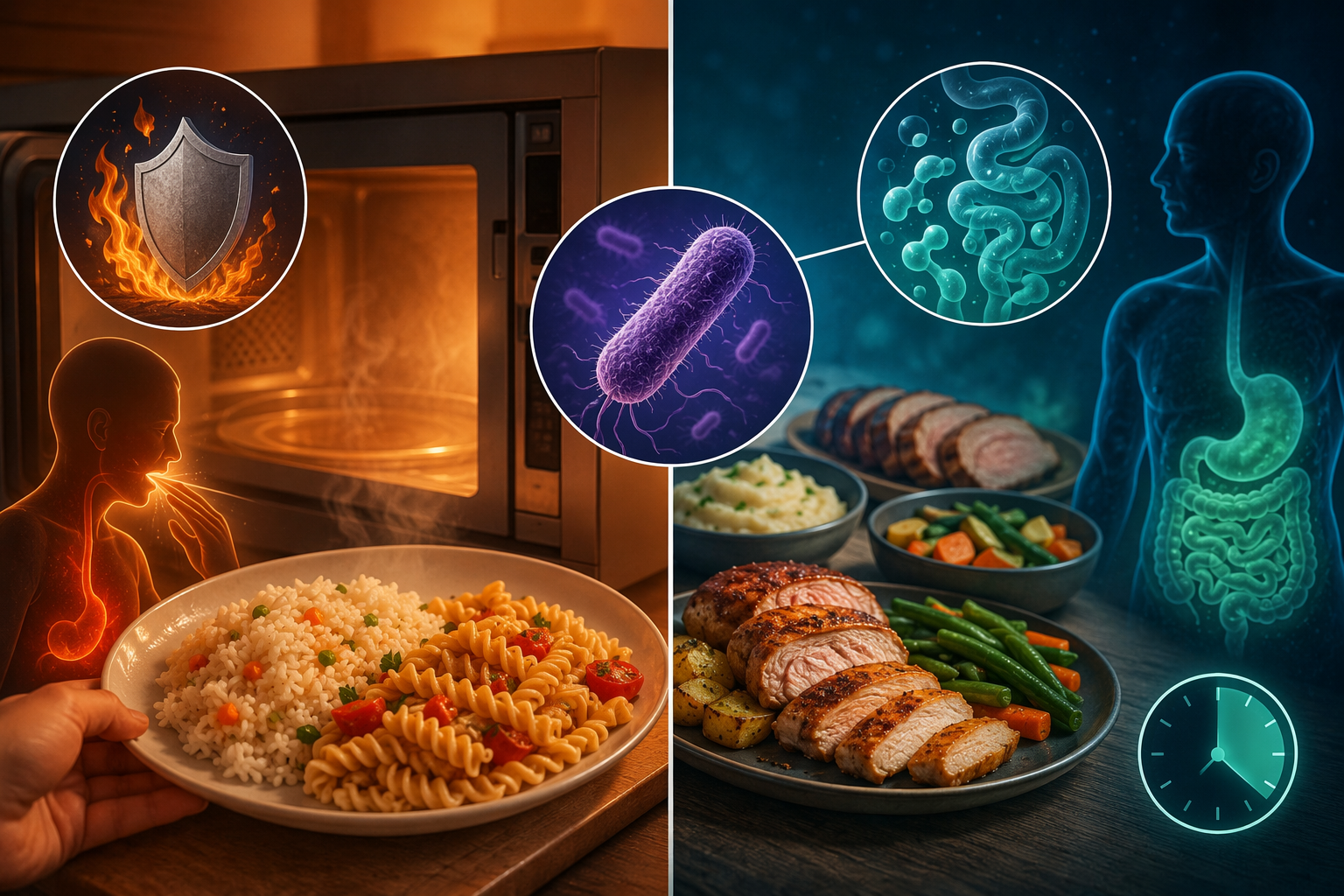
The Comparison That Actually Matters
| Clue | Emetic B. cereus | Diarrheal B. cereus |
|---|---|---|
| Toxin | Cereulide, a preformed emetic toxin; the ces genes are plasmid-encoded [1] | Enterotoxins including Hbl, Nhe, and CytK; described as chromosomally encoded in standard summaries [1] |
| Where the toxin problem begins | Toxin is made in food before ingestion | Toxins are produced during vegetative growth after ingestion |
| Incubation | 0.5-6 hours [1] | 6-15 hours [1] |
| Dominant symptom | Nausea and vomiting [1] | Watery diarrhea and abdominal cramping [1] |
| Classic food vehicle | Starchy foods such as rice, pasta, and tortellini [1] | Meats, vegetables, sauces, soups, and dairy foods [1] |
| Heat clue | Cereulide is heat-stable; reheating does not reliably solve the toxin problem [1] | Diarrheal enterotoxins are heat-labile, so the timing points away from a preformed toxin story [1] |
| Look-alike pathogen | Staphylococcus aureus: short incubation, vomiting-predominant, preformed toxin [2] | Clostridium perfringens: later onset, diarrhea-predominant illness [2] |
| Exam shortcut | Leftover starch plus vomiting within a few hours | Mixed food exposure plus watery diarrhea later the same day |
If you only remember one thing, make it the timing-toxin-food triangle. Short incubation after reheated starch means the toxin was already present. Longer incubation with watery diarrhea means the organism had time to grow and produce enterotoxins in the gut. That distinction carries more exam value than a long list of possible menu items.
Why the Same Organism Gives Two Different Question Stems
The emetic form is the cleaner mechanism for exam writers because the clinical clock starts fast. B. cereus can contaminate cooked starches, spores can survive cooking, and vegetative cells can produce cereulide while food sits at unsafe temperatures. Once cereulide is present, reheating the food is not the same as erasing the toxin. StatPearls describes cereulide as heat-stable, with survival reported at 121 degrees Celsius for 90 minutes [1].
That is why leftover rice is more than a trivia phrase. It compresses the whole mechanism: a starchy food was cooked, spores were not necessarily eliminated, the food sat long enough for toxin production, and the final reheating step made the meal look safe without removing the emetic toxin. Microbenotes similarly emphasizes the heat resistance of spores and the heat stability of the emetic toxin, which is the biochemical reason this scenario keeps appearing in study materials [2].
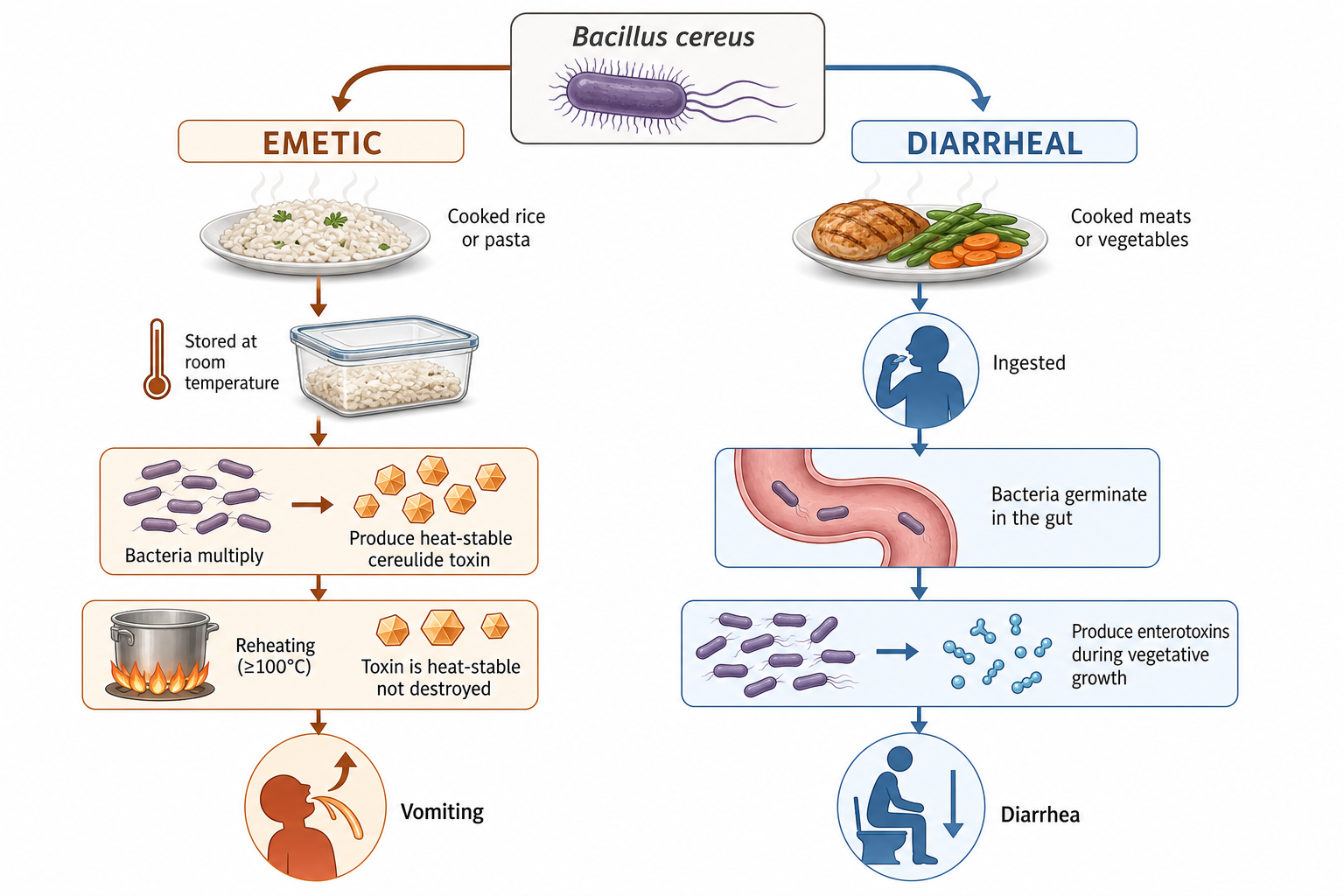
The diarrheal form asks a different kind of question. Here, the food does not need to contain a finished, heat-stable toxin at the moment it is swallowed. The organism is ingested, vegetative growth occurs, and enterotoxins such as Hbl, Nhe, and CytK contribute to watery diarrhea after a longer incubation period [1]. The time delay is the clue. If a stem says a student ate at noon and develops diarrhea late that evening, the mechanism is no longer the same as the leftover-rice vomiting story.
The genetic detail is worth one card, not ten. Cereulide is associated with plasmid-encoded ces genes, while the major diarrheal enterotoxins are treated in standard review sources as chromosomally encoded [1]. That can help if a passage asks about horizontal gene transfer, plasmid carriage, or toxin expression. It is not a reason to bury yourself in every named toxin subunit unless your course requires it.
How AAMC-Style Stems Disguise B. cereus
The stem may never say Bacillus cereus. It may say gram-positive rods, spore formation, rice held at room temperature, rapid vomiting, or beta-lactam resistance. Those clues are enough. For MCAT purposes, the organism is a vehicle for testing cause-and-effect: toxin location determines incubation, heat stability determines whether reheating helps, and spore biology explains why a cooked food can still become risky.
| Stem clue | What it is trying to make you infer |
|---|---|
| Vomiting 1-3 hours after leftover fried rice | Preformed heat-stable cereulide; emetic B. cereus or a Staphylococcus aureus look-alike |
| Watery diarrhea 8-12 hours after a mixed meal | Enterotoxin production after ingestion; diarrheal B. cereus or a Clostridium perfringens look-alike |
| Food was reheated before symptoms | Reheating may kill many vegetative cells but does not necessarily remove preformed cereulide |
| Gram-positive spore-forming rod | Bacillus or Clostridium family logic; oxygen requirement and food clue help separate them |
| No fever, self-limited gastroenteritis | Toxin-mediated food poisoning is more likely than invasive bacterial dysentery |
| Severe non-gastrointestinal infection not responding to a beta-lactam | Consider beta-lactamase production by B. cereus |
The misleading comparison most students feel first is Staphylococcus aureus. Both the emetic form of B. cereus and S. aureus can cause rapid vomiting through preformed toxin. If a question gives creamy picnic foods, potato salad, or a human handling clue, S. aureus becomes more attractive. If it gives rice, pasta, tortellini, spore-forming rods, or reheated starch, B. cereus moves up.
The diarrheal form is easier to confuse with Clostridium perfringens. Both can produce abdominal cramps and watery diarrhea after a longer incubation period. The MCAT-friendly separation is not perfect species diagnosis from symptoms alone; it is recognizing that later-onset diarrhea is not the same mechanism as preformed cereulide. If the stem adds aerobic gram-positive rods or classic B. cereus food vehicles, the answer becomes cleaner.
A Real Outbreak Makes the Rice Clue Less Abstract
A 2021 school outbreak in Chongqing, China, is useful here because it shows the operational mistake behind the classic exam clue. Investigators reported 198 cases across two middle schools, a 24.63% attack rate, rice noodles stored at room temperature for 9-21 hours, a B. cereus count above 10^5 CFU/g, and a relative risk of 39.63 for the implicated exposure [3].
For exam prep, do not turn that into an epidemiology memorization exercise. The high-yield point is the sequence: cooked starch, prolonged room-temperature storage, bacterial growth or toxin production, then illness. If a passage describes a cafeteria batch cooked early in the morning and served much later, the storage interval is not decorative.
The emetic syndrome is often taught as self-limited, and most cases are. Still, it should not be treated as biologically harmless. A UF/IFAS EDIS review, revised in 2026, discusses a 2024 German outbreak associated with pre-cooked tortellini in which emetic B. cereus was linked to fatal liver failure [4]. For MCAT prep, treat that as a caution, not as a reason to make rare severe outcomes the center of your study.
The Treatment Detail Worth Keeping
Uncomplicated B. cereus food poisoning is usually managed supportively, with attention to hydration. Cleveland Clinic describes most cases as mild and self-limited, while noting that symptoms can be more serious in vulnerable patients [5]. That is enough for the food poisoning version of the organism.
The antibiotic detail becomes testable when B. cereus appears outside a simple vomiting-or-diarrhea stem. B. cereus produces beta-lactamases, so beta-lactam antibiotics are ineffective; severe infections may be treated with agents such as vancomycin, gentamicin, or ciprofloxacin according to clinical summaries [1]. That is a clean biochemical resistance clue, and it is more worth remembering than a long treatment algorithm.
Infective dose is a lower-priority fact unless the passage gives it. StatPearls reports a broad range of 10^3-10^8 CFU/g depending on syndrome and host factors [1]. The breadth of that range is the lesson: dose matters, but the MCAT is more likely to reward mechanism and timing than a single memorized cutoff.
What to Put in Anki
If your Anki card for B. cereus has twelve disconnected facts, it is probably making the organism harder than it needs to be. Build the card around discrimination, not recitation. Use this review inside a broader MCAT study prep workflow, where microbiology facts are useful only when they change how you answer a passage or discrete question.
- Emetic B. cereus: preformed cereulide, short incubation, vomiting, reheated rice or pasta, heat-stable toxin.
- Diarrheal B. cereus: enterotoxins produced after ingestion, longer incubation, watery diarrhea, meats or vegetables, heat-labile toxins.
- Microbiology identity: gram-positive, spore-forming rod.
- Look-alikes: S. aureus for short-incubation vomiting; C. perfringens for later-onset diarrhea.
- Treatment exception: beta-lactams are ineffective because B. cereus produces beta-lactamases.
A good cloze card might ask: Vomiting 2 hours after reheated rice suggests {{c1::preformed heat-stable cereulide}} from {{c2::Bacillus cereus}}. A second card should force the contrast: Watery diarrhea 8-12 hours after contaminated food suggests {{c1::enterotoxins produced in the gut}}, not preformed cereulide. If you are still refining your review system, connect this to a full Anki for the MCAT workflow rather than making pathogen cards in isolation.
What Not to Overlearn
Do not spend your limited MCAT time turning this into a food safety certification chapter. Cooking temperatures, restaurant prevention protocols, and detailed outbreak surveillance can matter in other settings, and a separate Bacillus cereus food safety exam guide is the better place for that angle. For the MCAT, prevention details are useful only when they reveal the biology: spores can survive cooking, unsafe holding permits growth or toxin formation, and reheating does not necessarily neutralize cereulide.
Also be careful with overconfident claims that the AAMC "tests B. cereus" as a named requirement. The safer and more accurate statement is that B. cereus fits several recurring MCAT biology patterns: toxin-mediated illness, bacterial spores, gram-positive rods, heat stability, plasmid-associated virulence, and antibiotic resistance. That is enough to justify studying it without pretending there is an official named-organism mandate.
If you use a broader set of MCAT study tools, place B. cereus in the small group of organisms that teach a general rule. It belongs next to other pathogen case reviews because the point is transfer: when a stem gives timing, toxin, and food vehicle, you should know which variable decides the answer.
The compact exam takeaway is this: B. cereus is high-yield because one organism lets a question test toxin timing, heat stability, spore survival, food vehicle, differential diagnosis, and beta-lactam resistance without needing a long clinical vignette. Learn the split, practice the look-alikes, and move on.
References
- Bacillus Cereus — StatPearls, NCBI Bookshelf.
- Bacillus cereus food poisoning with foodborne toxins — Microbenotes.
- A foodborne outbreak linked to Bacillus cereus at two middle schools... Chongqing, China, 2021 — PLoS One.
- Preventing Foodborne Illness: Bacillus cereus — UF/IFAS EDIS, revised 2026.
- Bacillus cereus: Food Poisoning, Symptoms & Treatment — Cleveland Clinic.
Related exhibits & inventory
Verified outcomes
Planners
No planner filed for this exam yet
A downloadable timeline template for this exam hasn't been published yet.
Tool verdicts
Questions about this plan
Ask a question about a specific section, timeline, or citation in this plan — or flag something that needs correcting.
Comments
Join the discussion with an anonymous comment.