
MCAT Exam Hub
Analyze the Bylvay Trial Failure Like an MCAT Passage
Use the real-world BOLD trial failure to master MCAT research design concepts—Phase III structure, primary endpoints, and why negative results from a well-designed study still count as evidence.
- gre
- mcat
- asvab
- sat
- act
- digital-adaptive
- official-material
- section-strategy
- test-date-timeline
A headline like “Bylvay trial fails” is almost designed to make an MCAT student overreact. The testable version is narrower and much more useful: in the Phase III BOLD trial, odevixibat 120 mcg/kg/day in patients with biliary atresia who had undergone Kasai hepatoportoenterostomy within the first 90 days of life did not meet the primary endpoint of native liver survival at Week 104.[1]
That sentence already contains most of the passage. Drug. Population. Prior procedure. Dose. Trial phase. Endpoint. Time point. Result. The implication for biliary atresia treatment is not that the study was useless, and not that the drug was “proven ineffective” in every possible patient. It means the planned Phase III analysis did not demonstrate the required benefit on the trial’s primary endpoint.
For exam purposes, that distinction matters more than the word “failure.” A poorly designed trial can fail because it cannot answer its own question. BOLD appears more like the cleaner, more uncomfortable category: a rigorous randomized controlled trial that asked an important clinical question and returned a negative answer on its main measure.
Rebuild BOLD as a clinical trial passage
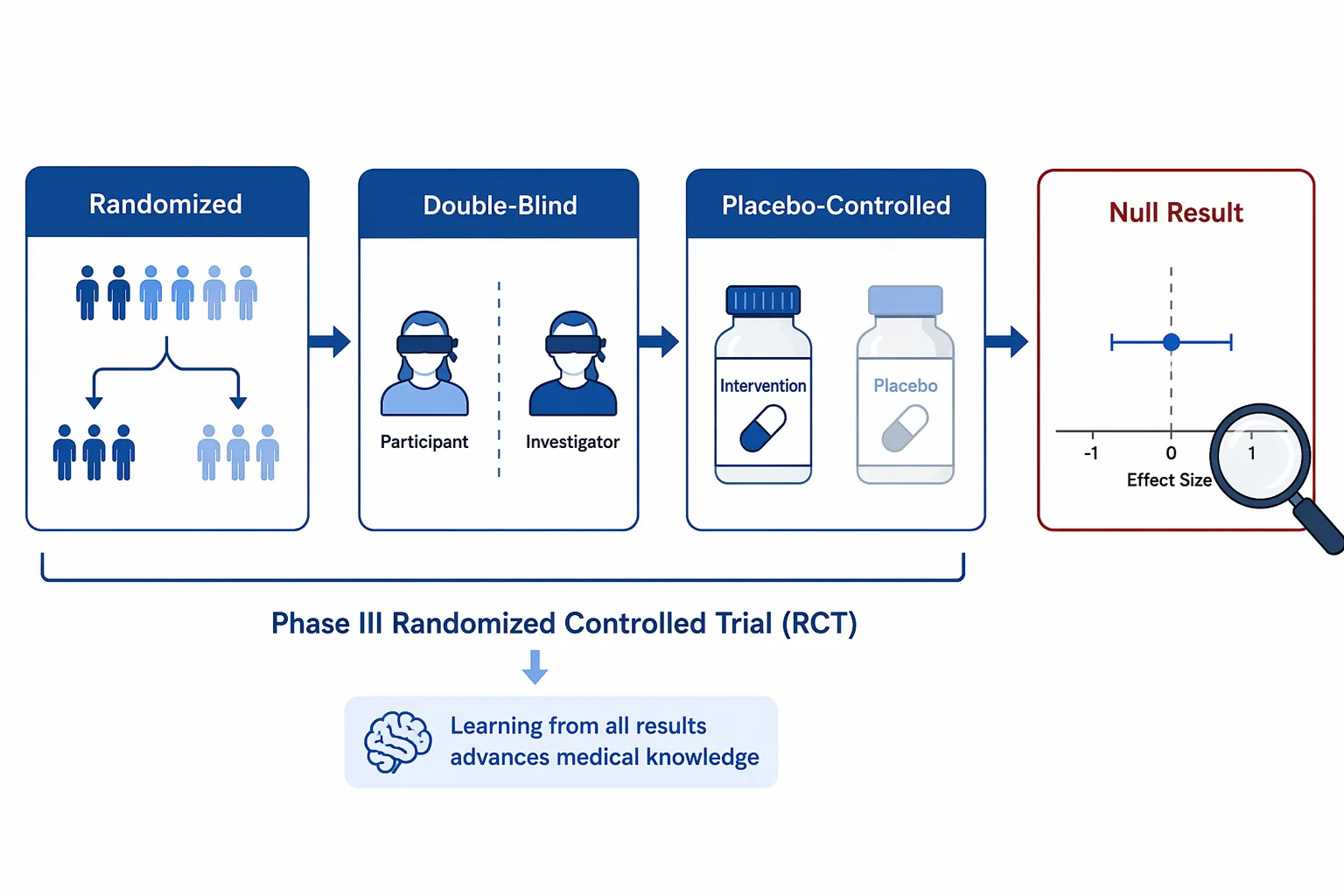
BOLD was a Phase III, randomized, double-blind, placebo-controlled trial enrolling 254 patients across 19 countries, with treatment for up to 104 weeks.[1] The ClinicalTrials.gov record identifies the study as NCT04336722 and lays out the same basic passage architecture: eligible children with biliary atresia after Kasai HPE were assigned to odevixibat or placebo and followed for native liver survival.[2]
On the MCAT, “Phase III” should immediately place the study late in the clinical development pathway. The FDA describes Phase III trials as studies that gather more information about safety and effectiveness after earlier phases have examined safety, dosage, and preliminary evidence of activity.[3] In plain exam language: this is not the first-in-human question, and it is not mainly a small dose-finding exercise. It is the stage where a treatment is being tested in a larger patient group to see whether it provides clinically meaningful benefit.
| Design feature | What it lets you conclude | What it does not let you conclude |
|---|---|---|
| Randomized | The treatment and control groups were assigned by chance, reducing systematic baseline differences. | It does not guarantee the groups will be identical in every individual characteristic. |
| Placebo-controlled | The odevixibat group was compared against a control group that did not receive the active drug. | It does not mean every clinical decision in the study was simple or that all symptoms are subjective. |
| Double-blind | Participants, families, investigators, or evaluators were protected from expectation effects, depending on the trial’s blinding procedures. | It does not make the outcome positive; it protects interpretation of the comparison. |
| Primary endpoint | The main outcome was specified in advance as the principal test of benefit. | It cannot be replaced casually by a more favorable secondary or subgroup result. |
Randomization is the first place students should slow down. If patients are assigned by chance to odevixibat or placebo, the study is trying to prevent the treatment group from being systematically healthier, sicker, younger, or otherwise different in a way that would distort the result. Randomization does not eliminate all variability, especially in a rare pediatric disease, but it is the best standard tool for making a causal comparison.
Placebo control answers a different question. It tells you what odevixibat was compared against. A trial can be randomized without being placebo-controlled, and placebo-controlled without being adequately blinded. The MCAT likes those distinctions because they are easy to blur when a passage uses all the terms in one sentence.
Double-blinding protects the study from expectation effects. In a pediatric liver disease trial, the hardest endpoint here is not a parent-reported itch score or a clinician’s impression of improvement. Still, blinding matters because care, evaluation, follow-up intensity, and interpretation of less objective measures can all be influenced when people know who received the active drug.
The primary endpoint is the center of the case
The BOLD trial’s primary endpoint was native liver survival at Week 104, defined in the trial record as time to liver transplant or death.[2] That is the sentence to underline twice.
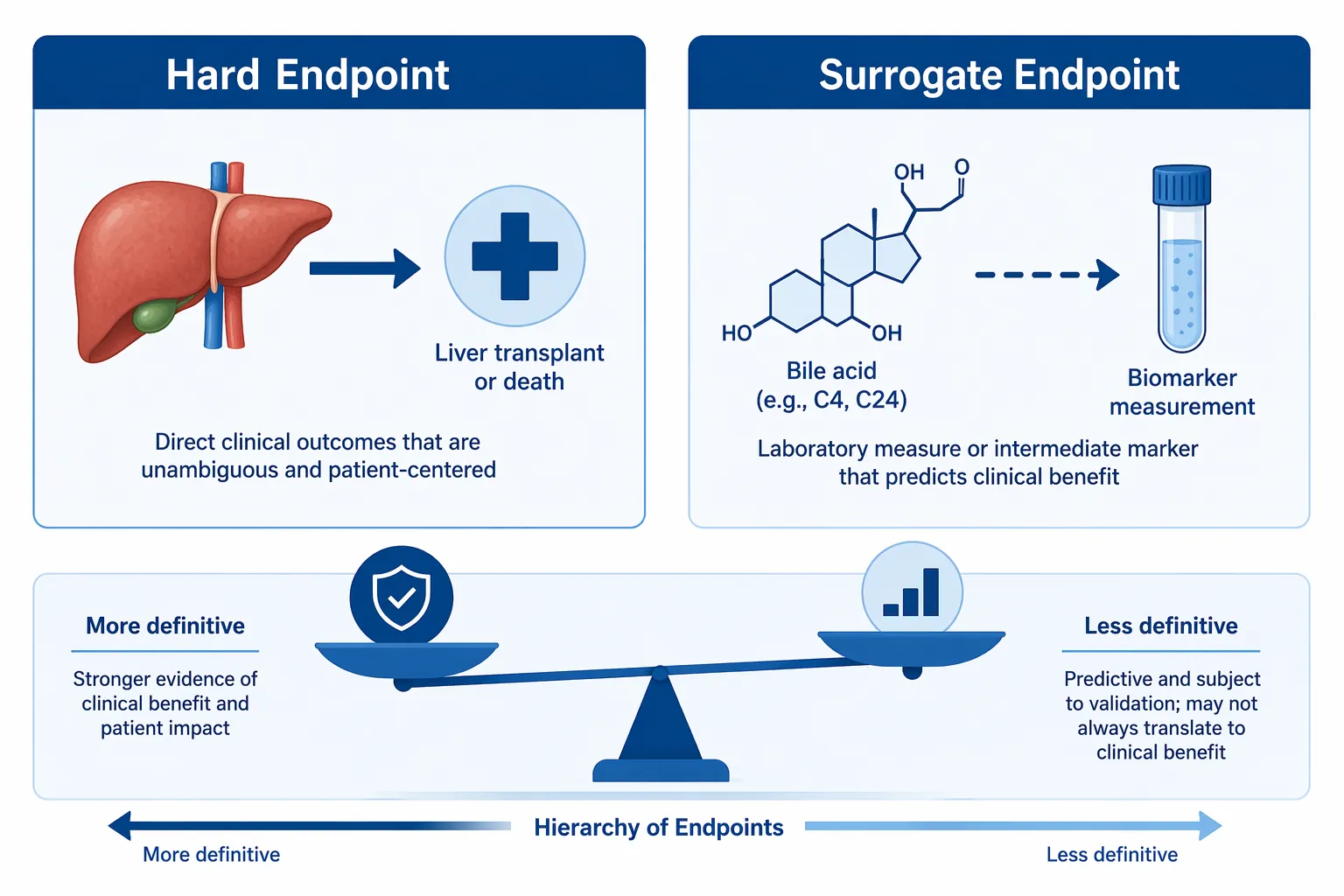
Native liver survival is a harder endpoint than a lab marker. It asks whether the child remained alive with the original liver rather than requiring transplant or dying. A biomarker might tell researchers that bile acid handling changed. A symptom measure might show that a patient felt or appeared better in one dimension. Those outcomes can matter, but they sit at a different evidentiary level than transplant-free survival with the native liver.
This is why the phrase “did not meet the primary endpoint” has a specific meaning. It does not mean “nothing happened.” It does not mean “every patient did badly.” It does not mean “the mechanism was impossible.” It means the trial’s pre-specified main comparison did not show the benefit required by its statistical plan.
Ipsen’s July 24, 2026 announcement did not provide p-values, hazard ratios, Kaplan-Meier curves, or a numerical estimate of the treatment effect.[1] Without those data, a careful reader cannot say the drug “almost worked,” “barely missed,” “clearly had no effect,” or “helped for a while and then stopped.” Those may sound like interpretations, but they would be guesses.
A test question could make that the entire point. If the passage states only that a Phase III trial did not meet its primary endpoint, the best answer is not the most dramatic answer. The best answer is the one that stays inside the disclosed evidence: the study failed to demonstrate superiority on the primary endpoint under the planned analysis.
Why “time to transplant or death” carries more weight than a surrogate
A surrogate endpoint stands in for the clinical outcome researchers actually care about. In bile-acid biology, a surrogate might involve a biochemical measure that suggests the drug is affecting bile acid circulation. That can be useful in early development, especially when the disease is rare and long-term outcomes take time.
But BOLD did not rest its main result on a surrogate. It used an endpoint tied directly to whether the child avoided liver transplant or death during the Week 104 analysis window.[1][2] If a treatment changes a biomarker but does not improve that kind of endpoint in a Phase III trial, the biomarker cannot rescue the primary conclusion by itself.
That is a common MCAT trap. The exam may give a plausible biological pathway, then ask which result provides the strongest evidence of clinical benefit. A direct patient-centered outcome usually outranks a mechanistic marker, even when the mechanistic marker is scientifically interesting.
Why the mechanism was plausible—and why that is not enough
Odevixibat is an ileal bile acid transporter inhibitor. The basic idea is to reduce bile acid reabsorption in the ileum, changing the enterohepatic circulation of bile acids. Reports on the BOLD announcement noted that Bylvay had already been approved for progressive familial intrahepatic cholestasis and Alagille syndrome, which helps explain why investigators had a biologically plausible reason to test it in another pediatric cholestatic condition.[4]
That plausibility should not be mocked after a negative result. It is exactly how many clinical hypotheses begin: related pathway, serious unmet need, prior evidence in nearby conditions, then a controlled trial in the new disease. But biliary atresia is not simply “another bile acid disease” in the abstract. Its clinical problem involves destruction or obstruction of bile ducts, and patients often undergo Kasai HPE early in life to restore bile flow.
For MCAT reasoning, the lesson is clean: mechanism supports a hypothesis; it does not prove a clinical outcome. A drug can make sense in PFIC or Alagille syndrome and still fail to show benefit on native liver survival in biliary atresia. Related biology is not interchangeable biology.
Subgroups can teach, but they cannot casually overturn the primary result
Dr. Saul Karpen, the BOLD lead investigator quoted in Ipsen’s announcement, described biliary atresia as “heterogeneous with variable clinical presentation and progression” and said planned subgroup analyses would explore potential responder profiles.[1] That is a useful statement because it names the real problem without letting the reader skip the hierarchy of evidence.
Disease heterogeneity means that patients with the same diagnosis may not have the same disease trajectory, response pattern, or baseline risk. In a rare pediatric disease, that can make a trial harder to interpret. If one subset progresses quickly and another progresses slowly, the average treatment effect across the full randomized population may hide clinically important differences.
But subgroup analysis has to be handled carefully. A planned subgroup analysis is more credible than a purely post-hoc search because the investigators identified the comparison before looking for patterns. Even then, it usually generates or refines hypotheses unless the trial was powered and structured to make that subgroup claim decisive.
A passage might tell you that the overall primary endpoint was negative but that one subgroup appeared to benefit. The tempting answer is to say the drug works for that subgroup. The more disciplined answer asks what was pre-specified, whether the subgroup was adequately powered, whether multiple comparisons were controlled, and whether the subgroup result changes the primary endpoint conclusion. In BOLD, based on the disclosed announcement, planned subgroup analyses may help identify possible responder profiles, but they do not erase the reported failure to meet native liver survival at Week 104.[1]
Rare-disease trials can be rigorous and still underpowered for difficult questions
BOLD enrolled 254 patients, which is small compared with many Phase III trials in common diseases but large in the context of biliary atresia; Ipsen described it as the largest trial ever conducted in the disease.[1] Both halves of that sentence matter. Calling 254 “small” without context is lazy. Treating it as equivalent to a large common-disease Phase III program is also misleading.
A 2026 meta-epidemiological review by Jovanovic and colleagues found that smaller enrollment was the most consistent predictor of trial failure across therapeutic areas, appearing in 18 of 25 included studies that evaluated predictors of trial failure.[5] That is a useful framework for thinking about rare diseases, where recruitment constraints can limit sample size and statistical power.
It should not be turned into a universal explanation. The review does not prove that BOLD failed because of sample size, and the public announcement does not provide enough numerical detail to diagnose the statistical reason for the result. The safer inference is narrower: rare-disease trials often face power and heterogeneity challenges, and BOLD sat inside that difficult category while still using a strong randomized, blinded, placebo-controlled design.
What the Bylvay trial failure implies for biliary atresia treatment
The practical implication is limited but important: BOLD did not provide Phase III evidence that odevixibat improves native liver survival at Week 104 in the studied biliary atresia population.[1] That is the treatment implication supported by the disclosed data.
It also means clinicians, researchers, families, and sponsors do not get the clean positive trial they were hoping for in a disease with few options beyond surgical management and eventual transplant for many patients. That human disappointment is real. It still does not allow a reader to invent missing efficacy curves or re-label exploratory analyses as primary proof.
The current pipeline consequence is also real but should be stated carefully: after BOLD, no other active Phase III program in biliary atresia was identified in the cited sources. That is a present gap, not a permanent law of the field.
For an MCAT answer choice, the implication would not be “IBAT inhibition is disproven in all cholestatic disease” or “the study design was invalid because the result was negative.” The better answer would say that a rigorous Phase III RCT failed to demonstrate benefit on its pre-specified hard clinical endpoint in this specific disease setting.
How to answer the passage question
If BOLD appeared as an MCAT passage, the question would probably not ask you to predict Ipsen’s stock price or redesign pediatric hepatology. It would ask what conclusion is justified.
- Identify the phase: Phase III means late-stage testing for safety and effectiveness in a larger patient group, not an early mechanistic screen.
- Identify the comparison: randomized odevixibat versus placebo, with blinding to reduce expectation and assessment bias.
- Identify the endpoint: native liver survival at Week 104, defined as time to liver transplant or death.
- Respect the hierarchy: the primary endpoint carries more interpretive weight than later subgroup exploration or mechanistic plausibility.
- Do not infer missing numbers: no public p-value, hazard ratio, or Kaplan-Meier curve means no claim about how close or far the result was.
A null result from a well-designed trial is still evidence. It may redirect research, narrow a hypothesis, expose disease heterogeneity, or show that a plausible mechanism did not translate into the chosen clinical outcome. What it does not do is automatically indict the design.
So when the passage gives you a rigorous study with a negative result, resist the emotional answer. Respect the endpoint, respect the design, and state exactly what the evidence does and does not show.
References
- Ipsen announces topline results from Phase III BOLD study of odevixibat in biliary atresia. Ipsen. July 24, 2026.
- Odevixibat in Children With Biliary Atresia Who Have Undergone a Kasai Hepatoportoenterostomy. ClinicalTrials.gov.
- The Drug Development Process. U.S. Food and Drug Administration.
- Fierce Pharma and pharmaphorum reporting on Bylvay approvals and the BOLD trial announcement. July 24, 2026.
- Meta-epidemiological review of predictors of clinical trial failure. BMC Medical Research Methodology. 2026.
Related exhibits & inventory
Verified outcomes
Planners
No planner filed for this exam yet
A downloadable timeline template for this exam hasn't been published yet.
Tool verdicts
Questions about this plan
Ask a question about a specific section, timeline, or citation in this plan — or flag something that needs correcting.
Comments
Join the discussion with an anonymous comment.