Why a ChatGPT Outage Might Actually Help You Study Better
Accuracy Warning — ChatGPT
ChatGPT's session-based format does not enforce retrieval practice; do not treat explanations as a substitute for active recall.
- Accuracy:
- Limited
- Tested:
- explaining concepts
- Last tested:
- 2026-07-26
When ChatGPT goes down in the middle of a study block, the clock suddenly gets loud. The MCAT chapter is still half-finished. The SAT math set is still blank. The ASVAB practice window you protected all week is now leaking minutes while you refresh a status page and search for another chatbot.
The first instinct is understandable: find Claude, Gemini, Copilot, DeepSeek, anything that will answer back. During the June 2025 ChatGPT outage, which lasted more than 12 hours, searches for alternatives reportedly jumped sharply: DeepSeek up 109%, Claude up 95%, Gemini up 80%, and Copilot up 52%.[1] That behavior says something important. For many students, the emergency plan is not a study plan. It is another chat box.

If you are searching what to do when ChatGPT is down for studying, the answer is not simply “use a different AI.” If your exam date is close, you may need a quick workaround, and a troubleshooting guide like 7 fixes when ChatGPT isn't working for your study session can help with the immediate mess. But the better question is sharper: what can you do tonight that still counts as studying even if no chatbot comes back online?
That is where the outage becomes useful. Not pleasant. Not convenient. Useful. It exposes whether your study system can survive without a conversational assistant.
The problem is not that ChatGPT explains badly
ChatGPT can be genuinely helpful. A confused student can ask for a second explanation, a simpler analogy, a worked example, a quiz question, or a summary of messy notes. Used that way, it can rescue a study block that would otherwise collapse into staring at a textbook paragraph for 40 minutes.
The trouble starts when interaction gets mistaken for active studying. A chat feels alive. It responds. It adjusts. It lets you say, “Explain that again,” and then rewards you with a smoother version. But smoothness is not the same as retrieval. Understanding an explanation while it is in front of you is not the same as producing the answer later, under time pressure, with no hint waiting in the next message bubble.
That distinction matters more for test prep than for casual learning. On a GRE verbal question, ACT science passage, MCAT amino acid item, or ASVAB arithmetic problem, the exam does not ask whether an explanation sounded familiar last night. It asks whether you can pull the right move from memory, choose under pressure, and recover after missing something.
The broader student culture is already moving toward chatbot help. Pew Research reported that 54% of U.S. teens had used chatbots for schoolwork in a September–October 2025 survey, and 10% said they used chatbot help for all or most of their schoolwork. Pew also found that among teens who viewed AI negatively, 34% named overreliance and loss of critical thinking as their primary fear.[2] That does not prove every ChatGPT user is dependent; Pew asked about chatbots broadly. It does show that this is no longer a fringe study habit.
A replacement chatbot does not fix the weakest part of the method
The weakest part of chatbot-heavy studying is usually not the model. It is the missing loop.
A durable study loop does three things. First, it makes you try to recall before you see the answer. Second, it brings missed material back after time has passed. Third, it tracks which items are easy, shaky, or still failing. ChatGPT can help you build pieces of that loop if you deliberately ask for them, but its default session-based Q&A format does not enforce them.
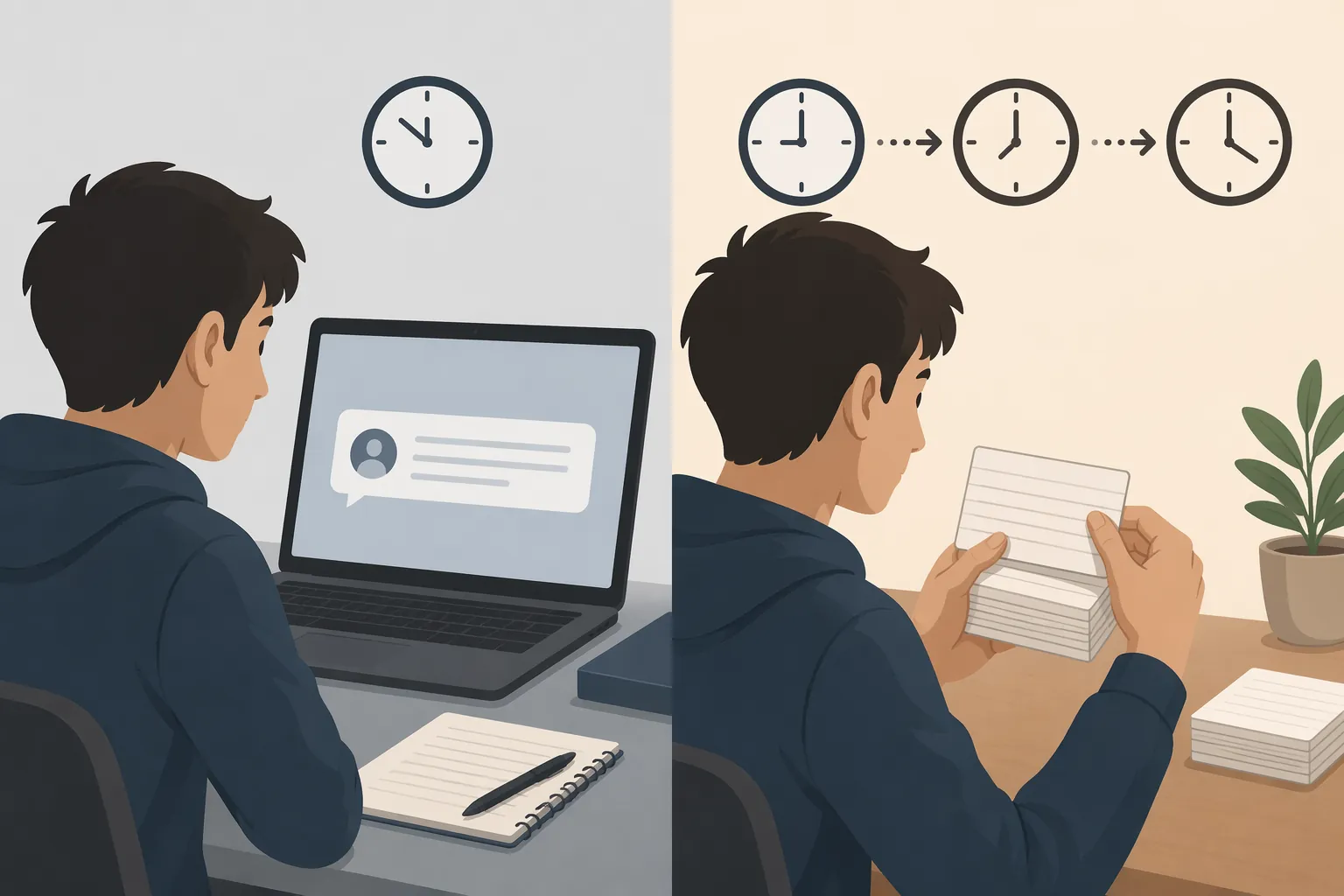
A chat thread is built around the present session. You ask; it answers. You ask again; it adjusts. That can clarify a concept, but it does not automatically hide the answer until you have struggled, schedule the same weak idea for tomorrow, and keep showing it until you stop missing it. Students can bolt those behaviors onto AI, but most do not when they are tired. They ask for one more explanation and call the feeling of comprehension “review.”
The evidence for doing the harder thing is not subtle. A 2021 meta-analysis of 117 studies found that retrieval practice improved long-term retention by an average of 72% compared with rereading.[3] That finding is broad; it is not a promise that your SAT score rises by a particular number of points if you use flashcards. But it does support the mechanism test-takers care about: pulling information from memory strengthens later access more than looking at the material again.
Spaced repetition adds the second half of the loop. In a 2026 randomized controlled trial in undergraduate pediatrics, the spaced-repetition group scored 16.24 out of 20 on a post-test, compared with 11.89 out of 20 for the control group; more than 90% of students in the intervention group reported improved retention.[3] That was undergraduate medical education, not the GRE, SAT, ACT, MCAT, or ASVAB. Still, the study lines up with the same practical point: material that returns after a delay is harder, and that difficulty is part of why it sticks.
This is why swapping ChatGPT for another chatbot is usually a weak first move. Claude may write a clearer explanation. Gemini may be easier to access. Copilot may be sitting in a browser you already use. Those tools can be useful, and comparisons like whether a high-priced Claude subscription can replace test prep have their place. But if the new tool still lets you read answers before attempting recall, it has not solved the study problem.
What to do in the first 10 minutes of an outage
Do not spend the whole study block diagnosing the outage. If ChatGPT is unstable, give yourself a short decision window. Check whether the issue is local, glance at an outage-aware resource like ChatGPT Outages: What Exam Prep Students Need to Know, and then move. Status pages can show high effective uptime while individual users still run into partial disruptions, slow responses, login problems, or tool-specific failures. For a student with one free evening, the distinction is not comforting.
| If you were going to use ChatGPT for... | Do this instead during the outage |
|---|---|
| Explaining a concept | Write what you remember, then use notes or a textbook to correct it |
| Making quiz questions | Turn headings, formulas, missed questions, or vocab into physical flashcards |
| Practicing exam problems | Run an official practice set in a timed Pomodoro block |
| Summarizing notes | Cover the notes and produce a blank-page explanation first |
| Organizing old AI notes | Export or copy only the facts worth converting into retrieval prompts later |
The point is not to punish yourself for using AI. The point is to stop the outage from turning into an hour of tool-shopping.
Start with physical active-retrieval flashcards
If you have paper, a pen, and any source material, you can study. That sounds old-fashioned until you watch what actually happens: the answer is covered, the student has to produce something, and the miss is obvious. There is no elegant paragraph to nod along with.
Make the front of the card a prompt, not a title. “Mitochondria” is weak. “What does the electron transport chain create that ATP synthase uses?” forces a move. “Quadratic formula” is weak. “Solve ax² + bx + c = 0 when factoring is not efficient” asks for a procedure. For vocabulary-heavy exams, put the word in a sentence or ask for a contrast. For math and science, put the trigger condition on the front: when would you use this formula, rule, or shortcut?
Then sort cards into three piles: got it cold, hesitated, missed. The missed pile comes back today. The hesitated pile comes back tomorrow. The cold pile can wait longer. That is not a perfect spaced-repetition algorithm, but it preserves the behavior that matters most during an outage: weak material returns instead of disappearing into a chat transcript.
If you already have useful ChatGPT notes, do not reread the whole thread when the system returns. Convert it. Pull out formulas, rules, definitions, traps, and missed-question patterns. A guide on exporting ChatGPT study notes for exam review is most valuable when it helps you turn old explanations into prompts you can fail, repeat, and eventually answer cleanly.
Use official practice sets before another AI explanation
For standardized tests, official practice is not glamorous, but it has one advantage a chatbot cannot guarantee: it reflects the exam owner’s view of the task. Use ETS materials for GRE-style practice, College Board materials for SAT-style practice, AAMC materials for MCAT-style practice, and DoD materials for ASVAB-style practice. If you are studying for another exam, use its official source for the same reason.
A simple outage block can look like this: 25 minutes of official questions, 5 minutes to mark misses, 25 minutes to redo only the misses without looking at the explanation, then 10 minutes to write flashcards from the errors. The Pomodoro timer is not magic. It just keeps the block from dissolving into open-ended review.
The redo matters. A student who reads an explanation after every miss often learns to recognize the solution once it is shown. A student who reattempts the missed item has to locate the failed step: misread the question, forgot a formula, chose the wrong passage detail, rushed the arithmetic, or used the right rule in the wrong place. That diagnosis is worth more than another fluent explanation.
Use the Feynman technique when you are pretending you understand
The Feynman technique is useful during an outage because it is brutally low-tech. Pick one concept and explain it on paper as if teaching a younger student. No quotes from the textbook. No copied AI summary. If the explanation collapses, circle the exact gap and return to the source.
This works especially well for concepts that feel familiar until you have to connect them: enzyme inhibition, comma rules, experimental controls, probability setups, electrical circuits, rate problems. The goal is not to produce a beautiful explanation. The goal is to expose the sentence where your understanding starts borrowing confidence from words you cannot actually control.
When ChatGPT comes back, change its job
You do not need to ban ChatGPT after one outage. That would be theatrical, and it would throw away a tool that can be useful. Change its job instead.
- Use it after an attempt, not before one.
- Ask it to generate alternative explanations for missed concepts, not to replace official practice.
- Have it convert notes into flashcard prompts, then study the prompts away from the chat.
- Use it to compare your explanation with a cleaner one, not to avoid writing your own.
- Treat medical, legal, or safety-sensitive answers with extra caution; overreliance gets more expensive when the domain has real-world consequences.
That last point is not abstract for students in health-related tracks. If you are using AI around clinical or medical material, the risks are different from using it to make a vocabulary list; a separate discussion of why ChatGPT medical advice is dangerous for students belongs in the background of any serious study plan.
There is room for AI tutors. There is room for custom Gemini setups, careful tool testing, and model comparisons. But the fallback plan for an exam student cannot be “find a chatbot that is still awake.” The fallback plan is a stack of prompts you can answer from memory, a schedule that brings weak material back, and official practice that still works when the most impressive tool in your study routine goes silent.
References
- ChatGPT down live updates as OpenAI developers work to fix outage, NY Post, June 10, 2025.
- How Teens Use and View AI, Pew Research Center, February 24, 2026.
- AI Study Tools Better Than ChatGPT, Agentive AI Agents.
Authoritative source
For the authoritative version of this contentHow to Read the '1 in 4 NFL Players CTE' Study
Report an error in this tool's output
Found something this tool got wrong beyond what's documented above? Report it so the accuracy log stays current.
Comments
Join the discussion with an anonymous comment.