ChatGPT Outages: What Exam Prep Students Need to Know
Accuracy Warning — ChatGPT
ChatGPT math answers correct ~50% of the time; overreliance may degrade unassisted test scores.
- Accuracy:
- Limited
- Tested:
- solving math practice problems
- Last tested:
- 2026-07-25
A ChatGPT outage is not just a tech inconvenience when your exam date is fixed. If your MCAT CARS review, SAT math corrections, GRE quant drill set, or ASVAB practice block lives inside one chat window, an unavailable login screen can erase the exact hour you were counting on.
That is the practical problem: the study calendar does not care that a platform is usually available. OpenAI’s own status history showed 99.86% uptime for April through July 2026, which sounds strong in the abstract, but aggregate uptime still leaves downtime that can cluster into the wrong evening or weekend block.[1] Third-party outage tracker IsDown counted 159 OpenAI incidents from October 2025 through July 2026, with an average resolution time around 297 minutes.[2]
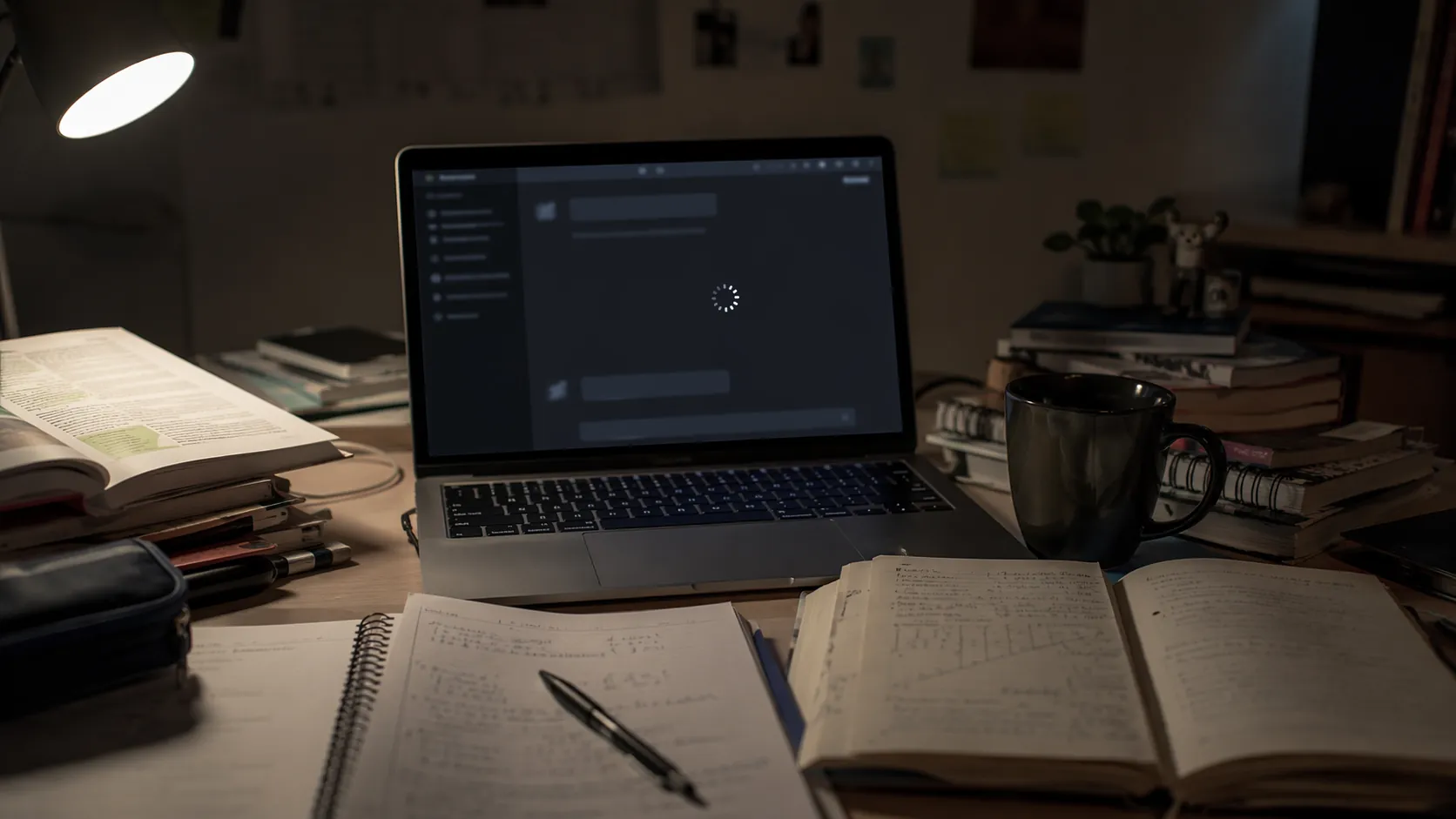
Those two facts are not contradictory. Official uptime describes broad service reliability across products, tiers, models, and error types. Third-party incident counts capture the messier user experience, including partial failures, login problems, and feature-specific breakdowns. For exam prep, the mess matters. A student does not lose “0.14% of a quarter.” They lose Tuesday night after work, Saturday morning before a shift, or Sunday afternoon when the house is finally quiet.
The July 2026 Cluster Is What Study Plans Are Bad At Absorbing
The July 2026 incident cluster is a useful stress test because it was not one clean outage with one clean lesson. It included several user-affecting days in the same week: login failures on July 14–15 with more than 10,000 Downdetector reports, SSO errors on July 16, an enterprise app lockout on July 18 lasting 5 hours and 15 minutes, and a July 19 global outage that affected Conversations, Voice mode, and ChatGPT Work.[2]
July 19 was a Sunday. That detail is easy to skip in an incident write-up and hard to ignore if you study around school, work, childcare, military obligations, or a commute. Weekend study blocks are not always replaceable. If the plan was “use ChatGPT to review every missed biology question from the practice exam,” the failure is not just that ChatGPT went down. The failure is that the plan had no second path.
The scale also changes the stakes. Webiano reported that ChatGPT had 900 million weekly active users and handled 2.5 billion messages per day as of February 2026.[2] Even a partial outage can collide with millions of study, work, and teaching sessions. But the number that should matter most to an exam student is smaller: one blocked session close enough to test day that it cannot be made up cleanly.
| Failure mode | What the student experiences | Why it matters for exam prep |
|---|---|---|
| Login failure | The student cannot get into saved chats, custom instructions, or study history. | A planned review session can disappear before it starts. |
| SSO or account error | School, work, or enterprise access fails even if the public site partly works. | A student using an institution-managed account may not have a quick workaround. |
| Feature-specific outage | Voice, conversations, file tools, or workspace features stop working. | The exact study method scheduled for that block may be unavailable. |
| Slow recovery | The service returns after hours, not minutes. | A five-hour resolution window can consume an entire evening. |
The root cause of the July 19 outage had not been publicly disclosed as of July 25, 2026. Any diagnosis beyond the affected features is inference, not confirmed cause. For a student, though, root cause is secondary. The operational lesson is plain enough: if your study workflow depends on one live vendor session, the vendor’s bad hour becomes your bad hour.
High Uptime Still Fails the Calendar Test
A 99.86% uptime number can be both honestly reported and insufficient for a deadline-driven student.[1] The problem is not that the service is unreliable in some broad, useless sense. The problem is that exam prep is scheduled in chunks. You do not need ChatGPT to be unavailable often for it to hurt you. You need it to be unavailable during the one block assigned to a task that has no offline equivalent.
That distinction is why averages can feel insulting after an outage. If your study week has four serious blocks, and one of them was supposed to be an AI-guided rebuild of your weakest section, losing that block is not a rounding error. It changes what gets delayed, compressed, or abandoned.
The fix is not to swear off ChatGPT. It is to stop assigning it jobs that only it can perform at the last minute. Use it where it speeds feedback, creates fresh practice, or explains a confusing passage. Do not let it become the only place where your notes, prompts, explanations, and next actions live.
If you have already built outage habits around school platforms, the same logic applies here. A backup plan for AI study tools is closer to the planning used for keeping a study plan alive during a Microsoft Teams outage than to a debate about whether AI is good or bad. The question is what still works when the preferred system does not.
The Other Risk: Practice Can Feel Better Than It Is
Outages are the visible failure. The quieter risk is that ChatGPT can make studying feel productive while weakening the skill you need on test day: unassisted performance.
The most vivid evidence comes from a Penn study reported by The Hechinger Report. The study involved about 1,000 high school students across four 90-minute cycles and four math topics. Students using ChatGPT solved 48% more practice problems correctly, but later scored 17% worse on the actual test. A fine-tuned tutor version produced 127% more correct practice problems but no improvement in test scores.[3]
That deserves careful handling. The study was a preprint on SSRN and had not yet been peer-reviewed. It was also a high school math study, not a GRE, MCAT, SAT, ACT, or ASVAB study. Still, the pattern is relevant to exam prep because the task structure is familiar: students practiced with help, felt they were learning, and then had to perform without the helper.

The same report said ChatGPT’s math answers were correct only about 50% of the time and that its step-by-step reasoning was wrong 42% of the time.[3] That matters because a student can copy the structure of a bad explanation without noticing the damage. If the answer looks fluent, the session feels settled. The test later asks whether the student can choose the move alone.
This is where AI accuracy testing belongs in a real study workflow. If you use ChatGPT for math, chemistry, grammar, or logic games, compare its explanations against official answer keys and known-good worked solutions. A hands-on prompt comparison like Which AI Prompt Actually Solves Math Problems? A Hands-On Test is useful not because prompts magically remove risk, but because it forces the tool to earn trust problem by problem.
A separate MIT-linked study reported by The Guardian tracked 67 participants over four weeks in the United States and United Kingdom. AI-assisted news verification improved accuracy by 21% in the moment, but unassisted performance declined 15.3% over four weeks.[4] The sample was small and the task was not exam prep, so it should not be stretched into a universal claim. It does, however, support the same warning: assisted success and durable skill are not the same measurement.
Students already seem to feel the tension. TestPrepInsight reported that 92% of university students used AI tools in 2025, while more than half believed too much AI reliance would negatively affect their academic performance.[5] That is not a rejection of AI. It is a sign that convenience and confidence are pulling in different directions.
The overreliance problem is not limited to one tool. It shows up whenever the study system rewards completed-looking work more than retained skill. That is the same trap behind AI replacing teachers and student learning and tokenmaxxing when studying for an exam: more output can hide less ownership.
What ChatGPT Should and Should Not Own in Your Study System
ChatGPT is best used after the exam’s official materials have already defined the work. Let the test maker’s guide, released questions, official practice exams, and scoring rubrics set the target. Then use AI to explain, vary, quiz, or reframe. That order matters because the test date is attached to the exam, not to the chat.
| Study job | Safe role for ChatGPT | What should remain outside ChatGPT |
|---|---|---|
| Reviewing missed questions | Ask for alternate explanations after checking the official answer. | The missed-question log, official answer key, and final correction. |
| Generating extra drills | Create similar practice only after the concept is identified. | Core practice from official or trusted prep sources. |
| Planning the week | Suggest ways to sequence topics or balance sections. | The master calendar, deadlines, and buffer days. |
| Explaining confusing content | Offer analogies, simpler wording, or a second explanation. | The final definition, formula, rule, or passage strategy in your own notes. |
| Simulating test pressure | Provide prompts or question variants. | Timed, closed-book, unassisted practice. |
OpenAI’s Study Mode is built around guided learning rather than simply handing over answers, and that can be useful when a student is stuck.[6] The limitation is that a feature design cannot guarantee how a student uses it under pressure. A tired student two weeks from test day can still turn guided help into answer-renting.
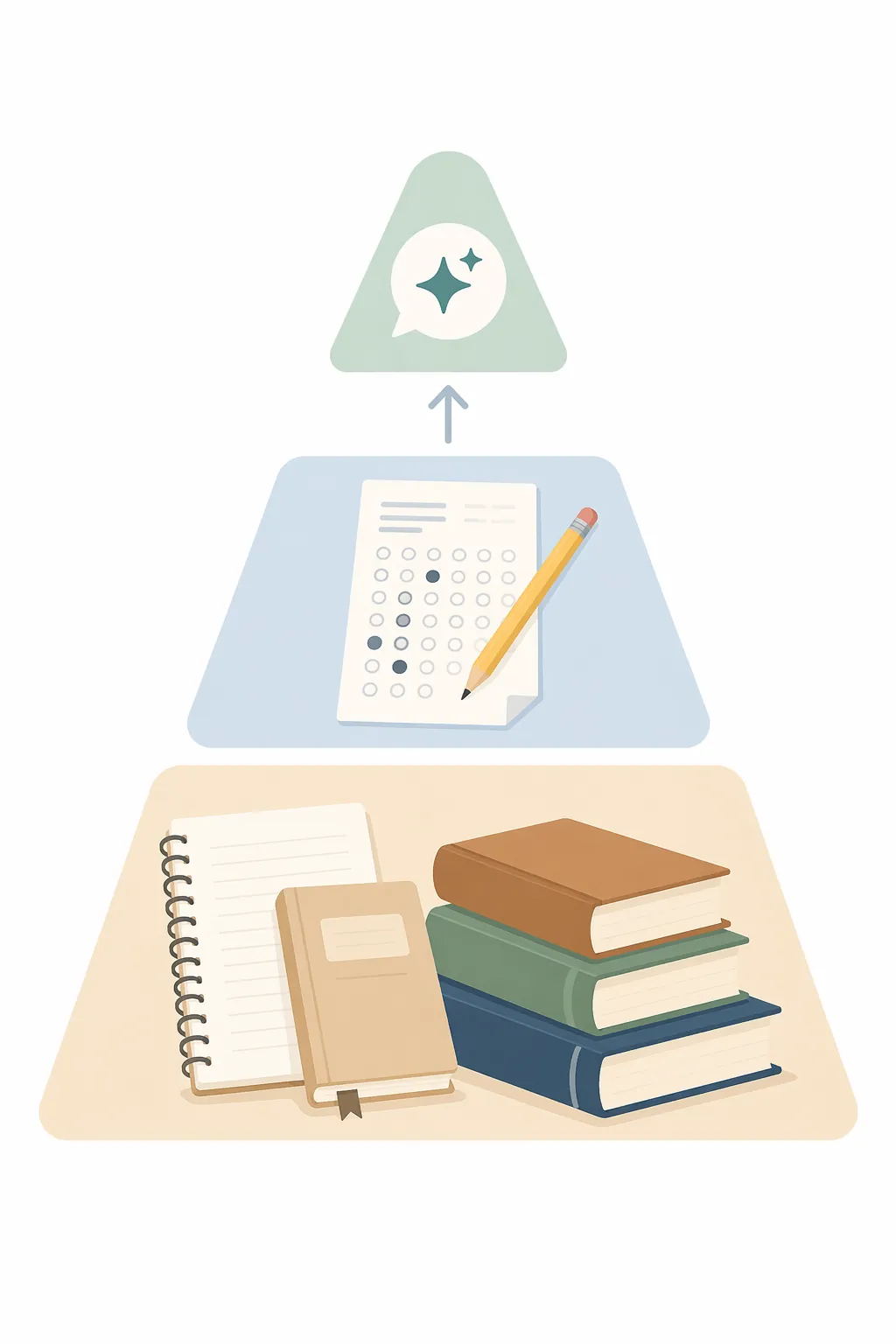
A healthier setup looks more like a hierarchy than a hub: official materials and offline notes at the bottom, independent practice in the middle, AI at the top as a supplement. If ChatGPT disappears, the foundation should still be there.
A One-Hour Fallback Plan Before the Next Outage
You do not need a complicated productivity system. You need enough redundancy that tonight’s study block can survive a login failure, and enough unassisted practice that your score is not an artifact of constant help.
- Export or copy your essential notes outside ChatGPT. Keep your error log, formulas, vocabulary, passage strategies, and current study plan in a local document, notebook, or cloud file you can open without the chat interface.
- Save your best prompts in a separate prompt library. Include prompts for missed-question review, drill generation, explanation checks, and timed quiz creation, so an outage does not trap the instructions inside old chats.
- Test a second AI assistant before you need it. Do not wait until an outage to learn whether another tool can read your files, handle your subject, or produce acceptable explanations.
- Put a one-day buffer around AI-dependent sessions. If a task requires AI help, schedule it before the last possible day, not on the only open night before a practice exam.
- Schedule closed-book, no-AI practice every week. Use official timing when possible. The score that matters is the one produced without a model nudging the next step.
- Use ChatGPT’s data export feature regularly if your study history is important. The export is not a substitute for keeping active study materials somewhere you control.
The second assistant should be treated as a spare tire, not a second steering wheel. If you maintain two AI tools but no official-answer workflow, no offline notes, and no independent practice, you have duplicated the dependency rather than reducing it. A broader guide like How OpenAI and Hugging Face Can Help You Pass Exams is most useful when AI is placed inside a study system that already has a backbone.
For students on longer calendars, the same principle can be built into the plan from the start. A structured schedule such as The 16-Week AP Study Plan: When and How to Use an AI Tutor works better when AI-supported sessions are separated from score-checking sessions. One is for learning support. The other is for evidence.
The Test-Date Rule
A reasonable ChatGPT study rule is simple: if the task directly protects your test score, it must be possible without ChatGPT. Official practice, answer review, core notes, timing discipline, and score tracking should not depend on a live chat session. AI can sit beside those tasks, but it should not own them.
That still leaves plenty of room for useful AI. Ask it to rephrase a dense explanation. Ask it for another version of a weak algebra skill. Ask it to quiz you on vocabulary or turn your notes into a short recall drill. Then close it and prove the skill without help.
The next outage may be brief, partial, or irrelevant to you. It may also land on the study block you cannot replace. The safer move is to spend the next hour making your prep outage-resistant before a frozen login screen, or an inflated practice score, shows you where the weak point was.
References
- OpenAI Status History, OpenAI
- A Global ChatGPT Outage Exposes the Fragility Behind 900 Million Weekly Users, Webiano.digital
- Kids who got help from ChatGPT did worse on tests, The Hechinger Report
- Chatbots could be eroding critical thinking skills, study suggests, The Guardian, June 2026
- How AI Is Changing Study Habits, TestPrepInsight
- Using Study Mode in ChatGPT, OpenAI Help Center
Authoritative source
For the authoritative version of this contentHow to Read the '1 in 4 NFL Players CTE' Study
Report an error in this tool's output
Found something this tool got wrong beyond what's documented above? Report it so the accuracy log stays current.
Comments
Join the discussion with an anonymous comment.