
Why ChatGPT Medical Advice Is Dangerous for Students
Accuracy Warning — ChatGPT
Under-triages 51.6% of emergencies; hallucinates lab tests; user accuracy 34.5% vs model 94.9% when used interactively
- Accuracy:
- Limited
- Tested:
- Medical symptom triage and condition identification
- Last tested:
- 2026-02
The dangerous part is not that students use ChatGPT. Of course they do. It is fast, patient, always open, and willing to explain the same idea five different ways at 1 a.m. The dangerous part is the leap from “this model performs well on medical exams” to “this model is safe to trust when I am tired, anxious, half-informed, and asking a medical question badly.”
That leap is where the real ChatGPT medical advice dangers for students begin. A benchmark asks whether the model can produce the right answer under controlled conditions. A student asks something messier: “Is this symptom serious?” “Is my understanding of renal physiology right?” “Could this be anxiety?” “What should I do tonight?” The second situation is not just a harder version of the first. It is a different task.
The exam score is the wrong evidence
The strongest reason not to treat ChatGPT as a student medical adviser is not a vague worry about AI. It is a randomized trial published in Nature Medicine in February 2026 that tested what happens when ordinary people use large language models for medical advice. The trial included 1,298 participants, and the gap between model performance and user performance was not subtle: when the model was tested alone, it reached 94.9% accuracy at identifying relevant conditions; when people used LLMs interactively, they identified relevant conditions less than 34.5% of the time.[1]
Worse, the people using LLMs did not merely fail to capture the model’s isolated ability. They performed worse than the control group using traditional search methods. The trial found that LLM users were 1.76 times less likely than the control group to identify a relevant condition.[1]
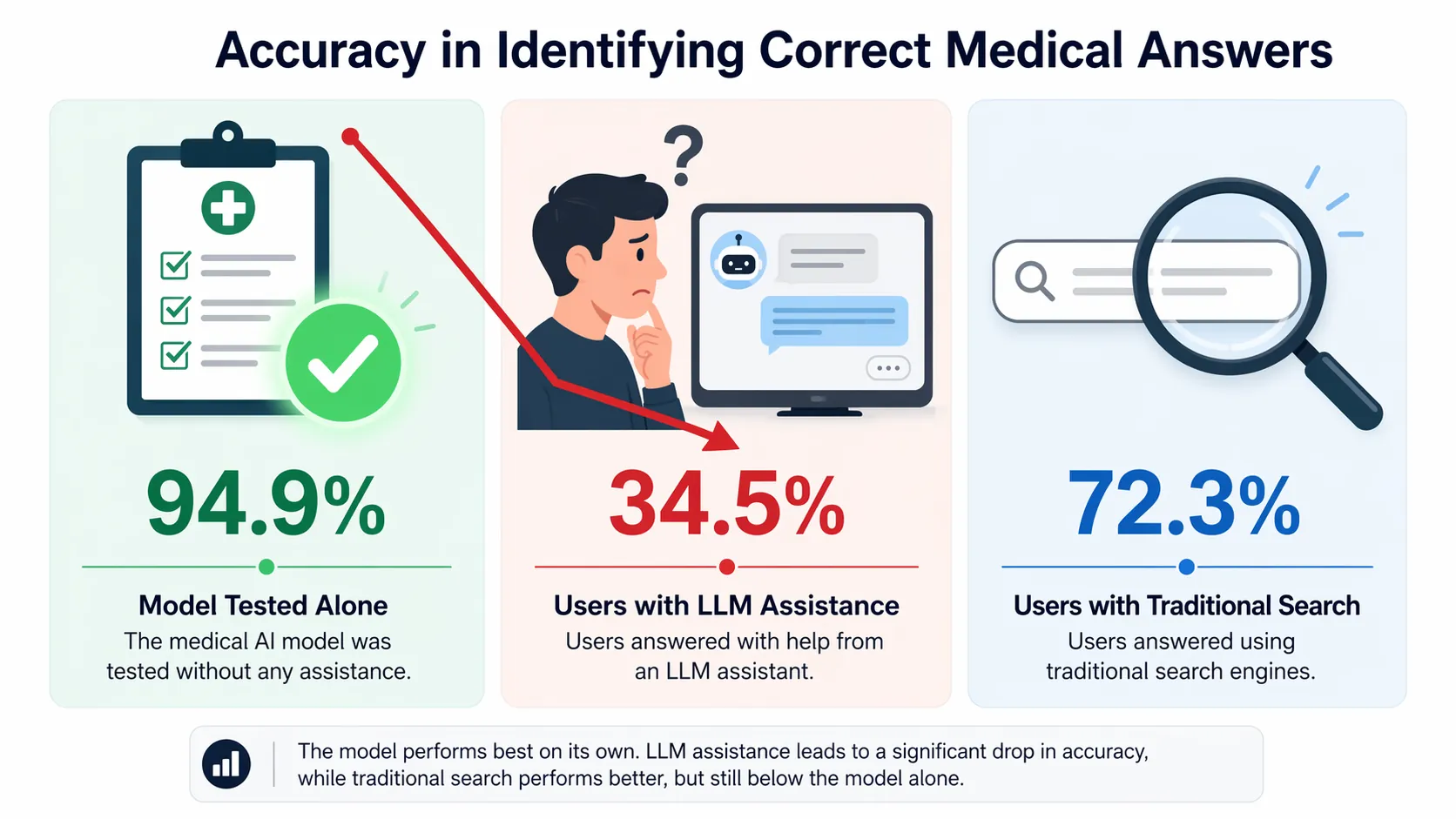
That result should bother any MCAT student who has been reassured by exam-passing headlines. The model’s solo score is not what a student gets. The student gets a conversation: a question, a response, a follow-up, a little confusion, a more specific question, a more confident response, and then a choice about whether to believe it. The Oxford trial measured that loop, and the loop broke the promise of the benchmark.
This does not mean Google, WebMD, Reddit threads, or late-night symptom searches are good medical care. They are not. But in this trial, adding an LLM did not rescue the user from the usual internet problem. It made the condition-identification task worse than traditional search. That is the part students need to sit with before letting a fluent answer become the thing they remember.
The failure happens in the interaction
A student rarely asks a clean benchmark question. They leave out a detail. They overemphasize a phrase they just learned in biochemistry. They ask whether something is “probably fine” because they want it to be fine. They paste in symptoms without knowing which ones matter. Then ChatGPT answers in a tone that makes the whole thing feel more organized than it is.
The Oxford materials made that instability visible. In one transcript example, two users described the same symptoms with slightly different wording and received opposite advice: one was told to lie down in a dark room, while the other was told to seek emergency care.[1] That is not a harmless style difference. It is the exact point at which a student’s wording, the model’s sensitivity to phrasing, and the user’s trust collide.
This is also why “just ask better prompts” is not a serious safety plan for students. A pre-med who already knows which symptom detail is decisive is no longer the person most at risk. The risk falls on the student who knows enough vocabulary to sound clinical but not enough medicine to audit the answer. That student can ask a beautifully formatted question and still be asking the wrong question.
The same problem shows up in studying. If ChatGPT gives a wrong explanation of a medical concept in smooth, high-confidence prose, the student may not simply miss one question. They may build a small false structure around it: a wrong causal chain, a wrong exception, a wrong memory hook. Unlearning that later is slower than learning it correctly the first time.
Medical language is not the same as safe triage
The danger becomes sharper when the question is not “explain this pathway” but “what should I do?” A student with chest tightness before an exam, worsening asthma, severe abdominal pain, suicidal thoughts, or a strange medication reaction is not looking for a polished essay. They are making a triage decision. The answer affects whether they wait, call someone, go to urgent care, or seek emergency help.
A 2026 safety evaluation of ChatGPT Health reported exactly the kind of failure that should make students cautious. The system under-triaged 51.6% of genuine emergency cases. In asthma simulations, it sent a suffocating patient to a future appointment in 84% of cases. In a suicide-risk test, adding routine lab results to the same patient description caused the crisis banner to disappear; with those lab results included, the warning appeared in 0 of 16 runs.[2]
Those failures are not about whether the prose sounded medical. It almost certainly did. That is the trap. A response can use the right kind of language, mention plausible differentials, and still send the user toward the wrong level of care.
A separate Mount Sinai study published in Communications Medicine found another version of the same problem: when fabricated medical information was embedded in user queries, major chatbots hallucinated in 50% to 83% of cases, including inventing non-existent lab tests and diseases.[3] For a student, that matters because ChatGPT does not only answer questions; it can absorb the premise of a bad question and build from it.
That is especially hazardous in medical learning. If a student asks, “Why does X disease cause Y lab result?” and X does not actually cause Y, a safe tutor should challenge the premise. A chatbot may instead produce a neat mechanism. The student walks away with a clean explanation for a relationship that was never true.
Students are already using it, and they are already seeing the cracks
This is not a hypothetical future problem. A USC/Keck School of Medicine study reported in November 2024 that 52% of surveyed medical students had used ChatGPT for coursework. Among those users, 75% reported encountering vague, inaccurate, or biased responses.[4]
That survey does not prove every student use of ChatGPT is harmful. It does show that the tool is already inside medical education routines, and that many users have already noticed output quality problems. The troubling part is not that students experiment with the easiest tool available. The troubling part is that the tool can be wrong in a way that still looks like help.
The low-stakes version can be almost funny until it is your study plan. In a 2025 Blueprint Prep blog post, ChatGPT reportedly gave bad MCAT study advice and even claimed that “the square root of 2 is 2.”[5] That example is an anecdote from a test-prep company blog, not peer-reviewed evidence. It should not carry the argument. But it does capture the texture of the problem students recognize: the answer can be absurd and still arrive wearing a lab coat.
For MCAT preparation, that matters because the exam rewards exactness. A slightly wrong explanation of equilibrium, amino acid behavior, renal compensation, study design, or psych terminology can feel “basically right” while training the wrong instinct. The danger is not only that ChatGPT may give a false fact. It may give the student a false sense that the concept has been settled.
Where ChatGPT can fit without becoming the source of truth
None of this requires pretending ChatGPT is useless. It can reduce friction in bounded, low-stakes study tasks. It can rephrase dense notes into simpler language. It can generate draft flashcards from a passage you provide. It can quiz you on vocabulary. It can help you notice that you are mixing up two terms. Those uses are different from asking it to decide what is medically true.
| Use | Reasonable boundary |
|---|---|
| Terminology clarification | Use it as a first-pass explanation, then verify against lecture notes, textbooks, AAMC materials, or another authoritative source. |
| Flashcard drafting | Let it create rough cards, but edit every answer before studying from them. |
| Practice prompts | Use generated prompts to find weak spots, not to define what the official answer should be. |
| Symptom, diagnosis, triage, or treatment questions | Do not use it as the decision-maker. Contact a clinician, campus health service, urgent care, emergency service, or a trusted human support line as appropriate. |
| Unsupervised medical concept learning | Do not let a chatbot explanation become the final version in your notes unless you have checked it. |
The boundary is simple: ChatGPT can help you manipulate material you already have, but it should not be the authority that decides whether the material is true. If it turns your lecture notes into recall questions, you can check the output. If it invents a mechanism, diagnosis, or triage recommendation, the student is left doing expert review without expert knowledge.
The Oxford trial also needs to be read with the right scope. It tested GPT-4-based systems, so it is not a permanent verdict on every future model.[1] A later system may perform differently and should be tested rather than dismissed by assumption. But for students making decisions in 2026, the current evidence is enough to reject the benchmark argument. A strong model-only score does not prove safe student use.
So the verdict is firm: ChatGPT is not a medical adviser for students. Its exam-passing reputation is not evidence that it can safely handle diagnosis, triage, treatment decisions, or unsupervised medical learning. If a student uses it at all, it belongs in bounded support roles that are checked against official or authoritative materials. The danger is not that ChatGPT knows nothing; it is that it often sounds reliable precisely when the student is least equipped to catch the failure.
References
- Reliability of LLMs as medical assistants for the general public, Nature Medicine, February 2026
- ChatGPT Health fails to recognise medical emergencies, The Guardian, February 26, 2026
- AI Chatbots Can Run with Medical Misinformation, Study Finds, Highlighting the Need for Stronger Safeguards, Mount Sinai, August 2025
- Study reveals medical students’ use of ChatGPT in education and calls for ethical guidelines, Keck School of Medicine of USC, November 2024
- The 5 Worst MCAT Study Tips I Got From ChatGPT and What to Do Instead, Blueprint Prep, 2025
Authoritative source
For the authoritative version of this contentHow to Read the '1 in 4 NFL Players CTE' Study
Report an error in this tool's output
Found something this tool got wrong beyond what's documented above? Report it so the accuracy log stays current.
Comments
Join the discussion with an anonymous comment.