GRE Exam Hub
What the ChatGPT Author Mimicry Block Means for Your Essays
OpenAI's July 2026 block on ChatGPT mimicking famous authors doesn't affect test-prep essay writing as much as you might think. The real concern for GRE, SAT, and ACT students is how they use the tool—whether for feedback or for copying.
- gre
- mcat
- asvab
- sat
- act
- digital-adaptive
- official-material
- section-strategy
- test-date-timeline
OpenAI’s July 2026 author-mimicry block sounds, at first, like it should matter to students who use ChatGPT for essays. If the tool refuses to “write like” a famous novelist, maybe it is becoming less useful for shortcuts and safer for practice. For GRE, SAT, and ACT-style essay prep, that is mostly the wrong place to look.
The change reported by The Verge is narrow: ChatGPT now refuses direct requests to mimic living famous authors, a move tied to copyright lawsuits involving writers including George R.R. Martin and John Grisham.[1] IBTimes UK also reported that the restriction does not eliminate style imitation by description; users can still ask for prose with certain sentence lengths, vocabulary choices, tone, structure, and pacing without naming the author.[2]

That distinction matters because timed essay prep was never built around literary impersonation. A student trying to raise an analytical writing score does not need “write like Hemingway” to get a polished sample. They can ask for a concise, high-scoring, exam-style response with a clear thesis, two body paragraphs, a counterargument, and formal language. The author-name block does not touch that workflow.
The block changes the prompt, not the temptation
The useful question is not whether ChatGPT can still produce essay-like prose. It can. The question is whether the student is doing the thinking that has to survive when the timer starts and the response box is empty.
Even before this 2026 restriction, Education Week showed that ChatGPT 3.5 could mimic a fourth-grade student’s writing style when given writing samples.[3] That example is not a GRE or ACT study, and it does not prove that every student can evade every teacher or scoring system. It does show something more relevant to prep: style imitation is not limited to famous names. If a model can absorb sample prose and produce similar surface features, blocking celebrity author prompts does not protect the core act of student writing.
The descriptive loophole is also less magical than it may sound. Describing “short sentences, concrete verbs, sparse modifiers, restrained emotion” is not identical to summoning a particular author’s full literary signature. But for standardized-test practice, near-mimicry is already more than enough. Test essays reward organization, relevance, explanation, and control; they do not require a distinctive artistic voice.
So the policy matters most as a copyright and platform-governance event. For the student trying to practice an argument under time pressure, it leaves the important risk almost untouched: ChatGPT can still generate a response that looks finished before the student has learned how to build one.
The substitution trap is the real essay-prep problem
The strongest warning light in the research is behavioral, not legal. In a 2026 Frontiers in Psychology lab study of 60 female EFL students at one Saudi institution, Alsadoon used screen recordings to compare what students said about academic integrity with what they actually did while using ChatGPT.[4] The study identified three use patterns: 42% constructive users, 38% hybrid users, and 20% substitutive users.[4]
That last group is the one essay-prep students should pay attention to. Substitutive users copied more than 60% of AI text, with a reported copy ratio of about 0.64, and weaker integrity beliefs were correlated with substitutive use at r = -0.46.[4] This is not a universal estimate for GRE, SAT, or ACT students; the sample is narrow, language-learning focused, and institution-specific. Still, the pattern names the problem cleanly: the student is no longer using AI to practice writing. The student is using AI to replace writing.
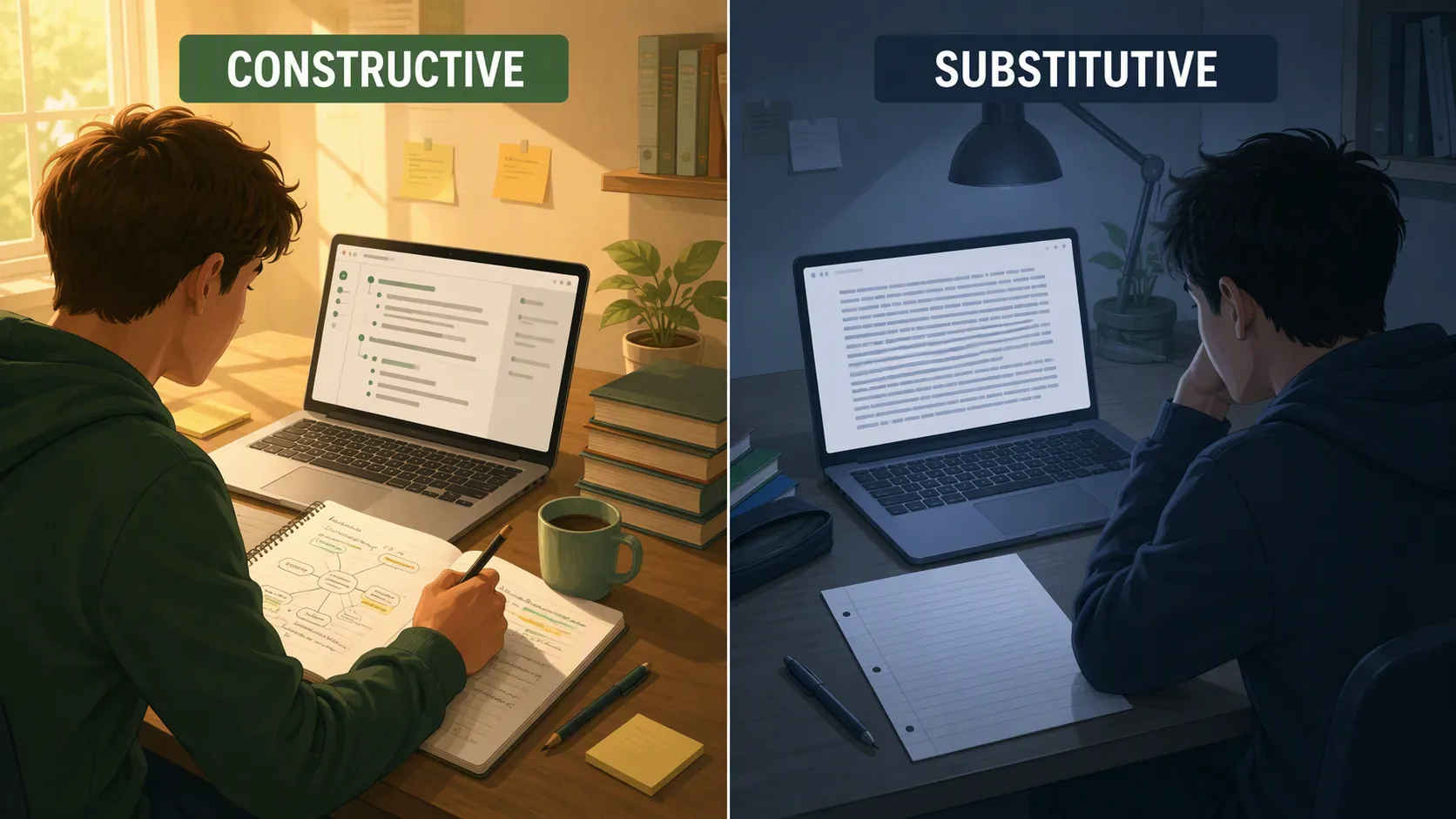
That replacement can feel deceptively educational. A full AI essay gives the student fluent transitions, clean paragraphing, and a thesis that arrives on time. It may even explain an issue in a way the student would not have reached alone. But reading a finished answer is not the same as choosing a position, deciding which evidence is worth using, noticing a weak assumption, and writing a second paragraph when the first one has already taken too long.
The trap is especially easy in timed writing because the deadline changes the psychology. A student who would never submit a copied research paper may still paste a model response into a practice document “just to see the structure,” then revise around it, then keep the best sentences, then start the next practice session by asking for another model. The visible product improves while the underlying skill may stay thin.
AI can approximate a strong exam essay
There is no need to pretend the outputs are always bad. A 2024 arXiv study evaluating AI-generated essays with the GRE Analytical Writing Assessment reported scores in the 4.0 to 5.0 range.[5] That does not mean a student who copies such an essay has developed 4.0-to-5.0 writing ability. It means the model can produce text that resembles competent exam writing under the scoring frame used in that study.
That distinction is the whole issue. A strong-looking sample can be useful when it exposes the shape of a task: how a claim is narrowed, how a paragraph stays tied to the prompt, how a concession is handled without surrendering the argument. It becomes corrosive when the sample supplies the student’s decisions for them.
Standardized writing tasks do not only test whether the final prose sounds mature. They test whether a student can produce an organized judgment on demand. In that setting, the important unit of practice is not the beautiful sentence. It is the move the student can repeat without help: framing the issue, choosing a side, anticipating an objection, explaining why an example matters, and leaving enough time to revise.
Useful ChatGPT practice leaves work in the student’s hands
There is good evidence that ChatGPT can support writing development when it is used as a feedback tool rather than a substitute writer. Mahapatra’s 2024 mixed-methods intervention study found that ChatGPT used for formative feedback significantly improved ESL students’ academic writing, with gains sustained at a two-month delayed post-test.[6] Again, that is not a direct timed-test study. But it supports the practice pattern that matters for exam prep: the student drafts, the tool responds, and the student revises.
For essay practice, that means ChatGPT is most valuable after the student has made an attempt or before the student has outsourced the central decision. The safer uses are not glamorous, but they build the muscles that a timed exam actually calls on.
- Ask for thesis feedback: “Is my claim specific enough to guide the essay, and does it answer the prompt?”
- Pressure-test an outline: “Which paragraph is weakest, and what assumption does it depend on?”
- Drill counterarguments: “Give me two objections to my position, but do not write the essay for me.”
- Diagnose revision priorities: “Rank the top three changes that would improve clarity, organization, and support.”
- Practice timing decisions: “What should I cut if I have five minutes left?”
Those prompts keep the student in charge of the argument. ChatGPT becomes a reader, examiner, sparring partner, or revision coach. It can still be wrong, generic, or too agreeable, so the student has to judge the advice. That friction is part of the benefit.
The danger-zone prompt is easy to recognize
The risky prompt usually asks for a complete answer before the student has done the hard part: “Write a high-scoring essay on this prompt.” Sometimes it is softened with “for inspiration,” “as a model,” or “I’ll adapt it.” The wording changes; the dependency is the same.
| If the student asks ChatGPT to... | Likely effect on practice |
|---|---|
| Critique a thesis the student already wrote | Useful: the student still owns the claim |
| Find weaknesses in a student-made outline | Useful: the student still builds the structure |
| Generate counterarguments without drafting the response | Useful if the student answers them in their own words |
| Rewrite a paragraph after the student identifies the problem | Mixed: useful for comparison, risky if copied |
| Produce a full essay to adapt | Risky: the model supplies the argument and prose |
A simple test helps: if ChatGPT disappeared after the practice session, would the student know how to do the next essay better? If the answer is yes, the tool probably supported learning. If the answer is no, the session may have produced a better document without producing a better writer.
What to do differently after the mimicry block
Not much changes mechanically. Students who were using ChatGPT for feedback can keep doing that. Students who were using it to generate full model essays can still do that without famous-author names. The July 2026 block removes one conspicuous style prompt, not the broader ability to produce polished, exam-like prose.
The better adjustment is to change the workflow. Draft first when possible. If time is limited, at least outline first. Ask ChatGPT to challenge the plan before asking it to improve wording. When it gives a sample sentence, treat that sentence as a comparison point, not as material to paste. When it gives a full paragraph, ask what moves the paragraph is making, then close it and reproduce those moves in your own words.
For GRE, SAT, and ACT-style writing practice, the useful boundary is plain: feedback, diagnosis, counterargument practice, and revision coaching can make a student more capable. Full-essay generation can make a practice file look better while leaving the student underprepared for the next blank screen. OpenAI’s author-mimicry block changes little about that. The student’s workflow changes almost everything.
References
- ChatGPT now refuses to mimic famous authors, The Verge, Jul. 28, 2026
- OpenAI Quietly Bans Author Mimicry in ChatGPT, but a Simple Loophole Remains, IBTimes UK, 2026
- AI Can Mimic Students' Writing Styles. How Are Teachers Supposed to Catch Cheaters Now?, Education Week, Dec. 2023
- Perceptions vs. practices: academic integrity and actual ChatGPT use among EFL students, Frontiers in Psychology, Mar. 2026
- Evaluating AI-Generated Essays with GRE Analytical Writing Assessment, arXiv, 2024
- Impact of ChatGPT on ESL students' academic writing skills: a mixed methods intervention study, Smart Learning Environments, 2024
Related exhibits & inventory
Verified outcomes
Planners
No planner filed for this exam yet
A downloadable timeline template for this exam hasn't been published yet.
Tool verdicts
AI-tool cautions
No AI tools tested for this exam yet
No hands-on AI-accuracy logs have been filed for this exam.
Questions about this plan
Ask a question about a specific section, timeline, or citation in this plan — or flag something that needs correcting.
Comments
Join the discussion with an anonymous comment.