How AI Addiction Is Sabotaging Your Study Habits
Accuracy Warning — ChatGPT
AI study addiction inflates practice scores but reduces closed-book exam performance due to cognitive offloading.
- Accuracy:
- Moderate
- Tested:
- AI-assisted practice problem solving
- Last tested:
- 2026-07-28
The uncomfortable finding is not that AI can help you get more practice questions right. It can. The problem is that some of the same help that raises your practice score can disappear on exam day and leave less stored in memory than your practice log suggested.
Current as of Q3 2026, the strongest warning comes from controlled study evidence, including a 2024 Bastani et al. pre-print involving about 1,000 high school students: AI-assisted students performed 48% to 127% better during practice, then performed significantly worse on later closed-book exams without the AI available.[1] For GRE, SAT, MCAT, ACT, and ASVAB prep, that is the risk that matters: the tool can make studying feel more successful while weakening the exact unaided retrieval the real test demands.
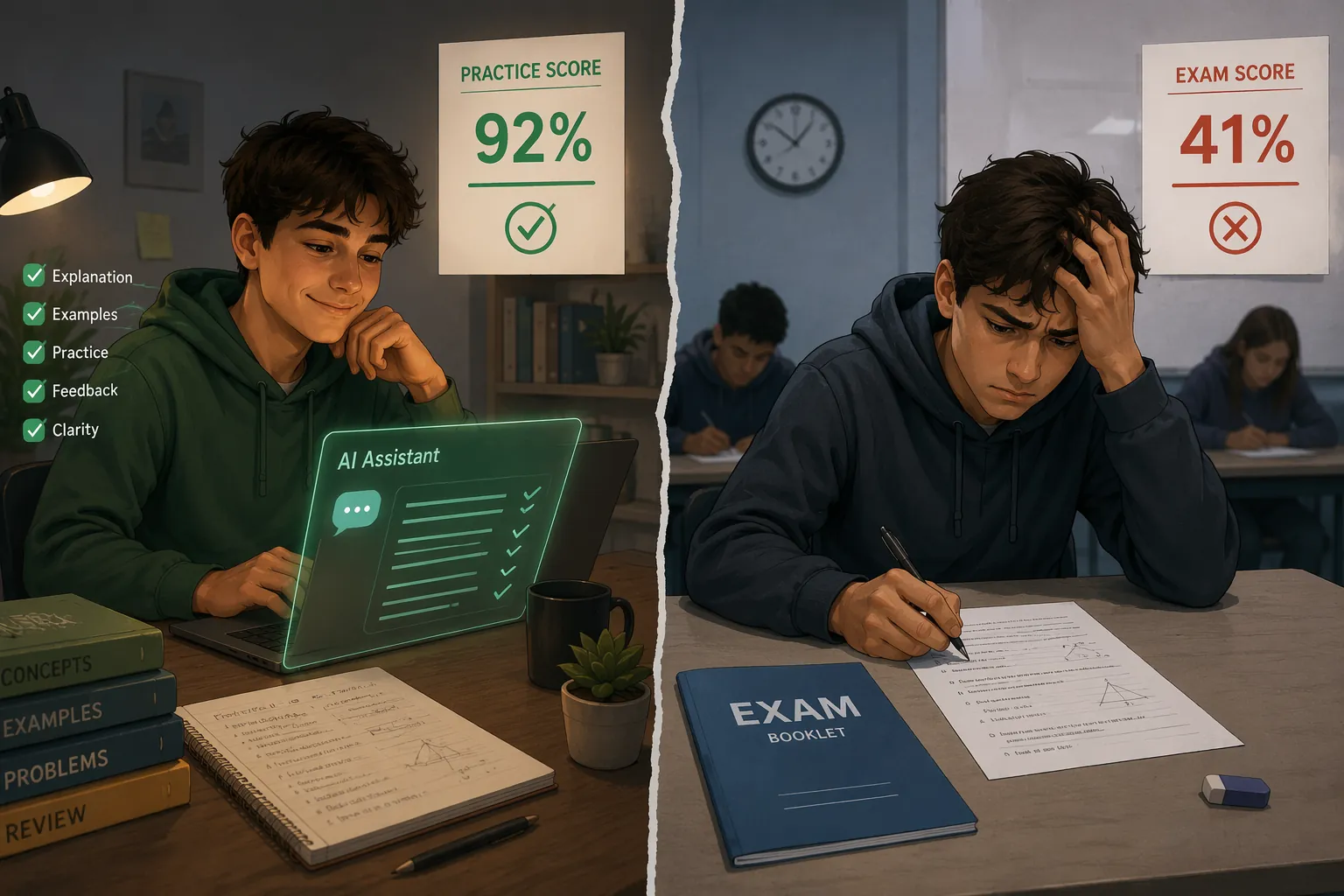
That does not make every AI study session harmful. It does make one standard non-negotiable: does the help you receive while studying survive when the help disappears?
The practice-score trap
A boosted practice score is persuasive because it looks like learning. You ask for an explanation, follow the reasoning, choose the right answer, and feel the fog lift. If you are under a test deadline, that feeling is hard to ignore. It is also easy to misread.
The Bastani pattern is worth taking slowly because it contains the whole danger in miniature. During practice, AI assistance improved output sharply. On a later closed-book exam, the advantage not only failed to transfer; the assisted students did worse. Evidence level: moderate but provisional, because the study is a pre-print and still awaits peer review. Still, the design points at the exact condition high-stakes test-takers face: no chatbot, no hint button, no instant worked solution, no chance to outsource the next step.[1]
That distinction matters more than whether the AI explanation was clear. A clear explanation can help after you have tried. It can also rob the attempt of its useful difficulty if it arrives too early. The practice session records a correct answer, but the student may not have done enough of the mental work that makes the answer retrievable later.
For exam prep, the question is not “Did AI improve this study block?” It is “What part of this study block did my brain actually have to perform without help?”
How AI offloading quietly changes the work of studying
Closed-book exams reward retrieval. They reward noticing what a question is asking, pulling the relevant rule or concept from memory, testing an answer path, catching an error, and deciding under time pressure. A lot of that work feels unpleasant. That is partly why it works.
AI assistance can remove exactly those frictions. It can supply the first step before you search for it. It can reword the question before you wrestle with it. It can generate a clean explanation before you have exposed your own misconception. It can give you the answer path before you have built one. Each of those interventions can be useful in the right place. Used too early or too often, they turn a retrieval task into a recognition task: you recognize that the explanation makes sense, but you did not have to produce it.
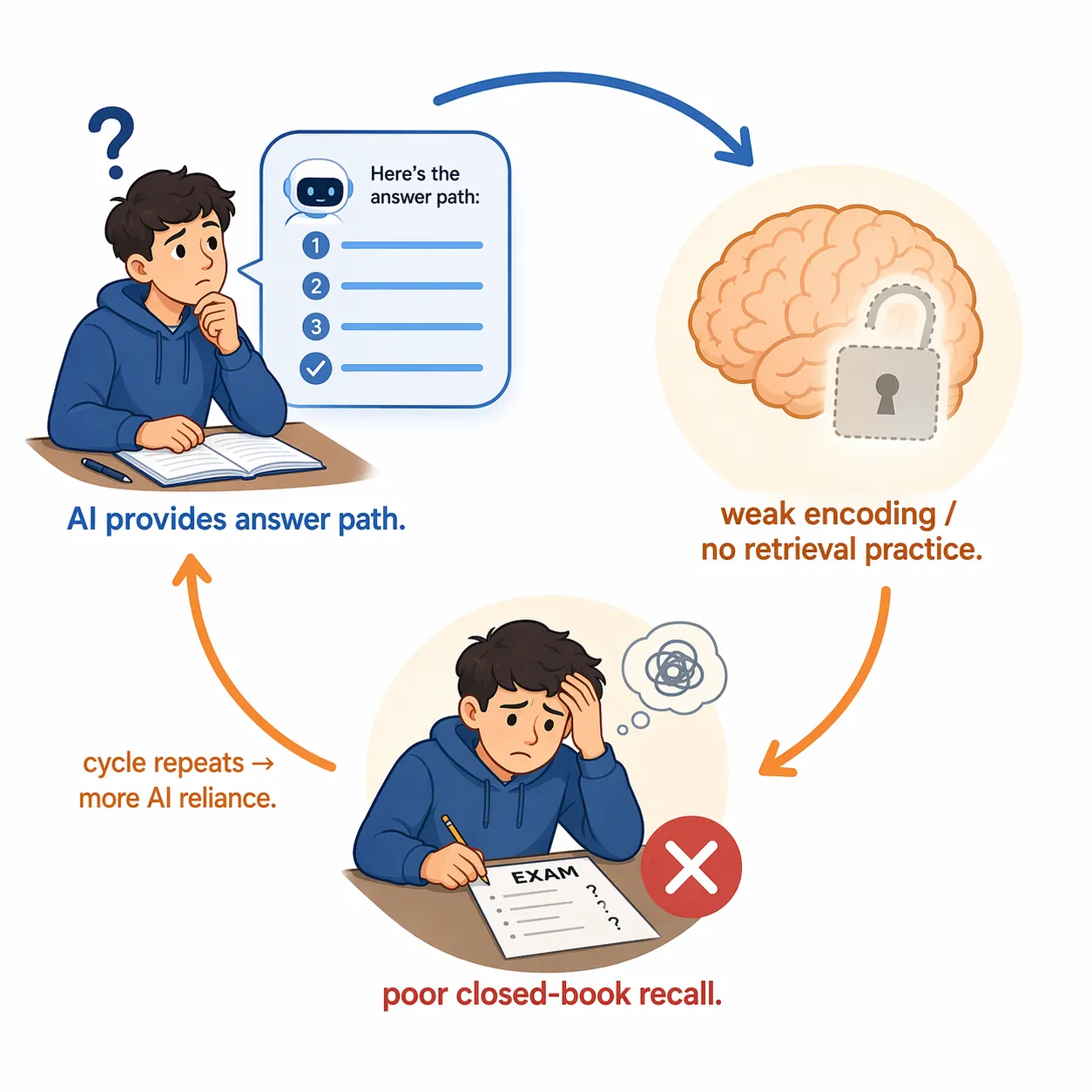
That is cognitive offloading in practical test-prep terms. The student completes the task, but the tool carries part of the mental load that the exam later asks the student to carry alone. The cost may stay hidden until the next unaided quiz, the next full-length practice test, or the official exam.
A University of Pennsylvania controlled study points in the same direction. ChatGPT users solved 48% more practice problems correctly, but then scored 17% lower on exams measuring concept understanding. Evidence level: moderate, controlled study, as reported in the AI-in-education synthesis cited below.[1] Again, the important split is not AI versus no AI in the abstract. It is assisted success versus later independent understanding.
This is why a smooth AI session can be a bad diagnostic. The more polished the help, the easier it is to confuse “I followed that” with “I can produce that under pressure.” Those are different abilities.
When useful help becomes a dependency pattern
The word “addiction” gets thrown around too loosely in education writing. For test prep, the useful definition is behavioral: repeated checking, failed attempts to cut back, continued reliance even after noticing skill damage, and a growing sense that unaided work is unusually hard.
Revesai’s 2025 study of 248 students at one Zimbabwean university gives those behaviors measurable shape. It found that 32.7% of students showed moderate-to-severe AI dependency; dependent users averaged 18.3 daily AI interactions; 65.8% reported failed attempts to reduce use; and 72.1% recognized negative skill impacts but continued using AI anyway. Dependent users also showed a 0.41 GPA deficit compared with non-dependent peers, with writing skill degradation mediating 31.3% of the GPA effect and critical-thinking atrophy mediating 34.7%. Evidence level: limited-to-moderate for U.S. test-takers, because the sample came from a single Zimbabwean university, but strong enough to show that dependency is not just a vibe.[2]
For a student preparing for the MCAT or SAT, the most relevant part is not the GPA number. It is the failed reduction pattern. If you keep opening AI even when you planned to do a closed-book set, the habit has started to interfere with the training condition. If you cannot tolerate five minutes of being stuck without asking for a hint, your study environment no longer resembles your test environment.
Lan et al.’s 2026 study of 412 Chinese university students widens the pattern. Using the I-PACE model, the study found serial mediation from perceived usefulness to AI dependence to AI addiction to learning burnout, with all chain-mediation paths statistically significant at p<0.01. AI addiction predicted learning burnout at β=0.49, p<0.001. Evidence level: limited for U.S. exam-prep generalization because the sample was Chinese university students, but useful for understanding how “this tool helps me” can become “I feel unable to study without it.”[3]
That progression is easy to recognize in ordinary study behavior. At first, AI saves time on one confusing problem. Then it becomes the default source for every explanation. Then the student stops writing predictions before checking. Then missed questions turn into conversations instead of retrieval drills. Eventually, unaided study feels slower, uglier, and less rewarding, even though it is the part that most resembles exam day.
Faculty anxiety is not the main evidence, but it is not irrelevant
Faculty surveys cannot prove that AI lowers your test score. They measure concern, not exam transfer. Still, they show that the same overreliance pattern is visible to instructors at scale.
In a 2026 AAC&U and Elon University survey of 1,057 faculty members, 95% said generative AI increases student overreliance, 90% said it diminishes critical thinking, and 62% expected learning outcomes to worsen over the next five years. Evidence level: contextual survey evidence, not direct performance evidence.[4]
That context should not replace the controlled practice-to-exam studies. A nervous professor is not the same thing as a measured score drop. But when instructor observations line up with controlled evidence and dependency studies, the burden shifts. A student using AI heavily during prep should not assume that smoother study is harmless until an unaided test proves it.
The evidence is strong enough to change behavior, not strong enough for panic
There are caveats. The Bastani result is a pre-print. The Revesai dependency study comes from one Zimbabwean university. Lan et al. studied Chinese university students. A Corvinus University experiment involving 95 students reported knowledge levels 20 to 40 percentage points below pre-AI cohort baselines when AI was freely permitted, but the design was complicated by a last-minute group merger after student protests, so it should be treated as suggestive rather than clean causal proof.[1]
Those limits matter. They prevent a lazy conclusion like “AI always damages learning.” The better conclusion is narrower and more useful: AI becomes dangerous when it replaces retrieval, struggle, error correction, and closed-book practice. Those are not decorative parts of studying. They are the training conditions for the exam.
The same tool can occupy a safer role if it is moved later in the sequence. Try the problem first. Write the answer path first. Commit to an explanation first. Then use AI to compare reasoning, expose a misconception, generate another example, or explain why a tempting answer is wrong. In that order, the tool supports feedback instead of stealing the retrieval attempt.
| AI use during study | Likely exam-prep risk |
|---|---|
| Asking for the answer before making an attempt | High: replaces retrieval and error detection |
| Asking for a hint after a timed attempt | Lower: preserves some struggle, but can still become a crutch |
| Using AI to review why your chosen answer was wrong | Lower: can improve feedback after retrieval has happened |
| Using AI to generate similar practice after you understand the solution | Potentially useful: depends on whether you solve the new items unaided |
| Using AI during every practice block, including timed sets | High: makes practice conditions unlike exam conditions |
A simple test for whether AI is helping your score
Do not judge your AI workflow by how many questions you get right with the tool open. Judge it by what happens when the tool is gone.
- Can you redo a missed problem 24 to 48 hours later without AI help?
- Can you explain the rule, concept, or passage logic before reading the AI explanation?
- Can you complete timed sets with no hints, no rewording, and no answer checking until the end?
- Do your closed-book practice-test results rise along with your AI-assisted practice performance?
- Can you study when the tool is unavailable, or does the session collapse?
If the answer is no, the problem is not that you used AI. The problem is that AI has moved from feedback into substitution. At that point, it is training you to perform with an external support system that your exam will not provide.
This is also where tool selection matters, but not in the usual “which chatbot is smartest?” sense. The safer question is whether the tool protects active recall and spaced repetition, forces an attempt before explanation, and keeps full-length practice closed-book. StudyMethod’s related guides on AI study tools that teach instead of just giving answers, AI tools versus traditional study tools, and what to do when ChatGPT goes down during exam prep are better places to sort through specific workflows.
For high-stakes exams, a study aid has to survive transfer. If an AI tool makes you look better during practice but leaves you less able to answer without it, it is not helping your preparation. It is borrowing performance from exam day.
References
- How AI Vaporizes Long-Term Learning, Edutopia
- AI dependency and academic performance among university students, Taylor & Francis Online, 2025
- Perceived usefulness, AI dependence, AI addiction and learning burnout among university students, Frontiers in Computer Science, 2026
- National Survey: 95% of College Faculty Fear Student Overreliance on AI and Diminished Critical Thinking Among Learners Who Use Generative AI Tools, AAC&U, 2026
Authoritative source
For the authoritative version of this contentHow to Read the '1 in 4 NFL Players CTE' Study
Report an error in this tool's output
Found something this tool got wrong beyond what's documented above? Report it so the accuracy log stays current.
Comments
Join the discussion with an anonymous comment.