
MCAT Exam Hub
Can a 12-Week MCAT Study Plan Deliver a 520+ Score?
This article evaluates whether a structured 3-month MCAT study plan—divided into a 6-week content phase followed by a 6-week practice phase with weekly full-length exams and a missed-question log—can realistically produce score improvements from ~500 to 515–520+ when executed consistently at ~25 hours per week.
- gre
- mcat
- asvab
- sat
- act
- digital-adaptive
- official-material
- section-strategy
- test-date-timeline
Yes, a 12-week MCAT plan can be a serious attempt at moving from roughly a 500 diagnostic into the 515–520+ range. It is not a casual plan, and it is not a score guarantee. The version worth considering in Q3 2026 asks for about 25 hours per week, usually landing around 300–350 total logged hours, with a clear shift from content-heavy study to practice-heavy study halfway through the schedule.[1]
The evidence label matters before the calendar does. The hour target and 6-week/6-week structure come from expert-designed MCAT methodology, not a controlled trial proving that this exact schedule causes a 520+. The Anki evidence is stronger, but it comes from medical-school exam performance, not MCAT score outcomes. The weak-section prioritization claim is useful, but still closer to expert observation than experimental proof. That is enough to build a demanding plan around, not enough to promise a result.

The Commitment Test Comes First
A student starting near 500 usually has two problems at once: unfinished content and untrained passage reasoning. A beautiful calendar can hide both. The more honest question is whether the student can protect enough time to let the calendar create feedback: full-length exam, review, weak-section adjustment, targeted practice, then another full-length.
At 25 hours per week, the schedule has room for content review, UWorld blocks, Anki maintenance, full-length exams, and review days. At 12–15 hours per week, the same 12-week calendar starts to become decorative. Something gets silently cut, and it is usually the thing that hurts most: reviewing missed questions deeply enough to change the next week.
| Claim | Evidence Strength | How to Use It |
|---|---|---|
| 300–350 total hours is a realistic floor for this kind of score push. | Moderate-to-high: expert synthesis, not a controlled score trial. | Treat it as a workload requirement, not a motivational estimate. |
| Six weeks content-heavy, then six weeks practice-heavy is a reasonable 3-month structure. | Moderate: expert-designed methodology. | Use it to avoid hiding in content review until the final month. |
| Anki can improve retention and exam performance when used consistently. | High for the cited medical-school cohort; limited for direct MCAT prediction. | Use it for retention, not as a substitute for passage practice. |
| Weak-section prioritization can beat equal time distribution. | Limited-to-moderate: expert observation from a 520+ scorer source. | Let misses and full-length data decide where the next hours go. |
The 12-Week Structure That Is Actually Plausible
The clean version is a 6-week content phase followed by a 6-week practice phase. In the first half, about 70% of study time goes to content and 30% to practice. In the second half, that flips to about 30% content and 70% practice. Shemmassian’s 3-month schedule uses this kind of phased structure and also emphasizes full-length exams rather than delaying test simulation until the end.[1]
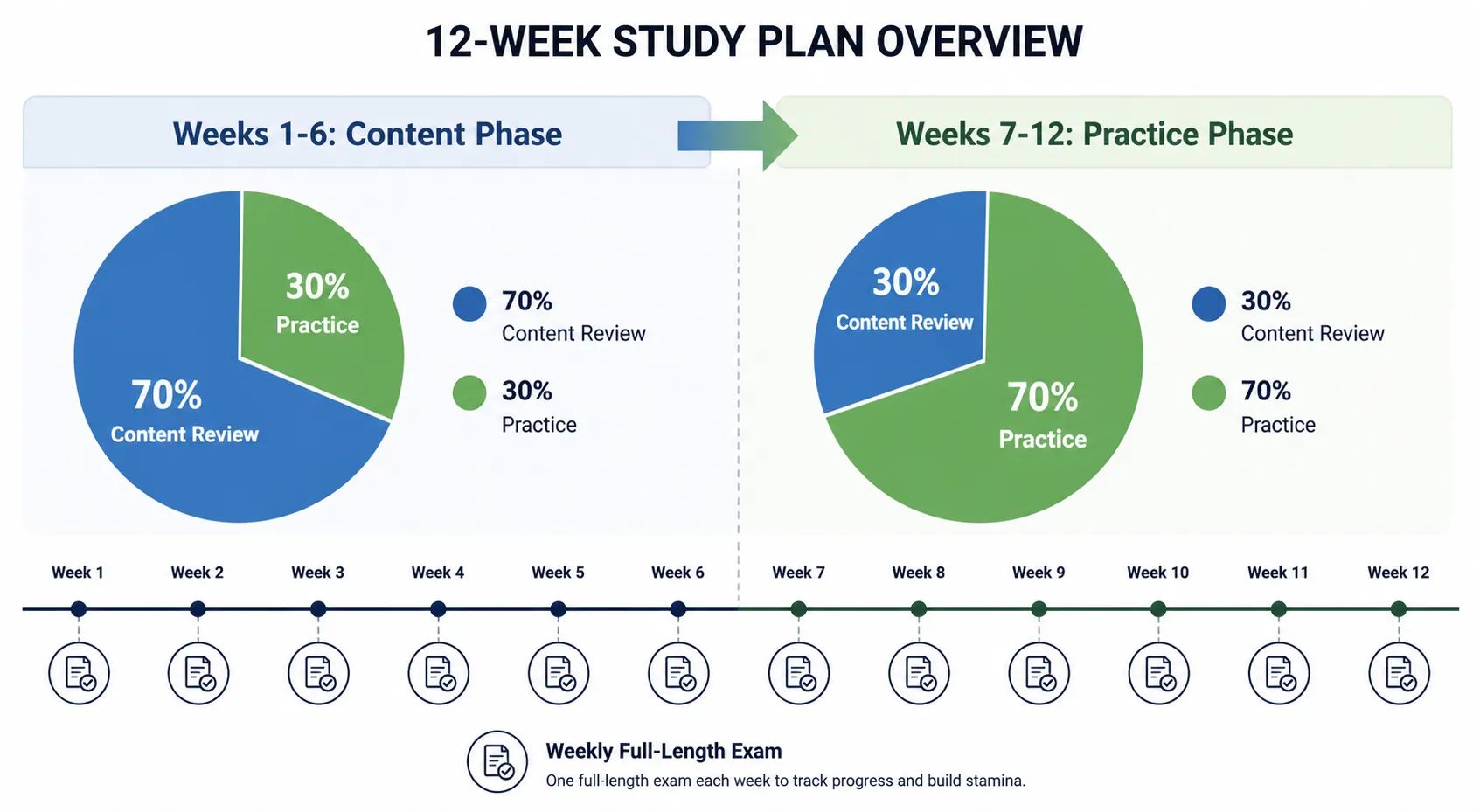
That split is not magic. It is a guardrail. The first six weeks give a student permission to repair content gaps without pretending that flashcards alone are MCAT prep. The last six weeks force the student to stop waiting until they feel ready. Passage timing, stamina, question interpretation, and trap recognition only improve when practice becomes the center of the week.
| Weeks | Main Job | Approximate Time Split | Non-Negotiable Output |
|---|---|---|---|
| Weeks 1–2 | Diagnostic repair and high-yield content mapping | 70% content / 30% practice | A missed-question log with patterns, not just wrong answers |
| Weeks 3–4 | Content coverage plus passage exposure | 70% content / 30% practice | UWorld blocks tied to the weakest sections |
| Weeks 5–6 | Finish first-pass content and increase exam realism | 60–70% content / 30–40% practice | A ranked weak-section list before the practice phase begins |
| Weeks 7–9 | Practice-heavy correction | 30% content / 70% practice | Weekly full-lengths with full review |
| Weeks 10–11 | AAMC simulation and precision review | 30% content / 70% practice | AAMC-style timing decisions and fewer repeated error types |
| Week 12 | Taper, review, and test-day execution | Targeted review only | No last-minute content binge replacing rest and review |
A minimum full-length target of 5 AAMC exams plus 2–3 third-party exams is commonly recommended for building test-day stamina across the 7.5-hour MCAT format.[1] That does not mean every third-party score should be treated as destiny. It means the student needs repeated exposure to the physical and cognitive demand of the exam before the score report counts.
Weeks 1–6: Content Review Without Disappearing Into Content Review
The first half of the plan should feel content-heavy, not content-only. A student near 500 probably has real gaps in biochemistry, general chemistry, physics equations, psychology/sociology terms, CARS timing, or experimental reasoning. Those gaps deserve direct study. They do not deserve six weeks of rereading with no passages attached.
A workable weekly rhythm in the first six weeks looks like this: three to four content blocks, two to three UWorld or passage blocks, daily Anki review, and one longer weekly review session where the student updates the missed-question log. If a full-length is scheduled that week, the full-length and its review replace other work; they do not get stacked on top of an already full schedule.
- Content blocks should end with questions, not notes. A biology chapter becomes useful when the student can answer passage questions under pressure.
- Anki cards should be created or unsuspended from missed facts, recurring equations, definitions, pathways, and confusing contrasts.
- CARS should appear early enough to expose timing habits, even if the student would rather wait until sciences feel stronger.
- The weekly review should identify error categories: content gap, misread passage, wrong equation, timing pressure, trap answer, or reasoning jump.
This is also where cross-section topics earn attention. A topic like hormone signaling can show up as molecular biology, physiology, biochemistry, and data interpretation. Studying it only as a memorized pathway leaves points on the table. For implementation examples, the broader MCAT study prep hub is a better place to handle tool setup than this score-outcome article.
Weeks 7–12: Practice Becomes the Center of the Week
The second half is where many 520+ dreams either become plausible or quietly collapse. The student has to tolerate seeing weaknesses in public, so to speak: full-length scores, section breakdowns, timing problems, and repeated misses written down where they cannot be rationalized away.
During these six weeks, UWorld and AAMC materials should do most of the teaching. UWorld is useful because it forces application and gives detailed explanations. AAMC materials are necessary because they represent the closest available simulation of official style. Anki remains in the schedule, but it should no longer be allowed to consume the best study hours of the day.
| Day Type | What Happens | What Gets Logged |
|---|---|---|
| Full-length day | Take the exam under realistic timing and break conditions. | Section scores, timing breakdown, endurance issues, and flagged guesses. |
| Review day | Review every missed and guessed question before doing new practice. | Error type, content tag, reasoning mistake, and next action. |
| Targeted practice day | Do UWorld or AAMC blocks in the weakest current area. | Accuracy, timing, repeated traps, and card-worthy facts. |
| Content patch day | Repair only the content that recent practice exposed. | Specific topic, source used, and follow-up question set. |
| Taper/recovery day | Keep Anki light, review high-yield notes, and protect sleep. | Only urgent repeated misses; no panic expansion. |
The plan gets worse when students treat every section equally out of fairness. Equal time feels organized, but the MCAT does not reward fairness. If Chem/Phys is ten points behind the other sections, the next week should not give Chem/Phys the same number of hours as a comfortable Psych/Soc section. Inspira’s 520+ scorer schedule reports that students who prioritize their weakest section may see 3–5 more points of improvement than those who divide time evenly, though that should be read as expert observation rather than controlled evidence.[2]
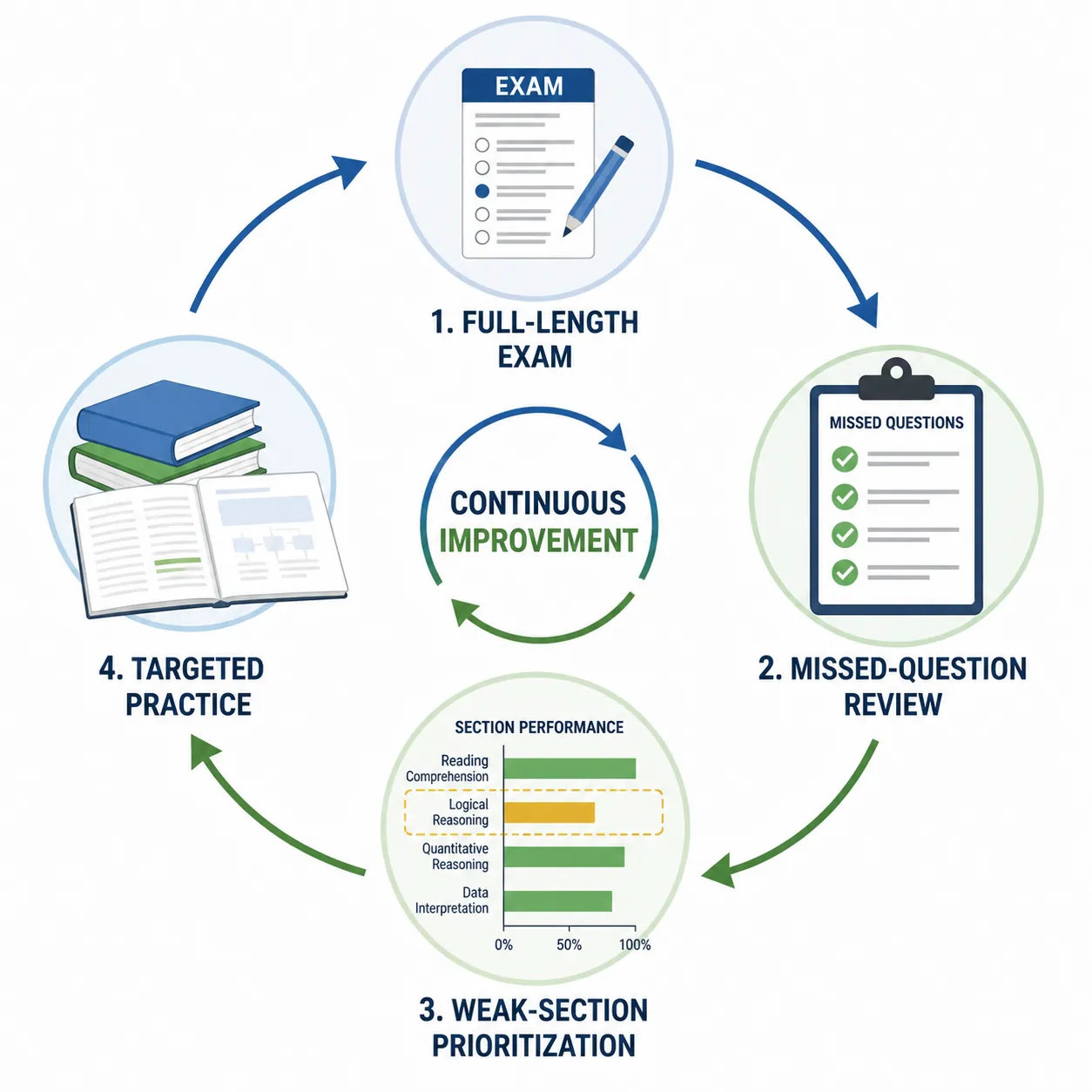
The Missed-Question Log Is the Engine, Not an Extra
A missed-question log is not a spreadsheet for guilt. It is the mechanism that decides tomorrow’s work. Without it, a student often studies the topic that feels productive or familiar. With it, the student can see that the real leak is not “physics” but units, graph interpretation, electrostatics equations, or rushing the last two questions of every passage.
The log should be specific enough to change behavior. “Forgot amino acids” is better than nothing, but “confused polar uncharged vs. charged side chains in a passage about enzyme binding” is actionable. That entry can become a short Anki card, a targeted content review, and a small UWorld set. One miss produces three follow-up actions only when the student names the miss accurately.
| Log Field | Useful Entry | Bad Entry |
|---|---|---|
| Source | AAMC FL review, Chem/Phys passage | Practice |
| Error type | Used the right equation but converted units incorrectly | Careless |
| Content tag | Fluids: pressure, density, height relationship | Physics |
| Reasoning fix | Write units before substituting numbers | Be more careful |
| Follow-up | Do 10 targeted fluid questions and make one equation card | Review later |
The log also protects the student from ego-friendly review. If Psych/Soc feels comforting because the student can fly through terms, but the log shows repeated Bio/Biochem experimental design errors, the next serious block belongs to Bio/Biochem. For students who need a card-making workflow, the site’s guide to turning MCAT practice questions into high-value flashcards is the right place to go deeper.
Where Anki Helps, and Where It Starts Wasting Time
Anki has better evidence behind it than most study tips, but that does not make it the main character of a 520+ plan. In a 2023 cohort study at Wright State University’s Boonshoft School of Medicine, Gilbert et al. studied 130 medical students and found that Anki users scored 6.2–12.9% higher on standardized exams than non-users, even after controlling for baseline MCAT percentiles. High-dependency users also outperformed low- and medium-dependency users by 4.6–18.5 points, with p < 0.01.[3]
That is meaningful, but the boundary is just as important as the result. The study was conducted at one institution in an integrated, non-lecture curriculum, and the authors note possible selection bias: motivated students may be more likely to use Anki heavily. Medical-school standardized exams are also not the same as the MCAT, especially when the MCAT is asking students to reason through unfamiliar passages rather than recall isolated facts.[3]
For MCAT purposes, Anki earns its place when it keeps memorization from leaking: amino acids, equations, units, hormones, lab techniques, psychology terms, sociology definitions, biochemistry pathways, and common contrasts. It loses its place when a student spends two hours polishing cards and then skips passages because the daily streak feels like enough.
- Use Anki daily, but cap it tightly enough that UWorld and AAMC practice still happen.
- Make cards from repeated misses, not from every sentence in a prep book.
- Keep cards short enough to answer quickly and honestly.
- Delete, suspend, or rewrite cards that create recognition without recall.
- Do not count Anki review as passage practice.
Students who are still setting up their deck should use a dedicated Anki-for-MCAT setup guide rather than reinventing settings in the middle of a 12-week score push. If the problem is not setup but avoidance, the more relevant read is the guide to Anki mistakes that keep MCAT scores in the low 500s.
What a 25-Hour Week Can Look Like
A 25-hour week does not need to be elegant. It needs to be protected. The exact distribution should change after every full-length, but the baseline can be simple enough to follow while tired.
| Study Element | Content Phase Weekly Hours | Practice Phase Weekly Hours |
|---|---|---|
| Content review | 10–12 | 4–6 |
| UWorld or passage practice | 5–7 | 8–10 |
| Anki retention | 3–4 | 3–4 |
| Full-length exam or section exam | 0–7 depending on week | 7–8 |
| Full-length or missed-question review | 3–5 | 5–7 |
The table should not be used as a permission slip to ignore the data. If the missed-question log shows that CARS timing is collapsing, the week changes. If a student keeps losing Bio/Biochem points on passage-based experimental design, more hours go there even if the content plan says physics was next. The plan is a feedback system, not a school timetable.
The tool stack is straightforward: Anki for retention, UWorld for application, and AAMC materials for simulation. Inspira also frames this pairing as a practical strategy for high-score preparation, while Shemmassian’s schedules emphasize the full-length structure needed to make the final weeks realistic.[1][2] For a fuller implementation map, use the MCAT workflow for integrating Anki, UWorld, and AAMC instead of trying to turn this article into a software tutorial.
When the 520+ Target Is Realistic Enough to Pursue
A jump from around 500 to 515–520+ in three months is ambitious. It is most plausible when the diagnostic reflects underprepared content and untrained timing, not years of repeated plateauing after strong prep. It is also more plausible when the student can actually log the work: 300–350 hours, weekly exams in the second half, complete review of misses, and a willingness to spend the next block on the weakest section.
The target becomes less realistic when the student keeps delaying practice, refuses to review every miss, treats Anki as the main study event, or builds a schedule around ideal weeks that do not exist. A fixed test date is unforgiving. If school, work, family responsibilities, or burnout make 25 hours per week impossible, the honest move is to adjust the target, extend the timeline if possible, or accept that the plan is now a riskier attempt.
So the answer is not that a 12-week MCAT study plan delivers a 520+ score. The answer is that this specific kind of 12-week plan can make a 515–520+ outcome realistic enough to pursue if the student protects the hours, shifts into practice early, reviews every miss, and lets weak-section data override whatever feels easiest to study next.
References
- The Ideal MCAT Study Schedule (1 Month | 2 Months | 3 Months | 4 Months | 6 Months), Shemmassian Consulting
- Free MCAT Study Schedules From 520+ Scorer [1-6 Months], Inspira Advantage
- A Cohort Study Assessing the Impact of Anki as a Spaced Repetition Tool on Academic Performance in Medical School, PMC, 2023
Related exhibits & inventory
Verified outcomes
Planners
No planner filed for this exam yet
A downloadable timeline template for this exam hasn't been published yet.
Tool verdicts
Questions about this plan
Ask a question about a specific section, timeline, or citation in this plan — or flag something that needs correcting.
Comments
Join the discussion with an anonymous comment.