AI Hallucination Checklist for Students
Accuracy Warning
This tool's exam-prep accuracy has not been fully characterized.
The embarrassing part is not that an AI answer can be wrong. The embarrassing part is that it can be wrong while looking more organized than anything in your class notes.
In one controlled study of 211 economics and management students at a UK business school, only 20% of students successfully identified hallucinations in AI-generated material.[1] That is not a universal student failure rate, and it does not mean every class or every tool behaves the same way. It does mean the trap is real: fluent text can beat your suspicion before you have checked a single source.
This is why an AI hallucination checklist for students has to be practical, not dramatic. The question is not “Can ChatGPT, Gemini, Claude, NotebookLM, or a PDF summarizer hallucinate?” Yes, they can. The better question is: what do you check before the answer becomes notes, flashcards, a source list, or something you submit?
Why confident AI answers feel safer than they are
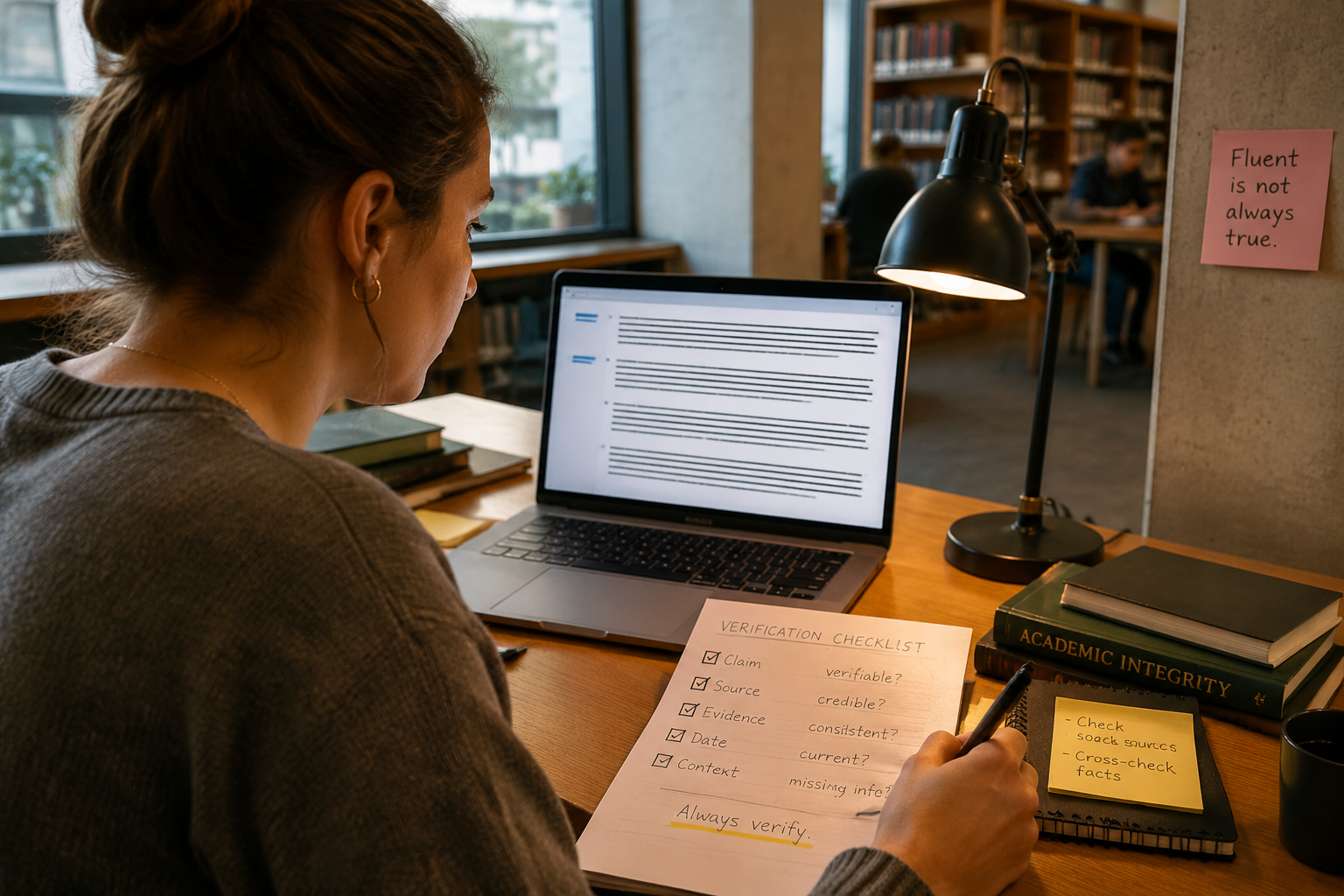
Large language models are very good at producing sentences that feel finished. They add headings, transitions, definitions, examples, and sometimes citations. That polish creates a fluency-truth problem: people tend to trust information more when it is easy to read, even before they have verified it. Duke University Libraries warned that this is still a live problem in 2026, and a thematic analysis of student experiences found that students often trust AI output because it sounds authoritative.[2][3]
That is exactly how a bad fact gets into a study group doc. Nobody means to make the review deck worse. Someone asks for a summary, the answer looks clean, and the group moves on. Three days later, somebody is memorizing an invented date, a distorted definition, or a citation that does not exist.
AI study tools are now part of ordinary student routines, as covered in How AI Changed Online Study Tools. That makes verification less like a special research skill and more like washing your hands before lab: quick, boring, and extremely worth doing.
The six-point AI hallucination checklist
Use this as a fast pass over any AI-generated study material. For ordinary notes, it can take under two minutes once you know what you are looking for. For citations, formulas, graded work, or anything you will teach to other people, slow down.
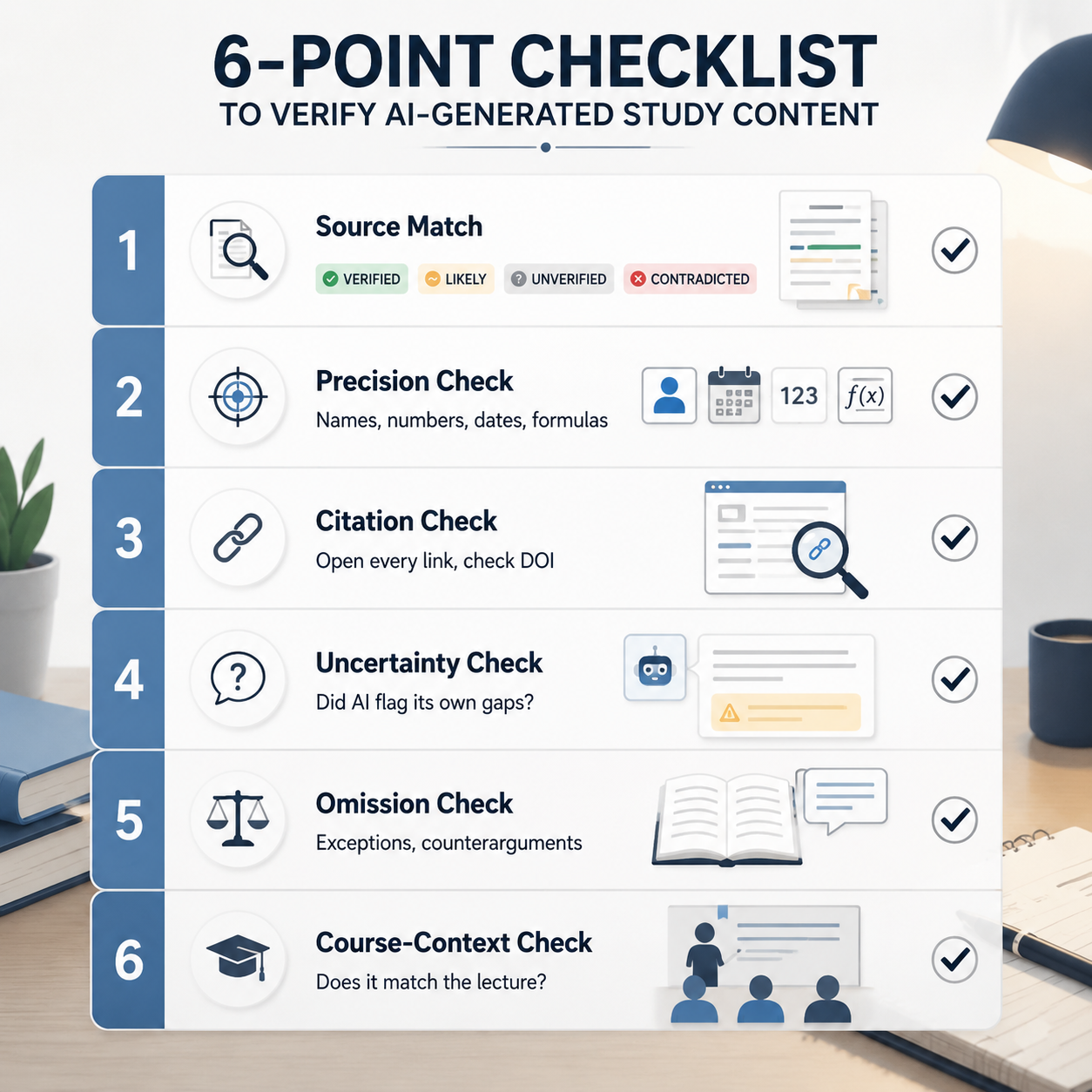
| Check | What you are trying to catch |
|---|---|
| 1. Source match | Claims that do not appear in the assigned source, slide deck, article, or textbook section |
| 2. Precision check | Wrong names, numbers, dates, formulas, definitions, labels, or sequence of steps |
| 3. Citation check | Fake, distorted, mismatched, or irrelevant references |
| 4. Uncertainty check | Overconfident answers where the tool should have admitted a gap |
| 5. Omission check | Missing exceptions, counterarguments, limitations, or required steps |
| 6. Course-context check | Material that may be generally true but does not match how your instructor framed the topic |
The checklist draws on student-facing verification guidance, research-summary verification checklists, and hallucination-prevention guidance that all point in the same direction: do not judge AI output by style; compare it against a trusted source, the task, and the exact claim being made.[4][5][6]
1. Source match: label every important claim
Start with the assigned material, not the AI answer. If you have a textbook chapter, lecture slides, a PDF, a lab manual, or a professor-approved article, keep it open beside the output. Then label the important claims.
- Verified: the claim clearly appears in the assigned or trusted source.
- Likely but needs context: the claim sounds compatible, but the source uses different framing or leaves out part of the idea.
- Unverified: you cannot find the claim in the material you are supposed to use.
- Contradicted: the source says something different from the AI output.
That last label matters. If the AI gives you a smooth explanation that contradicts your lecture slides, the slides win until you have a reason to ask your instructor. Do not average them together and hope the truth is somewhere in the middle.
This check works best when you actually have course materials nearby. If you are learning a brand-new topic from scratch and have no syllabus, assigned reading, slides, or trusted source, the checklist becomes weaker. In that case, treat the AI answer as a map of possible search terms, not as notes.
2. Precision check: inspect the parts students actually memorize
AI errors are most dangerous when they land on the parts you later repeat exactly: names, numbers, dates, formulas, legal tests, anatomical terms, theorist labels, theorem conditions, and step order. A paragraph can be mostly right and still ruin your flashcard deck with one wrong coefficient or swapped author.
Run your eyes over the output looking only for precision items. Ignore the prose for a moment. Circle or highlight anything exact. Then ask: can I point to this exact item in the course source?
- Numbers: statistics, sample sizes, percentages, dates, page ranges, equation values.
- Names: researchers, cases, authors, institutions, concepts, models.
- Formulas: variables, signs, assumptions, units, and when the formula applies.
- Sequences: lab steps, proof steps, historical order, clinical or legal tests.
For a quick study summary, this check may take thirty seconds. For math, chemistry, accounting, coding, statistics, or any class where a small symbol changes the answer, it deserves more time.
3. Citation check: never trust a reference because it looks academic
Fake citations are especially irritating because they often look like the most responsible part of an AI response. A made-up journal title, plausible author list, and neat DOI can pass the “looks scholarly” test while failing the “exists in the world” test.
In one study of AI-generated references, GPT-3.5 produced hallucinated citations at a rate of 39.6%, while GPT-4 produced them at 28.6%.[7] Sourcely’s 2026 analysis reported that only 26.5% of AI-generated references were completely accurate, and it described fully fabricated references as appearing at a 25–40% rate in its analysis.[8] Those figures should not be treated as the rate for every tool or every assignment, but they are enough to justify a hard rule: open the source before it enters your bibliography.
Citation hallucinations usually fall into a few recognizable patterns. Sourcely describes fully invented sources, chimera sources that stitch real and fake metadata together, distorted sources with altered titles or authors, and ghost sources that point toward something real but cannot actually be found as cited.[8]
- Resolve the DOI or URL. If the DOI does not work, do not shrug and keep it.
- Search the exact title in a library database, Google Scholar, Crossref, or the publisher site.
- Cross-check the metadata: authors, year, journal or book title, volume, issue, and page range.
- Confirm the claim. A real source is still not useful if it does not support the sentence you attached it to.
That fourth step is where a lot of messy student writing happens. The reference may exist, but the AI may have used it for the wrong claim. If your paper says a study proves one thing, open the study and check whether it actually says that thing. If you need a slower source-checking process, use a citation generator that checks sources instead of pasting AI references straight into your works cited page.
4. Uncertainty check: look for missing doubt
A good study answer should sometimes say “the source does not specify,” “this depends on the course definition,” or “I need the original passage to verify that.” If the AI gives a clean answer to a question that your materials treat as debated, conditional, or incomplete, pause.
This is not about making your notes timid. It is about marking the places where certainty would be dishonest. In literature, that might mean an interpretation is plausible but not the only reading. In biology, it might mean a mechanism differs by organism or condition. In economics, it might mean a model result depends on assumptions your instructor expects you to name.
5. Omission check: ask what the answer made too neat
Some AI mistakes are not false statements. They are missing pieces. The answer may skip an exception, flatten a counterargument, leave out a required step, or turn a conditional rule into a universal one.
Compare the AI output against the structure of the class material. If your professor spent ten minutes on limitations and the AI summary gives you only the main claim, the summary is not ready for review. If your lab manual says a step must happen before another step and the AI compresses them into one sentence, do not build a quiz card from that version.
6. Course-context check: make sure it sounds like your class
AI often gives the broad textbook version. Your course may use a narrower definition, a different notation system, a specific case study, or a professor’s preferred framing. That difference matters because exams usually reward the course version, not the internet’s most common version.
Check vocabulary first. Does the answer use the same terms your instructor uses? Then check emphasis. Does it spend space on the examples your class actually discussed? Finally, check format. If your professor wants a particular proof method, citation style, diagram label, or problem-solving setup, the AI output needs to match that expectation before you study from it.
This is also an academic integrity issue. A hallucinated source or unsupported claim can create problems even when you had no intention of cheating. If you use AI in graded work, pair this checklist with an ethical AI studying guide so you know what your course allows before the deadline panic starts.
Where students should check hardest
You do not need to spend equal energy on every sentence. The thematic analysis of student AI use points to several areas where hallucinations are especially likely to deceive students: summaries, citations, math and formulas, flashcards, and writing feedback.[3]
Summaries
AI summaries are useful for turning a dense reading into a first-pass map. They are less reliable when they decide what mattered in the reading. For assigned PDFs, compare the summary against headings, topic sentences, figures, and any concepts your instructor named in class. If you use a PDF tool, choose the workflow based on your study phase; a quick preview summary and a final exam review summary should not be treated with the same trust. A PDF summarizer study guide can help separate those use cases.
Citations
Check citations harder than almost anything else. A hallucinated citation can waste library time, weaken a paper, and force an awkward email to a professor. Sourcely also points to a NeurIPS 2025 incident in which about 100 hallucinated citations reportedly passed through peer review, which is a useful reminder that fake sources do not only fool careless undergraduates.[8]
Math, formulas, and technical steps
For technical material, do not just read the final answer. Rework the steps. Check the formula against your notes. Confirm units, signs, assumptions, and variable definitions. If the AI skips from line two to line five, fill in the missing lines yourself or ask your instructor, TA, or study group to inspect the gap.
Flashcards
Flashcards are where small errors become stubborn. Once a wrong definition is in spaced repetition, you may rehearse it several times before noticing. Before importing AI-made cards, scan for precision items, unsupported claims, and cards that ask about material your class never covered. If you are building decks with an AI flashcard generator, verify before the first review session, not after the deck has trained you.
Writing feedback
AI writing feedback can help you see unclear transitions, weak organization, or missing explanation. It can also suggest changes that move your paper away from the assignment, invent source support, or flatten your argument into something generic. Check feedback against the rubric before accepting it, especially when it comments on evidence you have not provided.
Use source-grounded tools, but still verify
Tools that work from uploaded sources can reduce some risk because they are at least anchored to documents you choose. NotebookLM, for example, is often more useful for class readings when you load the assigned PDFs and ask it to stay within them. A NotebookLM student guide is worth reading if you use it for research-heavy courses.
Source-grounded does not mean error-proof. The tool can still pull the wrong passage, miss an exception, overstate a conclusion, or answer with general knowledge when the document is thin. Use the same six checks, just with better source material in front of you.
The amount of verification should match the consequence. Brainstorming possible essay angles does not need the same inspection as generating citations. A low-stakes practice question does not need the same inspection as a formula sheet. If you are comparing which tools deserve a place in your routine, start with when AI tools actually need heavy checking, not which app has the nicest interface. Broader comparisons like AI study tools versus traditional study tools and a study app stack guide can help, but no app stack removes the need to check important claims.
A two-minute routine before AI output becomes study material
Here is the routine I would want in every shared notes doc before anyone adds an AI answer and calls it done.
- Open the assigned or trusted source beside the AI output.
- Label major claims as Verified, Likely but needs context, Unverified, or Contradicted.
- Check exact names, numbers, dates, formulas, and step order.
- Open every citation and confirm that it exists and supports the claim.
- Look for places where the AI should have admitted uncertainty.
- Add missing exceptions, counterarguments, limitations, or course-specific wording.
This will not catch every possible hallucination. Subtle reasoning errors can still slip through, especially when you are new to the topic. But it will catch many of the errors that cause the most avoidable damage: fake sources, wrong exact facts, overconfident summaries, and study cards that do not match the course.
AI output can be useful draft material. It can turn messy lecture notes into something reviewable, generate practice questions, and help you see a reading’s main shape. Just do not let fluent text become trusted study material until it survives a structured check: before adding facts to notes, before importing flashcards, before trusting citations, and before using an AI explanation to correct your understanding.
References
- Distinguishing Fact from Fiction: Student Traits, Attitudes, and AI Hallucination Detection, Stanford SCALE, May 2025
- It’s 2026. Why are LLMs still hallucinating?, Duke University Libraries, January 5, 2026
- Thematic analysis, arXiv
- AI Hallucination Checklist for Students, AI Study Pilot
- Simple checklists to verify the accuracy of AI-generated research summaries, George Veletsianos, August 18, 2025
- AI Hallucinations, INRA
- Study on AI-generated citation hallucinations, JMIR / PMC
- AI Hallucinated Citations: Spot Fake Sources Before Submit, Sourcely, 2026
Authoritative source
No specific exam hub matched
Browse the exam hubs directory for the authoritative plan on any of the five exams.
Report an error in this tool's output
Found something this tool got wrong beyond what's documented above? Report it so the accuracy log stays current.
Comments
Join the discussion with an anonymous comment.