
World Cup Red Card Suspension Rules Explained
A complete explainer of how red cards, yellow-card accumulation, and suspensions work at the 2026 World Cup — including the two new red-card offenses, VAR review of second yellows, and the no-appeal rule that still lets FIFA suspend a ban.
Updated:
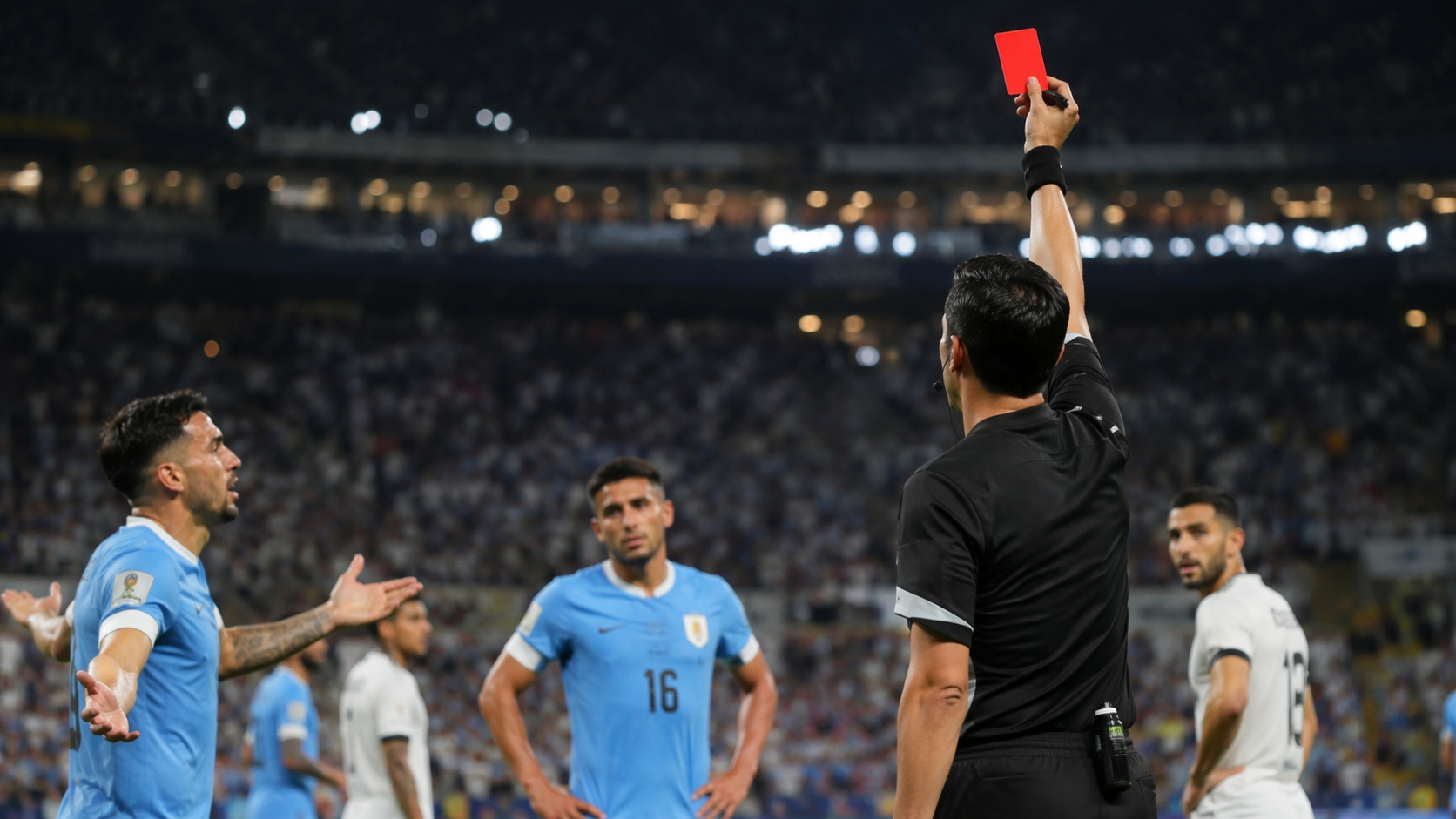
A World Cup red card answers one question immediately and opens another. The player is gone from the match right away, and the team plays short for the rest of that game. For the next match, the baseline is also simple: any red card at the 2026 World Cup brings an automatic one-match suspension, whether it came from a straight red or from two yellow cards in the same match. FIFA’s disciplinary committee can then add more games if it judges the conduct to be serious enough; violent conduct is commonly described as a three-match category, and Qatar’s Assim Madibo received a five-game ban after his sending-off in the 2026 tournament.[1]
That is the practical answer fans need before anything else: red means off now, and it normally means out next game. The part that gets messy is what happens after the card is shown. A broadcast may say the red was “rescinded,” a coach may talk about an appeal, or a graphic may show the player available again. Those phrases can hide the actual FIFA process.
The Two Ways A Player Gets Sent Off
There are two routes to the same match consequence. A player can receive a straight red card for an offense the referee treats as sending-off conduct: serious foul play, violent conduct, denying an obvious goal-scoring opportunity, abusive language, or other red-card offenses. Or a player can receive two yellow cards in one match, with the second yellow turning into a red-card dismissal.[2]
For the match in front of you, the distinction barely matters. The player leaves and cannot be replaced. For the suspension that follows, the distinction matters more. A second-yellow red often stays at the automatic one-match ban. A straight red for serious misconduct is more likely to be reviewed for a longer suspension, although FIFA has not published a tidy public chart that turns every kind of foul into a fixed number of games.
| What happened | Immediate effect | Next-match effect |
|---|---|---|
| Straight red card | Player is sent off; team plays short | Automatic one-match suspension, with possible extension |
| Second yellow card in the same match | Player is sent off; team plays short | Automatic one-match suspension |
| Yellow-card accumulation across matches | Player stays in the current match unless also sent off | Suspension depends on tournament accumulation rules |
From Card Shown To Suspension Served
Once the red card is shown, the automatic suspension attaches to the team’s next World Cup match. If the player’s team advances, the suspension is served in that next fixture. If the team is eliminated, serious disciplinary sanctions can still matter later because FIFA bans can carry into other FIFA competitions or qualifying contexts, depending on the case. Serious red-card bans from qualifying can carry into the World Cup, while qualifying yellow cards do not.[1]
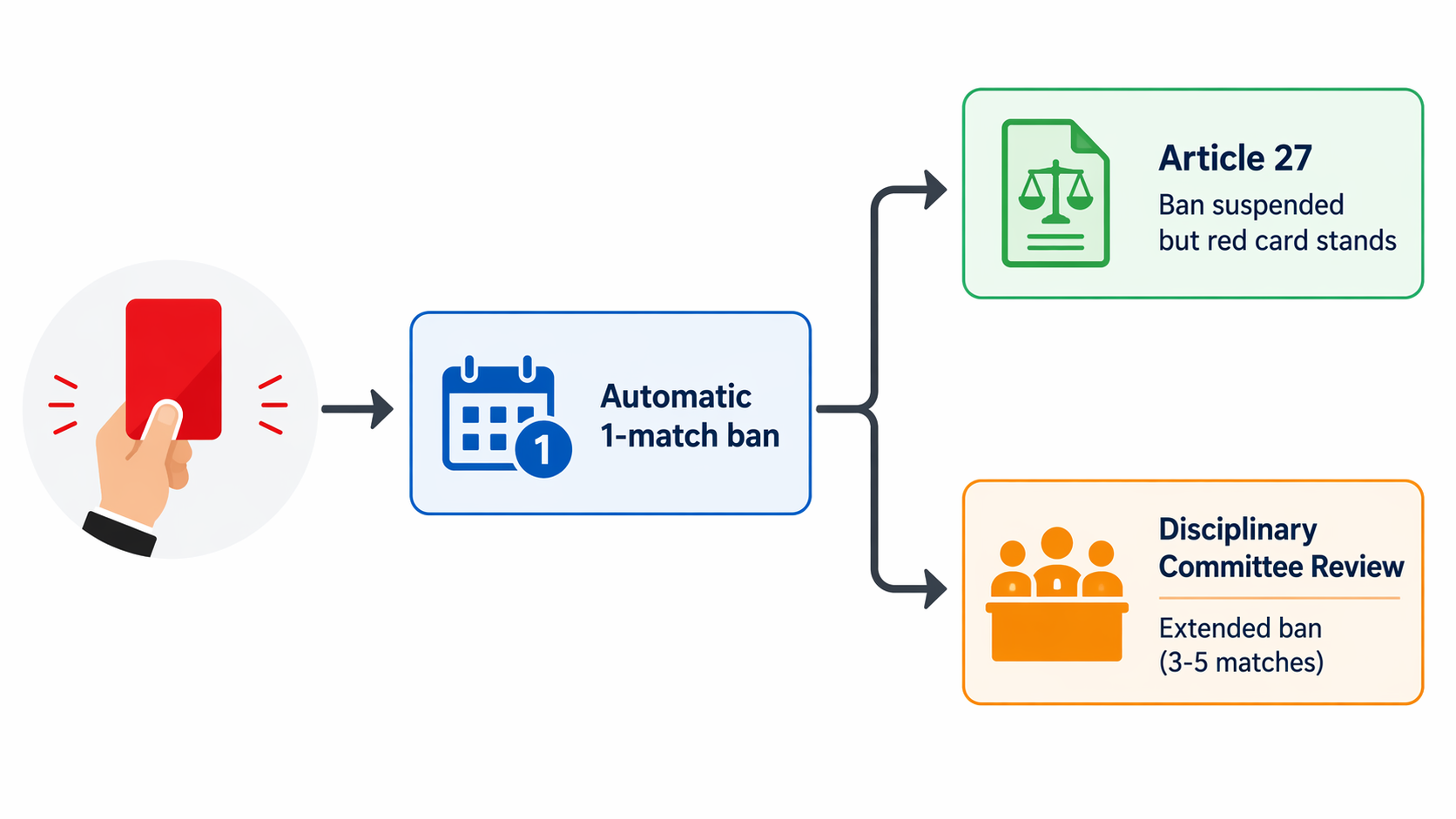
The disciplinary committee is the next important actor. It does not need to change the referee’s decision to change the tournament consequence. It can leave the automatic one-match ban alone, or it can extend the suspension when the conduct is treated as more serious. Madibo’s five-game ban is the clean example: escalation is not just a theoretical threat tucked away in the rules.[1]
What FIFA does not offer is the kind of normal appeal route many club fans expect. FIFA Regulation 9.6 bars teams from appealing on-field decisions. In plain terms, a team cannot simply ask a higher body to retry the referee’s red-card judgment after the match.[3]
Why “Overturned Red Card” Is Usually The Wrong Shortcut
This is where World Cup coverage can get sloppy. FIFA’s Article 27 gives the disciplinary committee power to suspend enforcement of a sanction. That is not the same thing as erasing the red card. The card remains in the match record; the punishment can be put on probation for a period described in available reporting as one to four years.[3][4]
Folarin Balogun’s 2026 case is the useful model. Reporting on the decision described FIFA as allowing him to be available by suspending enforcement of the automatic ban under Article 27. The better way to say it is not “the red card disappeared.” It is: the red card still stands, but the next-match suspension is not being enforced unless the probation terms are later breached.[3][4]
Cristiano Ronaldo’s earlier qualifying case is useful for the same reason, not because it proves every famous player receives the same treatment. It shows the mechanism: FIFA can maintain the on-field decision while suspending the sanction attached to it.[4]
That distinction matters for viewers because it explains the otherwise odd sequence. The rule can say there is no ordinary appeal of the referee’s red card, and FIFA can still use a disciplinary-code provision to suspend the punishment. Those are not the same procedural act.
Yellow Cards Have Their Own Tournament Clock
Yellow cards are easier during one match and harder across a tournament. In one match, a yellow is a caution. A second yellow in that same match becomes a red-card dismissal. Across the World Cup, yellows accumulate toward suspension, but the 2026 tournament has two wipe points because of the expanded format.[5]
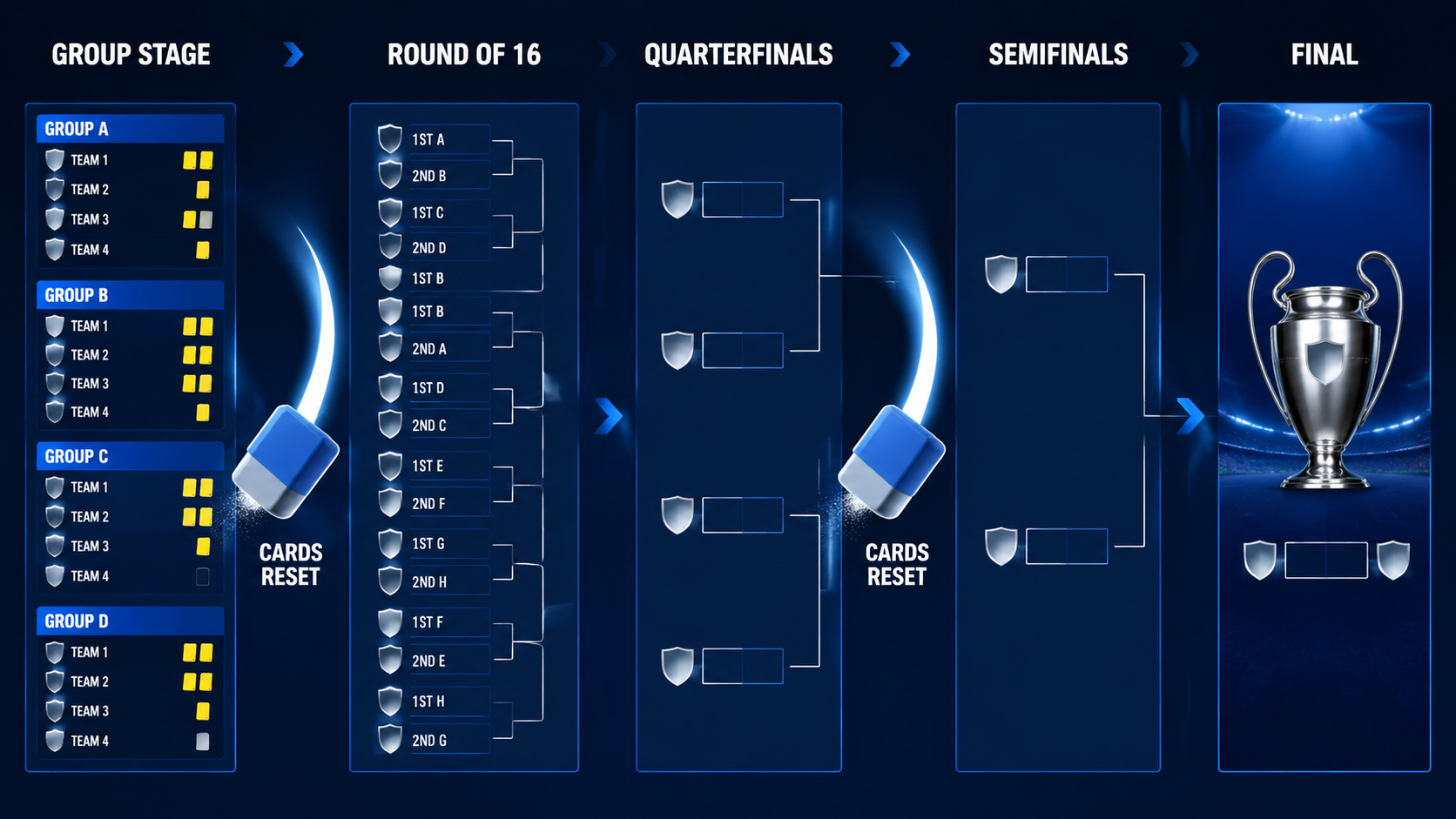
The sequence is the part to keep straight. Yellow cards from qualifying do not carry into the World Cup. During the World Cup, accumulated yellows are wiped after the group stage. They are wiped again after the quarterfinals. Because of that second wipe, yellow-card accumulation cannot make a player miss the final.[1][5]
| Tournament point | What happens to yellow cards | What it means for availability |
|---|---|---|
| Before the World Cup | Qualifying yellows do not carry into the tournament | Players start the World Cup without qualifying-yellow accumulation |
| After the group stage | World Cup yellow-card accumulation is wiped | Players who advance get a reset for the knockout rounds |
| After the quarterfinals | Yellow-card accumulation is wiped again | A player cannot miss the final because of accumulated yellows |
| Semifinal red card | Red-card suspension still applies | The player misses the final automatically unless FIFA suspends enforcement |
The final line in that table is the trap. The yellow-card wipe after the quarterfinals protects the final from accumulation suspensions, not from red-card suspensions. If a player is sent off in the semifinal, the automatic next-match ban points directly at the final.[6]
This is also where club habits mislead people. In a league season, fans are used to accumulation thresholds, domestic competition rules, and appeal customs that may look familiar but do not control the World Cup. Tournament timing is harsher because “the next match” may be the match everyone has waited four years to see.
The 2026 Red-Card Offenses Many Viewers Will Not Expect
The 2026 World Cup added two red-cardable offenses that should not be casually treated as universal soccer law. They are tournament-specific changes, and their origins explain why FIFA cared enough to add them.
The first is covering the mouth during confrontations with officials. USA Today reported that the rule was triggered by the Prestianni-Vinicius Jr. incident at the 2025 U-20 South American Championship, and that Paraguay’s Miguel Almirón became the first World Cup example under the new provision.[1]
The second is deliberately leaving the field to protest a referee decision. That change was tied in reporting to a walkoff protest in the 2026 AFCON final.[1]
Neither rule changes the suspension pipeline. If the referee sends a player off under one of these 2026 offenses, the player leaves the match, receives the automatic next-match suspension, and can still face disciplinary review for any additional sanction.
VAR Can Now Review Second-Yellow Send-Offs
One review change is easy to miss because it sits between familiar categories. VAR has long been associated with goals, penalties, straight red cards, and mistaken identity. For 2026, second-yellow send-offs are also reviewable by VAR, which BBC Sport described as a new expansion from previous tournaments.[7]
That does not mean every yellow-card judgment turns into a video debate. The important point is narrower: when a second yellow would send a player off, the dismissal consequence can now bring VAR into the process. Readers who want the same kind of review-mechanics breakdown for another World Cup flashpoint can move next to How Semi-Automated Offside Technology Works or Learn the Offside Rule in 20 Minutes with Self-Test Scenarios.
The Live-Match Version
When a red card appears on screen at the 2026 World Cup, follow four checks. Was it a straight red or a second yellow? The player is off either way. What is the automatic suspension? One match. Could FIFA add more? Yes, especially for serious conduct, as Madibo’s five-game ban shows. Could the player still become available? Only through FIFA suspending enforcement of the sanction under Article 27, not through a normal team appeal that wipes away the referee’s decision.
For yellow cards, keep the tournament clock separate: no qualifying-yellow carryover, a wipe after the group stage, another wipe after the quarterfinals, no final suspension from yellow accumulation, and no protection from a semifinal red.
References
- World Cup 2026 red card, yellow card rules, suspension explained, USA Today, June 15, 2026
- World Cup 2026 yellow, red card accumulation, FOX Sports
- 2026 World Cup red card, Yahoo Sports
- Why FIFA can rescind World Cup red card: What Article 27 of the Disciplinary Code says, MARCA, July 7, 2026
- 2026 FIFA World Cup yellow card and suspension rules, MLS Soccer
- 2026 World Cup red card rules explained: How it works, suspension unavoidable for USA’s Folarin Balogun, NBC Sports
- VAR expansion to second-yellow send-offs, BBC Sport
Comments
Join the discussion with an anonymous comment.