

US Third Country Deportation Agreements Explained
An explainer on how the Trump administration turned a rarely used statute into a core deportation strategy by signing agreements with over 35 countries, why actual deportations remain limited, and what the four types of agreements mean for migrants and asylum seekers.
Updated:
The fastest way to misunderstand US third country deportation agreements is to start with the phrase itself. It sounds administrative, almost tidy: the United States removes a person to a country that is not their own. But the real questions come immediately after. Third country for whom? Chosen by whom? And what happens when the person gets off the plane?
By 2026, the Trump administration had made these agreements a central piece of its deportation strategy. The scale of the diplomacy was large: the Migration Policy Institute reported that the administration contacted more than 58 governments and, in its 2025 count, had arrangements involving 27 countries. MPI also reported about 15,000 third-country deportations in 2025, with roughly 13,000 of those to Mexico alone.[1] Third Country Deportation Watch, using a broader tracking method and a later time window, counted 35 agreements and more than 21,000 people sent to 24 countries as of May 2026.[2]
Those numbers matter because they show both expansion and limit. The policy reached across continents, but the documented removals still fall far short of the mass-deportation language that made the policy politically useful. That gap is where this explainer has to begin. The issue is not only whether third-country deportations are legally possible. It is what work the policy is doing: actual removal, deterrence, diplomatic leverage, or legal avoidance.
What a Third-Country Deportation Agreement Does
A third-country deportation agreement lets the United States send a noncitizen to a country other than that person’s country of citizenship or nationality. In ordinary speech, people often describe this as deporting someone “elsewhere.” In legal and operational terms, “elsewhere” can mean very different things: a country that agrees to consider the person’s asylum claim, a transit stop before another removal, a detention destination, or a mixed arrangement that does several of those things at once.
The statutory hook is INA § 1231, the removal provision the administration used more aggressively as it built these arrangements into a broader deportation strategy.[1] The administration treated a rarely used authority as a routine instrument: find a government willing to receive people, create a diplomatic or operational pathway, and put people on flights even when the receiving country had no strong personal connection to them.
For the person being removed, the agreement is not an abstraction. It can decide whether they get an asylum interview, whether they are detained after arrival, whether they can contact family or counsel, whether they receive papers they can understand, and whether they are at risk of being sent onward to a place where they may be harmed.
Why the Counts Do Not Match
Two public counts are commonly cited, and they do not measure the same thing. MPI reported 27 countries and about 15,000 third-country deportations for January through December 2025. Third Country Deportation Watch reported 35 agreements and more than 21,000 people sent to 24 countries as of May 2026.[1][2]
| Source | What it counted | Reported scale |
|---|---|---|
| Migration Policy Institute | 2025 third-country deportations and country arrangements | 27 countries; about 15,000 deportations, including about 13,000 to Mexico |
| Third Country Deportation Watch | Agreements and people sent through May 2026 | 35 agreements; 21,000+ people sent to 24 countries |
That discrepancy does not automatically mean one count is useless. It means readers have to ask what is being counted: signed agreements, active routes, people physically removed, countries contacted, or people whose asylum cases were affected. Government announcements tend to make the map look bigger. Removal totals show a narrower operational result.
This is also where deterrence enters. A policy can be numerically modest and still powerful if it makes people believe that any immigration encounter might end in a flight to a country they do not know. Fear can do administrative work. It can discourage asylum claims, increase pressure to accept voluntary departure, or make legal challenges harder because people are moved faster than lawyers can respond.
The Four Types Hidden Inside One Phrase
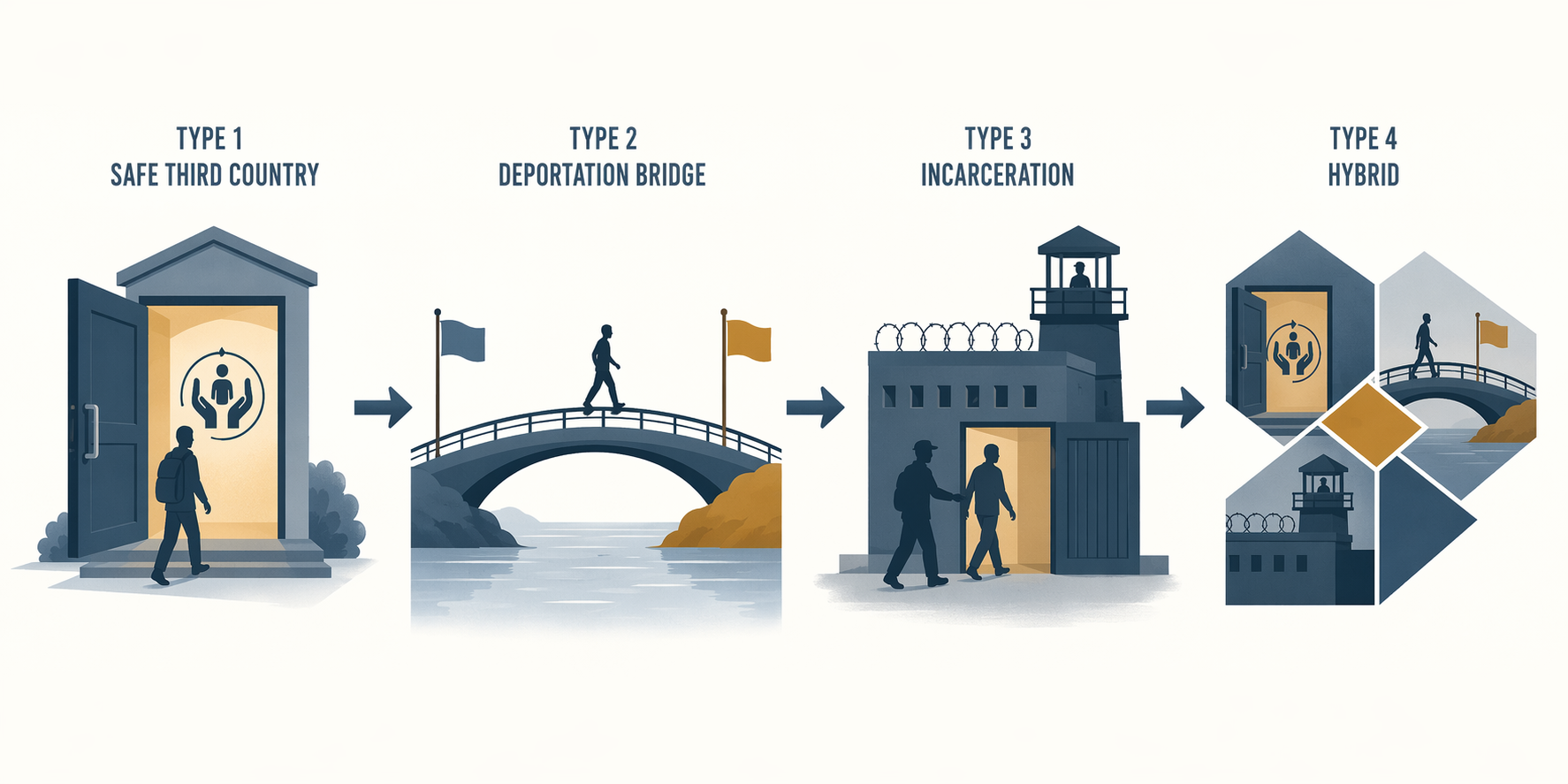
MPI’s useful contribution is not just a count. It separates third-country arrangements into four types: safe third country or asylum cooperation agreements, deportation bridge agreements, incarceration agreements, and hybrid agreements.[1] The categories matter because they produce different risks. One person may be told to seek asylum in a country they passed through. Another may be held abroad before being sent somewhere else. Another may be placed in a foreign prison-like setting under an arrangement that looks diplomatic on paper and coercive in practice.
Safe third country and asylum cooperation agreements
A safe third country or asylum cooperation agreement shifts the asylum question away from the United States. Instead of deciding the claim in the US system, the government sends or directs the person to another country that is supposed to provide access to protection. The legal premise is that the receiving country can offer a fair process and safety from persecution.
The weak point is obvious: “safe” is not a label that makes itself true. It depends on the receiving country’s asylum system, detention practices, ability to issue documents, and willingness not to send the person onward. Through May 2026, the US Committee for Refugees and Immigrants tracker counted more than 30,000 asylum cases pretermitted under Asylum Cooperative Agreements.[3] A pretermitted case is not a full protection win or loss on the merits; it is a procedural closure that can keep the person from receiving a standard asylum hearing in the United States.
That distinction is not technical nitpicking. If an asylum seeker’s US case is cut off because another country is deemed available, then the receiving country’s real capacity becomes part of the person’s survival plan. The paperwork moves first. The human being has to catch up.
Deportation bridge agreements
A deportation bridge agreement uses a third country as a transfer point. The receiving country may not be the person’s final destination in any meaningful sense. It functions as a bridge because it lets the United States move someone out of US custody while another removal path is arranged or while the person’s options narrow.
Mexico is the clearest example in the available numbers because MPI reported that about 13,000 of the roughly 15,000 third-country deportations in 2025 went there.[1] That does not mean every person sent to Mexico experienced the same process. It does mean Mexico carried much of the numerical load in the 2025 data, even while the public story emphasized agreements across a much wider set of countries.
Bridge arrangements are attractive to an administration because they reduce the immediate problem of custody. But for the person removed, the question becomes what legal status, protection process, or practical support exists on the other side. If the answer is unclear, the bridge can become a way to move uncertainty offshore.
Incarceration agreements
Incarceration agreements are the bluntest version. The receiving country does not merely accept a person into an immigration process; it detains or confines people on terms shaped by the agreement. Amnesty International and Third Country Deportation Watch have tracked payments of at least $44 million connected to third-country arrangements, including $5.1 million to Eswatini, $7.5 million to Rwanda, $7.5 million to Equatorial Guinea, and more than $6 million to El Salvador.[2][4]
Payment figures do not by themselves prove abuse. They do show that this is not simply a matter of countries casually accepting deportees. Money, custody, and diplomatic bargaining are part of the machinery. When a receiving government has weak due process protections or poor detention conditions, the transfer can expose people to arbitrary detention and make legal accountability harder to trace.
The human version of this category is why country names should not stay abstract. The case study How a Jamaican Pastor Was Deported to Eswatini shows the kind of displacement hidden by a clean phrase like “third country.” Jamaica to Eswatini is not a routine return. It is a forced rerouting into a place where language, documents, family contact, and legal help may all become harder at once.
Hybrid agreements
Hybrid agreements combine functions. A country may accept some people as asylum applicants, detain others, and act as a transit point for still others. That is administratively convenient and legally messy. It lets officials describe the arrangement in whichever vocabulary sounds least troubling: cooperation, reception, processing, custody, or removal.
Hybrid design also makes public oversight harder. If one person is transferred for processing and another for detention under the same diplomatic umbrella, a headline about the agreement will not tell families, lawyers, or judges what is actually happening. The category matters because people need to know which rules apply before the flight leaves, not months later in litigation.
The Legal Status Is Unsettled, Not Simple
It is inaccurate to say the courts have simply approved or blocked the policy. The current legal picture is layered. In June 2025, the Supreme Court allowed third-country deportations to proceed through a stay while litigation continued.[5] A stay is powerful in practice because it permits removals to happen, but it is not the same thing as a final merits ruling that resolves every statutory and constitutional question.
Then, in February 2026, Judge Brian Murphy ruled the policy unconstitutional, according to reporting and court materials tracked by advocates, while appeals remained pending.[2][6] That ruling did not erase the practical effect of earlier removals, and it did not give every affected person an easy path back into US custody or US courts.
This is the procedural trap. If removals continue while the legal theory is being contested, the person challenging the transfer may already be in another country by the time a court clarifies the rules. Legal uncertainty is not evenly distributed. The government litigates from offices. The migrant litigates from detention, transit, or disappearance into another bureaucracy.
Protection From Harm Is the Hardest Test
The central human-rights risk is not only that a person is sent to a country they did not choose. It is that the transfer may break the chain of protection. Once the United States sends someone to a third country, that country may detain them, deny them a meaningful protection process, or send them onward. The last risk is often called chain refoulement: one government does not directly return a person to danger, but it sends them to a place where another government may do so.
Amnesty International reported one especially stark episode involving a South Sudan flight, where individuals were held in shipping containers at a Djibouti military base.[4] That is not a minor paperwork defect. It is the kind of operational fact that shows why “agreement” is too clean a word for what people may experience after removal.
The protection question has to be asked before removal, because after removal the ordinary tools of legal representation often weaken. Lawyers may not know where a client is. Family members may receive no clear notice. The receiving country may treat the person as a foreign detainee rather than an asylum seeker. Even when litigation later recognizes a legal problem, the harm may already have occurred.
Why Governments Use Outsourced Deterrence
The United States is not the only government to experiment with deterrence by outsourcing. The United Kingdom’s Rwanda plan, Australia’s offshore processing system, and the European Union’s arrangement with Turkey all used some version of the same political idea: move protection responsibilities away from the destination country, make arrival less predictable, and signal that reaching the border will not guarantee access to the ordinary asylum system.[7]
Those comparisons should not be stretched too far. Each system has its own laws, geography, and institutions. But they help explain why a policy can be attractive even if it does not produce mass removals. Deterrence does not require every person to be deported. It requires enough visible uncertainty that people believe the next plane could be theirs.
That is why the gap between 35 agreements and limited documented removals is not a contradiction from the administration’s point of view. The agreements can serve as diplomatic pressure, campaign evidence, and psychological threat all at once. The policy looks bigger than its removal totals because part of its effect is to project reach.
How to Read Any New Agreement
When a new third-country deportation agreement is announced, the useful questions are practical rather than ceremonial:
- Who can be sent there: asylum seekers, people with removal orders, people from specific nationalities, or a broader group?
- What role does the receiving country play: asylum processor, bridge, jailer, or some combination?
- What money or diplomatic benefit is attached to the agreement?
- What happens after arrival: release, detention, asylum screening, onward removal, or no public answer?
- What court orders apply, and are removals continuing while appeals are pending?
Those questions keep the policy from disappearing into official labels. A safe-third-country agreement and an incarceration agreement may both sit under the same headline, but they do not mean the same thing for the person removed. A country can be counted in a diplomatic tally without being a realistic place for protection. A payment can be described as cooperation while functioning as custody infrastructure.
The evidence available through mid-2026 supports a careful judgment. US third country deportation agreements have become politically and psychologically powerful. They have expanded the government’s removal options, disrupted asylum processing, and created real fear for people in immigration custody. But the documented numbers do not show a mass-removal machine on the scale promised. They show a policy whose main force is deterrence through fear, uncertainty, and distance.
References
- MPI commentary on third-country deportation agreements, Migration Policy Institute.
- Third Country Deportation Watch, Third Country Deportation Watch.
- Third-Country Deportation Tracker, US Committee for Refugees and Immigrants.
- Amnesty International campaign page on third-country deportations, Amnesty International.
- SCOTUSblog June 2025 analysis of Supreme Court stay, SCOTUSblog, June 2025.
- Al Jazeera reporting on Judge Murphy’s February 2026 ruling, Al Jazeera, February 2026.
- Council on Foreign Relations article on comparative migration arrangements, Council on Foreign Relations.
Comments
Join the discussion with an anonymous comment.