
Peter Thiel's AI Media Scoreboard Explained
Learn what Peter Thiel's AI media scoreboard is, how it evolved from Objection AI to The Primary, and why it's controversial.
Updated:
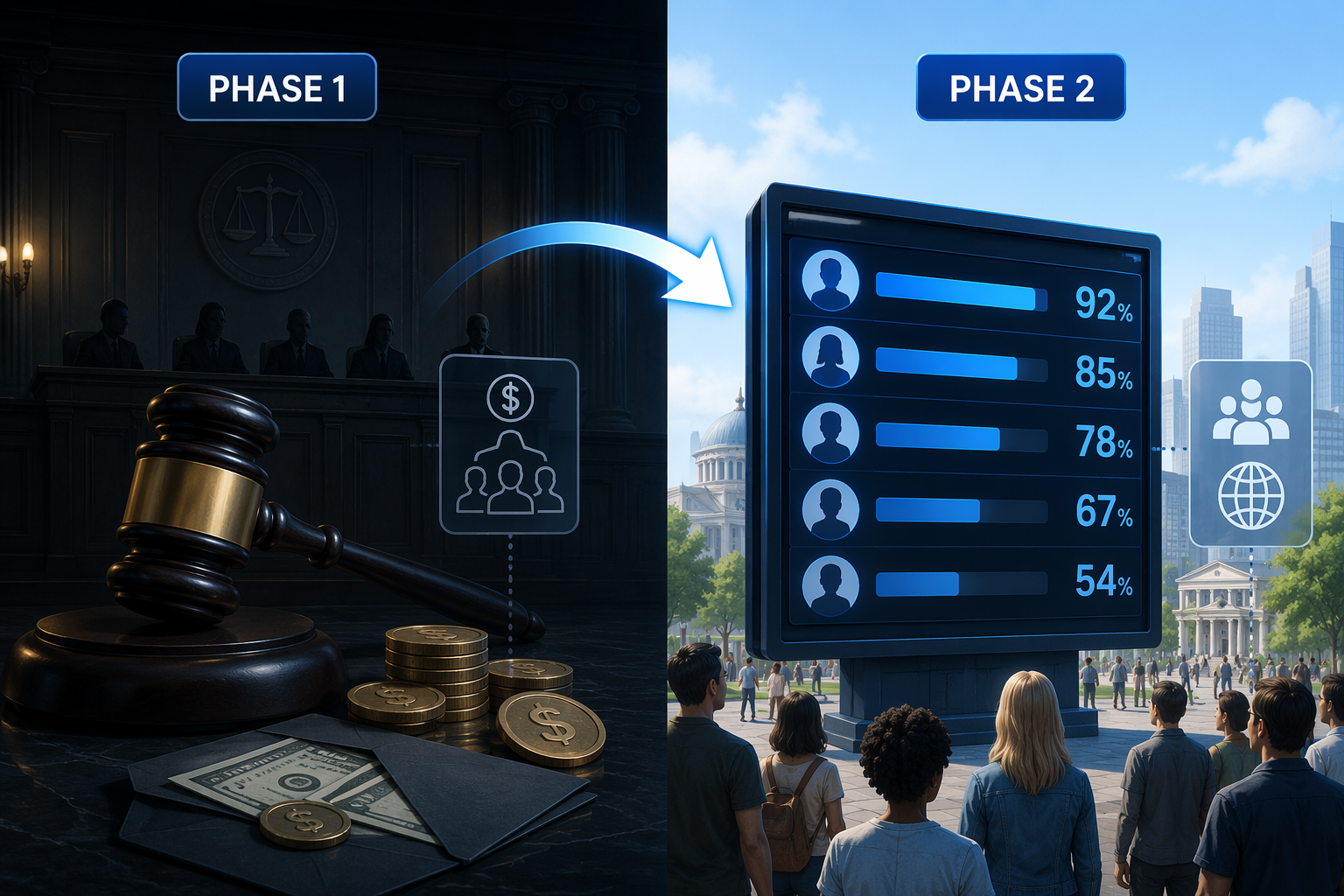
Peter Thiel’s AI media scoreboard is easiest to understand in two phases. In April 2026, a project called Objection AI launched as a paid AI tribunal: someone could pay to challenge an individual news article, have several large language models evaluate it, and receive a machine-generated judgment. After the site went dark in late May, the project reappeared in July as The Primary, a public scoreboard that ranks journalists and outlets on AI-evaluated methodology metrics rather than issuing one-off verdicts on disputed stories.[1][2][3]
That distinction matters. If you only heard the phrase “AI media scoreboard,” it may sound like a dashboard for media literacy, a lawsuit engine, a watchdog group, or a political weapon. The answer is uncomfortable because it has elements of all four: a product interface, a complaint mechanism, a public trust-rating system, and a project backed by people with a long record of adversarial pressure against journalists.
From paid objection to public scoreboard
Objection AI’s first version was built around a formal challenge process. A user could submit a news article and pay a fee to trigger review by what the company described as an AI tribunal. Reporting at launch put the basic entry fee at $2,000, with higher tiers reaching into the five-figure range depending on the level of investigation requested.[1]
The tribunal was described as using multiple large language models, including ChatGPT, Claude, Mistral, Grok, and a Google model, overseen by a proprietary system the company called a “Judicial-Purpose Transformer.” That last label should be read as the company’s claim, not as an independently validated legal or journalistic standard.[1]
The original pitch did not merely say, “Here is a second opinion on an article.” It borrowed the language and posture of adjudication. A challenged story could be processed through models, scored, and treated as if the result carried public meaning. Objection AI also had a companion mechanism called Fire Blanket, which could post “under investigation” warnings on X before any final verdict had been reached.[1]
For anyone who has handled a serious correction request, that sequence is not a small procedural detail. A correction process normally begins with a claim: this sentence is wrong, this source was misrepresented, this context was omitted, this person was not given a fair chance to respond. Objection AI inserted a paid, automated layer before the newsroom’s own review had necessarily run its course, and Fire Blanket made the accusation itself publicly legible.
| Phase | Public form | Main action | Main concern |
|---|---|---|---|
| Objection AI, April 2026 | Paid AI tribunal | Users paid to challenge individual articles and receive AI-generated judgments | The process could turn a complaint into reputational pressure before human review was complete |
| The Primary, July 2026 | Public media scoreboard | Journalists and outlets were ranked on AI-evaluated methodology metrics | The rankings depended on opaque model judgments and an unaudited scoring process |
Then the first version stalled. By late May 2026, Objection AI’s site was inaccessible and showed a rebuilding message.[2] In July, the project returned under a different name: The Primary. Instead of centering the product on individual verdicts, the rebrand presented a broader public ranking system for journalists and outlets.[3]
The new framing shifted the project from punishment to incentives. Aron D’Souza, the lawyer behind the project, explained the pivot by saying, “Verdicts punish failure but don’t fix the incentive.”[3] That is the hinge of the whole rebrand. Objection AI treated the disputed article as the unit of judgment. The Primary treats the journalist or outlet as the recurring object to be scored.
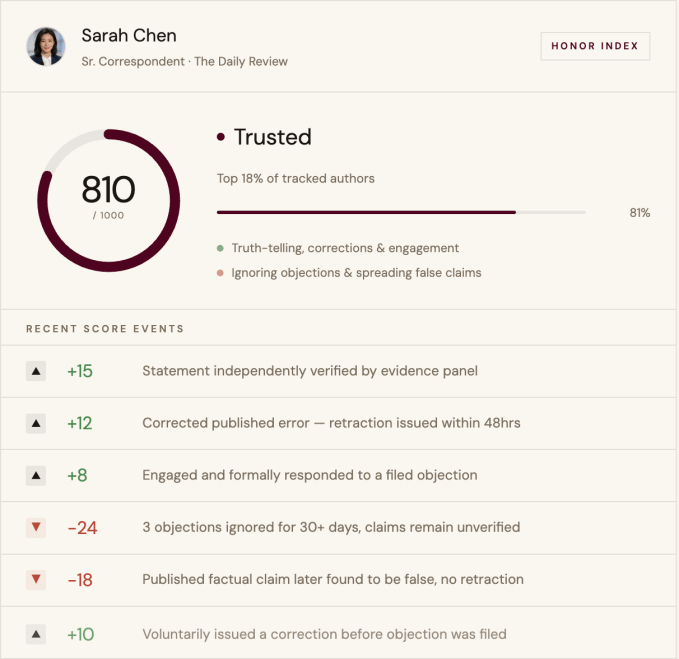
Reports describing The Primary say its metrics include source attribution, tone, and right of reply.[3][6][7] Those are real journalistic concerns. A story that leans on anonymous accusation, buries a denial, or uses loaded language while pretending to be neutral deserves scrutiny. The unresolved issue is whether The Primary’s scoring system can show, with enough transparency, how it separates weak reporting from reporting that merely angers a powerful subject.
Why Peter Thiel is central to the story
Thiel is not just a famous name attached to an AI product. Reporting on Objection AI identified him among the project’s backers, alongside D’Souza and Balaji Srinivasan.[1][2] For readers who follow Thiel’s broader politics and worldview, that fits into a much larger pattern; for more context, see Inside Peter Thiel’s End-Times Theology. But the immediate media story runs through Gawker.
In 2007, Gawker published a post outing Thiel as gay. Years later, Thiel secretly funded Hulk Hogan’s privacy lawsuit against Gawker, a case that ended with Gawker’s bankruptcy in 2016. D’Souza helped orchestrate that legal campaign.[2]
That history is not just background color. D’Souza reportedly described Objection AI by saying, “the Gawker litigation took 10 years and millions of dollars. Objection industrializes this process.”[5] The word “industrializes” is doing a lot of work. It suggests a system designed to make pressure cheaper, faster, and more repeatable than a decade-long lawsuit.
There is a legitimate argument that journalism needed some of this pressure. Newsrooms have published careless headlines, thinly sourced stories, and moral posturing dressed up as verification. Public distrust is not imaginary. In September 2025, Gallup found that only 28% of Americans said they had a great deal or fair amount of trust in the mass media, the lowest level Gallup had recorded.[4]
That number explains why a scoreboard can find an audience. If people already believe news organizations grade everyone else while refusing to be graded themselves, a public ranking system feels like overdue accountability. The danger is that “accountability” can become a softer word for intimidation when the person pressing the complaint has money, lawyers, and a large platform, while the reporter is trying to document what happened before a deadline.
What changed in the rebrand, and what did not
The Primary is more civic-minded on its face than Objection AI. It does not begin with a paid challenge to a single article. It presents itself as a public methodology scoreboard: a way to reward better sourcing, clearer attribution, fairer tone, and more consistent right-of-reply practices.[3][7]
That change matters. A newsroom can reasonably be judged on whether it contacted the subject of a serious allegation. It can be judged on whether a story distinguishes documents from interpretation, eyewitness accounts from secondhand claims, and verified facts from inference. If The Primary forced more public attention onto those habits, it would be responding to a real weakness in the media ecosystem.
But the rebrand does not erase the deeper problem. Both versions depend on large language models making judgments about journalistic practice. Both place those judgments inside a reputation system. And both emerge from a circle of actors whose most famous media intervention was not a public ethics project but a secretly financed lawsuit that destroyed a publication.[2][5]
The most important unresolved question is methodological. If The Primary scores “tone,” readers need to know what counts as loaded language, whether the same standard applies across political subjects, and how the system handles investigative reporting that necessarily describes misconduct. If it scores “right of reply,” readers need to know whether a reporter gets credit for seeking comment when a subject refuses to answer. If it scores attribution, readers need to know how it treats documents, anonymous sources, public records, and previously reported facts.
As of the July rebrand, the details available publicly did not amount to an independent audit of The Primary’s rankings. Some methodology categories have been reported, but the scoring process is still emerging, and it is unclear whether major news organizations have formally engaged with or challenged the system.[3][7]
This is not the first attempt to rate journalism
The AI wrapper makes The Primary feel new, but the basic ambition is not new. Earlier attempts to rate news credibility included NewsTrust, launched in 2005; The Factual, launched in 2016; and Credder, launched in 2019. Those projects did not become durable public infrastructure.[6]
That history should cool down two overstatements at once. The Primary is not unprecedented simply because it uses LLMs. At the same time, its failure is not guaranteed simply because earlier rating projects failed. What is different in 2026 is the combination of generative AI, public distrust, and a backer network already associated with litigation as a media-pressure tool.
There is also a practical difference between a media-literacy tool and a reputation machine. A media-literacy tool helps a reader ask better questions: Who is the source? What evidence is shown? What is missing? A reputation machine attaches a score to a person or outlet and invites others to treat that score as a proxy for trust.
The controversy is about power, not only accuracy
Some criticism of Objection AI focused on the obvious First Amendment concern: a paid system that flags or judges articles could chill reporting, especially on wealthy or litigious subjects. Media law professor Jane Kirtley was among the critics cited in early coverage, and First Amendment lawyer Chris Mattei called the project a “high-tech protection racket for the rich and powerful.”[1][5]
That phrase is sharp, but the underlying concern is ordinary. A reporter at a small outlet does not need to lose a lawsuit to be harmed by a process like this. They can lose time, confidence, institutional backing, or search-visible credibility. An editor can end up spending days responding to a machine-framed accusation instead of checking the original complaint on its merits.
The Primary’s public-scoreboard model lowers some of that temperature. It is less directly punitive than a paid tribunal attached to a single disputed article. But rankings create their own pressure. A low score can circulate without context. A subject unhappy with coverage can point to the scoreboard as if it were a neutral umpire. A platform can amplify the score faster than the underlying methodology can be examined.
None of this means journalists should be exempt from outside review. They should not be. A newsroom that cannot explain why it used a source, why it denied anonymity, why it granted anonymity, whether it sought comment, or how it corrected an error is asking readers to trust a black box. The problem is not review. The problem is replacing one black box with another and calling the second one accountability.
A late signal from the media world
One odd feature of this story is that Thiel remains both an antagonist of parts of the press and a figure celebrated inside parts of the media business. The Hollywood Reporter noted that Axel Springer planned to give Thiel its 2026 Axel Springer Award on September 24, with a tribute by CBS News editor in chief Bari Weiss.[3]
That detail should not become the whole plot. Awards do not validate The Primary’s methodology, and criticism of The Primary does not settle every argument about Thiel. It does show why the project is not happening outside media power. It is being built in the same world of owners, investors, platforms, lawyers, editors, and public reputations that it claims to measure.
How to read the scoreboard if you encounter it
The useful response is not to dismiss every AI-assisted media rating as censorship or to accept every score as proof. A serious reader should ask what the system evaluated, what evidence it used, whether the article’s subject had special incentive to attack the coverage, and whether the scoring rules are visible enough for outsiders to test.
- Does the score show the exact passages, sources, or omissions it is judging?
- Does it distinguish factual error from tone, framing, or disagreement with the article’s conclusion?
- Does it credit a reporter for seeking comment when a subject refuses to respond?
- Does it disclose which models were used and how their outputs were weighted?
- Does it provide an appeal, correction, or audit process for the journalists it ranks?
Those questions are not special pleading for reporters. They are the same questions journalists should expect to answer about their own work. If The Primary wants to judge sourcing, fairness, tone, and right of reply, it has to make its own sourcing, fairness, tone, and right-of-reply process inspectable.
That is why Peter Thiel’s AI media scoreboard matters. It packages a real public distrust of journalism into an AI-mediated rating system backed by people with a record of using legal and financial pressure against journalists. It also points at problems journalism has too often handled defensively: weak sourcing, opaque corrections, selective fairness, and lazy claims of objectivity.
The Primary can only be evaluated seriously if its own process is as transparent and accountable as the standards it claims to impose.
References
- TechCrunch report on Objection AI, TechCrunch, April 15, 2026, link
- The Intercept report on Objection AI and Peter Thiel, The Intercept, June 29, 2026, link
- The Hollywood Reporter report on The Primary, The Hollywood Reporter, July 16, 2026, link
- Americans’ Trust in Media Remains at Trend Low, Gallup, September 2025, link
- Coda Story report on Objection AI, Coda Story, link
- Nieman Lab report on The Primary and media-rating startups, Nieman Lab, link
- SSBCrack News summary of The Primary methodology, SSBCrack News, link
Comments
Join the discussion with an anonymous comment.