
How Semi-Automated Offside Technology Works
This explainer walks through the four coordinated subsystems—tracking cameras, ball sensors, AI processing, and human VAR review—that together reduce offside decision time by about 30 seconds while maintaining or improving accuracy.
The offside decision begins at the awkward instant most replays blur over: the moment the attacking player plays the ball. Semi-automated offside technology has to answer two questions at the same time. Where was every relevant part of the attacker and second-last defender? And exactly when, frame by frame, did the pass or touch happen?
That is why the system is better understood as a timed officiating pipeline than as a robot referee. In FIFA’s 2022 World Cup version, 12 dedicated tracking cameras monitored up to 29 data points on each player 50 times per second, while the official match ball carried an inertial measurement unit transmitting ball data 500 times per second.[1] The technology produced a recommendation, but the VAR team still had to validate the kick point, the offside line, and the player involvement before the decision became final.[2]
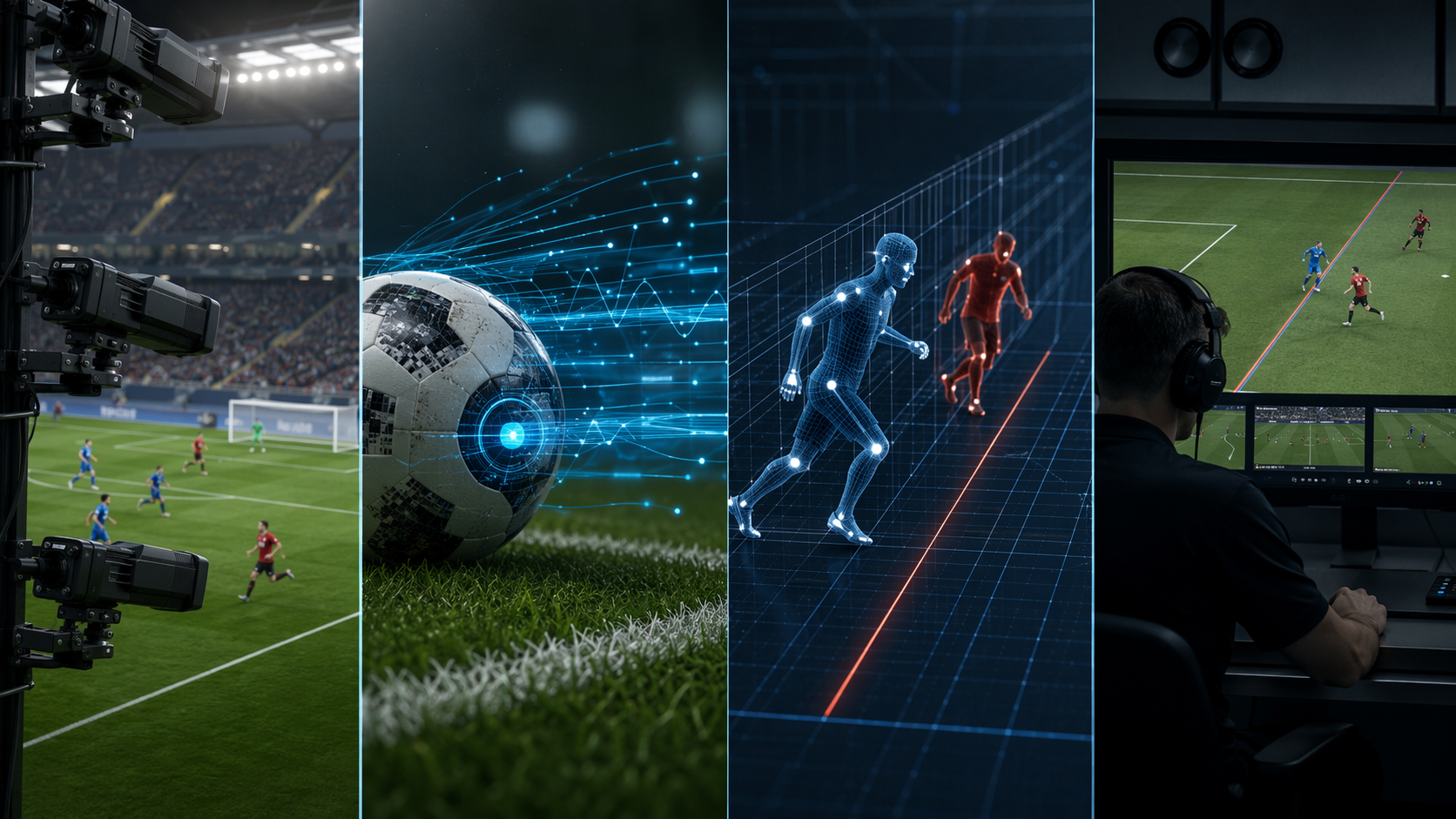
The Whole Chain, From Pass To Confirmation
When people ask how semi-automated offside technology works, the useful answer is not “AI draws the line.” The line is only one output. The decision comes from four coordinated subsystems: optical tracking, ball-contact detection, AI position processing, and human VAR review.
| Stage | What It Does | Why It Matters |
|---|---|---|
| Tracking cameras | Follow players and map body points or surface meshes | Establish where offside-relevant body parts are |
| Ball-contact detection | Identifies the decisive instant when the ball is played | Selects the frame used for the offside judgment |
| AI processing | Calculates limb positions and generates the recommended offside line | Turns raw tracking data into a reviewable decision package |
| VAR review | Checks and confirms the recommendation | Keeps the final call with match officials |
The order matters. A beautifully plotted offside line on the wrong frame is still the wrong decision. A perfect ball-contact signal is not enough if the system has misidentified which shoulder, knee, or boot is nearest to the goal line. The difficult part is the synchronization: matching the exact playing of the ball with the exact body positions at that instant.
Tracking Cameras Build The Player Map
The camera system is not there to make a nicer replay. It creates the positional evidence. FIFA’s 2022 system used 12 dedicated tracking cameras mounted under the stadium roof, separate from the standard broadcast cameras. Those cameras tracked 29 data points on each player, including limbs and extremities relevant to an offside decision, at 50 Hz.[1]
That “29 data points” figure is important because offside is not judged from a player’s whole body as a single blob. The law cares about the parts of the body with which a player can legally score. A hand or arm does not set the offside line in the same way a shoulder, head, knee, or foot can. The system therefore has to identify body geometry, not just shirt color or shirt number.
The Premier League’s later system is built differently. Its Genius Sports setup uses up to 30 cameras around the stadium, captures 10,000 surface mesh data points per player at 100 frames per second, and operates without a sensor inside the ball.[3][4] Those figures should not be casually blended with FIFA’s 2022 specifications. They describe different implementations solving the same officiating problem with different hardware choices.
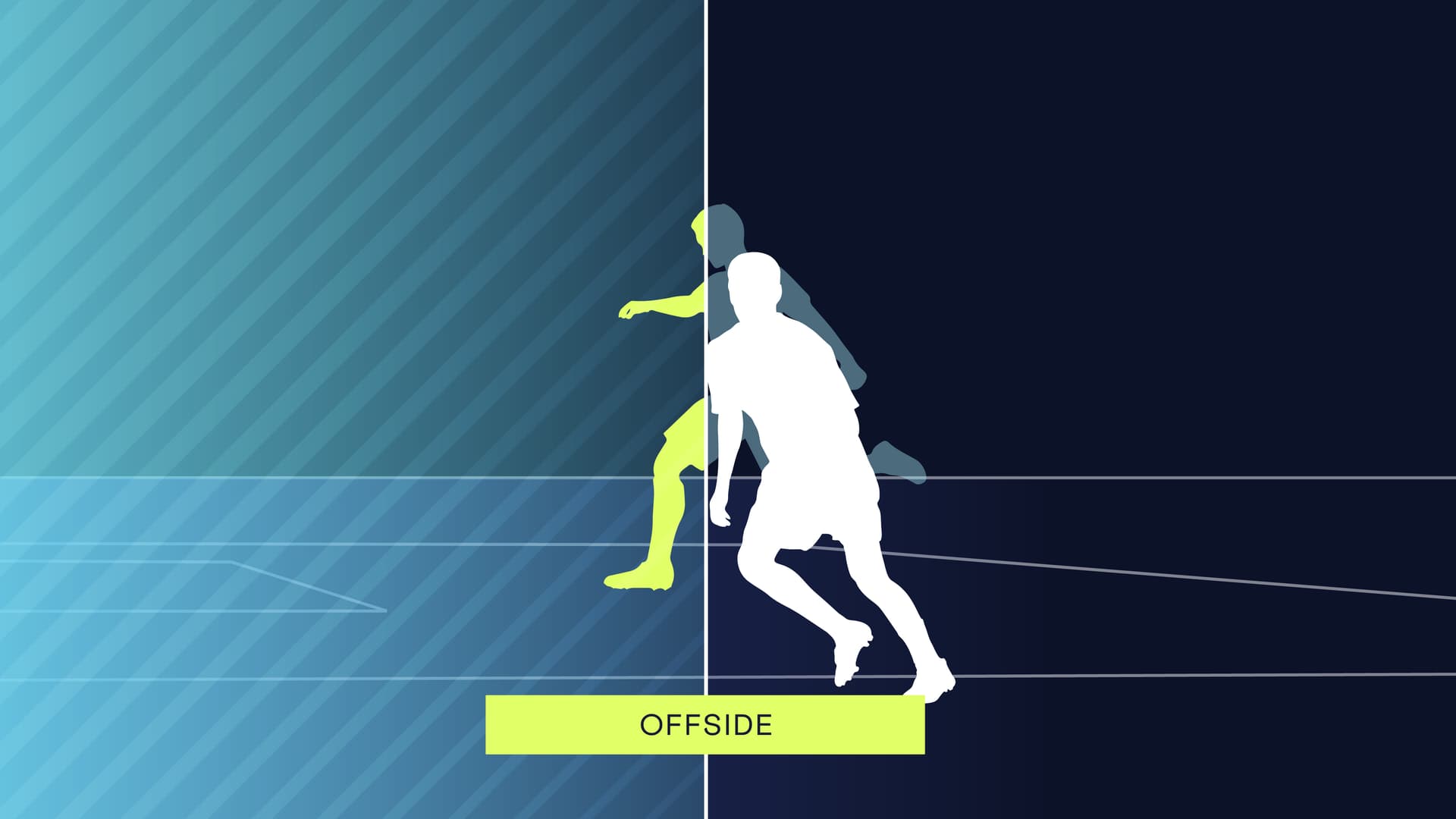
The practical gain from this dense tracking is that the VAR team no longer has to manually construct every line from scratch in the old, slow manner. The system has already mapped the likely body points, generated candidate positions, and prepared an offside line for review. That does not remove judgment, but it changes the workload from manual line-building to verification.
The Kick Point Is A Separate Problem
Player tracking answers “where.” It does not, by itself, answer “when.” Offside is judged when the ball is played or touched by a teammate, so the system has to identify the kick point with enough precision that the chosen frame is defensible in a marginal case.
FIFA’s 2022 configuration approached that timing problem with a connected ball. The inertial measurement unit inside the ball transmitted data 500 times per second, giving the system a high-frequency signal around contact events.[1] That signal was then combined with the player-tracking data, so the system could align ball contact with the positions of attackers and defenders.
The Premier League’s Genius Sports system does not use a ball sensor. It relies on optical tracking to detect the kick point, using its camera network and processing model rather than an instrumented ball.[3][4] That is not a small footnote. It changes where the timing evidence comes from and what the review team may need to inspect when a touch, deflection, or crowded challenge is involved.
This is also where the most delicate complaints usually live. An error of one or two frames can alter a marginal offside judgment, especially when a forward is moving one way and a defender is stepping the other. Training data for these systems has to include awkward edge cases such as falls, deflections, and goalkeepers leaving their line, because those are the situations most likely to produce visible errors if the model has mostly learned from clean, ordinary movements.[5]
A freeze-frame on television can make this look simpler than it is. The real question is not whether a still image can be drawn with a tidy line. It is whether the system selected the correct instant before drawing anything at all.
AI Turns Tracking Data Into An Offside Recommendation
Once the system has player positions and a candidate ball-contact moment, the AI layer performs the job most viewers associate with the technology: it maps limb positions, identifies the relevant attacker and defender body points, and generates a recommended offside line.
In plain terms, it is matching two moving maps. One map shows the attacking player’s furthest legal scoring body part toward the opponents’ goal line. The other shows the relevant defender’s position, usually the second-last opponent. If the attacker’s eligible body part is beyond that defender at the moment the ball is played, the system can recommend an offside decision.
The recommendation is generated from tracking data, not from a broadcast operator pausing a television feed and drawing a line by eye. That is why the visible output often appears so exact. The line is anchored to the computed positions of the relevant body points, and the system can package the evidence for VAR review more quickly than a manual process.
The 3D animation shown to viewers after a decision should be understood as a rendering of the tracking data, not as a separate simulation inventing a new version of the incident. It is a communication layer built from the same positional information used to support the recommendation, which is why the offside line appears to snap to the attacker’s and defender’s positions rather than float like a graphic approximation.[6]
Why The System Is Still “Semi” Automated
The “semi” is not a branding nicety. The system calculates positions and generates a recommendation, but a human VAR official reviews and confirms it before the referee is told to change or uphold the on-field decision.[2]
That review can include checking whether the correct attacker and defender were selected, whether the kick point is acceptable, whether the body point used for the line is lawful for offside purposes, and whether the attacking player became involved in active play. The technology can accelerate the geometry. It does not repeal the law or remove the official’s responsibility for applying it.
This handoff is easy to miss because the public sees the polished output: the frozen shape of the players, the line, and then the decision. Inside the process, the important moment is the confirmation. Until the VAR team accepts the recommendation, it is not the match decision.
What Gets Faster, And What Does Not
The strongest supported claim for semi-automated offside technology is speed and consistency in close offside reviews. The FA’s explainer for the Premier League-linked system reported an expected average reduction of about 30 seconds per close offside decision.[7] That is meaningful in a stadium, where a long wait after a goal can drain the moment and leave players arguing in a vacuum.
But “average” is doing real work in that sentence. It does not mean every review will be 30 seconds shorter, or that difficult incidents become instant. A crowded penalty area, an unclear touch, a possible deflection, or a question about active involvement can still require officials to slow down and check the sequence properly.
The Premier League also framed its adoption carefully. Before introducing semi-automated offside technology, the league stated that offside calls had already been adjudged 100% correct in the previous season.[3] Because that is a self-reported league figure, it should be treated as the league’s own assessment, not an independent proof that every supporter accepted every call. Still, it changes the burden of the technology. The main promise is not “AI fixes offside accuracy from broken to perfect.” It is that the same narrow law application can be processed faster and with a more standardized workflow.
A Short Timeline Of Adoption
FIFA introduced semi-automated offside technology at the 2022 World Cup, using the 12-camera, 29-body-point, connected-ball model described by FIFA.[1] UEFA then used the technology at Euro 2024, and the Premier League began rolling out its Genius Sports version from 2025.[2][3][4]
For the 2026 World Cup, FIFA’s enhanced setup includes automated voice alerts to the assistant referee’s earpiece in clear offside situations. The reported alert says “offside, offside, offside” or “delay,” and the clear-offside trigger applies beyond a 10 cm margin.[8] That threshold should not be treated as a universal rule for every semi-automated offside system. It belongs to the described 2026 World Cup enhancement.
The assistant referee still matters here. A voice alert may help with flag timing in clearer cases, but it does not turn every offside situation into an automatic whistle. Football still contains delayed flags, phase-of-play questions, rebounds, deliberate plays, and involvement judgments that require officials to manage the match as well as the geometry.
The Grounded Way To Read The Technology
Semi-automated offside technology works by tightening the data pipeline around one narrow decision: whether an attacker is in an offside position at the moment a teammate plays the ball, and whether that position matters under the law. Cameras locate the players. A connected ball or optical system identifies the kick point. AI prepares the body-point geometry and recommended line. VAR officials confirm the decision.
The practical value is faster, more consistent handling of close calls, not the removal of the assistant referee. The important limits remain implementation differences, marginal frames, body-point selection, and the fact that a 30-second saving is an expected average, not a promise attached to every raised flag.
References
- Semi-automated offside technology, Inside FIFA
- Semi-automated offside technology, BBC Sport
- Semi-automated offside technology, Premier League
- Semi-Automated Offside Technology, Genius Sports
- Semi-Automated Offside Technology: The Future of VAR AI in Football, Train Matricx
- Understanding FIFA World Cup 2026 Technology Part 3: Semi-Automated Offside Technology, Medium
- Emirates FA Cup semi-automated offside explainer, The FA, February 27, 2025
- Semi-automated offside at World Cup to include assistant referee voice alerts, The Guardian, June 8, 2026
Apply This Method
Related Methods
- How the Daylight Offside Rule Works in 2026
This guide breaks down the daylight offside rule — the proposed change to offside law being trialed in the Canadian Premier League in 2026. Learn how it differs from the current rule, why Arsène Wenger proposed it, and what early data from the CPL trial reveals about its real-world impact.
- Learn the Offside Rule in 20 Minutes with Self-Test Scenarios
This guide breaks down soccer's offside rule into four learnable conditions and tests your knowledge with real-match scenarios — helping you master Law 11 in about 20 minutes.
- Turn the 2026 Perseid Meteor Shower Into an Astronomy Study Session
Learn how to use the 2026 Perseid meteor shower peak (Aug 12–13) as a hands-on astronomy study session. Apply concepts like radiant geometry, ZHR, magnitude estimation, and atmospheric entry physics while collecting real observational data with standard reporting forms.
Comments
Join the discussion with an anonymous comment.