
Fairlife Ransomware Attack Explained for Students
Learn what happened in the Fairlife ransomware attack, how ransomware works in simple terms, and why a dairy company became a target — explained with real-world context for students.
Updated:
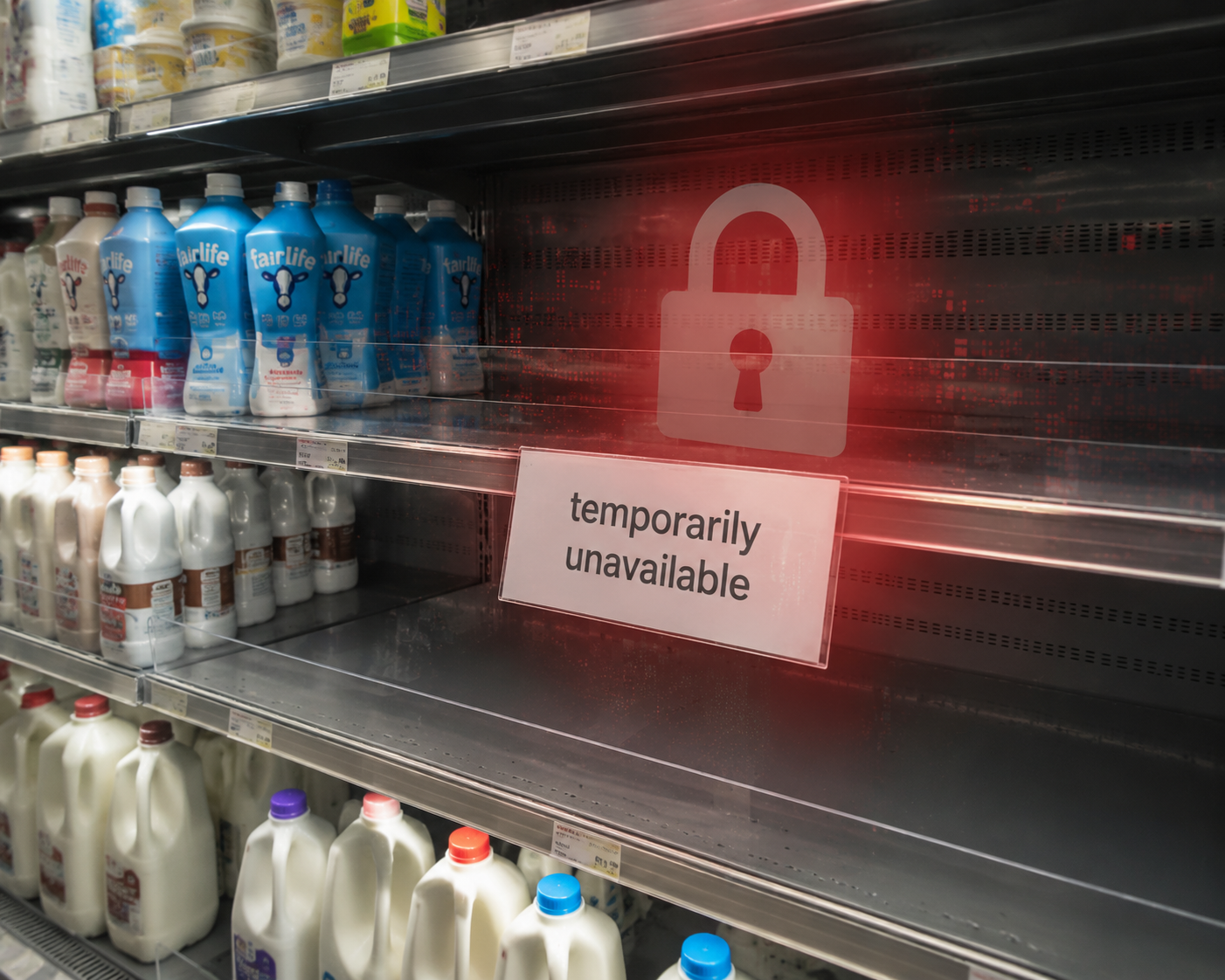
The story becomes real at the shelf. Fairlife ultra-filtered milk and Core Power shakes are the kind of products students may have seen at Target, Walmart, Costco, Amazon, a gym fridge, or a campus dining cooler. They look ordinary: white bottles, protein numbers on the label, something to grab after practice or between classes. Then a cybersecurity headline says a ransomware attack suspended production. Suddenly, “critical infrastructure” is not just power plants and airports. It can also mean the system that helps get a protein shake into a refrigerator case.
As of July 18, 2026, the Fairlife ransomware attack is still a developing incident, so the careful version matters. Coca-Cola disclosed on July 16, 2026, that Fairlife had detected “unauthorized access by a third party to a portion of its systems, including its production-related systems,” and said it suspended production at affected U.S. facilities while responding to the incident.[1]
The known production impact was specific: Fairlife suspended U.S. production at plants in Coopersville, Michigan; Goodyear, Arizona; and Webster, New York. Its Canadian operation in Peterborough, Ontario, was not affected.[2] Coca-Cola also said product quality and safety were not compromised, which means the reported problem was about production capacity and systems access, not a confirmed safety problem with milk or shakes already made.[3]
That is the core of the case: a digital intrusion reached systems connected to making physical products, and the company stopped production at multiple U.S. plants. There is no confirmed attacker name in the public reporting, no confirmed ransom amount, no confirmed stolen-data details, and no public recovery timeline as of this writing. Those gaps are not small footnotes. They are the difference between explaining what happened and pretending the whole mystery has already been solved.
What Happened at Fairlife, in Plain Language
Fairlife is not a tiny brand hiding in one regional cooler. Coca-Cola first invested in Fairlife in 2014 and fully acquired it in 2020.[1] The brand’s retail value grew from about $10 million in 2014 to roughly $4 billion by 2024, a retail-value measure of consumer spending rather than the same thing as profit.[4][5] That size is why this incident matters beyond one company’s IT department.
For students, the useful way to read the event is as a chain. Someone gained unauthorized access to part of Fairlife’s systems. The disclosed affected area included production-related systems. Fairlife and Coca-Cola responded by suspending production at three U.S. plants. Stores, distributors, workers, and customers can feel the result before they know the technical cause.
| Part of the chain | What is known |
|---|---|
| Digital access | Fairlife detected unauthorized third-party access to part of its systems. |
| Production connection | The affected systems included production-related systems. |
| Physical response | U.S. production was suspended at Coopersville, Goodyear, and Webster. |
| Unaffected site | The Peterborough, Ontario operation was reported as unaffected. |
| Product safety | Coca-Cola said product quality and safety were not compromised. |
| Unknowns | No public attacker attribution, ransom amount, data-theft confirmation, or recovery timeline has been confirmed. |
Notice what the table does not say. It does not say every machine on a factory floor was encrypted. It does not say the attackers directly controlled dairy equipment. It does not say a specific ransomware gang did it. Publicly available facts support a narrower claim: the incident involved unauthorized access to systems that included production-related systems, and the company suspended U.S. production while responding.
That narrower claim is still serious. A dairy plant is not like a homework document you can ignore until tomorrow. Milk has to be processed, packaged, stored cold, shipped, stocked, and sold on a timeline. A disruption at the production stage can push pressure outward: plant workers wait for direction, supply-chain teams recalculate, retailers watch inventory, and customers discover the issue as an empty space on a shelf.
How Ransomware Can Turn a Computer Problem Into a Factory Problem
Ransomware is usually described as malicious software that encrypts files and demands payment to unlock them. IBM’s plain-language explanation describes a common sequence: attackers get initial access, move through systems, encrypt data or systems, and then use the disruption to pressure the victim into paying.[6]
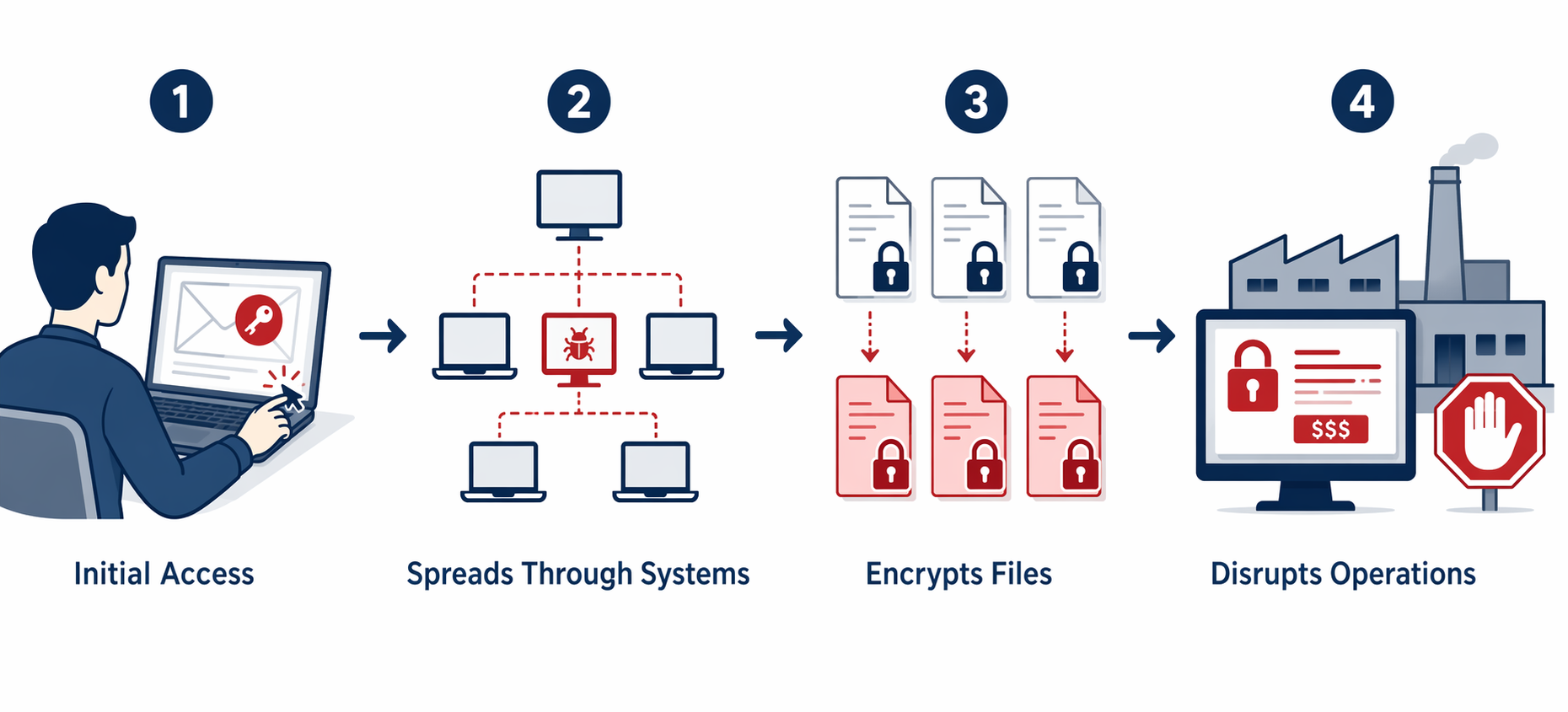
A classroom version might sound like this. First, the attacker needs a doorway. That doorway could be a stolen password, a trick email, or another weakness, but the public Fairlife reports do not confirm which doorway was used. Second, the attacker tries to reach more useful systems. In a large company, one login or one computer is rarely the whole prize. Third, ransomware may lock files or systems so the company cannot use them normally. Fourth, the attacker may demand payment while the company is trying to restore operations.
The point for students is not that every ransomware attack works in exactly the same way. It is that modern companies use computer systems to run physical work. A dairy plant depends on schedules, sensors, production controls, quality checks, inventory systems, shipping coordination, and employee workflows. If enough of those systems become untrusted, locked, or unreachable, the safest business decision may be to stop production until people can verify what is happening.
That is why “production-related systems” is the phrase to slow down on. It does not just mean someone’s office laptop had a bad day. It points toward systems connected to making the product. The public filing does not give a map of exactly which systems were touched, and it should not be read as if it did. But it does explain why the company’s response moved from cybersecurity investigation to a real production halt.
A Hypothetical Example
Imagine a school cafeteria where the lunch line depends on a digital ordering screen, a refrigerator temperature monitor, a payment system, and a delivery schedule. If the payment system fails, lunch might still happen. If the temperature monitor cannot be trusted, the refrigerator logs are unavailable, and the delivery schedule is locked at the same time, the cafeteria may have to pause service even if the food looks fine. That example is hypothetical, but it shows the logic: when systems that prove, coordinate, or control physical work are disrupted, stopping can be safer than guessing.
Fairlife’s case belongs in that category of lesson. The public facts do not prove every technical step of the attack. They do show that ransomware can matter because computers are not separate from the world students live in. They are stitched into the machines, schedules, checks, and decisions that move real goods.
Why Would Attackers Care About a Dairy Company?
A dairy company may sound like an odd target only if cybersecurity is imagined as a movie scene: spies, secret files, and glowing code. In real life, attackers often care about pressure. A food or beverage company operates on time-sensitive production. Ingredients, cold storage, transportation, store shelves, and customer demand do not pause politely while an IT team rebuilds systems.
Manufacturing is also heavily targeted. IBM’s X-Force Threat Intelligence Index, as reported by SecurityWeek, said manufacturing was the most-targeted sector for the fifth consecutive year, and that active ransomware groups rose 49% year over year, from 73 to 109 groups.[7] Those numbers do not prove why Fairlife was attacked by a specific group. They do show that the broader environment is not random: companies that make things are attractive because downtime is visible and expensive.
Food-sector incidents before Fairlife show the same basic pressure point. JBS, one of the world’s largest meat companies, halted production in 2021 and paid an $11 million ransom. UNFI reported supply-chain disruption after a 2025 cyberattack, and Arizona Beverages was hit by ransomware in 2019.[7][8] These cases should not be used to predict Fairlife’s recovery timeline. They are useful because they show students that food and beverage production has already been part of the ransomware story.
The pressure is easy to understand without exaggerating it. If a streaming service goes down, people complain and watch something else. If a dairy plant pauses production, there may be cold-storage constraints, retailer commitments, transportation schedules, worker shifts, and quality-control rules involved. That does not automatically mean a national shortage. It does mean the consequences can leave the screen quickly.
What Students Should Not Assume Yet
A live cyber incident creates a temptation to fill in the blanks. The blanks in this case are still important. As of July 17–18, 2026, public reporting said no ransomware group had claimed responsibility, and Coca-Cola had not disclosed whether data was stolen or whether a ransom was demanded.[9] That means several common claims should be treated as unconfirmed.
- Do not assume a named gang was responsible unless Coca-Cola, investigators, or reliable reporting confirms it.
- Do not assume customer or employee data was stolen; that has not been publicly confirmed.
- Do not assume the company paid, refused to pay, or received a specific ransom demand.
- Do not assume product on shelves was unsafe; Coca-Cola said product quality and safety were not compromised.
- Do not assume a specific date for full recovery; no public recovery timeline has been confirmed.
This kind of caution is not being boring. It is how responsible readers handle a developing event. Cybersecurity reporting often changes as companies investigate logs, rebuild systems, notify regulators, and learn whether data left the network. The first public filing can tell us that something serious happened without answering every technical question.
The Supply-Chain Lesson Behind the Fairlife Attack
For students, the Fairlife ransomware attack is useful because it changes the shape of the word “cyber.” It is not only about passwords, stolen selfies, or a school account getting locked. It can involve a production plant, a shipping schedule, a grocery store cooler, and a student looking for the same drink they buy every week.
The cleanest explanation is this: Fairlife detected unauthorized access to systems that included production-related systems; Coca-Cola suspended U.S. production at three plants; the Canadian operation was not affected; the company said product safety was not compromised; and the attacker, ransom details, data-theft status, and recovery timeline were not publicly confirmed as of July 18, 2026.
If students can explain that in their own words, they have learned the main civics-and-technology lesson. Ransomware is not just an invisible computer problem. In companies that make everyday goods, a digital disruption can become a physical production problem. The Fairlife case makes that visible, while still requiring readers to separate confirmed facts from open questions.
References
- Coca-Cola suspended production at its Fairlife dairy after a ransomware attack, TechCrunch, July 16, 2026
- Coca-Cola says Fairlife ransomware attack halts US dairy production, BleepingComputer
- Coca-Cola confirms ransomware attack as Fairlife US production halts, FoodNavigator, July 17, 2026
- Fairlife, Wikipedia
- fairlife LLC Surpasses $1 Billion in Annual Retail Sales, Fairlife
- What is ransomware?, IBM
- Coca-Cola Suspends US Fairlife Production Due to Ransomware Attack, SecurityWeek
- Dairy company Fairlife suspends production in US following cyber incident, The Record
- Coca-Cola confirms Fairlife ransomware attack, Help Net Security, July 17, 2026
Comments
Join the discussion with an anonymous comment.