

What Motivates Voters? A Research Overview
This article synthesizes key academic research on voter motivation, explaining the psychological drivers behind why people vote despite the paradox of rational choice. Students will learn the five main motives and the most cited field experiments on turnout.
Updated:
The puzzle behind voting is simple enough to state and hard enough to teach well: if one ballot almost never decides an election, why do people keep casting ballots at all? In the narrowest rational-choice version of the problem, turnout should be close to zero because the private cost of voting usually exceeds the expected instrumental payoff of one vote. Yet elections regularly draw millions of voters, so the interesting question is not whether the simple model is elegant. It is what the model leaves out. [1]
A good answer to “what motivates voters?” has to do two things at once. It has to respect the mathematical puzzle, because a single voter usually has little chance of changing the result. It also has to take ordinary moral and social life seriously, because voters are not only payoff calculators. They are neighbors, partisans, parents, union members, church members, students, immigrants, veterans, and people who have learned that some actions matter even when their immediate individual effect is tiny.
The Five Motives Students Should Start With
A useful map comes from Bali, Robison, and Winder’s study of psychological motives for voting. Their framework separates voter motivation into five reported motives, with altruism and civic duty doing the most work. In their account, altruism and civic duty together explain more than 60% of reported motives for voting, while selfishness is the least important motive. [2]
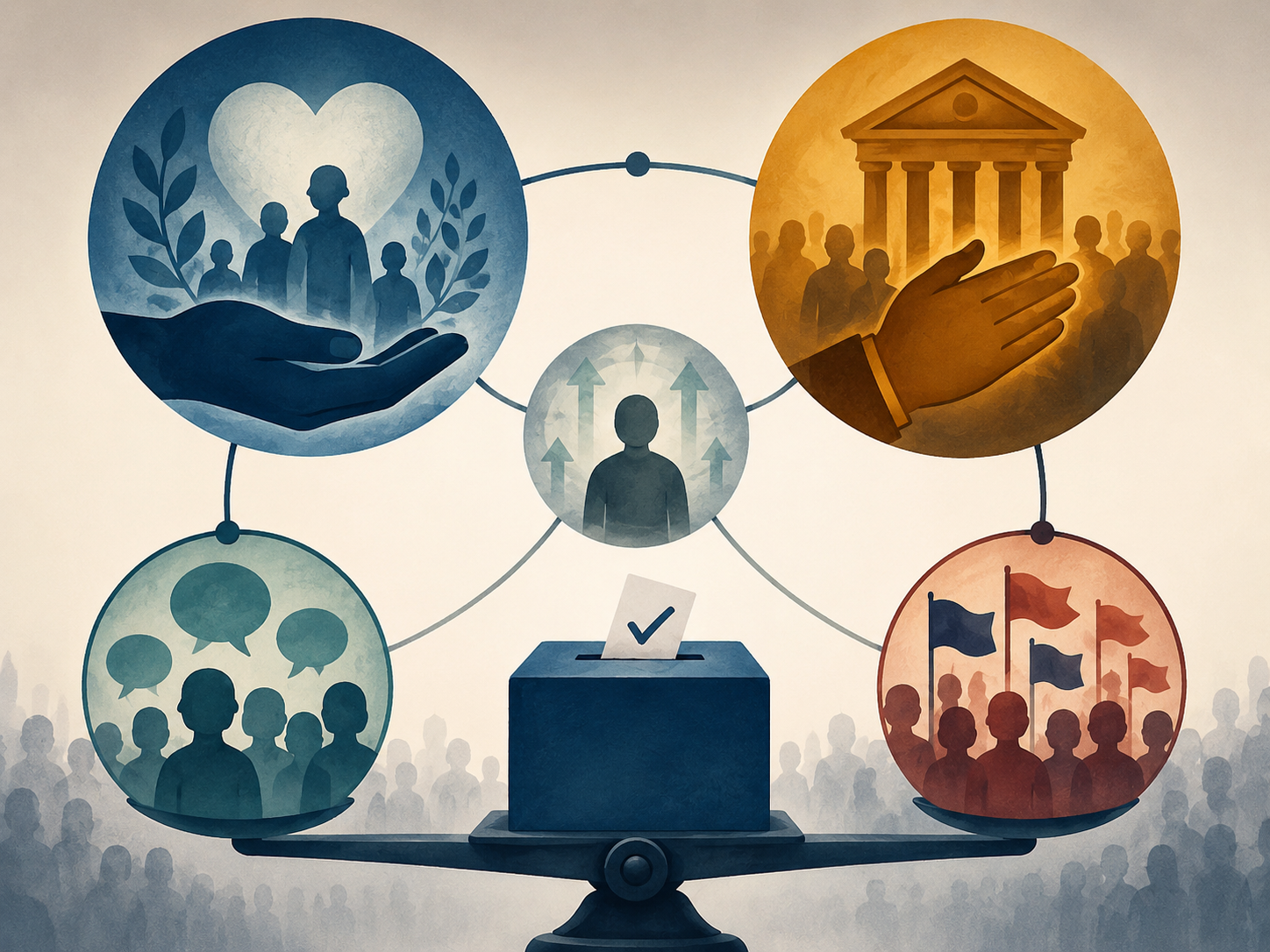
| Motive | What It Means In Voting Research | Why It Matters |
|---|---|---|
| Altruism | Voting because an outcome may benefit other people, not only oneself. | It helps explain why people participate even when the personal payoff of one ballot is tiny. |
| Civic duty | Voting because participation feels like a responsibility attached to citizenship or community membership. | It captures the moral force of turnout without reducing it to sentimentality. |
| Selfishness | Voting mainly to secure direct personal benefit. | Bali, Robison, and Winder find it to be the least important reported motive. |
| Socially embedded motives | Voting because participation is connected to group identity, visibility, norms, or belonging. | These motives help connect survey answers to field experiments on identity and social pressure. |
| Political attachment | Voting because parties, candidates, or causes make participation meaningful. | It helps explain why elections can activate identity and concern even when one vote remains unlikely to be decisive. |
Altruism is often the motive students underplay because it sounds too generous for political behavior. But in turnout research, altruism does not require a voter to be selfless in every part of life. It means that the voter can care about collective consequences: public schools, health care, taxes, civil rights, war, climate policy, neighborhood safety, or the treatment of groups to which the voter may not personally belong. A single ballot is weak as a private instrument, but voting can still be intelligible as a contribution to a public outcome.
Civic duty is different. It does not say, “My vote will decide this election.” It says, “People like me ought to take part.” That distinction matters. Duty is not a prediction about the probability of being pivotal; it is a norm about the kind of person one is expected to be in a political community. This is why duty can survive the arithmetic that embarrasses a purely instrumental model.
Selfishness still belongs in the framework, but it should not be allowed to swallow the whole explanation. Some voters do support candidates or policies because they expect direct benefits. That is ordinary politics. The empirical point from Bali, Robison, and Winder is narrower and more useful: when people report why they vote, selfishness is not the dominant motive, and it is less important than altruism and civic duty. [2]
The framework is especially helpful because it keeps two bad explanations off the page. One says voters are secretly rational calculators who must be getting a private payoff large enough to justify turnout. The other says voters show up simply because democracy is inspiring. The evidence points to something more mixed and more believable: people vote because the act is tied to concern for others, moral obligation, identity, social expectation, and practical habit.
Reported Motives Are Not the Same as Turnout Effects
The five-motives framework gives students a vocabulary, but it does not end the inquiry. A survey about why people say they vote measures reported motivation. A field experiment that changes a message and then observes turnout measures behavioral response. Those are related, but they are not interchangeable.
This distinction is not a technical nuisance. It is one of the main lessons of the literature. People may sincerely report civic duty and altruism, while the marginal increase in turnout during a particular election may come from identity language, social pressure, a reminder that others are voting, or a plan made in advance. The underlying motive and the immediate trigger do not have to be the same thing.
That is why the strongest studies in this area are often modest in appearance. They do not claim to discover the soul of the voter. They change a word, an image, a phone script, or a mailing, and then ask whether turnout changes. The best of them are useful not because they provide universal campaign recipes, but because they reveal which psychological channels can be moved.
Identity: The Difference Between Voting and Being a Voter
The most memorable experiment for many students is Bryan, Walton, Rogers, and Dweck’s study on noun-versus-verb framing. The researchers compared language that framed participation as an action — “voting” — with language that framed participation as an identity — “being a voter.” In a demographically diverse statewide field experiment, the identity framing increased turnout by up to 10.9 percentage points. [3]

The wording change is small enough to seem almost trivial. That is what makes the result worth sitting with. “Voting” describes something a person may or may not do on Tuesday. “Being a voter” invites the person to see turnout as evidence of a valued self. The mechanism is not mainly information. The intervention does not teach citizens where the polling place is or explain the candidates’ platforms. It changes the psychological category into which the act falls.
This study also shows why identity cannot be treated as mere decoration on top of interests. If the only question were whether the voter’s ballot changes the outcome, noun framing should not matter much. But if voting helps maintain a self-concept — responsible citizen, engaged community member, reliable participant — then a small linguistic cue can make abstention feel less like skipping an errand and more like failing to act as the kind of person one claims to be.
There is a caution here. The experiment is foundational, not new. It belongs to the early 2010s wave of field experiments that students still encounter because the designs are clean and the effects are concrete. That does not mean the exact effect size should be expected in every electorate, media environment, or election year. It means the study remains a powerful demonstration that political participation can be moved through identity, not only through policy information or material incentive.
Visibility, Norms, and the Uneasy Power of Social Pressure
Identity makes voting part of the self. Social pressure works from another direction: it makes voting feel observed. Panagopoulos’s work on visual cues found that postcards with images of watching eyes increased turnout compared with postcards using more generic images such as flags or palm trees. The same research profile also reports that financial incentives of $10 to $25 stimulated turnout by 3 to 7 percentage points. [4]
The watching-eyes result is useful precisely because it is a little uncomfortable. It does not flatter citizens by imagining that they always vote from pure civic reflection. It suggests that some participation is responsive to the feeling of being seen. The ballot is secret, but turnout is often socially legible: people can ask whether someone voted, campaigns can use public turnout records, and households can develop expectations about who participates.
Social-norm messages sharpen the point. Todd Rogers’s work on turnout messaging found that communications emphasizing high expected turnout outperform messages lamenting low turnout. In the same line of research, adding an accountability cue — “We may call you after the election” — increased a mailing’s effectiveness by nearly half. [5]
The mechanism is not identical in each case. Watching eyes cue observation. High-turnout messages tell people that participation is normal. Accountability language implies that abstention may later have to be acknowledged. They all move through the social environment around voting, but they do not all appeal to the same inner motive.
| Intervention | Psychological Channel | What the Evidence Supports |
|---|---|---|
| “Be a voter” language | Identity | A small wording shift can increase turnout by making participation part of the self. |
| Watching-eyes imagery | Social visibility | Cues of being observed can increase turnout relative to generic images. |
| High expected-turnout messages | Social norms | People respond better to messages that present voting as common than to messages that stress low participation. |
| Accountability cues | Anticipated follow-up | A suggestion that someone may ask afterward can strengthen a turnout mailing. |
| Planning scripts | Implementation intention | Helping voters specify when, where, and how they will vote can reduce friction at the moment of action. |
Planning Helps When Motivation Is Already There
Not every turnout intervention tries to deepen duty or activate identity. Some simply help a motivated person complete the act. Nickerson and Rogers’s 2010 work on implementation intentions tested get-out-the-vote phone scripts that asked people to form a specific voting plan: when they would vote, where they would go, and how they would get there. These planning scripts were more than twice as effective as standard scripts, with the effect concentrated in single-voter households.
This kind of intervention is easy to underrate because it sounds administrative. But voting often fails at the handoff between intention and action. A person may approve of voting, identify as a voter, and still miss the window because of work, transportation, childcare, confusion about timing, or ordinary forgetfulness. Planning does not create the deepest motive. It protects the motive from friction.
For students, this is a useful distinction: some studies explain why voting matters to people; others explain why people who already think voting matters actually make it to the ballot. A turnout model that ignores logistics will overstate psychology. A model that treats logistics as the whole story will miss why anyone bothers to make the plan in the first place.
What About Anger, Partisanship, and Polarization?
Students often want to add anger or affective polarization to the answer, and that instinct is understandable. Contemporary voters do not encounter politics as a neutral spreadsheet of policy preferences. Party identity, dislike of opponents, candidate attachment, and issue conflict can all make elections feel personally and morally charged.
The materials here support a cautious treatment rather than a grand claim. Affective polarization can be part of the motivational environment, but the research base summarized in this overview does not provide one canonical affective-polarization study equivalent to the Bali framework or the Bryan identity experiment. It is safer to say that polarization may intensify identity and group-based participation than to say it has replaced duty, altruism, or social norms as the main explanation for turnout.
For a contemporary example of how motivations connect to electoral choice rather than turnout alone, polling comparisons such as Democratic Socialists vs. MAGA polls can be useful. A competitive race case such as the 2026 Maine Senate race notes can also help students see how turnout, candidate evaluation, and issue salience meet in actual electoral contexts. Those examples illustrate application; they are not substitutes for the research evidence on motivation.
A Disciplined Answer to “What Motivates Voters?”
The cleanest answer is not the most reductive one. People vote less because one ballot is instrumentally powerful and more because voting expresses duty, group membership, concern for others, and responsiveness to social context. Bali, Robison, and Winder give students the broad motivational map: altruism and civic duty dominate reported motives, while selfishness is least important. Bryan, Walton, Rogers, and Dweck show that identity language can change actual turnout. Panagopoulos and Rogers show that visibility, norms, and accountability can also move participation. Planning research adds that even motivated voters sometimes need help turning intention into action. [2][3][4][5]
The age of several major experiments should be kept in view. Many of the field studies students still cite come from roughly the 2010–2014 period. That makes them older than the current political media environment, but it also explains their status: they are foundational because they isolate mechanisms clearly enough to teach, test, and debate.
The lesson is not that campaigns can manufacture turnout with a clever phrase or a pair of printed eyes. Small psychological interventions matter, but they work against a deeper motivational background. Voting is a low-probability instrument and a high-meaning act. That is why the paradox persists, and why a serious study of voter motivation has to include morality, identity, social life, and practical follow-through.
References
- What is voter turnout, and why does it matter? University of Rochester.
- What Motivates Voters? SAGE Open, 2020.
- Motivating voter turnout by invoking the self. PNAS, 2011.
- What Motivates Voters? Political Scientist Peers into Voter Behavior. Fordham Now.
- Todd Rogers: The Psychology Around Voter Turnout. Stanford Graduate School of Business.
Comments
Join the discussion with an anonymous comment.