

Everything You Need to Know About the 2026 Maine Senate Race
This study guide covers the 2026 Maine Senate race from the June primaries through the replacement convention and general election matchups, with key dates, spending data, and review questions to help political science students prepare for exams.
Updated:
Study Notes: What to Remember First
The 2026 Maine Senate race is not just another incumbent-versus-challenger contest. It is a compact case study in how primaries, scandals, party rules, campaign money, polling uncertainty, and Senate control can collide in one election cycle.
The basic frame is this: Republican Sen. Susan Collins is seeking a sixth term. She last won reelection in 2020 with 51% of the vote even as Joe Biden carried Maine by 9 points, and Democrats have not won a U.S. Senate seat in Maine since 1988. Collins is also the only Republican senator representing a state Donald Trump never carried in three presidential campaigns. The general election is scheduled for November 3, 2026, and Maine uses ranked-choice voting in federal elections.[1]
For an exam, the important part is not to memorize every campaign insult. The important part is to keep the sequence straight: June 9 primaries, a large Democratic primary win by Graham Platner, a wave of post-primary controversies, Platner’s July 8 withdrawal, a Democratic replacement convention scheduled for July 25, and a general election that remains unsettled as of July 20, 2026.[1]
| Item | Study Note |
|---|---|
| Incumbent | Susan Collins, Republican, seeking a sixth term |
| Democratic situation | Graham Platner won the June 9 primary, then withdrew on July 8 |
| Replacement process | Democratic convention scheduled for July 25, 2026 |
| General election | November 3, 2026 |
| Voting system | Ranked-choice voting for federal elections |
| Senate control context | 51 Republicans to 49 Democrats, counting independents who caucus with Democrats |
The Chronology That Holds the Race Together
If this race appears on a test, the safest starting point is chronology. Without the order of events, the replacement convention, the polling uncertainty, and the spending numbers will look like disconnected facts.
| Date or Period | What Happened | Why It Matters |
|---|---|---|
| June 9, 2026 | Maine held U.S. Senate primaries. | Collins secured the Republican nomination, while Democrats nominated Graham Platner. |
| June 9, 2026 | Platner won the Democratic primary with 72.1% and 156,084 votes. | His win showed the strength of the progressive wing and produced the largest vote total ever received by a Democrat in a Maine primary. |
| After June 9 | Controversies involving Platner surfaced after the primary. | The Democratic Party moved from primary unity to crisis management. |
| July 8, 2026 | Platner withdrew from the race. | Maine Democrats had to replace a Senate nominee by convention for the first time in state history. |
| July 25, 2026 | Democrats are scheduled to hold a replacement convention. | As of July 20, the nominee is still unknown. |
| November 3, 2026 | The general election is scheduled. | The race could affect which party controls the U.S. Senate. |
The Republican Primary Was Brief but Important
Collins defeated minor Republican challengers, including state Rep. Michael Soboleski, and won the June 9 Republican primary with roughly 80% of the vote.[1] That result matters less because of suspense and more because of contrast. The Republican side preserved the normal advantages of incumbency: name recognition, fundraising continuity, staff continuity, and a nominee already known to general-election voters.
Students should connect this to the concept of incumbency. An incumbent who survives a primary easily can usually move straight into general-election organization. The opposing party, by contrast, may lose time if its nomination process breaks down after the primary.
The Democratic Primary Created the Exam-Worthy Part of the Race
The Democratic primary is where the race becomes institutionally unusual. Graham Platner, a progressive and former congressional staffer, defeated state House Speaker Ryan Mills and former Portland mayor Kate Snyder on June 9. Platner won 72.1% of the vote and received 156,084 votes, described in the available race materials as the most votes any Democrat had received in a Maine primary.[1]
That result was not a narrow upset that party leaders could easily reinterpret. It was a large primary victory over more establishment-aligned alternatives. Mills withdrew after Platner’s victory and endorsed him, which briefly made the party’s next step look ordinary: consolidate after the primary and turn toward Collins.[1]
The primary also illustrates a recurring party-politics problem: the candidate who can mobilize primary voters is not always the candidate party professionals consider least risky for the general election. That does not mean primary voters were irrational, and it does not mean party leaders were automatically correct. It means nomination contests can expose different definitions of electability.
Why Platner’s Win Changed the Democratic Side
- It showed that the progressive lane was not symbolic; it could win the nomination decisively.
- It defeated candidates with more conventional governing credentials.
- It initially gave Democrats a nominee with demonstrated primary-voter enthusiasm.
- It made the later withdrawal more disruptive because the party was not replacing a marginal nominee.
The Withdrawal Turned a Primary Result Into a Party Procedure Problem
After the primary, controversies involving Platner emerged, including past Reddit posts, a tattoo linked to a Nazi symbol, explicit messages to a 17-year-old when he was 26, and later a rape allegation. Several Democratic figures rescinded endorsements, and the state party chair resigned. Platner withdrew on July 8, 2026.[1]
For study purposes, the point is not to linger over sensational details. The point is institutional consequence. Once the nominee withdrew after winning the primary, Democrats could not simply rerun the June 9 election. They had to use a party process to select a replacement nominee. Available materials describe this as the first time in Maine history that a party had to replace a Senate nominee through a convention.[1]
That distinction matters. A primary is a public election among party voters. A replacement convention is a party-controlled mechanism operating after the ordinary nomination vote has already occurred. Students should be able to explain why this changes legitimacy questions, campaign timing, and voter expectations.

The July 25 Convention Is the Next Major Fact
As of July 20, 2026, the Democratic replacement convention is still five days away. The leading possibilities identified in the available materials are former state Senate President Troy Jackson, Secretary of State Shenna Bellows, and state Sen. Shah.[1] Until delegates choose a nominee, the general-election matchup is conditional.
This is the place where many rushed summaries become misleading. A poll testing Collins against “a Democrat” or against a candidate who is not yet nominated does not have the same meaning as a poll taken after the ballot is settled. The replacement candidate will inherit some Democratic advantages, such as the national importance of the seat, but will also inherit lost time, organizational disruption, and the need to introduce or reintroduce themselves to voters.
| Convention Question | Why It Matters for Students |
|---|---|
| Who selects the replacement nominee? | The process shifts from ordinary primary voters to party convention delegates. |
| Which candidate wins? | The identity of the Democrat affects fundraising, messaging, and general-election polling. |
| How unified is the party afterward? | A replacement nominee needs time to repair the campaign structure after a public collapse. |
| How does Collins respond? | The incumbent can campaign against the party’s turmoil as well as against the eventual nominee. |
Ranked-Choice Voting Belongs in the Notes, Not in the Margins
Maine uses ranked-choice voting in federal elections, which means voters can rank candidates rather than selecting only one. If no candidate wins an initial majority, the last-place candidate is eliminated and that candidate’s voters can be reallocated according to next preferences.[2]
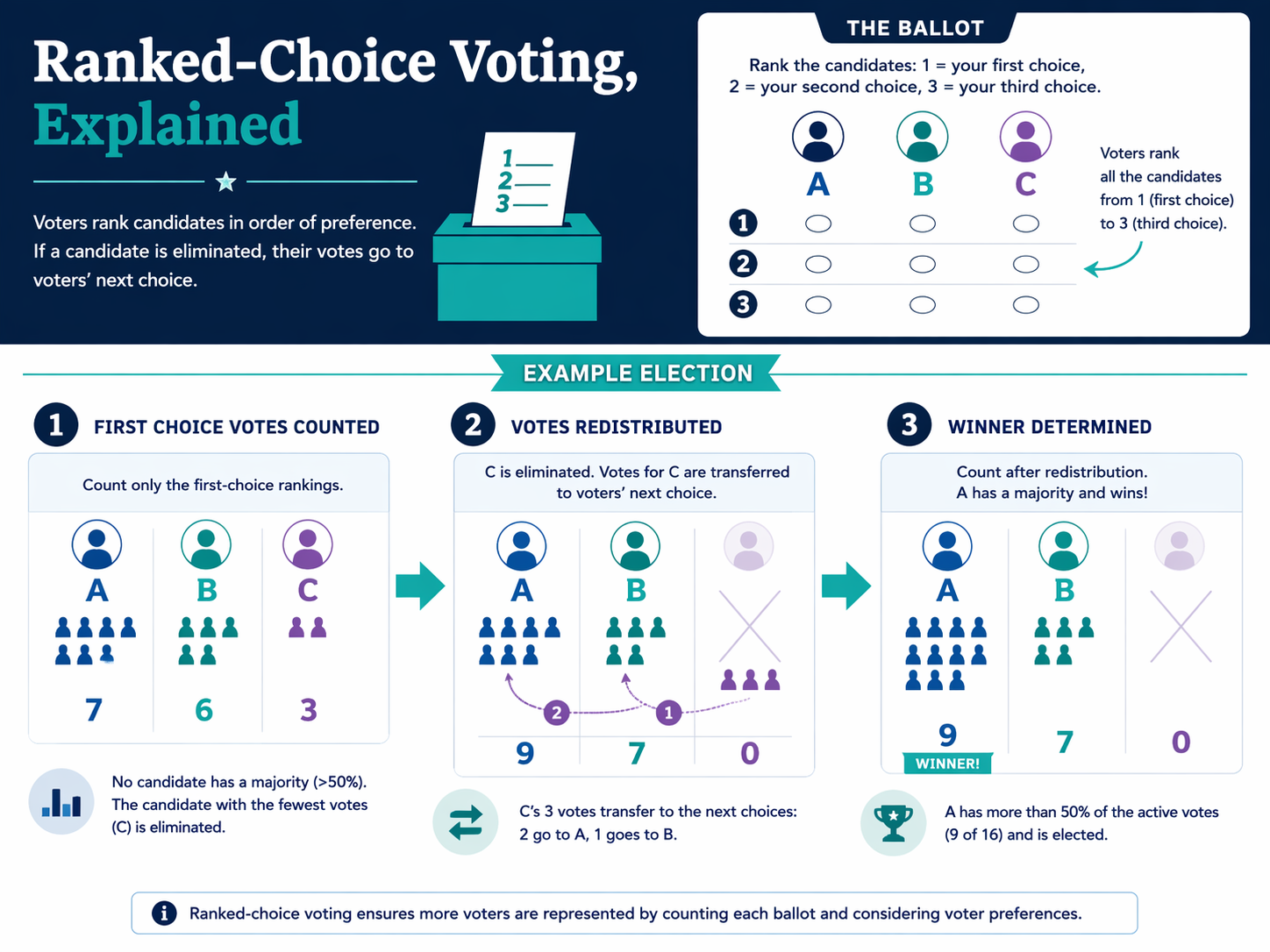
For this race, ranked-choice voting does not mean the major-party nominee fight is irrelevant. It means students should be careful about plurality assumptions. If additional candidates appear on the federal ballot, the final winner may depend not only on first-choice strength but also on how later preferences transfer.
What Polling Can and Cannot Tell You Yet
Polling from sources including UMass Lowell, Emerson, and the University of New Hampshire has shown a close race, with Collins and possible Democratic opponents within the margin of error in tested matchups.[3][4] That is enough to call the race competitive. It is not enough to treat any hypothetical matchup as a settled November forecast.
Sabato’s Crystal Ball has treated the Maine race as highly competitive, with its rating depending on the replacement nominee and the post-withdrawal state of the Democratic side.[5] RealClearPolling’s Maine Senate page has tracked the Collins-versus-Platner matchup, but that matchup became historically useful rather than directly predictive once Platner withdrew.[6]
| Evidence | What It Supports | What It Does Not Prove |
|---|---|---|
| Close public polling | The race is competitive. | The final nominee will lead in November. |
| Collins’s past ticket-splitting | She has previously won voters in a Democratic-leaning presidential state. | Ticket-splitting will remain equally strong in 2026. |
| Replacement convention uncertainty | The Democratic campaign is not yet fully defined. | Democrats cannot recover after July 25. |
| Race ratings | Analysts see Maine as one of the key Senate contests. | Ratings are election results. |
Spending Shows Capacity, Not Destiny
The money in this race is large enough that it belongs in any serious study guide. AdImpact reported more than $53 million in ad spending during the primary alone, making it the most expensive Senate primary in Maine history.[7] That figure helps explain why the primary was not a quiet intraparty contest. It was already operating at the scale of a nationally watched Senate race.
General-election reservations also show how national groups viewed Maine before the Democratic nominee was even replaced. AdImpact reported $67.8 million in pre-booked general-election advertising, including $28.7 million from Senate Leadership Fund and $20.4 million from WinSenate.[7]
Campaign finance reports add another layer. Federal Election Commission data showed Collins with $11 million cash on hand as of June 30.[8] OpenSecrets reported that Platner had raised $16.3 million but had only $2.2 million left, and his withdrawal meant Democrats lost the fundraising advantage attached to his campaign.[9]
Those numbers should be read as campaign capacity. Cash on hand can pay staff, reserve advertising, build voter-contact programs, and respond quickly to attacks. It cannot by itself repair a damaged nomination process or guarantee voter trust. In this race, money explains why both parties can still fight hard; it does not remove the uncertainty created by the July 25 convention.
Why Maine Matters for Senate Control
The national stakes are straightforward. The Senate stands at 51 Republicans and 49 Democrats, counting the two independents who caucus with Democrats. That makes Maine one of the clearest Democratic pickup opportunities, especially because Collins is the last Republican Senate incumbent in New England.[1]
Maine is also useful for studying ticket-splitting. Collins has survived in a state that has voted Democratic for president, while Democratic Gov. Janet Mills is another example of voters distinguishing between party labels and individual candidates in state politics. The caution is that nationalized elections have made ticket-splitting less common across American politics, so Collins’s past success is evidence of an electoral pattern, not a guarantee that the pattern will repeat.
Ad messaging also shows how nationalized the race has become. AdImpact’s 2026 messaging snapshot described Trump-centered messaging as a major feature of the cycle.[10] In a state Trump never carried, that national frame can matter even when the Republican incumbent has long presented herself as personally distinct from the national party.
Key Terms for Flashcards
- Incumbency: The electoral advantage held by a current officeholder, often including name recognition, fundraising networks, staff, and an existing public record.
- Primary election: An election used by party voters to select a party’s nominee for the general election.
- Replacement convention: A party process used here to select a new nominee after the primary winner withdrew.
- Ranked-choice voting: A system in which voters rank candidates and votes can be transferred if no candidate wins an initial majority.
- Ticket-splitting: Voting for candidates from different parties for different offices in the same election cycle.
- Cash on hand: The amount of campaign money available at a reporting deadline after previous receipts and spending.
- Ad reservation: Advertising time or space booked in advance, often by campaigns or outside groups.
- Margin of error: A polling concept showing the range within which the true public opinion value may fall, meaning small leads may not be meaningful.
- Nationalized election: An election in which national party issues and leaders heavily shape voter behavior, even in a state-level or Senate race.
Review Questions
- Put these events in order: Platner withdraws, Maine holds its Senate primaries, Democrats schedule a replacement convention, the general election takes place.
- Why did Susan Collins’s Republican primary result help preserve her incumbency advantage?
- What did Graham Platner’s 72.1% Democratic primary win show about the party’s internal politics?
- Why did Platner’s July 8 withdrawal create an institutional problem rather than just a campaign problem?
- Name the three leading Democratic replacement possibilities identified before the July 25 convention.
- Why should Collins-versus-Democrat polling be treated cautiously as of July 20, 2026?
- How does ranked-choice voting change the way students should think about a Maine federal election?
- What is the difference between campaign fundraising and cash on hand?
- Why does the 51R-49D Senate balance make Maine nationally important?
- Explain why this race is better studied as a sequence of institutional events than as a simple horse race.
What You Should Be Able to Explain by Late July 2026
By July 20, 2026, the central fact is that Maine has a Republican incumbent ready for the general election and a Democratic Party five days away from choosing a replacement nominee. That is the correct stopping point. The next major fact is the July 25 convention result, not an assumed November outcome.
For exam purposes, the 2026 Maine Senate race is valuable because it compresses many course concepts into one case: a progressive primary victory, factional tension inside a party, scandal fallout, nominee replacement rules, expensive campaign advertising, uncertain polling, ranked-choice voting, ticket-splitting, and Senate control. If you can explain how those pieces connect in order, you understand the race better than someone who only remembers the loudest headline.
References
- 2026 United States Senate election in Maine — Wikipedia
- How ranked choice voting is impacting the Maine primary: June update — FairVote
- Maine Poll: Platner Holds Slight Lead over Collins in U.S. Senate Race — UMass Lowell, June 4, 2026
- 2026 Polls: Maine Senate — 270toWin
- The Maine Senate Do-Over, and Rating Changes in Other Pine Tree State Races — Sabato's Crystal Ball
- Maine Senate Race 2026: Collins vs. Platner — RealClearPolling
- Mills Drops Out as Maine Senate Heads Toward Historic Spending — AdImpact
- 2026 Election United States Senate - Maine — FEC
- Platner's exit from Maine's Senate race leaves Democrats in a deep financial hole — OpenSecrets
- 2026 Ad Messaging Snapshot: It's All About Trump — AdImpact
Comments
Join the discussion with an anonymous comment.