

What Research Reveals About Independent Voters' Political Behavior
A synthesis of peer-reviewed research shows that independent voters are driven more by negativity—voting against a candidate they dislike—than by positive attachment, challenging the common stereotype that they are moderate, apathetic, or simply undecided.
Updated:
Independent voters are too often treated as the blank space between the two parties: moderate, undecided, faintly civic-minded, or just not paying attention. That shorthand is especially tempting because the group is large. Gallup reported in January 2026 that 45% of U.S. adults identified as political independents, the highest share in its trend and larger than either major-party identification group.[1] Pew Research Center's July 2026 party affiliation fact sheet places independence especially high among younger adults, with 56% of Gen Z and 54% of Millennials identifying as independents.[2]
Scale, however, is not explanation. The more useful question for studying independent voters' political behavior is not whether independents sit in the middle, but what their preferences are built from. A voter can lack warm attachment to a party and still have a highly organized aversion to a candidate, party, or political identity. That distinction is where the most interesting recent evidence begins.
The Problem With Treating Independents as the Middle
The word independent bundles together people who do not belong together analytically. Some independents lean Democratic or Republican. Some are genuine non-leaners. Some are habitual voters; others participate irregularly. Some may be ideologically cross-pressured, while others are simply alienated from party labels. If a student writes as though all of these voters are moderate swing voters, the paper has usually lost the behavior before it starts explaining it.
The leaner distinction is not a technical footnote. Gallup's 2026 account of party identification emphasizes that many self-identified independents still lean toward one party when pressed.[1] That means independence cannot automatically be read as neutrality. A voter may reject the label Democrat or Republican while repeatedly favoring one side, and another may reject both parties without moving evenly between them. The same survey answer can conceal different psychological arrangements.
This is why the old argument that independents are often hidden partisans remains useful. It prevents a naive reading of self-description. But it does not settle the question. If some independents behave like partisans without liking the party label, and others do not, then the next task is to identify what organizes their choices. The answer may not be positive attachment at all.
Negational Identification: A Preference Built Around Rejection
Siev, Rovenpor, and Petty give this pattern a name: negational identification. In their 2024 article in the Journal of Experimental Social Psychology, they argue that independents, more than partisans, tend to define electoral preferences by what they are against rather than what they are for.[3] The claim is not that independents are all angry, cynical, or disengaged. It is narrower and more important: negative preference can be an identity structure, not merely a mood.
Apathetic voters lack motivation; negationally identified voters can be quite motivated. Moderates may prefer compromise or hold centrist issue positions; negationally identified voters may or may not be moderate. Hidden partisans may vote reliably with one party while avoiding its label; negational identification asks whether their expressed choice is driven more by dislike of the alternative than by affection for their own side. These are different classifications, and collapsing them produces bad inference.
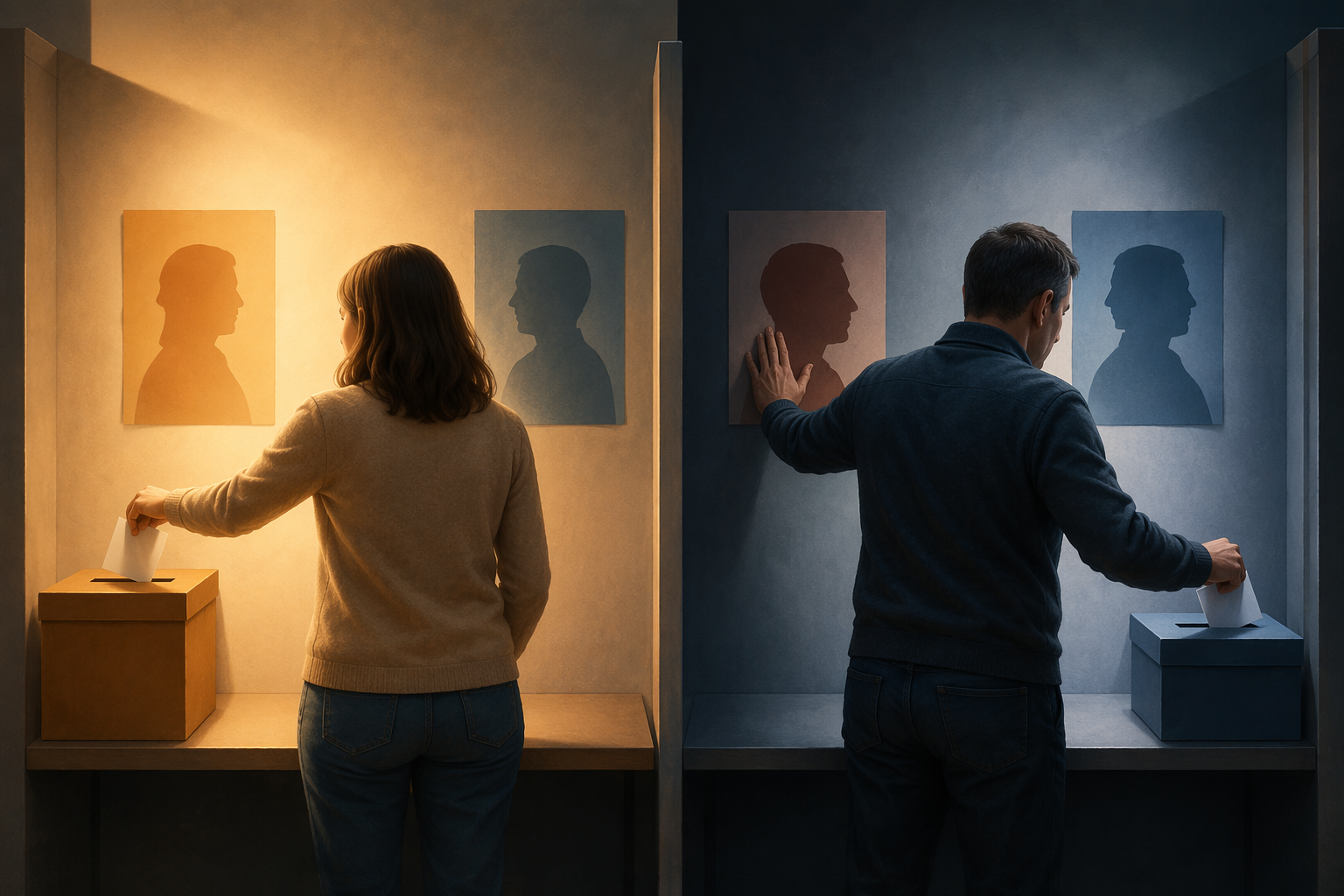
The simplest way to see the difference is to imagine two voters who choose the same presidential candidate. One says, in effect, "I want this candidate to win." The other says, "I cannot accept the opponent." The ballot records one action. The psychology behind the action differs. Siev and colleagues' contribution is to show that this difference is not just conversational color; it appears systematically in survey and experimental evidence.[3]
What Siev, Rovenpor, and Petty Actually Show
The 2024 study is useful because it does not rest on a single election-night anecdote. Across five studies, Siev, Rovenpor, and Petty analyze American National Election Studies data from 1968 through 2020, with a total N of 51,687, and test whether independents differ from partisans in the degree to which their electoral preferences are rooted in negativity.[3] The time span matters: a pattern that appears only in one unusually polarized election would be interesting, but much easier to dismiss as a campaign-specific artifact.
Their central electoral test compares whether people report voting for a candidate or against one. Across four presidential election cycles - 2000, 2008, 2016, and 2020 - a greater proportion of independents than partisans reported voting against a candidate rather than for one.[3] The point is not that partisan voters never cast negative votes. Of course they do. The finding is comparative: independents are more likely than partisans to express the vote in negative terms.
That comparative form should be kept intact. It is a statistical tendency, not a personality diagnosis. It does not authorize sentences such as "independents are anti-voters" or "independents have no positive commitments." It says that, relative to partisans, independents are more likely to anchor electoral preference in rejection. For students, that is the difference between a useful mechanism and a new stereotype.
The study also matters because it connects preference expression to participation. Siev and colleagues report that negativity-based attitudes predicted political participation better than positive attitudes among independents.[3] That is the finding that should make turnout interpretations more careful. If an independent voter is animated by opposition, low party warmth does not necessarily mean low political motivation. The voter may not be moved by belonging, but may still be moved by prevention: keeping someone out, blocking a direction, refusing an identity.
| Common label | What it assumes | What negational identification adds |
|---|---|---|
| Moderate | The voter is near the ideological center. | The voter may instead be organized by dislike of one side, regardless of issue moderation. |
| Undecided | The voter has not formed a preference. | The voter may have a clear negative preference before forming any strong positive attachment. |
| Apathetic | The voter lacks motivation. | The voter may be motivated by avoidance rather than enthusiasm. |
| Hidden partisan | The voter rejects the party label but leans predictably toward one side. | The voter may still express that lean as opposition to the alternative rather than attachment to the preferred side. |
Why the Non-Political Replications Matter
One strength of the Siev, Rovenpor, and Petty article is that it does not treat politics as a sealed-off exception. Their studies include replications in non-political domains such as sports fandom and consumer choices, where people can also define themselves by what they are not.[3] That broader testing does not prove that elections are psychologically identical to brand choice or fandom. It does, however, make the mechanism less likely to be a campaign-season quirk.
This is the part students often underuse. If a mechanism appears only in presidential voting, one might explain it by campaign negativity, candidate traits, or short-term context. If a similar pattern appears outside politics, the interpretation shifts. It becomes more plausible that some people maintain identities through exclusion: not that team, not that brand, not that party. Elections then become one setting in which a broader identity style becomes politically consequential.
What the Finding Explains About Voting Behavior
Negational identification helps explain why independent voting can look unstable from the outside while still being psychologically coherent. If a voter is choosing against the most objectionable available option, then their vote can change when the candidates, threats, or party images change. The movement is not necessarily random. It may follow the object of rejection.
It also clarifies why candidate evaluation and participation should not be read only through enthusiasm. A low positive rating for both candidates does not automatically imply withdrawal. In a two-candidate contest, aversion can be enough to produce a vote. The psychology is asymmetric: liking one candidate and disliking the other can both generate action, but they do not mean the same thing for future loyalty.
This asymmetry is especially important when interpreting persuasion. A campaign may not convert an independent into a warm supporter. It may instead heighten the cost of the alternative. From a behavioral standpoint, both can produce a vote. From a theoretical standpoint, they should not be coded as the same attachment.
Volatility Does Not Mean Emptiness
The volatility literature complicates the picture in a productive way. In their 2023 Politics & Policy article, Reilly and Hunting use ANES data from 1972 through 2020 to examine independent voting patterns over time, finding that independents move in and out of independent status across elections and show significant voting-loyalty volatility.[4] That evidence fits badly with any simple story in which independent is a stable ideological midpoint.
But volatility should not be used as a synonym for confusion. A voter can change party identification status because the parties have changed, because the candidates have changed, because the available objects of rejection have changed, or because a lean has become more or less socially acceptable to state openly. The 2023 study identifies movement and loyalty instability; it does not, by itself, tell us that every movement has the same psychological cause.[4]
Placed beside Siev, Rovenpor, and Petty, the volatility finding becomes more interpretable. If some independents are organized around opposition rather than attachment, then shifting electoral behavior need not indicate a lack of structure. It may indicate that the negative pole of the voter's choice has moved.
Younger Independents Add Another Layer, Not a Replacement Theory
Generational data add scale and texture, but they need careful handling. Pew's 2026 figures show that independent identification is especially common among Gen Z and Millennials.[2] That does not automatically mean younger independents are all negationally identified, or that their political behavior will mirror older independents. It means the category is becoming demographically consequential among cohorts whose relationship to party politics may be less settled.
Reilly and Hunting's 2025 study of Gen Z independent voters examines 1,315 Arizona registered voters aged 20 to 30. In that sample, Gen Z independents were more Latino, had significantly lower turnout, and more than two-thirds said the system was not working for their generation.[5] Those findings are valuable, but the Arizona sample should not be inflated into a national profile of all young independents.
The study is still useful because it separates two things that are often muddled: dissatisfaction with the political system and actual participation. Younger independents in that Arizona sample expressed strong system dissatisfaction while also showing lower turnout.[5] That combination cautions against assuming that negative evaluation always produces voting. Negational identification can motivate participation in the Siev, Rovenpor, and Petty evidence, but system dissatisfaction among younger independents may also coexist with withdrawal, barriers, or weak mobilization.
What This Does Not Prove
The negational-identification framework improves classification, but it does not erase older models. Some independents are leaners whose behavior looks strongly partisan. Some are persuadable between elections or candidates. Some may be disengaged. Some are better understood through ideology, issue cross-pressure, social identity, local context, or mobilization. A strong finding about a tendency among independents is not a license to treat the category as psychologically uniform.
Nor does the evidence mean negativity is always more important than positivity in every electoral setting. The Siev, Rovenpor, and Petty article shows that independents, compared with partisans, are more likely to hold and express electoral preferences based in negativity, and that this pattern appears across multiple studies and presidential cycles.[3] That is already a substantial claim. Making it broader would make it weaker.
The pure-independent question deserves particular care. Because many self-identified independents lean toward a party, research on independents can produce different interpretations depending on whether leaners are grouped with pure independents or separated from them. If the negativity effect is especially strong among pure independents, then treating all independents as one bloc may understate or blur the very mechanism the research is trying to identify.
A Better Way to Read Independent Voting
For students, the practical lesson is to stop using independence as a residual category. Ask first whether the voter is a leaner or a pure independent. Then ask whether the observed behavior is about ideology, party attachment, candidate evaluation, turnout habit, or rejection. The same vote can be produced by very different psychological routes.
Negational identification is most useful when it prevents a mistaken inference. A voter who says "not that candidate" is not necessarily undecided, moderate, apathetic, or above partisanship. They may be politically organized around avoidance. That organization can shape preference expression, participation, and volatility, even when it does not produce warm party loyalty.
The strongest synthesis is therefore not that independents are secretly one thing. It is that independent voters are heterogeneous, many lean toward a party, pure independents still matter, and negative preference can be a real political identity structure. Negational identification does not replace the hidden-partisan model or the swing-voter model. It gives a sharper way to understand why, for many independents, voting against can explain more than voting for.
References
- New High of 45% in U.S. Identify as Political Independents, Gallup, January 2026.
- Party Affiliation Fact Sheet, Pew Research Center, July 2026.
- Independents, not partisans, are more likely to hold and express electoral preferences based in negativity, Journal of Experimental Social Psychology, 2024.
- The Fluid Voter: Exploring Independent Voting Patterns over Time, Politics & Policy, 2023.
- Understanding the Gen Z Independent Voter, Politics & Policy, 2025.
Comments
Join the discussion with an anonymous comment.