

How to Research a Blockchain Token Before Investing
A repeatable five-phase method for students to systematically research any blockchain token using only free public resources. Learn how to evaluate token fundamentals, team credibility, tokenomics, and market signals before investing.
Updated:
A token can look ready before it is understood. A polished website, an active Discord, and a chart that seems early are enough to pull students toward a rushed buy, even when the project has not been checked against public evidence. That is why a process matters: a 2026 systematic review found that more than 80% of Web3 ventures fail, and it points to weak tokenomics as a major cause.[1]
The five-phase flow
The backbone of the method matches the checks most public evaluation guides converge on: whitepaper quality, team transparency, community engagement, tokenomics structure, and market trends.[2] Fidelity adds one on-chain check that often matters earlier than beginners expect: token distribution concentration.[3] The aim is not prediction. It is to reduce uncertainty until the remaining questions are specific enough to write down.
| Phase | What you are trying to learn | Free public evidence |
|---|---|---|
| 1. Blockchain fundamentals | What kind of token is this, and what public data can be checked? | Whitepaper, contract address, explorer, basic docs |
| 2. Initial screening | Is this worth deeper work, or should it be dropped now? | Team pages, token supply, community quality, simple market data |
| 3. Deep project evaluation | Does the project hold up when the pitch is tested? | Whitepaper detail, GitHub, LinkedIn, roadmap, competitors, tokenomics |
| 4. Market analysis | How is the token actually behaving in public markets? | Liquidity, volume, holders, exchange coverage, chart context |
| 5. Synthesis | Can the case be explained clearly enough to justify action or walking away? | A short decision note with unresolved questions |
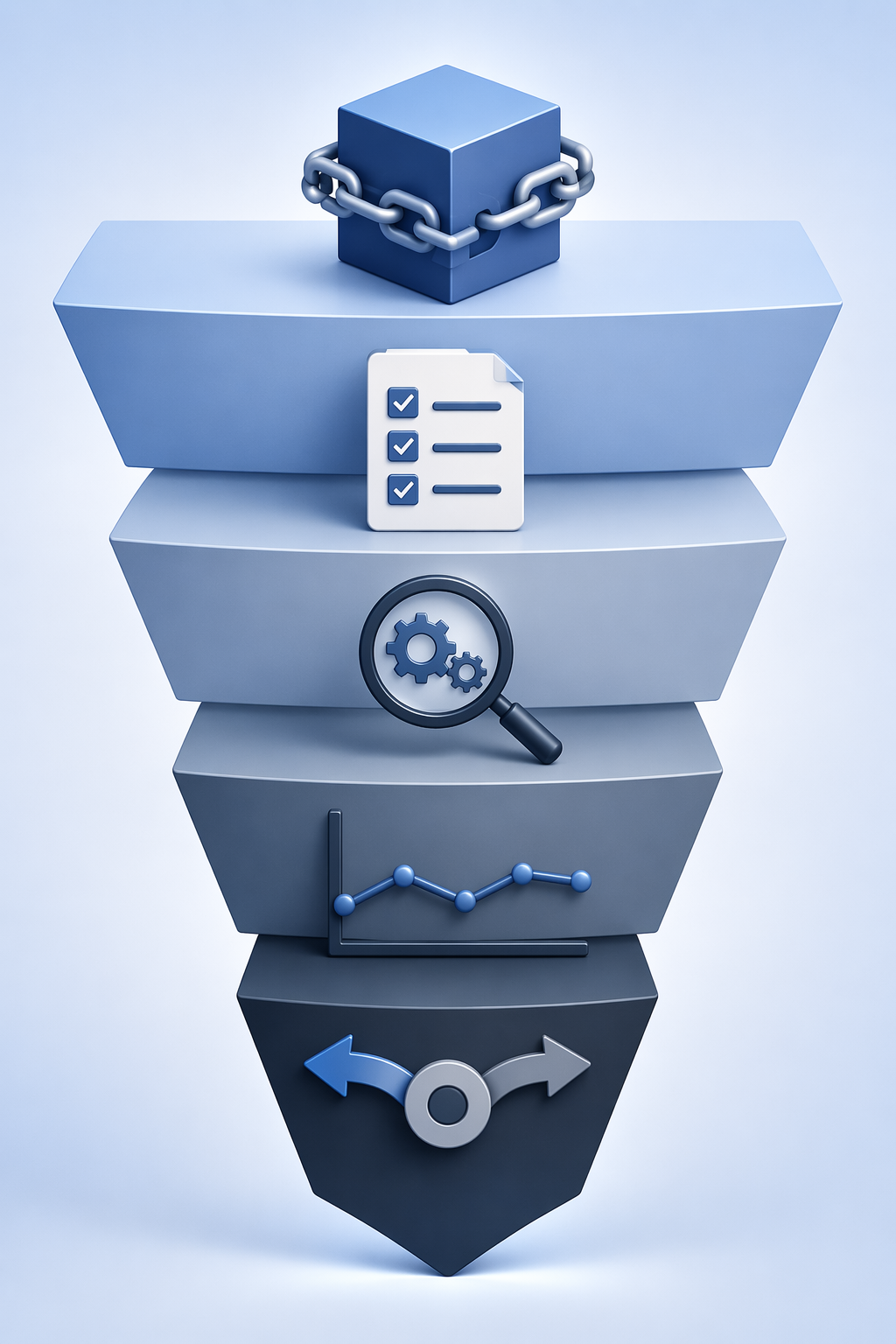
Start with the token's basics
Before comparing narratives or prices, identify exactly what is being studied. Read the project's own description and use a public explorer to confirm the contract address, chain, and supply basics. Then ask a simple question: what role does the token actually play inside the system? If that answer is fuzzy, the rest of the analysis is mostly decoration.
This is the point where many students overcomplicate the work. They start looking for valuation language before they know whether the token is a utility token, governance token, or something more unusual. A basic map is enough at this stage: what the token does, where it lives, and which public pages prove that it exists.
Screen out weak candidates early
This phase is where filtering earns its keep. CFA Institute's 2023 guide notes that more than 50 million cryptocurrencies exist, while fewer than 11,000 are actively traded, which is a useful reminder that almost every token should be screened out quickly.[4] The market is too large to treat every name as equally worth attention.
- Whitepaper: can the problem, mechanism, and token role be explained in plain language after one reading?
- Team: are names, roles, and prior work easy to verify on LinkedIn, GitHub, company pages, or other public profiles?
- Community: is there real discussion about product, governance, or code, or only hype, giveaways, and reposts?
- Distribution: does one wallet, a small cluster of wallets, or a controlled allocation hold too much supply?[3]
- Consistency: do the website, whitepaper, explorer, and market pages agree on the same basic facts?
These checks are intentionally plain. They are meant to catch the projects that look credible in a social feed but fall apart when the public record is compared line by line. If a student cannot verify the team, cannot explain the token's role, or sees extreme concentration in the supply, there is no reason to move deeper just because the chart is moving.
Read the project, not the pitch
This is where a practical checklist helps keep the work honest. Ren Heinrich's step-by-step guide, built from reviewing more than 100 projects, is useful because it keeps the researcher moving from the website to the code to the competitor set instead of drifting into vague impressions.[5] Its value is not the exact order of the checklist, but that it forces each claim to meet a public signal.
Tokenomics belongs in the middle of that work, not at the end. A 2026 Frontiers review found that tokenomics business-model innovation was the dominant research theme across 53 papers, and value proposition was the most-covered element.[1] That does not mean every token needs academic language. It does mean the token should be examined as a design, not as a slogan.
- Whitepaper detail: does it explain incentives, supply changes, governance, and the logic of the token in a way that survives a careful reread?
- Development signal: is the GitHub repository active, readable, and tied to the public roadmap, or is it a quiet page with little to inspect?
- Founder and team history: do the public profiles connect to real prior work, or only to newly created pages and recycled bios?
- Competitors: what does this token do that other projects in the same space do not already do?
- Token distribution: who can influence supply, unlocks, or voting power, and how visible is that from on-chain data?
A useful habit here is to write short contradictions in the margin. If the whitepaper sounds ambitious but the repo is stale, note that. If the community is large but answers only one kind of promotional question, note that too. The point is not to declare the project bad from one weakness; it is to see whether the weak spots line up.
Put the token in market context
Market analysis belongs after the project check, not before it. Price, volume, liquidity, exchange coverage, and holder data show how a token is being traded right now; they do not prove that the token deserves to exist. The useful move is comparison: how does this token sit beside peers with similar goals, similar supply design, or similar market visibility?
CFA Institute's crypto valuation guide is helpful here because it treats analysis as relative judgment rather than guesswork.[4] A 2025 study on investment intentions across diverse cryptocurrency categories also supports the broader pattern: market signals matter, but structured evaluation is what keeps them from becoming pure hype.[6]
- Look at liquidity and volume together, not in isolation.
- Check whether the token is listed widely or only on thin, hard-to-trade venues.
- Compare holder concentration and unlock timing with public explorer data.
- Treat charts as context for behavior, not as a forecast.
- Use free tools as current data sources, and recheck them because access and layouts change.
That last point matters more than it sounds. Free tools are enough for disciplined research, but they are not static. A student should expect to revisit the same pages, verify the same facts from more than one source, and avoid treating any single dashboard as final truth.
Write the decision note
The last step is not a trade. It is a short note that makes the conclusion visible before money is at risk. A good note states what the token does, which claims are supported by public evidence, which risks remain unresolved, and what still cannot be verified. If that note can be written plainly, the research is in decent shape. If it depends on optimism to fill gaps, it is not finished.
- Purpose: what problem does the token claim to solve?
- Evidence: which claims are backed by the whitepaper, explorer, code, or team profiles?
- Risk: what in the tokenomics, distribution, or market setup still looks fragile?
- Context: how does the token compare with peers that do something similar?
- Open questions: what would need to become clearer before any purchase would be defensible?
That is enough to keep curiosity intact without letting curiosity make the decision for you.
References
- Token design strategies for entrepreneurial crypto projects, a systematic literature review — Frontiers in Blockchain — 2026
- How To Evaluate and Analyze Cryptocurrency — Investopedia
- How to evaluate a cryptocurrency — Fidelity
- Valuation of Cryptoassets: A Guide for Investment Professionals — CFA Institute — 2023
- How To Research Cryptocurrencies? A Step-by-Step Guide — Medium
- Drivers of investment intentions across diverse cryptocurrency categories — ScienceDirect — 2025
Comments
Join the discussion with an anonymous comment.