

What Tom Watson's Golf Lesson Study Reveals About Learning Habits
Drawing from Tom Watson's fundamentals-first golf training, this article shows how students can stop hopping between study methods and build a progressive, evidence-based learning system that actually sticks — with support from motor learning research.
Updated:
The student who changes study systems every few days usually does not look lazy. They look busy: one app for flashcards, one planner for deadlines, one notebook style for lectures, one video about “active recall,” then a reset on Sunday night because none of it feels organized yet. The academic version of chasing swing tips has a familiar rhythm: more tools, more starts, very little compounding return.
That is why Watson’s lesson history is useful for students, even if they have never held a club. In Stan Thirsk’s account of coaching Watson, the progress was specific and slow enough to be believable: Watson was an 11-year-old with a 17 handicap, then 10 at age 12, 7 at 13, 4 at 14, and scratch by 17.[1] The famous ending matters less here than the six-plus-year structure underneath it.
Thirsk’s five basics were not glamorous: grip, alignment, posture, rhythm, and balance.[1] They sound almost too plain, which is partly the point. A beginner who cannot repeat a setup does not need a secret move. A student who cannot reliably capture, process, schedule, and review course material probably does not need a more elaborate productivity stack yet.
The Lesson Is the Sequence, Not the Sport
Watson’s reported path is tempting to flatten into an inspirational sports anecdote. That would waste the useful part. The study lesson is not “work hard like a champion.” Most stuck students are already working. The better lesson is that practice began with a stable order of attention. First the hands. Then the target line. Then the body. Then timing. Then the ability to keep the whole motion from falling apart.
In study terms, the same order would not start with an advanced spaced repetition database or a color-coded dashboard. It would start with whether the student has a dependable way to turn class, reading, homework, and feedback into usable material. If notes are scattered across photos, loose documents, app fragments, and half-finished outlines, the rest of the system has nothing solid to act on.
That is the study equivalent of grip. It is not the whole game, but it determines what every later movement has to compensate for. A simple lecture template, a consistent notebook, or a restrained version of Cornell notes can be enough. The important part is not brand loyalty to one format; it is that the format survives a normal week. If a student wants to compare that choice more carefully, the question behind Cornell-style note-taking is close to the one here: does the method create better material to review, or does it merely feel organized?
Alignment comes next. In golf, alignment means the body and clubface are aimed where the shot is supposed to go. In school, it means the study session is aimed at the actual assessment. A student can spend two hours making biology notes prettier and still avoid the skill the test will demand: explaining a process, solving a problem without hints, or choosing between similar concepts. Syllabus-based planning helps here because it forces the target to come from the course, not from the student’s mood.
Posture is less about sitting perfectly and more about whether the setup can be repeated without draining the learner. Sleep, location, phone friction, session length, and when the hardest work happens all belong here. A study method that only works during a heroic late-night burst is not a habit yet. It is a performance under emergency conditions.
Rhythm is where spaced practice belongs. Once notes are captured, targets are clear, and the study setup is repeatable, the question becomes timing: when does the student come back to the material, and what do they do when they return? This is where a spaced repetition guide or retrieval practice routine can become powerful. Used too early, though, those tools often become another place to hide unfinished basics.
Balance is the last piece because it requires seeing the whole workload. A student taking chemistry, history, statistics, and writing does not need every course to receive identical attention every night. They need the total load to stay upright: deadlines visible, hard subjects spaced, review sessions protected, and weak areas addressed before panic makes every task feel urgent.
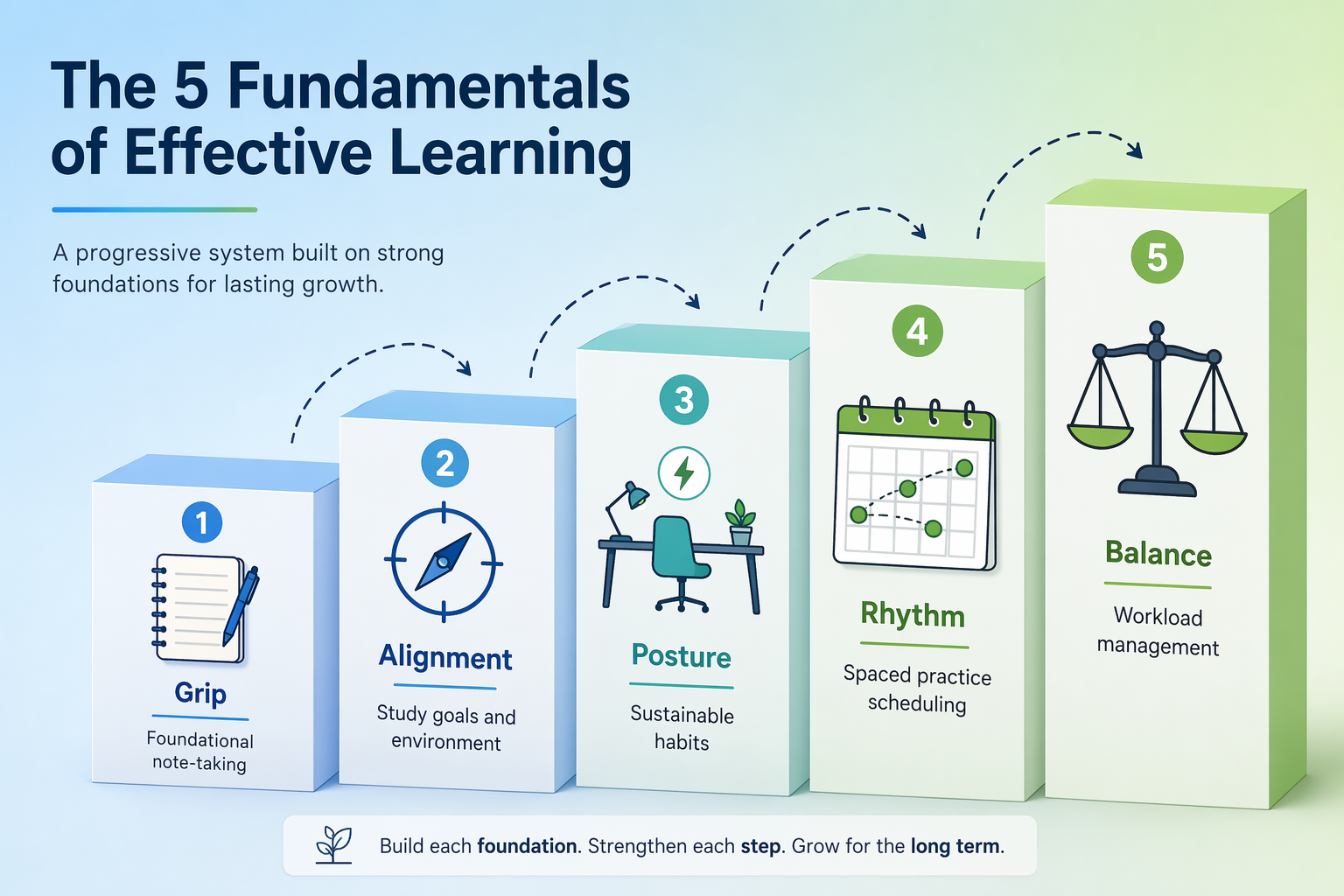
A Five-Basic Study System
| Watson basic | Study equivalent | What to check first |
|---|---|---|
| Grip | A dependable note-taking and processing system | Can you find and use last week’s material without rebuilding it? |
| Alignment | Clear targets, course demands, and study environment | Are you practicing the thing the exam, paper, lab, or discussion will actually require? |
| Posture | Sustainable energy and setup | Can this routine survive an ordinary school week? |
| Rhythm | Spaced review and retrieval practice | Do you return to material before it disappears? |
| Balance | Workload management across courses | Does one class or deadline keep knocking the whole system sideways? |
The table is useful only if it is treated as a progression. If grip is unstable, fix the capture system before debating the perfect review interval. If alignment is off, stop counting hours and inspect whether the work matches the task. If posture is broken, reduce friction before adding ambition. There is no virtue in building a beautiful schedule for a version of yourself who never gets tired.
This is where students often lose patience. The first fundamentals are boring because they do not feel like breakthroughs. They feel like cleaning up file names, rewriting messy lecture points, putting the phone in another room, checking the syllabus, and doing ten practice problems instead of designing a new dashboard. But these are the mechanics that let later practice compound.
Why Progression Beats Method-Hopping
The golfer who wants a new driver before checking grip and alignment is easy to laugh at because the mismatch is visible. The student version is harder to see. A new app can look responsible. A new planner can feel like a fresh start. A new study video can create the relief of motion. The problem is that each reset interrupts the feedback loop.
Feedback needs sameness. If a student uses one note system on Monday, another on Wednesday, rereads on Friday, makes flashcards the next week, and abandons the course plan after the first low quiz, it becomes difficult to know what actually failed. Was the material too hard? Was the retrieval practice too late? Were the notes unusable? Was the target wrong? Method-hopping turns every week into a new experiment with no clean comparison.
A fundamentals-first system is less exciting at the start because it narrows the experiment. Keep the note process stable. Keep the target visible. Keep the study location and timing predictable enough to notice patterns. Then change one variable when the evidence justifies it. That is not anti-tool. It is how a tool earns its place.
What Motor Learning Research Adds
Watson’s case is not a controlled study. It is a coach’s retrospective account, and it should be handled that way. Still, the structure Thirsk described lines up with several findings from modern motor learning research, especially for beginners.
In a 2024 systematic review of 52 randomized controlled trials on motor learning in golf, Barzyk and Gruber found support for distributed practice: across six golf RCTs, spaced sessions were favored over massed practice.[2] For students, that does not mean golf studies prove the perfect exam schedule. It does mean the rhythm piece of Watson’s system has a research cousin: learning generally benefits when practice is returned to over time rather than crammed into one heavy block.
That finding matters because many study routines fail in the rhythm stage. Students do a large first pass, feel temporary familiarity, and then wait until the material has cooled into something almost new again. Spacing is not just a calendar trick. It creates repeated chances to retrieve, correct, and strengthen the material under slightly different conditions.
The same review also discusses errorless early learning, where beginners start with tasks easy enough to build implicit competence before difficulty rises.[2] That sounds soft until you watch novices overload themselves. In golf, starting too hard can make the learner rehearse compensations. In school, the equivalent is opening with the hardest exam problems before the basic moves are fluent, then mistaking confusion for depth.
A better early study task is not fake success. It is calibrated success. A chemistry student might first classify problem types before solving full mixed sets. A history student might explain one cause-and-effect chain before writing a full essay. A language student might retrieve a small set of forms accurately before mixing every tense. The task is easy enough to complete, but specific enough to reveal whether the foundation is present.
Barzyk and Gruber also report evidence around external focus of attention: directing attention toward the movement outcome rather than internal body mechanics.[2] The study translation has to be cautious, but the principle is still helpful. Instead of obsessing over whether a study method “feels active,” students can ask what the session produces: Can I solve the problem without notes? Can I explain the concept to someone else? Can I choose the right method when the question changes?
That is also where retrieval practice belongs. It is not a moral upgrade over rereading; it is a way to make the outcome visible. Rereading can feel smooth while hiding weak recall. Retrieval makes the gap show up while there is still time to fix it.
How to Use the Watson Model Without Overclaiming It
The useful version of this model is modest. Do not copy golf practice into school as if putting and proof-writing are the same task. Do not treat Watson’s handicap timeline as a universal law of improvement. Do not pretend that a coach’s account can do the work of a randomized trial. The timeline is valuable because it shows what a stable learning sequence can look like over years, not because it proves that every student will improve on a similar schedule.
The research bridge also has limits. Barzyk and Gruber note that 29 of the 52 RCTs in their review were underpowered, with statistical power below 0.8.[2] Many golf motor-learning studies are more directly useful for novices than advanced performers, and many involve constrained skills that are cleaner to measure than essay writing, abstract math, or graduate-level reading.
Those caveats do not erase the practical lesson. They keep it honest. The student takeaway is not “Tom Watson proves my study routine.” It is that a stable sequence of fundamentals gives feedback somewhere to land. Without that, every technique becomes another loose club in the bag.
A Practical Standard for Students
If your study system keeps restarting, shrink it before you improve it. Choose one way to capture and process material. Aim sessions at course demands, not at whatever feels productive. Build a setup that works on a normal week. Space the work. Keep early practice manageable enough that correct moves can repeat. Then balance the load across classes before one urgent course steals the whole schedule.
Novelty is not the enemy. Sometimes a new tool really does solve a real problem. But it should enter after the basic fault is named. Otherwise the tool becomes another reset, and the learner starts from scratch again.
Watson’s reported progression is humbling because nothing in it looks instant. It is grip, alignment, posture, rhythm, and balance, repeated long enough for correction to accumulate. For students, the parallel standard is just as plain: stop rebuilding the whole system every time progress feels slow, and give the fundamentals enough stable practice to start paying you back.
References
- 5 golf-swing basics that helped Tom Watson elevate his game, Golf.com, republished 2024.
- Motor learning in golf—a systematic review, Frontiers in Sports and Active Living, Feb. 2024.
Comments
Join the discussion with an anonymous comment.