
25th Amendment Explained Through Four Historical Crises
Learn the 25th Amendment by connecting each of its four sections to the real presidential succession crisis it was designed to solve — from John Tyler's 1841 power grab to JFK's assassination. A memorable, test-friendly guide for civics students.
Updated:
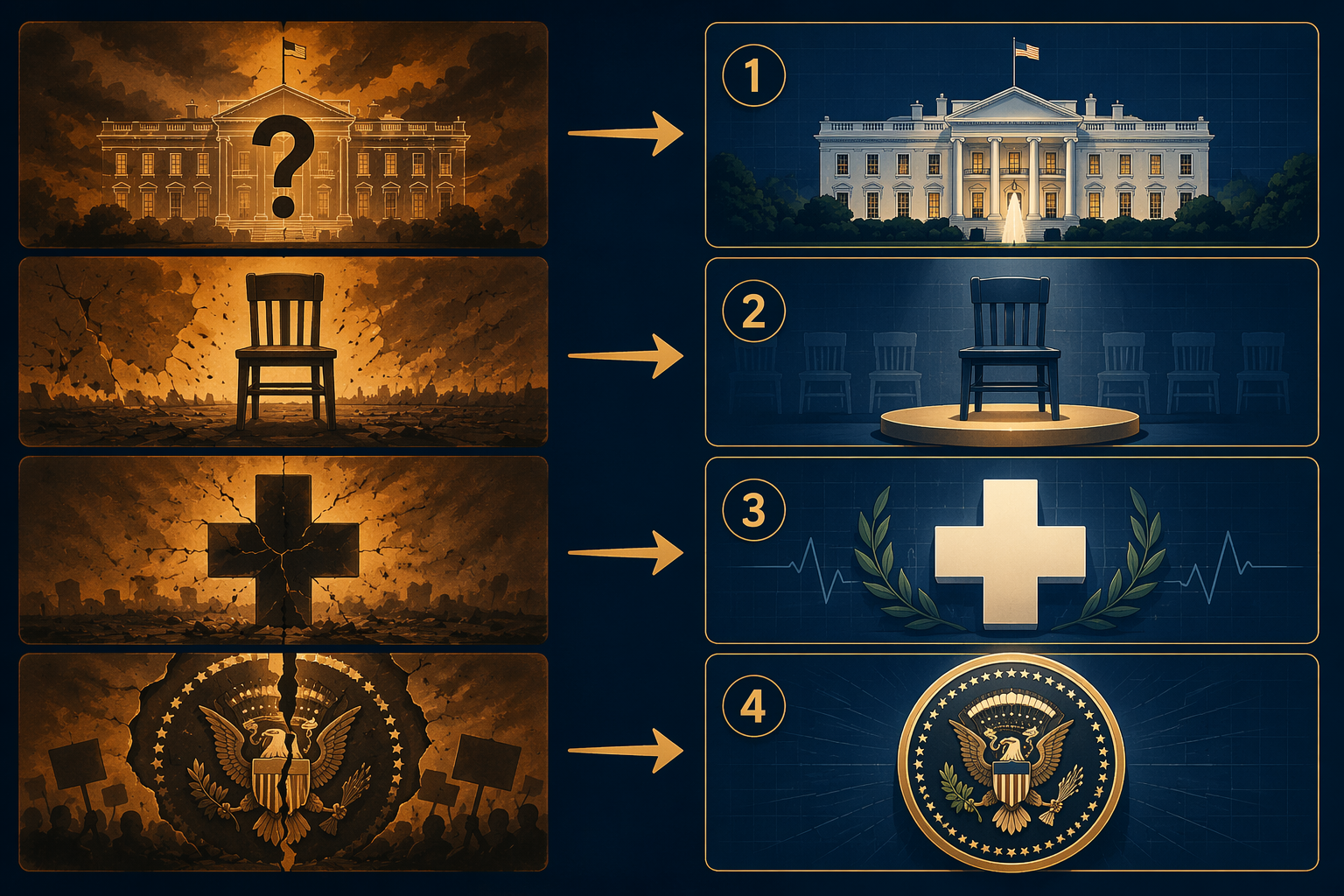
The 25th Amendment is easier to remember if you stop treating it like one long rule. It is really four repairs. Each section answers a different version of the same classroom problem: what happens when the presidency breaks in a way the original Constitution did not clearly fix?
That is why students should start with the problem, not the legal wording. A president dies. A vice president’s office is empty. A president knows he needs temporary medical treatment. A president may be unable to serve but does not, or cannot, say so. The amendment, ratified on February 10, 1967, gives each of those problems its own mechanism.[1]
| Section | The problem it fixes | The basic rule | Memory hook |
|---|---|---|---|
| Section 1 | The president dies, resigns, or is removed. | The vice president becomes President, not merely Acting President. | Tyler turns a vague succession clause into a rule.[1] |
| Section 2 | The vice presidency becomes vacant. | The president nominates a new vice president, and both houses of Congress confirm. | Ford shows that an empty office can be filled by appointment and confirmation.[2] |
| Section 3 | The president voluntarily steps aside temporarily. | The president sends a written declaration, the vice president acts as president, and the president later sends another declaration to return. | Medical procedures make this the cleanest handoff.[3] |
| Section 4 | The president may be unable to serve but does not voluntarily transfer power. | The vice president and a Cabinet majority can start the process; Congress decides if the president contests it. | Built for contested incapacity, but never invoked.[2] |
Section 1: John Tyler and the Question of Who Really Becomes President
The first repair begins in 1841, when President William Henry Harrison died after only 31 days in office. The Constitution said that the president’s powers and duties would “devolve” on the vice president, but that wording left an uncomfortable question: did Vice President John Tyler become the actual President, or only a temporary substitute using presidential powers?[1]
Tyler chose the stronger answer. He took the presidential oath, moved into the office, and insisted on being addressed as President. Some people mocked him as “His Accidency,” but Tyler did not accept the label Acting President. That decision mattered because it created a working precedent: when a president dies, the vice president succeeds to the office itself.[1]
For more than a century, the country followed that Tyler Precedent. The 25th Amendment did not invent the idea from scratch; Section 1 wrote the rule clearly into the Constitution. Its test-friendly point is simple: if the presidency is permanently vacated by death, resignation, or removal, the vice president becomes President.
Section 2: The Empty Vice Presidency Was Not a Rare Glitch
Section 1 solves the first half of the succession problem. It tells the country what happens when the vice president moves up. But then another problem appears immediately: who becomes vice president?
Before the 25th Amendment, the answer was usually nobody. If a vice president died, resigned, or became president, there was no constitutional process for filling the vacancy before the next election. The vice presidency was vacant 16 times before 1967, for a total of 38 years.[2]
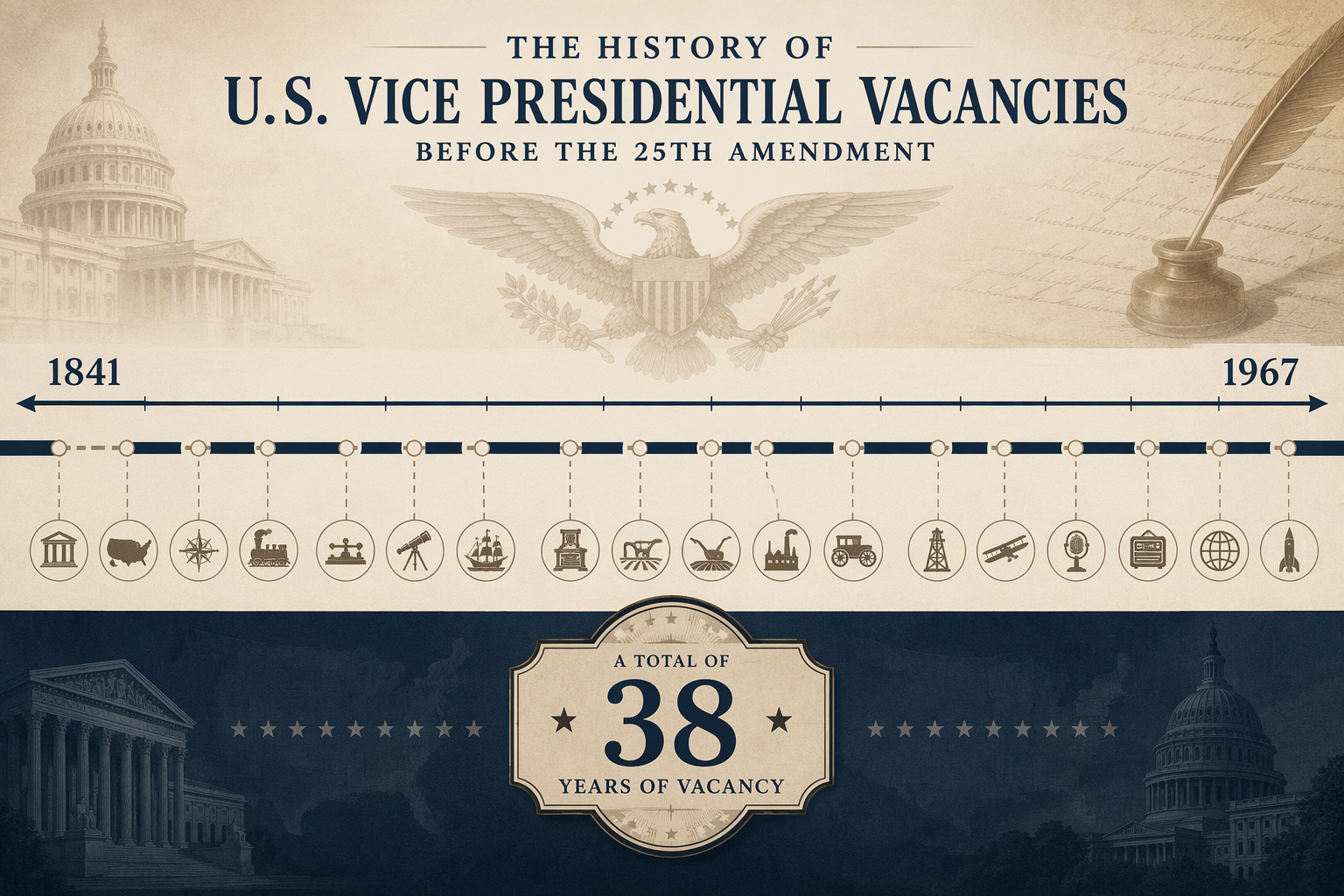
That number is worth pausing over because it turns Section 2 from a technical detail into a real design flaw. The vice president is not only a backup for the president; the vice president is also the person who may need to act quickly if the president is temporarily disabled. Leaving that office empty meant the next constitutional link in the chain was missing.
Section 2 fixes the vacancy with a two-part process: the president nominates a vice president, and that nominee takes office only after confirmation by a majority vote in both the House and the Senate.[4]
Ford Is the Example That Makes Section 2 Stick
The first real test came in 1973, after Vice President Spiro Agnew resigned. President Richard Nixon nominated House Minority Leader Gerald Ford. Congress confirmed him, and Ford became vice president on December 6, 1973.[5]
Then the story became even stranger, and more useful for remembering the amendment. When Nixon resigned in 1974, Ford moved from vice president to president under Section 1. That made Ford the only person to serve as both vice president and president without being elected to either office.[2]
Section 2 was used a second time after Ford became president. Ford nominated Nelson Rockefeller to fill the vice presidency, and Rockefeller was confirmed on December 19, 1974.[2]
The short counterfactual is the part students tend to remember: without Section 2, Agnew’s resignation would have left the vice presidency empty. If Nixon then resigned with no confirmed vice president in place, Speaker of the House Carl Albert would have been next in the statutory line of succession as Acting President. Section 2 prevented that vacancy from becoming a much larger constitutional problem.[1]
The takeaway for Section 2 is not just “fill the vice presidency.” It is “fill the vice presidency with democratic checkpoints.” The president chooses, but Congress must confirm.
Section 3: The President Can Hand Over Power Temporarily
Some presidential problems are not permanent. A president may need surgery, anesthesia, or another medical procedure that makes it sensible to transfer power for a short time. Section 3 handles the clean version of that situation: the president agrees there is a temporary inability and says so in writing.
The written declaration goes to the president pro tempore of the Senate and the speaker of the House. Once it is sent, the vice president becomes Acting President. When the president is ready to resume the job, the president sends another written declaration and takes the powers back.[4]
The first use came in 1985, when President Ronald Reagan invoked Section 3 before colon surgery.[3] President George W. Bush used it during colonoscopies in 2002 and 2007, and President Joe Biden used it during a colonoscopy in 2021.[2]
For a quiz, Section 3 is the easiest section to identify because the president starts it voluntarily. If the president is the one sending the letter and later reclaiming authority, you are almost certainly looking at Section 3.
Section 4: The Hard Case Is an Unable President Who Does Not Step Aside
Section 4 is the part people often describe too casually. It is not the “used when a president is unpopular” section, and it does not have a long history of real-life invocation. It has never been invoked.[2]
Its problem is narrower and more serious: what if the president is unable to discharge the powers and duties of the office, but the president does not voluntarily transfer power under Section 3? The amendment assigns the first move to the vice president and a majority of the principal officers of the executive departments, usually understood as the Cabinet. They send a written declaration to the president pro tempore of the Senate and the speaker of the House. At that point, the vice president immediately becomes Acting President.[4]
If the president does not contest the declaration, the transfer continues. If the president sends a written declaration saying no inability exists, the president can resume power unless the vice president and Cabinet majority disagree again within the amendment’s time limits. If they do disagree, Congress must decide. Keeping the president out of power requires a two-thirds vote of both the House and the Senate; otherwise, the president resumes the powers and duties of the office.[4]
The closest historical brush came after President Reagan was shot in 1981. Section 4 paperwork was drafted, but it was not signed, so the section was not invoked.[2] That distinction matters. Drafted papers are a near-use, not a use.
Section 4 is harder to remember because it has no Ford-like example and no routine medical handoff. Attach it instead to the contested question: who acts if the president cannot or will not acknowledge incapacity? The answer begins with the vice president and Cabinet, but if the president disputes them, Congress becomes the final judge.
Why the Amendment Finally Happened in the 1960s
The problems were old, but the urgency sharpened in the 20th century. President James Garfield lingered after being shot in 1881, leaving the country with an incapacitated president for weeks. President Woodrow Wilson suffered a stroke in 1919, and the full extent of his condition was hidden from the public. President Dwight Eisenhower and Vice President Richard Nixon later used informal written understandings after Eisenhower’s health scares, but informal agreements are not the same as constitutional rules.[6]
Then President John F. Kennedy was assassinated in 1963. Lyndon B. Johnson became president under the Tyler Precedent, but the assassination exposed how dangerous uncertainty could be in the Cold War era. The country needed more than custom, private understandings, and hope that everyone would agree in a crisis.[6]
That is the clean way to hold the whole amendment in memory: Section 1 answers death, resignation, or removal of the president. Section 2 answers an empty vice presidency. Section 3 answers voluntary temporary incapacity. Section 4 answers contested involuntary incapacity. Four sections, four exposed weaknesses, four constitutional repairs.
References
- The 25th Amendment: Succession of the Presidency, National Archives, February 10, 2017.
- 25th Amendment: Frequently Asked Questions, Bipartisan Policy Center.
- Constitutional Amendments: Amendment 25, Ronald Reagan Presidential Library and Museum.
- Amendment XXV, National Constitution Center.
- On this day, the 25th Amendment gets its first test, National Constitution Center.
- The 25th Amendment, HISTORY.
Comments
Join the discussion with an anonymous comment.