
A Science Student's Guide to Meteorite Chemistry
Understand the chemical fingerprints that classify meteorites — from ordinary chondrites to iron-nickel alloys — and learn how element ratios and oxide percentages reveal each meteorite's parent body and the origins of the solar system.
Updated:
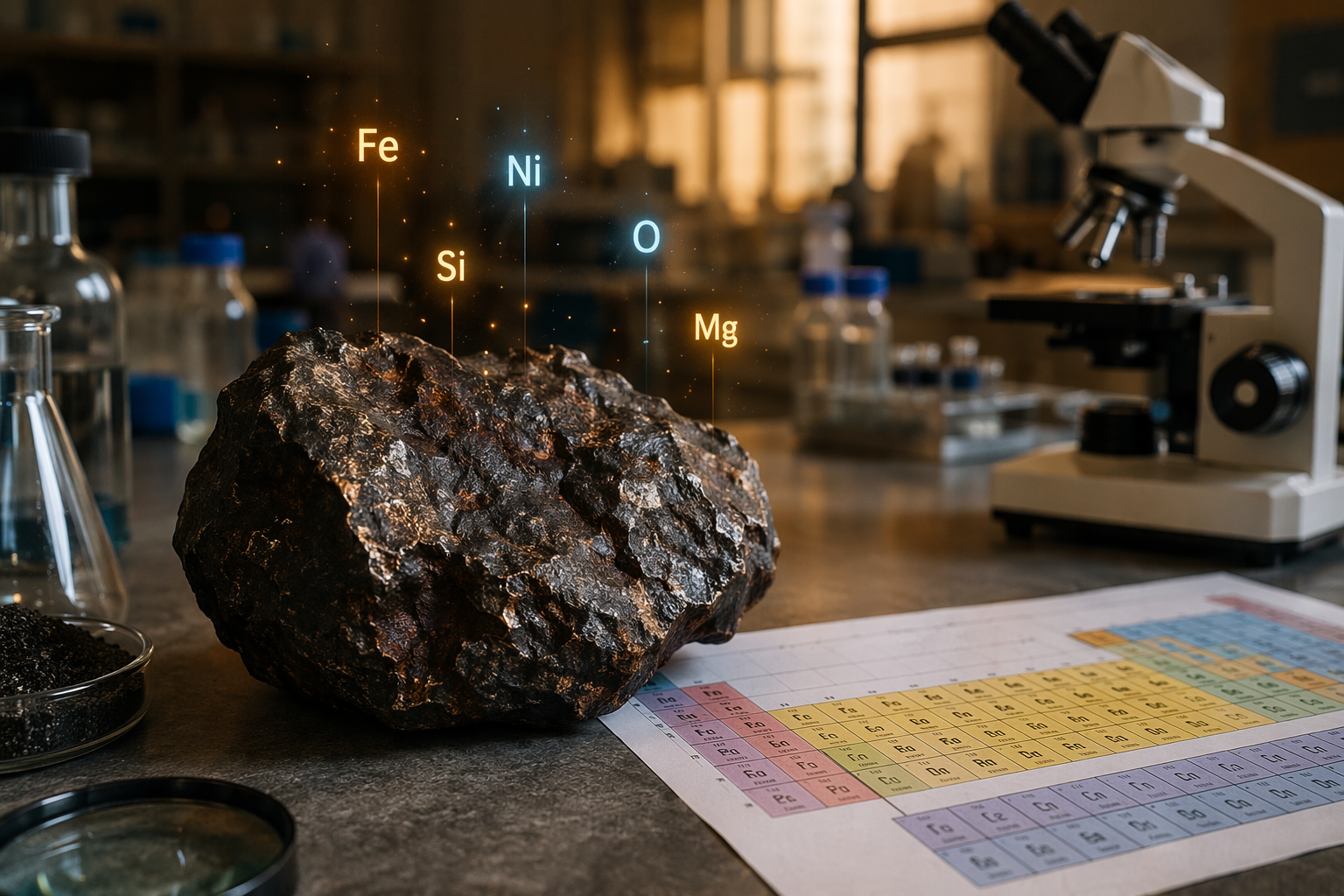
Put a meteorite on a lab bench and the first useful question is not how far it traveled. It is what the numbers say. A basic chemical readout may list familiar elements — Fe, Ni, Si, O, Mg, Al, Ca, Na, and K — but in meteorites those symbols become a sorting system. Silicon and oxygen point toward silicate minerals. Iron and nickel point toward metal. Magnesium, aluminum, and calcium help separate primitive material from processed rock. Sodium and potassium, easy to overlook in a first chemistry course, become warning lights when their oxide percentages look too terrestrial.
That is the chemistry of meteorites for science students in its most useful form: not a romance of space rocks, but a way to reason from composition to origin. Washington University in St. Louis summarizes one of the cleanest starting points for stony meteorites: chondrites typically have SiO2 below 60%, Na2O below 2%, K2O below 0.6%, and nickel commonly around 10,000–16,000 ppm; rocks with more than 2% Na2O or more than 5 ppm arsenic are almost certainly terrestrial rather than meteoritic.[1]
Those thresholds are not trivia to memorize before forgetting. They explain why a chemistry student can do real classification work. A rock may look dark, heavy, or burned on the outside, but the lab classification begins when its oxide percentages and trace elements fall into a pattern that known meteorite groups actually share.
Start With What Falls, Not What Looks Dramatic
Most meteorites students encounter in textbooks are introduced by type: stony, iron, and stony-iron. That division is chemically useful because it begins with the balance between silicate minerals and Fe-Ni metal. NASA ARES reports that more than 95% of observed meteorite falls are stony meteorites, and that ordinary chondrites make up 88% of stony falls.[2]
| Meteorite class | Main chemistry students should notice | Why it matters |
|---|---|---|
| Ordinary chondrites | Silicate-rich stony meteorites with Fe, Ni, Si, O, and Mg; Ni commonly around 10,000–16,000 ppm | They dominate observed stony falls and give the best first training set for chemical classification |
| Carbonaceous chondrites | Primitive stony meteorites with chemically important inclusions such as calcium-aluminum-rich inclusions | They preserve early solar-system material rather than only later planetary processing |
| Achondrites | Stony meteorites without chondrules; chemistry reflects melting and differentiation | They are closer to igneous rocks from parent bodies such as asteroids, Mars, or the Moon |
| Iron meteorites | Mostly Fe-Ni alloy, including kamacite and taenite | They sample metallic cores of differentiated parent bodies |
| Stony-iron meteorites | Mixtures of silicate minerals and Fe-Ni metal | They show boundary or breccia materials rather than one simple rock type |
This distribution also prevents a common beginner’s mistake. Iron meteorites are visually impressive and survive well on Earth, but they are not the main type falling from the sky. NASA ARES notes that iron meteorites are only about 5% of falls but about 66% of finds because they resist weathering better than many stony meteorites.[2] A museum drawer full of metal meteorites is not a random sample of what lands on Earth.
The Ordinary Chondrite Pattern
Ordinary chondrites deserve disproportionate attention because they are chemically ordinary in the statistical sense, not because they are dull. Their composition gives students a compact exercise in major elements, oxides, and trace elements all at once. The major-element view starts with silicates: oxygen bonded with silicon, magnesium, iron, aluminum, calcium, sodium, and potassium in mineral structures. The trace-element view then asks whether nickel and certain contaminants fit a meteoritic pattern.
In a basic oxide table, the first useful check is SiO2. Terrestrial crustal rocks can be silica-rich; chondrites, by contrast, sit below 60% SiO2 in the Washington University discrimination data.[1] That does not identify every meteorite by itself. It does make a high-silica candidate suspicious, especially when the rest of the chemistry also looks like common Earth rock.
The alkalis sharpen the separation. Chondrites generally have Na2O below 2% and K2O below 0.6%, while a sample above 2% Na2O is very likely terrestrial according to the same discrimination guide.[1] This is a good moment for students to notice that sodium and potassium are not minor because they are unimportant; they are minor because small differences in their abundance can carry diagnostic weight.
| Chemical clue | Chondrite-side pattern | Student interpretation |
|---|---|---|
| SiO2 | Below 60% | A lower-silica stony composition fits chondrite chemistry better than a silica-rich terrestrial rock |
| Na2O | Below 2% | Higher sodium oxide pushes the sample toward a terrestrial explanation |
| K2O | Below 0.6% | Low potassium supports, but does not alone prove, a chondritic pattern |
| Ni | Commonly around 10,000–16,000 ppm | High nickel helps separate chondrites from many ordinary terrestrial rocks |
| As | More than 5 ppm argues against a meteorite | Arsenic is useful as a red-flag trace element in the WUSTL discrimination set |
Nickel is where the chemistry becomes especially satisfying. Students often learn that meteorites contain iron and nickel, then stop there. The better question is how much nickel. Chondrites commonly contain nickel at roughly 10,000–16,000 ppm, a range high enough to be chemically meaningful rather than a decorative footnote.[1] A sample with a little nickel contamination is not automatically a meteorite; a sample whose nickel fits a chondrite pattern alongside the major oxides has a stronger case.
Washington University also emphasizes ratios such as Fe2O3(T)/MnO and MgO/Fe2O3(T) as stable intra-group fingerprint parameters for stony meteorites.[1] The notation Fe2O3(T) means total iron reported as Fe2O3, a common geochemical convention rather than a claim that every iron atom in the rock sits in that exact mineral form. For students, the lesson is simple but important: classification often depends less on one spectacular number than on a cluster of ratios staying in the right neighborhood.
A Careful Way to Read a Composition Table
- Check whether the sample is silicate-rich or metal-rich before trying to name a group.
- For a stony candidate, compare SiO2, Na2O, and K2O with chondrite-side thresholds.
- Use nickel in ppm as a trace-element check, not as a one-word verdict.
- Look for ratio patterns such as Fe2O3(T)/MnO and MgO/Fe2O3(T), because related meteorites tend to cluster chemically.
- Ask whether the sample is a fresh fall or a weathered find before trusting alkali and contamination-sensitive values too strongly.
That last step matters. A fall is observed when it lands, so its chemistry is less exposed to long terrestrial alteration. A find may have sat in soil, ice, or desert weathering conditions for an unknown time. Weathering can blur the very signals students are learning to read, especially when alkalis or contaminants are part of the decision.
Primitive Does Not Mean Simple
Chondrites are called primitive because they did not melt and separate into crust, mantle, and core the way differentiated bodies did. That word can mislead students into imagining chemical sameness. In reality, primitive meteorites can preserve chemically delicate records that later melting would erase.
Carbonaceous chondrites are the place to pause for the oldest solids. Calcium-aluminum-rich inclusions, usually shortened to CAIs, occur in carbonaceous chondrites and have been radiometrically dated to 4.567 billion years, making them the oldest known solids in the solar system.[3] The chemistry is in the name: calcium and aluminum concentrated into early-forming high-temperature inclusions before the familiar planets existed.
That date is not a decorative fact to place beside a photograph. It is a chemical timestamp. CAIs show that meteorites can preserve materials formed in the early solar nebula, before later parent bodies mixed, melted, or sorted their ingredients. The same periodic table students use for formula balancing becomes a record of condensation, heating, and survival.
When Melting Sorts the Elements
Not every meteorite preserves primitive mixture. Some parent bodies grew large enough and hot enough for differentiation: dense metal moved inward, silicate material stayed outward, and later impacts broke pieces loose. Once that happens, the chemistry no longer says only “solar-nebula mixture.” It also says “part of a body.”
Achondrites are stony meteorites shaped by igneous processing. They lack the chondrules that define chondrites, and their chemistry can connect them to differentiated parent bodies, including asteroids, Mars, or the Moon.[2] For students, this is where meteorites begin to resemble planetary geology. Major oxides still matter, but the question shifts from “does this match primitive chondritic material?” to “what kind of crustal or mantle process could make this composition?”
Iron meteorites take the sorting further. They are dominated by Fe-Ni alloy, chiefly the minerals kamacite and taenite, and are interpreted as samples of metallic cores from differentiated parent bodies.[2] Chemically, they are what happens when density and melting do the sorting work that a student might otherwise imagine only in a beaker: metal separates from silicate.
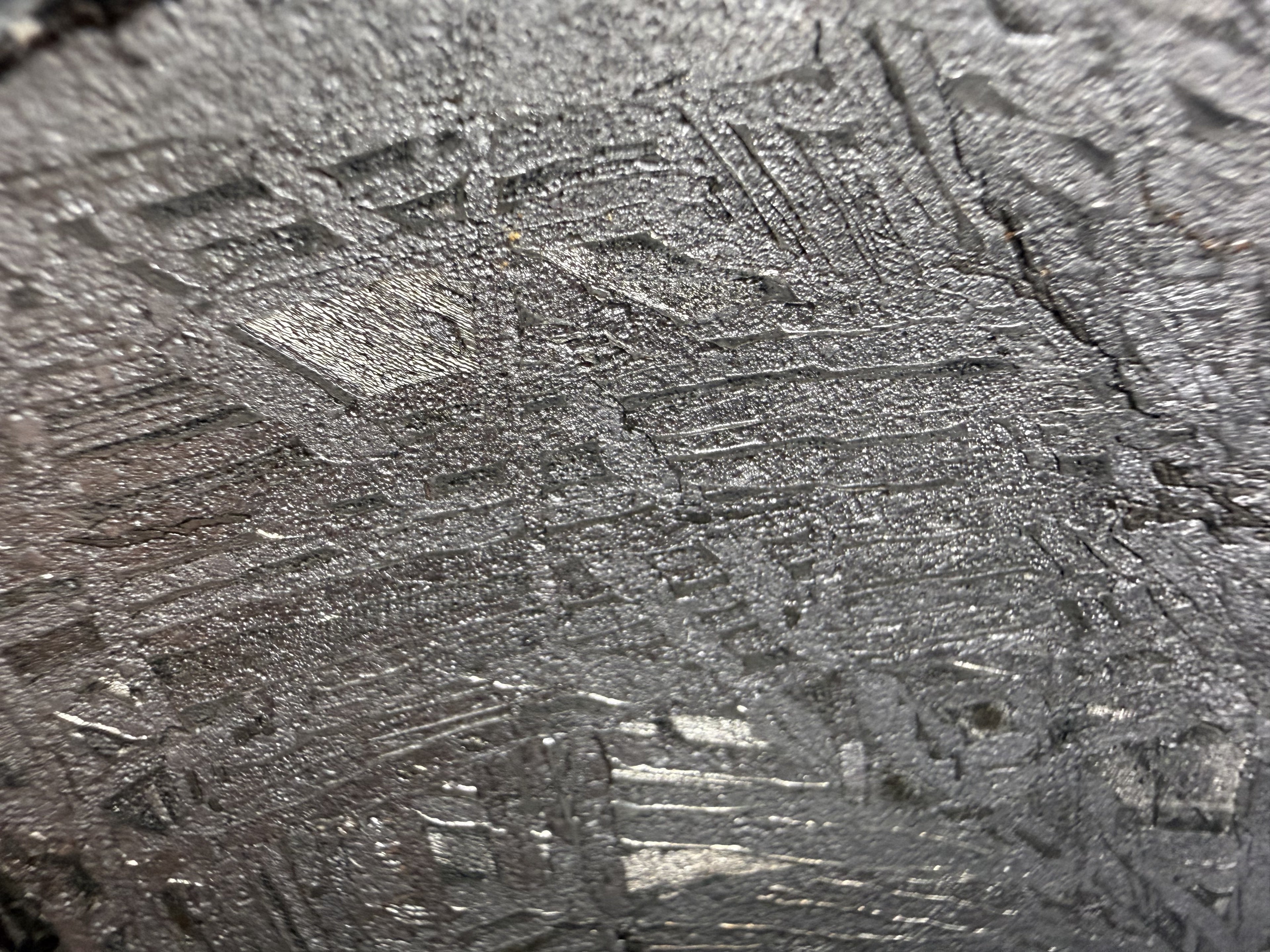
The Widmanstatten pattern in an etched iron meteorite slice is often treated as a pretty geometric texture. It is better than that. The intergrowth of low-nickel kamacite and high-nickel taenite records slow cooling over millions of years inside an asteroid core.[3] The pattern is visible because chemistry and time worked together: nickel distribution, crystal growth, and cooling rate left a structure too slow to reproduce in an ordinary classroom cooling experiment.
Stony-Irons Sit at the Boundary
Stony-iron meteorites are tempting to describe as a perfect halfway category: part rock, part metal. Chemically, that is a start, but not enough. The two familiar groups, pallasites and mesosiderites, tell different stories. NASA ARES describes pallasites as olivine crystals embedded in an iron-nickel metal matrix, while mesosiderites are breccias made of roughly equal parts metal and silicate material.[2]

A pallasite slice makes the boundary visible: yellow-green olivine crystals held in Fe-Ni metal. The usual interpretation is that pallasites represent material from the core-mantle boundary of differentiated asteroids.[2] That is a strong image for students because the chemistry is not merely identifying minerals; it is locating a sample inside a once-layered body.
Mesosiderites are less tidy. Their roughly equal metal-and-silicate mixture is brecciated, meaning broken and reassembled, so they do not read like a clean cross-section from one boundary.[2] A student should not force every stony-iron meteorite into the same story just because the name sounds balanced.
Oxygen Isotopes Are the Higher-Level Fingerprint
Major oxides and trace elements get students most of the way into meteorite classification. Oxygen isotopes add a parent-body fingerprint. Because silicate meteorites contain so much oxygen, the ratios among oxygen isotopes can group meteorites in ways that ordinary elemental abundance alone may not. Delta-17O, usually written as Δ17O, is one of the isotope measures used to distinguish related reservoirs and parent bodies.[1]
This is where chemistry links a sample to place. A meteorite can have a stony composition and still require isotope evidence to decide whether it belongs with a particular asteroid group, lunar material, or martian material. The isotope result is not a replacement for the oxide table. It is the next layer of evidence when major-element chemistry has narrowed the field but not finished the job.
For an introductory student, the safest mental model is layered evidence. Texture and mineralogy may suggest a class. Major oxides test whether the bulk chemistry fits. Trace elements catch false positives and refine the comparison. Oxygen isotopes connect chemically similar samples to reservoirs that formed separately in the early solar system.
Weathering Is the Reason Not to Overclaim
The cleanest discrimination thresholds come from comparing known meteorites with terrestrial rocks, but real specimens do not always arrive clean. Finds may be weathered, fractured, oxidized, or contaminated by the environment where they sat. That is why a field impression — dark crust, magnetism, unusual density — should never outrank a coherent chemical pattern.
Weathering especially matters when students apply alkali thresholds or trace-element red flags. A fresh fall whose Na2O and K2O sit in the chondrite range is more straightforward than an old find with altered surface chemistry. The correct response is not to throw away the thresholds. It is to treat them as strongest when the sample history is known and the analyzed material is representative.
This also explains why professional classification does not depend on a single classroom-style test. A magnet can notice metal. A streak plate can rule out some look-alikes. A microscope can show texture. But the evidence that carries the classification is the combined chemistry: oxide percentages, ppm-level trace elements, stable ratios, mineral context, and, when needed, isotope data.
What a Student Can Reasonably Conclude
A student with a composition table should not pretend to be a professional meteoriticist, but the table is not decorative. If the sample is stony, has SiO2 below 60%, Na2O below 2%, K2O below 0.6%, nickel near the chondrite range, and ratio patterns consistent with known chondrites, the chemistry supports a chondritic interpretation.[1] If it is mostly Fe-Ni alloy, the better comparison is an iron meteorite and a differentiated metallic parent body.[2] If it mixes olivine-rich silicate and Fe-Ni metal, the stony-iron possibilities need to be separated rather than flattened into “half rock, half metal.”[2]
The useful conclusion is measured: meteorite chemistry is patterned enough for students to classify intelligently from element ratios, oxide percentages, and trace thresholds. It is also vulnerable enough to Earth exposure that weathered finds deserve caution. The wonder comes after that. A rock can carry nickel at ppm levels, oxygen isotope ratios, Fe-Ni cooling textures, or calcium-aluminum inclusions old enough to mark the beginning of solar-system solids — and those claims mean more because the chemistry can be checked.
References
- Chemical composition of stony meteorites — Washington University in St. Louis
- What are Meteorites? — NASA ARES
- Meteorite — Wikipedia
Comments
Join the discussion with an anonymous comment.