
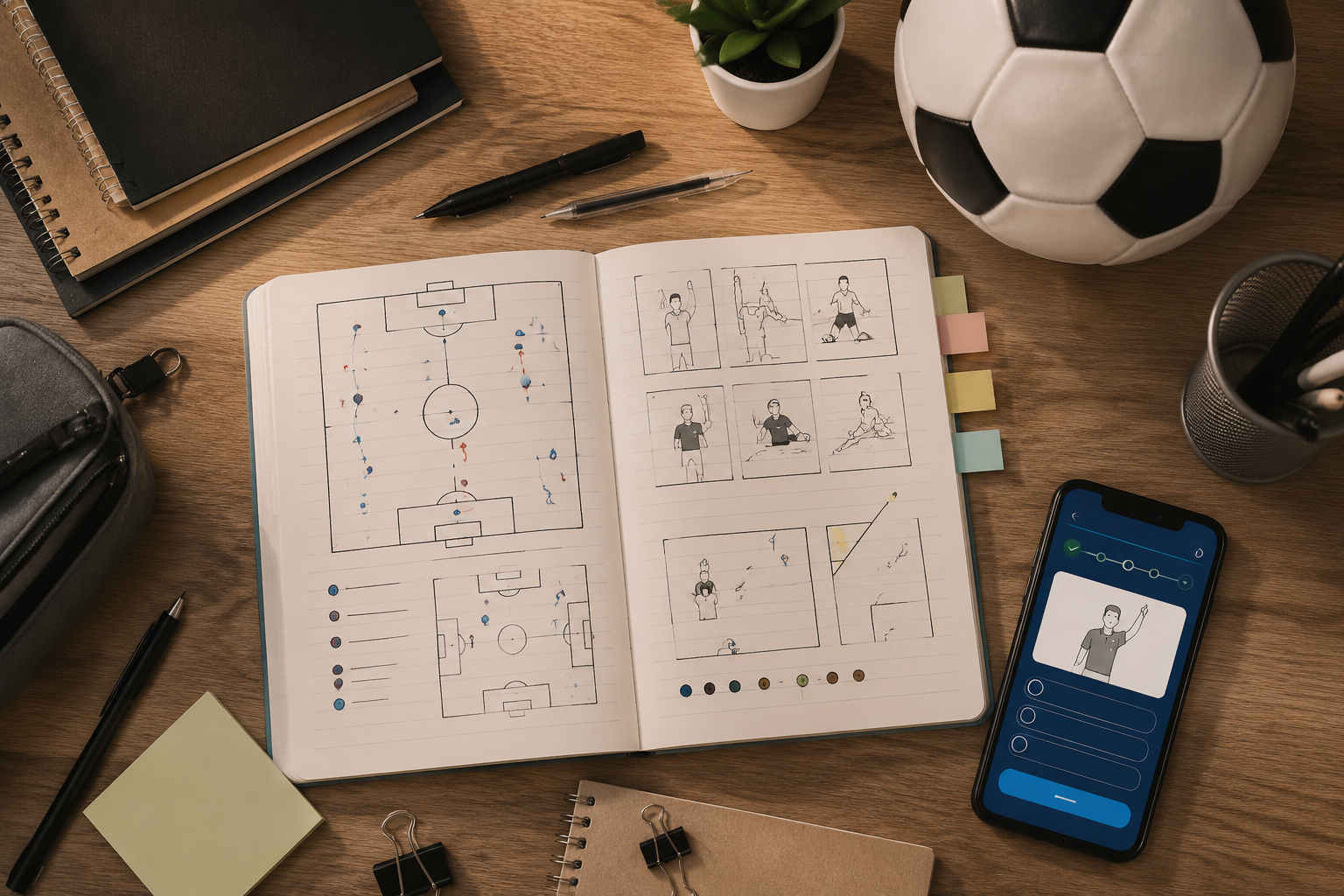
How to Learn Soccer Rules in One Study Session
Breaks down the essential soccer rules for beginners using memory-friendly techniques. Covers the eight core laws, the offside rule explained simply, and includes a self-test quiz — all structured for a single focused study session.
Updated:
If you searched for soccer rules explained for beginners, you probably do not need every clause of the Laws of the Game tonight. You need to watch a match without freezing when the whistle blows, survive a PE unit, or stop asking your rec-league teammate what just happened every five minutes.
So treat this like a focused study session. The official game is organized under 17 Laws of the Game, but a beginner can follow most match situations by learning eight core rules and grouping them into four chunks: start and restart, fouls and misconduct, scoring, and offside.[1] That is a much better first target than trying to memorize every field marking, tournament format, and referee signal at once.
This belongs on a study site in 2026 because soccer has become ordinary student-life knowledge, not just sports trivia. More than 850,000 U.S. high school students played organized soccer in the 2024-25 season, according to NFHS participation reporting.[2] SFIA reported in June 2026 that 25.5 million Americans play soccer, describing that figure as an all-time high and noting World Cup interest as part of the current growth context.[3] Those numbers do not mean everyone has to care about soccer. They do explain why a lot of students are suddenly expected to understand it.
The One-Session Plan
Give yourself one focused block. You are not training to referee; you are building the rule framework that lets you understand the common whistles.
| Study chunk | Beginner-essential laws | What you should be able to answer |
|---|---|---|
| Start and restart | Kickoff, throw-in, goal kick, corner kick, free kick | How does play restart after the ball goes out or a foul happens? |
| Fouls and misconduct | Direct free kicks, indirect free kicks, yellow cards, red cards | Was that just a foul, a warning, or a send-off? |
| Scoring | Ball fully crossing the goal line, penalty kicks | When does a goal count, and why is the penalty spot important? |
| Offside | Offside position and offside offense | Was the attacker beyond the second-to-last defender when the pass was played? |
A useful study order is: first scan the table, then learn the restart situations, then handle fouls and cards, then slow down for offside, and finally test yourself without looking. That is the same basic move you would use to turn a messy syllabus into a study guide: find the categories before you start memorizing details. If that method is new to you, the process in Create Study Guide from Syllabus transfers neatly here.
Start With What Happens When Play Stops
Beginners usually feel lost right after the whistle or after the ball crosses a line. That is good news, because restarts are one of the easiest places to build confidence. You only have to ask two questions: who touched the ball last, and where did the stoppage happen?
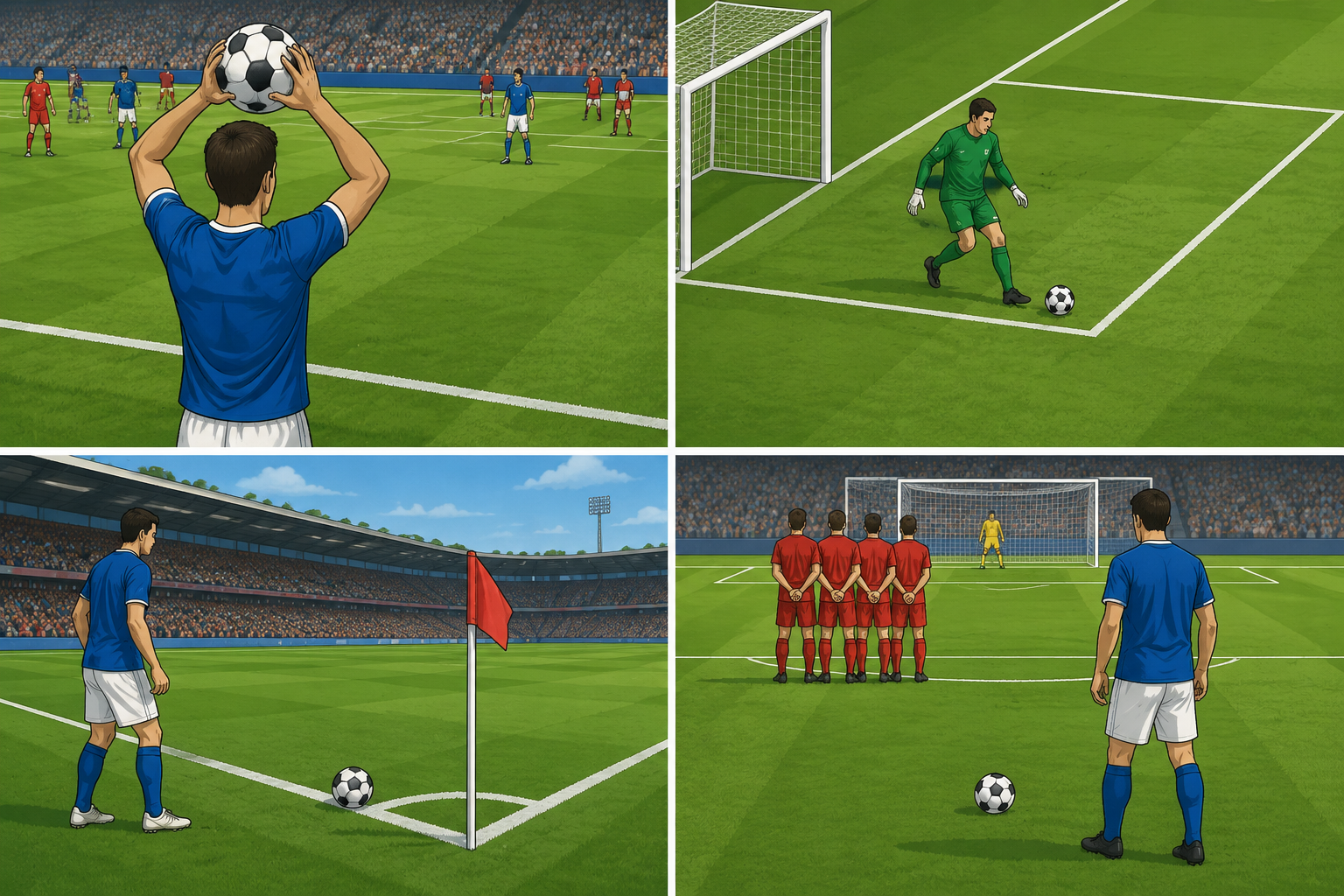
| Restart | When it happens | Beginner memory hook |
|---|---|---|
| Throw-in | The ball fully crosses a touchline, the long sideline of the field. | Out on the side means hands from the sideline. |
| Goal kick | The attacking team last touches the ball before it crosses the defending team’s goal line, without a goal being scored. | Attack missed it out past the goal, so defense restarts. |
| Corner kick | The defending team last touches the ball before it crosses its own goal line, without a goal being scored. | Defense knocked it out by its own goal, so attack gets the corner. |
| Free kick | Play stops for a foul or certain rule violations. | A rule was broken, so the other team gets the ball from the spot. |
The restart names sound like vocabulary, but they are really cause-and-effect labels. A throw-in tells you the ball went out over the side. A goal kick tells you the attacking team sent it out over the end line. A corner kick tells you the defending team touched it out near its own goal. A free kick tells you a foul or violation stopped play.[4][5]
That small set solves a surprising amount of beginner confusion. At a watch party, you do not have to identify the exact defensive mistake to know why the corner is happening. In PE, you do not need a speech about tactics to know where to stand for a throw-in. First learn the restart signal; the deeper explanation can come later.
Fouls, Free Kicks, and Cards
A foul is not just “someone fell down.” Soccer has contact, and not every collision is illegal. For beginner judgment, watch for unfair contact that stops or disadvantages an opponent: tripping, pushing, holding, charging carelessly, handling the ball deliberately, or making dangerous contact. Many fouls restart with a free kick for the other team.[1][5]
Cards are the referee’s way of moving from “that was a foul” to “that behavior needs discipline.” A yellow card is a caution. A red card sends the player off. Beginner guides commonly group yellow-card situations around reckless play, delaying the restart, dissent, repeated fouling, and unsporting behavior; red-card situations include serious foul play, violent conduct, denying an obvious goal-scoring opportunity, and receiving a second yellow card.[1]
You do not need to decide every borderline challenge from your couch. The useful beginner question is narrower: did the referee treat this as normal contact, a foul, a caution, or a send-off? That one distinction makes the next restart easier to understand.
Scoring Is Simple, Except When the Whistle Gets There First
A goal counts when the whole ball crosses the whole goal line between the goalposts and under the crossbar, as long as no rule violation cancels it.[1] That “whole ball, whole line” wording matters. A ball sitting partly on the line has not fully crossed.
The one field measurement worth memorizing early is the penalty spot: it is 12 yards from the goal line.[1] A penalty kick happens after certain fouls by the defending team inside its own penalty area. For a beginner, the big idea is not geometry; it is consequence. A foul near midfield usually gives a free kick. A punishable defensive foul inside the penalty area can give the attacking team a one-on-one shot from the spot.
Offside, Slowly Enough to Actually Learn It
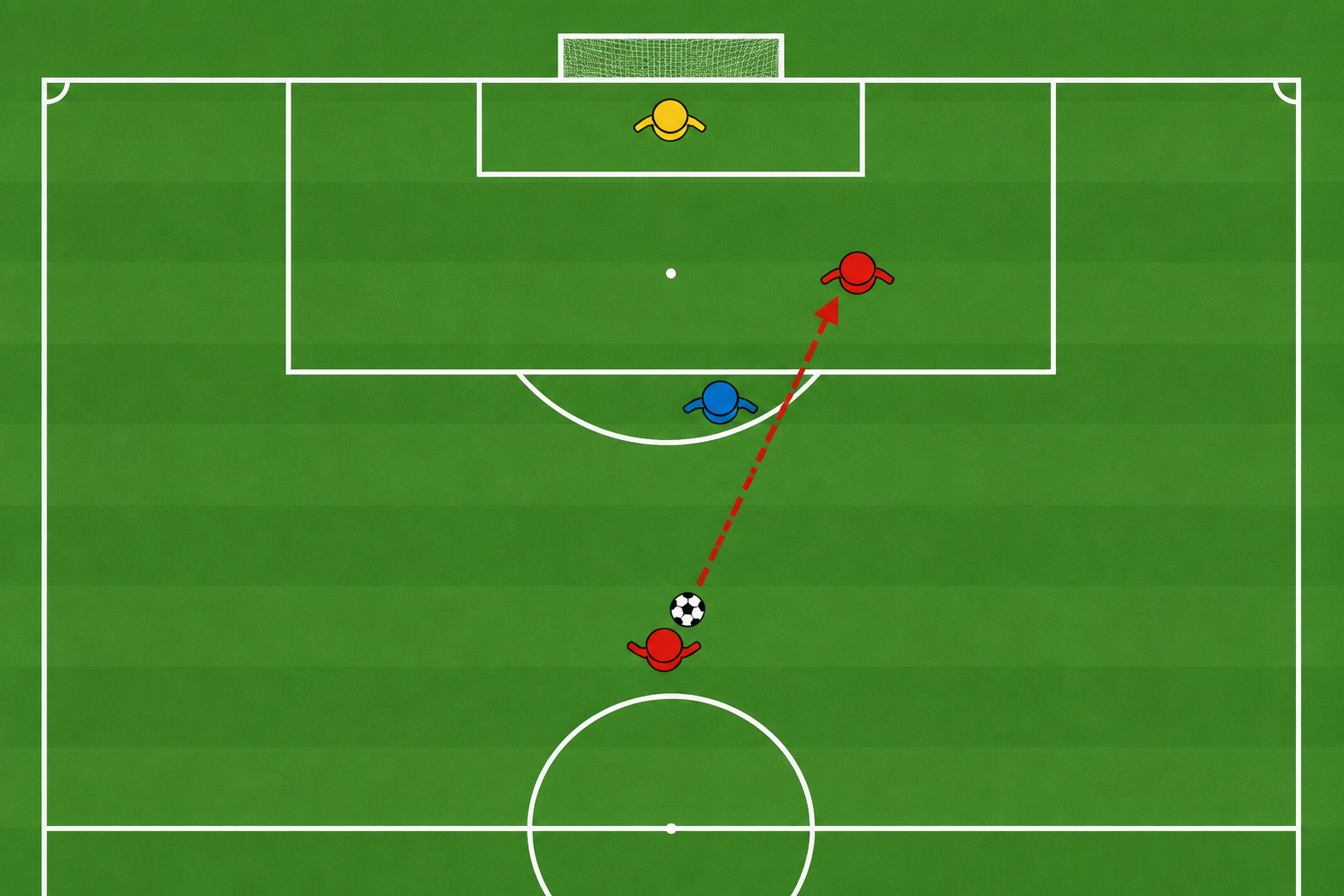
Offside is the rule that makes new fans feel like everyone else received a secret packet before the match. The secret is smaller than it looks: when a teammate plays or touches the ball, ask whether the attacker is closer to the opponent’s goal line than both the ball and the second-to-last defender.[1][5]
The second-to-last defender is the anchor
People often say “last defender,” but that phrase can mislead beginners because the goalkeeper is usually one of the last two defenders. The cleaner study phrase is second-to-last defender. Imagine a moving line across the field at that defender’s position. If an attacker is beyond that line when the pass is made, the attacker may be in an offside position.[1][5]
The timing is the part students miss. You freeze the picture when the teammate plays or touches the ball, not when the attacker receives it. A player can sprint behind the defense after the pass and still be fine if they were onside at the moment the ball was played.
Position is not automatically an offense
Being in an offside position is not the same thing as committing an offside offense. The player also has to become involved in active play. Official explanations and beginner guides describe that involvement through ideas such as interfering with play, interfering with an opponent, or gaining an advantage from the position.[1][5]
For first-session learning, keep the test simple:
- Was the attacker in the opponent’s half?
- At the moment the teammate played the ball, was the attacker beyond the second-to-last defender and beyond the ball?
- Did that attacker then become involved in the play?
If the answer to those questions is yes, you are probably looking at the reason for the flag. Real matches still produce judgment calls, especially around whether a player interfered with an opponent or gained an advantage. That is the second review topic, not the first wall you should run into.
The 2026 Goalkeeper Rule Students May Hear About
During the 2026 World Cup, students may hear commentators mention an eight-second goalkeeper possession rule. Houston Public Media, reporting with explanation from the University of Houston team, described the rule as part of the 2026 World Cup rules: a goalkeeper who controls the ball with the hands has eight seconds to release it.[6]
The careful wording matters. Learn it as a current World Cup rule you may hear during that tournament, not as proof that every league you watch has permanently adopted the same enforcement standard. Competitions can vary, and beginner confidence gets worse when someone turns one tournament update into a universal claim.
A 45-Minute Study Session That Actually Fits
If you are learning this beside actual schoolwork, do not make soccer rules sprawl across your whole evening. Put it in one box on the calendar, the same way you would schedule a small exam review inside a larger finals week study plan.
| Time | Task | Output |
|---|---|---|
| 0-5 minutes | Scan the eight-rule table. | Name the four chunks without notes. |
| 5-15 minutes | Study restarts. | Explain throw-in, goal kick, corner kick, and free kick. |
| 15-25 minutes | Study fouls, cards, and scoring. | Tell the difference between a foul, yellow card, red card, goal, and penalty kick. |
| 25-38 minutes | Work through offside. | Use the second-to-last defender test on simple examples. |
| 38-45 minutes | Take the quiz. | Correct your misses and mark one topic for review. |
If you are learning with friends before a watch party, split the quiz questions and make each person defend one answer out loud. A shared template can help if your group likes structure; the College Study Group Template Pack is built for exactly that kind of quick division of roles.
Self-Test Quiz
Answer without looking back. The point is retrieval, not rereading.
- The ball crosses the sideline. What restart should you expect?
- The attacking team shoots, misses, and the ball crosses the defending team’s goal line without a defender touching it. What restart should you expect?
- A defender blocks the ball over their own goal line, but no goal is scored. What restart should you expect?
- A player trips an opponent carelessly near midfield. What broad category of restart usually follows?
- What is the basic difference between a yellow card and a red card?
- How far is the penalty spot from the goal line?
- For offside, when do you freeze the play: when the pass is made or when the attacker receives it?
- In the beginner offside frame, which defender is the key reference point?
- True or false: simply standing in an offside position is always an offside offense.
- What is the careful way to describe the eight-second goalkeeper possession rule in 2026?
Answer Key
- Throw-in.
- Goal kick.
- Corner kick.
- Free kick.
- A yellow card is a caution; a red card sends the player off.
- 12 yards.
- When the pass is made.
- The second-to-last defender.
- False. The player must become involved in active play.
- It is a 2026 World Cup rule students may hear about; do not automatically treat it as a permanent rule across every competition.
If you missed mostly restart questions, review the four restart situations first. If you missed mostly offside questions, redraw the second-to-last defender line and practice freezing the play at the moment of the pass. After one session, the realistic goal is not mastery. It is enough to follow most matches, recognize the major whistles, and know which tricky calls deserve a second look.
References
- The Basic Rules of Soccer: A Complete Guide — soccer.com
- Participation in High School Sports Hits Record High — NFHS
- U.S. Soccer Participation Data — SFIA, June 2026
- Soccer For Dummies Cheat Sheet — Dummies.com
- Beginner's Guide To Soccer Rules — World Soccer Talk
- Here are the rules for World Cup soccer as explained by the University of Houston's team — Houston Public Media, June 11, 2026
Comments
Join the discussion with an anonymous comment.