
College Study Group Template Pack: Agenda, Roles, Contract, and Session Planner
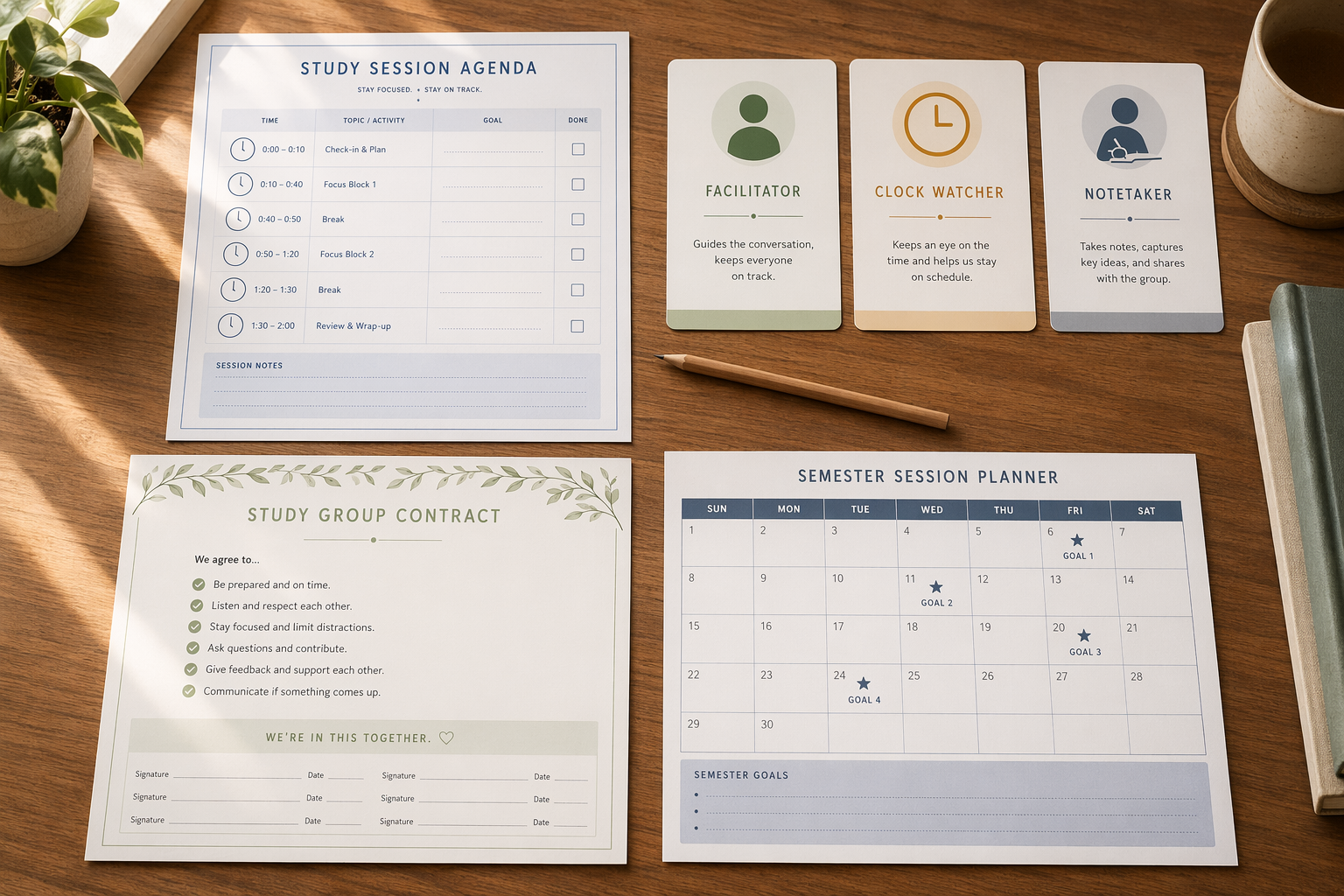
This pack gives you four ready-to-use templates — a timed agenda, rotating role cards, a group contract, and a semester session planner — so your study group spends more time learning and less time figuring out how to run the meeting.
Available Formats
Access links are provided in the guide below.
The awkward moment comes before the first meeting, not halfway through it. Everyone has said yes to “studying together.” Someone has made the group chat. Maybe one person has already shared the exam date twice. But the group still has not decided what will happen when people sit down, who keeps the meeting moving, what counts as prepared, or how this week connects to the rest of the semester.
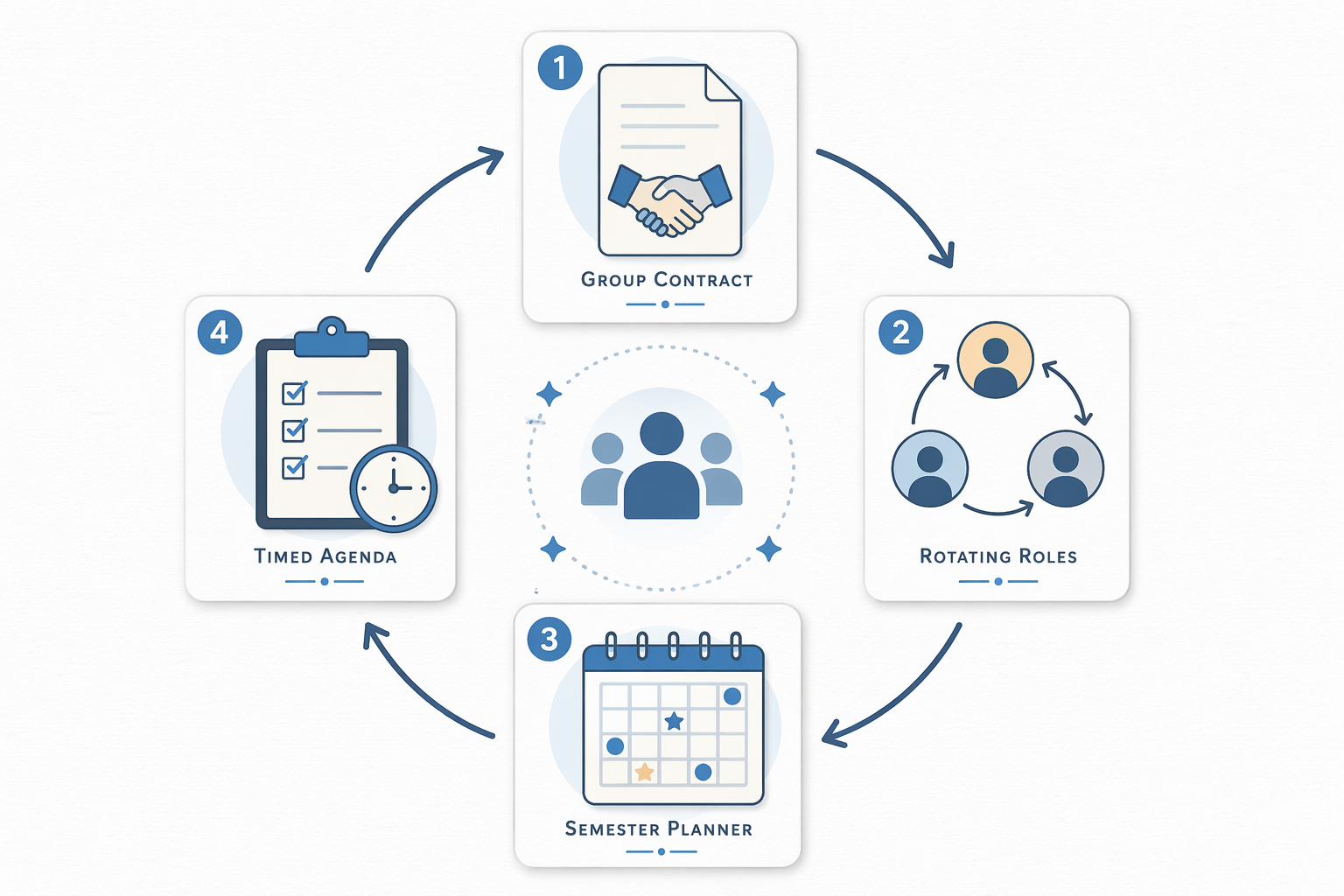
A useful study group template for college classes should answer those questions before the clock starts. The pack below works as one system: a timed agenda for each meeting, rotating role cards so responsibility does not quietly fall on one student, a short group contract for expectations, and a semester session planner that keeps weekly meetings pointed toward exams, projects, and problem sets.
Before filling anything out, keep the basic setup modest. Student success centers at UNC, Weber State, and the University of Utah converge around study groups of about 3–5 members, meeting once a week for roughly 60–90 minutes.[1][2][3] That is not a lab-tested magic formula. It is practical agreement from offices that spend a lot of time watching students try to make group study work. Fewer people makes scheduling and participation easier; a 60–90 minute window is long enough to do real practice without turning the meeting into a second lecture.
Use the four templates in this order
The first session should not open with “So, what do we want to do?” That question sounds harmless, but it can eat the first third of the meeting. Start with the decisions that prevent repeat confusion.
| When to use it | Template | What it decides |
|---|---|---|
| Before or at the start of the first meeting | Group contract | Attendance, preparation, communication, and what the group does when someone is consistently unprepared |
| At every meeting | Rotating role cards | Who facilitates, watches time, takes notes, and manages follow-up for this session |
| During the first meeting, then after major course updates | Semester session planner | Which weeks connect to exams, papers, labs, presentations, or problem sets |
| Every week | Timed agenda | How the meeting time is divided between review, active practice, recap, and next steps |
If your group only has time to prepare one thing before meeting, prepare the agenda. If you want the group to last past week two, use all four.
Template 1: Timed study group agenda
Cornell’s study group agenda precedent uses a one-hour meeting structure with explicit timed blocks, including check-in, role reminder, and rotating study activities.[4] Because the full document was not available to review, the agenda here is a student-ready adaptation rather than a reproduction. It also builds in active learning activities recommended by UNC, including teaching peers, concept mapping, practice tests, and collaborative problem-solving.[1]
| Time | Block | What the group does |
|---|---|---|
| 0:00–0:05 | Check-in | Name the topic, exam or assignment target, and any urgent confusion from the week. |
| 0:05–0:07 | Role reminder | Confirm today’s facilitator, clock watcher, notetaker, and question tracker. |
| 0:07–0:22 | Compare notes | Find missing lecture points, unclear definitions, and places where notes disagree. |
| 0:22–0:42 | Active problem-solving | Work through problems, explain concepts aloud, build a concept map, or teach one section to the group. |
| 0:42–0:52 | Practice questions | Write or answer quiz-style questions without looking at notes first. |
| 0:52–0:57 | Recap and next steps | List what is still confusing, what each person will review, and what topic comes next. |
| 0:57–1:00 | Social wind-down | Let the meeting end like a human gathering, not like everyone is fleeing a timer. |
For a 90-minute session, do not simply stretch every block. Add the extra time to the middle: more practice problems, more peer teaching, or a longer mock quiz. The check-in and role reminder should stay short. They exist to start the meeting, not become the meeting.
Copyable agenda template
| Field | Fill in |
|---|---|
| Course | |
| Meeting date and time | |
| Today’s target | |
| Facilitator | |
| Clock watcher | |
| Notetaker | |
| Question tracker | |
| Notes to compare | |
| Problems or concepts to practice | |
| Practice questions created | |
| Still confusing | |
| Before next meeting, each person will | |
| Next meeting topic |
The agenda is also where generic “review chapter 6” turns into an actual learning task. “Maya explains enzyme inhibition from memory, then the group solves three practice problems” is much harder to drift away from than “go over biology.” The point is not to make the group feel formal. It is to remove the tiny negotiations that otherwise happen every ten minutes.
Template 2: Rotating role cards
Roles are not there because college students need job titles to study. They are there because unassigned work still gets assigned — usually to the most organized person, the most talkative person, or the person who feels least comfortable watching silence stretch.
Providence College’s study group guidance names roles such as Facilitator, Clock Watcher, and Notetaker with specific responsibilities.[5] Washington University’s teaching center, citing POGIL research, explains that assigned roles can increase individual accountability and reduce free-riding in group work.[6] The University of Minnesota also recommends rotating group roles, including facilitator-style and organizer-style responsibilities, so participation does not harden into the same pattern every week.[7]
| Role | Main job | What this person says when the group drifts |
|---|---|---|
| Facilitator | Keeps the group on the agenda and invites quieter members into the work. | “Let’s hear one approach from someone who has not gone yet.” |
| Clock watcher | Tracks time blocks and gives short warnings before transitions. | “We have three minutes left for notes. Which confusion should move to practice?” |
| Notetaker | Records decisions, unresolved questions, and next steps in the shared doc. | “I’m writing that as unresolved. Who can check it before next week?” |
| Question tracker | Collects questions for office hours, discussion section, tutoring, or the next meeting. | “Is this something we can solve now, or should we send it to the TA?” |
Rotate roles every meeting unless there is a clear reason not to. The person who facilitates this week should not automatically facilitate next week. The person who takes notes should not become the permanent group secretary because they happened to open the Google Doc first.
Copyable role rotation tracker
| Meeting date | Facilitator | Clock watcher | Notetaker | Question tracker |
|---|---|---|---|---|
A group of three can combine roles. The facilitator can also track questions, or the notetaker can record next steps and unresolved issues in the same document. What matters is that the group names the responsibility before the session begins.
Template 3: Short group contract
The contract should be short enough that students will actually use it. Princeton’s McGraw Center offers group work templates, and UPenn’s Weingarten Center has a study group contract PDF, so the formal agreement approach is not unusual in academic support settings.[8] The useful version for a study group is less like a legal document and more like a way to prevent resentment from becoming the group’s communication system.
| Contract item | Group decision |
|---|---|
| Members | |
| Course and instructor | |
| Regular meeting day, time, and location | |
| Expected preparation before each meeting | |
| Attendance expectation | |
| How far in advance members should say they cannot attend | |
| What happens if someone repeatedly arrives unprepared | |
| Where notes, agendas, and questions will live | |
| How the group will handle disagreement or confusion | |
| When the group will revisit this contract |
Reliability and personality do matter. A group full of people who ignore messages or make others feel small will not be saved by a beautiful table. But the contract gives reasonable people a shared reference point. It lets the group say, “We agreed to post if we’re missing the meeting,” instead of making one student privately decide whether they are allowed to be annoyed.
Template 4: Semester session planner
The semester planner connects the weekly agenda to the course calendar. Without it, a group can have several decent meetings and still realize too late that the midterm includes chapters no one has touched. Fill this out during the first session with the syllabus open.
| Week | Course deadline or exam | Study group focus | Active practice plan | Questions to bring to class, TA, tutor, or office hours |
|---|---|---|---|---|
| Week 1 | ||||
| Week 2 | ||||
| Week 3 | ||||
| Week 4 | ||||
| Week 5 | ||||
| Week 6 | ||||
| Week 7 | ||||
| Week 8 |
For a full semester, extend the rows to match your academic calendar. Mark exams, lab practicals, paper deadlines, presentations, and major problem sets first. Then work backward. The week before an exam should probably not be the first time the group attempts practice questions.
The active practice column is the most important one. Use it to name what the group will actually do: teach a concept without notes, draw a concept map, build a practice test, compare solution methods, or solve a problem set collaboratively. UNC’s guidance is useful here because it points study partners away from passive rereading and toward activities that make students retrieve, explain, and apply material.[1]
How the first meeting can run
A first meeting does not need to be a constitution-writing session. It needs enough structure that the second meeting is easier to start.
- Spend 10 minutes agreeing to the group contract: meeting time, preparation, absence notice, shared-doc location, and how the group will handle repeated no-shows or no-prep arrivals.
- Spend 5 minutes assigning today’s roles and filling the next few meetings in the role rotation tracker.
- Spend 10–15 minutes filling the semester session planner from the syllabus, starting with exams and major assignments.
- Use the remaining time to run the timed agenda on one real course topic, even if the first version is rough.
- End by adjusting the next agenda: keep the blocks that helped, shorten the ones that dragged, and decide what everyone prepares before the next meeting.
Students whose schedules make a weekly in-person group unrealistic may need a different accountability setup. A study buddy app comparison can help if the problem is finding compatible availability rather than running the meeting itself. For an actual class group that already exists, the templates here solve the more immediate issue: deciding how the group spends its time together.
Use the pack, then revise it after one real session
The agenda is the template to bring every week. The role cards protect the group from accidental bosses and accidental passengers. The contract prevents small social frictions from becoming private grudges. The semester planner keeps the group from treating every meeting like an isolated homework rescue mission.
Copy the pack before the first session, fill in only what the group can honestly agree to, and run one meeting with the timer visible. After that, adjust the time blocks based on what helped people learn. A better first meeting is useful; a repeatable operating system for the semester is the real win.
References
- Study Partners, UNC Learning Center
- How To Form an Effective Study Group, Weber State University
- 5 tips for an effective study group, University of Utah David Eccles School of Business
- Template Study Group Agenda, Cornell Learning Strategies Center
- Creating an Effective Study Group, Providence College Academic Services
- Using Roles in Group Work, Washington University Center for Teaching and Learning
- Group Roles, University of Minnesota Effective U
- Group Work Templates, Princeton McGraw Center for Teaching and Learning
Related Guides & Templates
- Paper Planner vs. Digital App: Which Weekly Homework Planner Actually Works for Students? →
A research-backed comparison of paper planners and digital homework apps, helping high school and college students decide which format—or hybrid approach—best supports their study habits, time management, and academic success.
- Which Cornell Notes Template Should You Use? A Guide to Matching Template Style to Subject Type →
Not all Cornell notes templates are the same. This guide helps college and high school students choose the best printable PDF template for their specific classes — whether they need a graph-paper note area for science diagrams or a wide cue column for humanities discussions.
- How to Build a Weekly Assignment Planning Routine That Actually Sticks (Free Template) →
Most students abandon their planners after 2–3 weeks. This article explains why — and provides a 3-step weekly routine based on habit-formation psychology, plus a free printable template designed to make the habit stick.
Comments
Join the discussion with an anonymous comment.