

Hunger Games Sunrise on the Reaping Study Guide
A comprehensive, free chapter-by-chapter study guide for Suzanne Collins' Sunrise on the Reaping, including detailed summaries, character profiles, thematic analysis, key quotes, and connections to the original Hunger Games trilogy.
Updated:
This free Hunger Games Sunrise on the Reaping study guide is built for the reader who needs more than a plot recap: quick chapter help, a usable map of the novel’s three parts, character connections, theme analysis, symbols, key quotes, and essay-ready questions. Suzanne Collins’ 2025 prequel is a 400-page novel centered on Haymitch Abernathy and the Second Quarter Quell, with 48 tributes drawn from Panem’s 12 districts; it sold 1.5 million copies worldwide in its first week, had reached 4.4 million copies by January 2026, and has a film adaptation scheduled for November 20, 2026.[1]
That popularity explains why so many students are searching for a Hunger Games Sunrise on the Reaping study guide. The better reason to study the book closely is that Collins is doing something more precise than giving Haymitch a tragic origin story. She builds the novel around the Capitol’s ability to control what the country sees, what the districts believe can be changed, and which private losses can be turned into public obedience. NPR’s review notes Collins’ stated interest in David Hume’s idea of “implicit submission” and connects the novel to media manipulation, which is exactly where the strongest essays on the book usually begin.[2]
How to Use This Guide
If you are reading for class, use the three-part structure as your spine. Part 1: The Birthday sets up the reaping, District 12’s family and friendship networks, and the false normality that surrounds a public ritual of violence. Part 2: The Rascal follows Haymitch inside the Games, where survival depends not only on strategy but also on performance. Part 3: The Poster shows what happens after the spectacle, when the Capitol edits, punishes, and repackages events into a story it can safely broadcast.
| Section | What to Track | Best Use |
|---|---|---|
| Part 1: The Birthday | Reaping-day ritual, District 12 relationships, Lenore Dove, Burdock Everdeen, Maysilee Donner | Character setup, family trees, early theme notes |
| Part 2: The Rascal | Arena tactics, Haymitch’s persona, Maysilee, Beetee, Ampert, Newcomers, force field | Chapter summaries, survival analysis, resistance essays |
| Part 3: The Poster | Edited recap, broadcast control, aftermath, poisoned gumdrop, mockingjay pin origin | Propaganda essays, quote analysis, series connections |
Existing online study resources vary in depth. SparkNotes has a guide, but its visible material is comparatively brief for students trying to build full essays; SuperSummary offers a more developed thematic framework, though much of that ecosystem is designed around paid access.[3][4] This guide keeps the useful parts in one place: plot movement first, then characters, then themes, symbols, quotes, and prompts.
Part 1: The Birthday
The title of Part 1 matters because the Second Quarter Quell begins by making Haymitch’s birthday public property. A birthday should mark private life: family, friends, memory, the possibility of becoming older. In Panem, the Capitol can interrupt even that small boundary. The reaping does not merely select tributes; it turns ordinary district time into Capitol programming.
Opening Movement: District 12 Before the Quell
The early chapters are the place to track names, not just events. Haymitch is not yet the isolated mentor readers know from The Hunger Games. He belongs to a District 12 social world that includes Lenore Dove, Burdock Everdeen, and Maysilee Donner. That matters because Collins makes later loss more than personal sadness. The Capitol’s violence works by tearing apart local memory and then replacing it with an official story.
Burdock Everdeen is especially important because Sunrise on the Reaping names Katniss’ father and gives students a clearer District 12 family map. Maysilee Donner matters twice: inside Haymitch’s story and in the later history of the mockingjay pin through her family connection to Madge Undersee. Reader-created connection maps have treated these family links as one of the major revelations of the prequel because they show that rebellion in District 12 is not a single-generation accident.[5][6]
The Reaping as Scripted Reality
The reaping chapters should be read as a media scene. The Capitol does not need every district citizen to believe the Games are just; it needs them to act as if the event is unavoidable. That is where Collins’ Humean frame becomes useful without turning the chapter into a philosophy lecture. “Implicit submission” describes the way power persists when people comply with a system they may privately hate. Hogwarts Professor’s analysis of Collins’ comments identifies Hume’s concept as a direct philosophical inspiration for the novel.[7]
Lenore Dove gives the clearest early answer to that fatalism: “And that’s part of our trouble. Thinking things are inevitable. Not believing change is possible.” The line is not decorative wisdom. It tells the reader how to read the whole novel. The Capitol benefits when people confuse repetition with fate. The reaping has happened before; the Games have happened before; therefore the country is trained to imagine that they must continue.
What to Mark in Part 1
- Every moment when public ceremony replaces private feeling, especially around Haymitch’s birthday and the reaping.
- Lenore Dove’s language about inevitability, change, and refusal.
- Burdock Everdeen and Maysilee Donner’s connections to later Hunger Games history.
- Objects that look small at first: the flint striker, the mockingjay pin, gumdrops, birds, and fire.
- Any contrast between what District 12 knows emotionally and what the Capitol will later allow Panem to see.
Part 2: The Rascal
Part 2 shifts the guide from social setup to survival. The word “rascal” is worth pausing over because it makes Haymitch’s arena identity sound charming, unserious, and marketable. That is exactly the danger. A “rascal” can be laughed at. A “rascal” can be underestimated. A “rascal” can also be turned into a Capitol-friendly character type that hides the anger underneath.
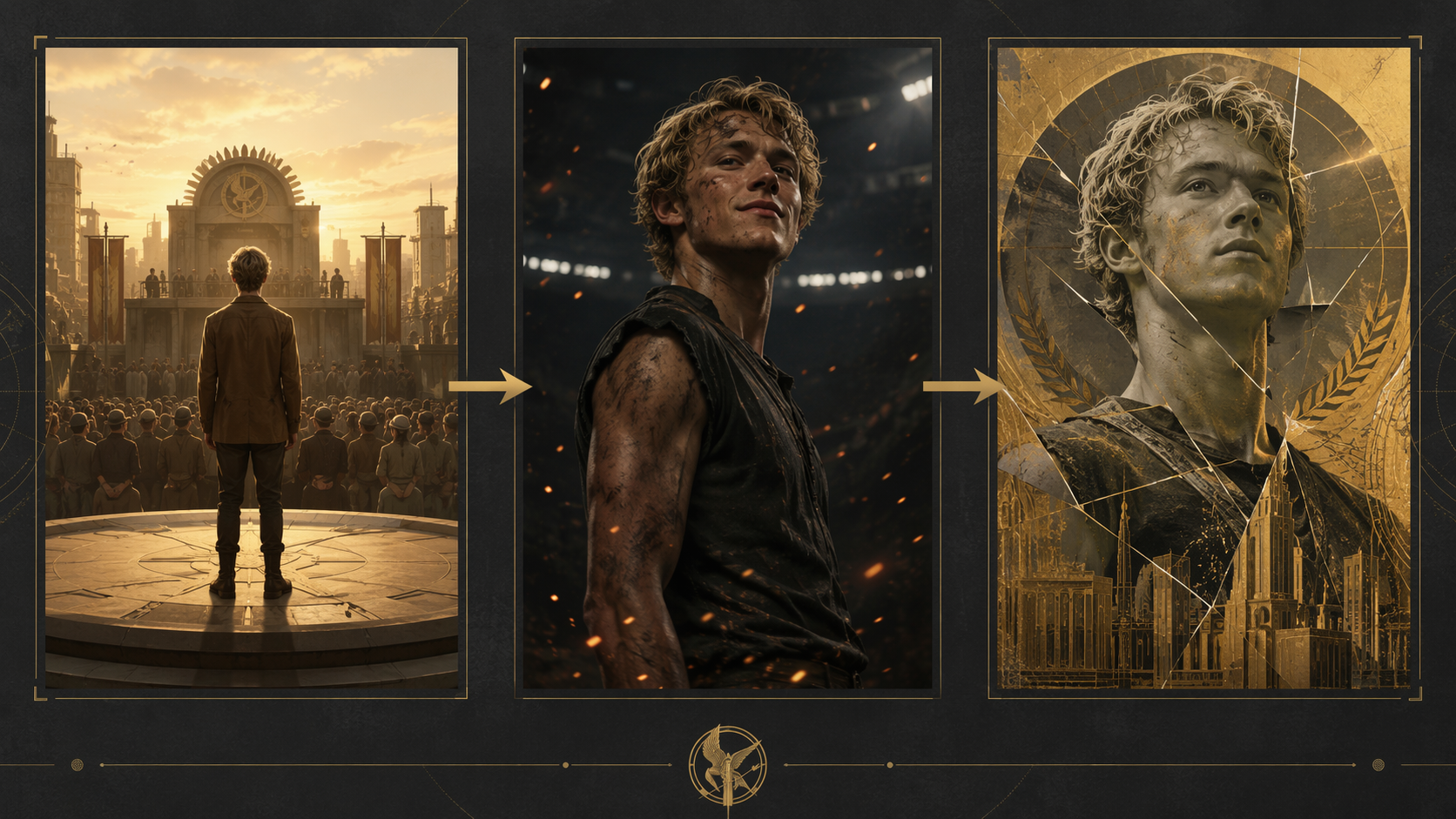
Haymitch Learns Performance as Survival
In the arena, Haymitch’s intelligence is never only technical. He has to read terrain, sponsors, opponents, cameras, and Capitol expectations at once. The persona that later hardens into the drunk, bitter mentor begins here as a survival performance. His line “they will not use my tears for their entertainment” belongs with Katniss’ later refusal to perform grief cleanly for the cameras. Both characters understand that the Capitol wants suffering, but only in forms it can consume.
This is a useful place for essay writers to avoid a common weak claim. Haymitch is not simply “rebellious” because he breaks rules. His resistance is sharper: he tries to control the meaning of his own body and emotions under conditions where the Capitol claims the right to frame everything. In an ordinary adventure plot, cleverness helps a hero win. In this novel, cleverness also creates a problem for the state, because an unplanned meaning can leak through the broadcast.
Maysilee, Alliance, and the Cost of Being Seen
Maysilee Donner should not be reduced to a familiar prequel name. Her presence gives the arena chapters a bridge between individual survival and inherited resistance. Students tracking the mockingjay pin should keep Maysilee in view because Sunrise on the Reaping clarifies the pin’s origin and later path into Katniss’ story through Maysilee’s family line.[5][6]
The arena alliances also widen the novel beyond District 12. Beetee and Ampert’s sacrifice, along with the Newcomers alliance, should be read as more than a sequence of tactical moves. They show how cooperation under surveillance becomes politically dangerous. The Capitol designs the Games to make tributes compete as isolated bodies. Any moment of deliberate mutual aid pushes against that design, even when it cannot save everyone involved.
The Force Field and the Limits of Capitol Design
The force field belongs on any symbol list, but it also belongs in the chapter summary notes. It is a literal boundary made by Capitol technology, yet Haymitch’s attention to it turns the arena’s design against itself. That is why his victory is not politically neutral. Winning by using the system’s hidden mechanics exposes the fact that the Games are constructed, not natural. The Capitol can tolerate a victor. It has more trouble tolerating a victor whose survival reveals flaws in the spectacle.
What to Mark in Part 2
- Haymitch’s jokes, smirks, and refusals as calculated performances rather than random attitude.
- Scenes where alliance interrupts the Capitol’s preferred story of isolated competition.
- Beetee and Ampert’s choices as early evidence of interdistrict resistance.
- The force field as both arena technology and a symbol of the Capitol’s imperfect control.
- Moments when the broadcast audience would see one thing while the tributes understand another.
Part 3: The Poster
Part 3 is where the novel becomes most useful for essays on propaganda. The Games end, but the struggle over meaning intensifies. A poster is an image designed for public consumption: simplified, repeatable, and stripped of whatever would make the viewer hesitate. That is the Capitol’s preferred version of Haymitch. Not the grieving boy, not the witness, not the person who understands too much, but a usable picture.
The Broadcast Delay and the Edited Recap
The Capitol’s 5-minute broadcast delay is one of the most important details in the novel because it turns censorship into a visible mechanism. The delay means Panem is not watching reality; it is watching reality after the state has had time to decide what reality is allowed to mean. The edited victory recap makes the same point after the fact. The Capitol does not merely hide facts. It arranges facts into a story that protects its authority.
This is where a strong essay can move beyond “the Capitol uses propaganda.” The novel shows stages of narrative control: delay the image, edit the sequence, replace the body, punish the survivor, and circulate a safer version. Each stage reduces the audience’s ability to connect what happened with why it matters.
Louella’s Body Double
Louella’s body double is one of the book’s clearest examples of the Capitol editing reality at the level of the body itself. A recap can cut footage. A delay can suppress an image. A body double goes further: it asks the public to accept a manufactured presence as if it were the person. For students writing about authoritarian media, this is a crucial escalation. The Capitol does not simply tell lies about people. It tries to decide who counts as visible.
The Poisoned Gumdrop
The poisoned gumdrop is small enough to look almost absurd, which makes it more disturbing. Candy suggests childhood, reward, softness, even celebration. In Snow’s hands, it becomes an instrument of punishment. The object fits the novel’s broader pattern: the Capitol prefers violence that can be disguised as ceremony, pleasure, or inevitability.
Lenore Dove’s fate also shows how love becomes a political weapon. Snow understands that killing someone close to Haymitch can discipline the victor more effectively than punishing Haymitch alone. The point is not just cruelty. It is instruction. The survivor is taught that any attachment can be converted into leverage.
The Mockingjay Pin Origin
The mockingjay pin is the rare prequel object that earns its significance because it accumulates history rather than merely explaining a franchise detail. In The Hunger Games, the pin is already a symbol of Katniss’ public image and eventual rebellion. Sunrise on the Reaping pushes that symbol backward through Maysilee Donner and District 12’s family network, making the pin a carrier of grief, memory, and unfinished resistance.[5][6]
That origin matters for exams because it lets students connect symbol and structure. The pin moves from private keepsake to public emblem. The Capitol repeatedly tries to convert private loss into obedience; the mockingjay pin moves the other way, converting private memory into a sign that can outlive official control.
Character Guide
| Character | Role in Sunrise on the Reaping | Why the Character Matters |
|---|---|---|
| Haymitch Abernathy | District 12 tribute and future victor of the Second Quarter Quell | His “rascal” persona becomes a survival strategy and later a damaged public mask. |
| Lenore Dove | Haymitch’s beloved and a Covey/Baird connection | Her refusal of inevitability gives the novel one of its clearest statements about change. |
| Maysilee Donner | District 12 tribute connected to the mockingjay pin’s history | Her family link ties Haymitch’s Games to Katniss’ later symbol of rebellion. |
| Burdock Everdeen | Haymitch’s best friend and Katniss’ father | His naming strengthens the District 12 family web behind the original trilogy. |
| Beetee | Mentor figure connected to technological resistance | His presence links the prequel’s interdistrict cooperation to Catching Fire. |
| Ampert | Figure associated with sacrifice and alliance | His choices help show that resistance can appear inside the Games before open rebellion. |
| Mags and Wiress | Mentors who later reappear in Catching Fire | They make the victor network feel older and more politically charged. |
| Plutarch Heavensbee | Cameraman connected to secret rebellion work | His early role shows that media systems can be used by both the Capitol and its future opponents. |
| President Snow | Architect of punishment and narrative control | He turns love, spectacle, and edited images into tools of rule. |
For a character essay, do not isolate these figures into biography cards. The useful question is how each person changes the meaning of Haymitch’s victory. Lenore Dove makes the victory morally unbearable. Maysilee makes it historically connected. Beetee, Ampert, Mags, Wiress, and Plutarch make it part of a longer network of resistance. Snow makes it clear that winning the Games does not mean escaping the Capitol’s story.
Themes for Essays and Class Discussion
Propaganda and Narrative Control
The strongest theme in Sunrise on the Reaping is not simply that propaganda exists. It is that propaganda works by controlling sequence, timing, visibility, and emotional interpretation. The 5-minute broadcast delay controls timing. The edited victory recap controls sequence. Louella’s body double controls visibility. The poster version of Haymitch controls interpretation.
SuperSummary’s thematic framing identifies government propaganda and media manipulation as central concerns of the novel, and NPR similarly emphasizes the book’s interest in how narratives are shaped for public consumption.[4][2] For a college essay, the key is to explain what each mechanism does. A delay prevents immediate collective reaction. An edit creates a preferred causal chain. A replacement body falsifies presence. A poster turns a complex survivor into a symbol the state thinks it can manage.
Implicit Submission and the Myth of Inevitability
Collins’ stated Hume inspiration gives students a more exact vocabulary for the political problem in the book.[2][7] Panem is not held together only by Peacekeepers, weapons, and punishment. It is also held together by habits of compliance: standing where one is told to stand, watching what one is told to watch, repeating that nothing can change, and surviving privately while the public system continues.
Lenore Dove’s line about inevitability is the best quote to pair with this theme. She does not deny danger. She denies the emotional training that makes danger feel permanent. The Capitol’s deepest victory would be a population that no longer has to be convinced because it has already learned to imagine obedience as realism.
Identity and Performance
Haymitch’s “rascal” identity is not a personality quirk floating above the plot. It is produced under pressure. He performs because the arena is watched; he withholds tears because grief can be consumed; he jokes because a joke can disarm both enemies and viewers. Later, readers of the original trilogy know the performance curdles into something sadder: a public mask that helps him survive after survival has already cost too much.
Love, Loss, and Political Punishment
Snow’s use of Lenore Dove shows that authoritarian power does not stop at the body of the dissenter. It follows relationships. The poisoned gumdrop is frightening because it makes affection dangerous after the Games have supposedly ended. This helps explain the older Haymitch without flattening him into backstory: his isolation is not merely grief but a learned form of harm reduction.
Sacrifice and Intergenerational Resistance
Beetee and Ampert’s sacrifice, the Newcomers alliance, Plutarch’s hidden work, and the mockingjay pin’s path all point beyond Haymitch’s individual victory. The rebellion that Katniss later helps ignite does not appear from nowhere. It depends on earlier people whose names are edited, buried, misread, or remembered only in fragments.
Symbols and Motifs to Track
| Symbol or Motif | Where It Points | How to Use It in Analysis |
|---|---|---|
| Mockingjay pin | Maysilee, District 12 memory, Katniss’ later rebellion | Argue that private memory can become public resistance. |
| Flint striker | Fire, survival, portable resistance | Connect practical survival tools to the series’ larger fire imagery. |
| Gumdrops | Sweetness corrupted by Snow’s violence | Show how the Capitol disguises punishment inside ordinary objects. |
| Force field | Arena design and technological control | Explain how Haymitch turns a boundary into evidence of the system’s weakness. |
| Birds and snakes | Freedom, surveillance, predation, Snow’s symbolic world | Compare Covey/mockingjay associations with Snow’s serpentine methods. |
| The meadow | District 12 memory, song, family, fragile peace | Connect local place to what the Capitol cannot fully own. |
| Fire | Survival, signal, danger, future rebellion | Link Haymitch’s world to Katniss as the later “girl on fire.” |
| Geese | Migration, wildness, non-Capitol patterns of life | Use cautiously as a motif of movement outside official order. |
The safest way to write about symbols is to attach them to scenes. A weak symbol paragraph says, “The mockingjay represents rebellion.” A stronger one follows the pin through Maysilee, family inheritance, Madge, Katniss, and the Capitol’s failed attempts to control what the bird comes to mean. The same rule works for the gumdrop, the force field, and the flint striker: begin with the object’s immediate use, then widen to its political meaning.
Key Quotes and How to Explain Them
| Quote | Speaker | How to Use It |
|---|---|---|
| “And that’s part of our trouble. Thinking things are inevitable. Not believing change is possible.” | Lenore Dove | Use for essays on implicit submission, fatalism, and the emotional habits that help authoritarian systems survive. |
| “They will not use my tears for their entertainment.” | Haymitch Abernathy | Use for essays on performance, grief, spectacle, and the refusal to let the Capitol consume suffering. |
| “I fulfilled my promise about the reaping, or at least lent a hand.” | Haymitch Abernathy | Use for essays on intergenerational resistance and Haymitch’s hidden role in the later rebellion. |
The epilogue promise is especially important because it changes how students can reread Haymitch in the original trilogy. He is not only a ruined mentor pulled into Katniss’ story. He is also someone who has been carrying unfinished obligations from his own Games. The phrase “or at least lent a hand” keeps the claim modest, which makes it more powerful. Resistance in Collins’ world often looks less like a single heroic act than a chain of partial, risky contributions.
Connections to the Hunger Games Series
Sunrise on the Reaping works best when read both forward and backward. It looks backward to The Ballad of Songbirds and Snakes through Covey/Baird traces around Lenore Dove and the lingering cultural memory of District 12. It looks forward to The Hunger Games through Burdock Everdeen, Maysilee Donner, the mockingjay pin, Haymitch’s mentoring, and the older victor network that becomes crucial in Catching Fire.[5][6]
Mags, Wiress, Beetee, and Plutarch are particularly useful for comparative essays. They remind readers that rebellion is not born only from Katniss’ televised defiance with the berries. The later rebellion needs technicians, mentors, camera workers, damaged victors, family stories, and objects that have survived previous attempts at erasure.
The novel has received some mixed reader reactions, especially around pacing, but for study purposes its density is often the point. Collins is less interested in surprise over who Haymitch becomes than in showing how many people and images had to be damaged, edited, or preserved for that later Haymitch to exist.
Essay Angles
- Analyze how the Capitol controls reality through delay, editing, replacement, and punishment rather than through violence alone.
- Compare Haymitch’s “rascal” persona with Katniss’ later public image as the “girl on fire.”
- Explain how Lenore Dove’s rejection of inevitability connects to Collins’ interest in implicit submission.
- Trace the mockingjay pin from private object to inherited symbol to public rebellion.
- Discuss how Snow weaponizes love and grief through Lenore Dove and the poisoned gumdrop.
- Show how Beetee, Ampert, Plutarch, Mags, and Wiress make rebellion look collective rather than spontaneous.
Discussion Questions
Teachers can pair these with the official Scholastic reading guide, which offers classroom-oriented discussion material for the novel.[8]
- Why does Collins make Haymitch’s birthday part of the reaping structure? What does the Capitol gain by invading private time?
- How does the 5-minute broadcast delay change the meaning of “live” television in Panem?
- When does Haymitch’s “rascal” persona protect him, and when does it risk becoming another Capitol-friendly label?
- How does Louella’s body double complicate the difference between hiding the truth and manufacturing a replacement truth?
- What does Lenore Dove mean by challenging inevitability, and why is that idea politically dangerous in Panem?
- How does the poisoned gumdrop turn an ordinary object into a symbol of Snow’s power?
- What changes when the mockingjay pin’s origin is connected to Maysilee and District 12 family history?
- Does the novel make Haymitch easier to understand, harder to judge, or both?
Study Tips for Exams
For a quiz or exam, do not try to memorize every event as an isolated fact. Build a one-page chart with three columns: Part 1: The Birthday, Part 2: The Rascal, and Part 3: The Poster. Under each part, list the major plot turns, the character relationships introduced or changed, and the symbols that gain new weight. If you need a broader method for turning assigned reading into exam materials, use this guide to creating a study guide from your syllabus and adapt the same process to the novel.
- For short-answer questions, memorize names and functions: Lenore Dove challenges inevitability; Maysilee carries mockingjay-pin history; Beetee and Ampert show sacrifice; Plutarch links media to rebellion.
- For quote IDs, attach each quote to a theme: inevitability, spectacle, grief, or intergenerational resistance.
- For essays, choose one mechanism and follow it closely: broadcast delay, edited recap, body double, poisoned gumdrop, or mockingjay pin.
- For comparison prompts, connect Haymitch to Katniss through performance under surveillance rather than through personality alone.
Once the chapters, characters, symbols, and quotes are tracked together, Sunrise on the Reaping stops looking like a backstory appendix. It becomes one of the series’ clearest studies of how authoritarian power survives: by controlling what people see, training them to call obedience inevitable, and converting private losses into public warnings. Haymitch’s tragedy matters, but the novel’s larger force is in showing how many people had already resisted before Panem learned to recognize rebellion by the shape of a mockingjay.
References
- Sunrise on the Reaping, Wikipedia
- Hunger Games: Sunrise on the Reaping, Suzanne Collins, NPR, March 18, 2025
- Sunrise on the Reaping, SparkNotes
- Sunrise on the Reaping Themes, SuperSummary
- Connections Between Sunrise on the Reaping, The Ballad of Songbirds and Snakes, and The Hunger Games Trilogy, Buried in a Bookshelf, December 31, 2025
- A District 12 and Mockingjay Pin Family Tree: What We Learn from Sunrise on the Reaping, World of Panem, March 31, 2025
- Sunrise on the Reaping Inspired by Hume’s Implicit Submission? Three Take Aways from Her Comments, Hogwarts Professor
- Scholastic Sunrise on the Reaping Reading Guide, Scholastic
Comments
Join the discussion with an anonymous comment.