

A Guide to The Odyssey's Moral Universe
Move beyond basic plot summaries and explore how The Odyssey constructs a morally complex world through hospitality, homecoming, and divine justice — and what tensions like the Phaeacian paradox reveal about its deeper themes.
Updated:
Zeus gives The Odyssey its first moral thesis before Odysseus even appears: human beings blame the gods for suffering that they have largely brought on themselves through reckless choices. That claim sounds wonderfully useful for a student essay. It gives the poem a structure: bad conduct produces punishment; good conduct deserves protection; the gods, however quarrelsome, enforce a moral order. The trouble is that Homer almost immediately makes that structure harder to trust. The poem does care about xenia, nostos, and divine justice. It also keeps showing what happens when those values do not line up neatly.[1]
That is the better starting point for a study guide or analysis of The Odyssey: not “hospitality matters” or “Odysseus wants to go home,” but how the poem builds a moral system strong enough to organize the story and unstable enough to generate real interpretive pressure. If you need book-by-book plot support first, use The Odyssey Summary and Analysis for Students as a companion. The argument here assumes you already know the main route from Troy to Ithaca and are ready to ask why the moral map is less tidy than it first looks.
The renewed interest around Christopher Nolan’s 2026 film has made that question timely again, especially for students encountering the poem through adaptation talk. But the poem itself is the sharper teacher. Its world is not built out of one lesson. It is built out of competing claims: the guest must be protected, the home must be restored, the gods must be honored, and yet the cost of enforcing those claims often falls unevenly.
The poem’s moral frame begins cleanly, then starts to strain
Three ideas do much of the organizing work. Xenia, usually translated as guest-friendship or hospitality, measures whether people recognize obligations to strangers. Nostos, homecoming, is not just arrival but the recovery of a place, a name, and a social role. Divine justice is the claim that the gods, especially Zeus, ultimately distinguish lawful behavior from reckless excess.
Those ideas are connected. A household proves its moral condition by how it treats strangers. Odysseus can only complete his homecoming if Ithaca becomes a functioning household again. The gods punish some violations of hospitality and permit, encourage, or avenge parts of the return. A very basic essay can stop there and still be partly right.
A stronger essay notices that the pillars do not always support one another. The hosts who help Odysseus most spectacularly are punished for it. A suitor who is not presented as equally guilty dies with the rest. Penelope’s loyalty matters, but her intelligence matters just as much, and the poem’s domestic order depends on labor that heroic summaries usually flatten. Homer gives students a moral architecture, then makes them inspect the cracks.
The Phaeacian paradox is the best test case
If The Odyssey were only a moral fable about rewarding good hosts and punishing bad ones, the Phaeacians would be easy. King Alcinous and Queen Arete receive Odysseus after shipwreck, offer him protection, listen to his story, load him with gifts, and send him safely home. They are not marginal examples of hospitality; they are among the poem’s clearest demonstrations of what proper xenia can look like at royal scale.[2][3]
Then Poseidon punishes them. After their ship carries Odysseus to Ithaca, Poseidon turns the returning vessel to stone and threatens the Phaeacian city, a punishment associated not with their failure as hosts but with their success in helping the man Poseidon wants to keep suffering.[2][3]
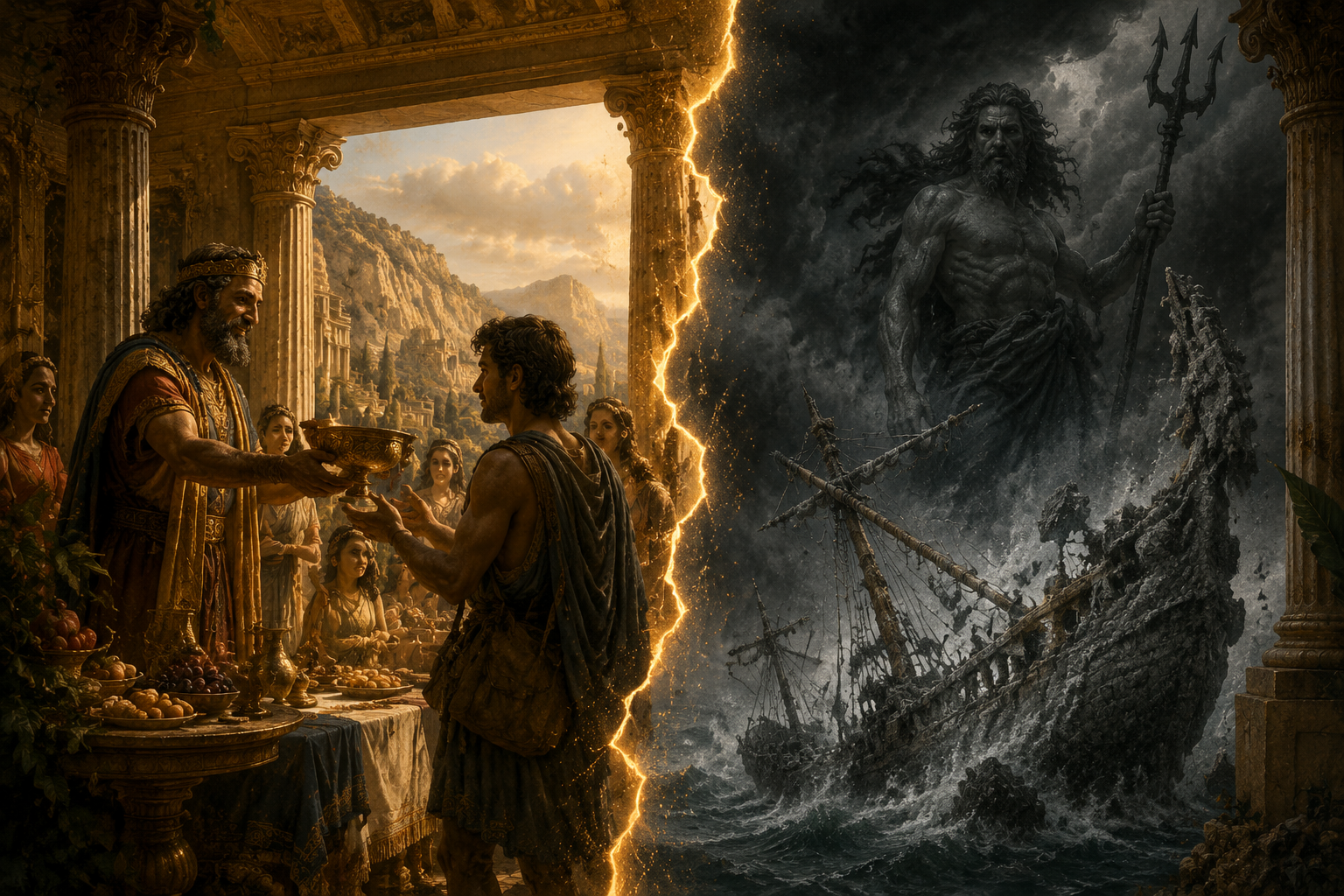
That scene matters because it does not simply add “complexity” in the decorative sense. It puts the poem’s own moral categories under pressure. The Phaeacians act as exemplary hosts; their action enables Odysseus’s rightful nostos; yet divine anger falls on them. Zeus’s Book 1 claim that mortals suffer through their own recklessness does not fully explain this. The Phaeacians are not Polyphemus. They are not the suitors. They are the people who do the right thing and still pay because divine conflict has entered the room.
This is not a reason to declare that The Odyssey has no moral order. It plainly does. The suitors’ abuse of Odysseus’s house matters; Polyphemus’s treatment of guests matters; Penelope’s endurance matters. But the Phaeacians prevent an overconfident claim that the gods simply reward virtue and punish vice. The poem’s theology can uphold norms while also exposing how badly humans can fare when gods defend status, honor, or grievance.
For essay writing, the Phaeacian episode is therefore not a side example. It is a pressure point. It lets you argue that The Odyssey is coherent in structure but not mechanically fair in outcome. The moral universe exists, but it is not a classroom chart where every deed receives a proportionate consequence.
Xenia works like a moral thermometer
Hospitality is the poem’s fastest way of taking a moral temperature. Before a stranger’s identity is known, the host’s character is already being examined. Food, shelter, questions, gifts, restraint, and safe passage are not decorative customs; they are the visible signs of whether a household recognizes limits beyond appetite and power.
| Scene or household | Hospitality pattern | Analytical use |
|---|---|---|
| Nestor and Menelaus receiving Telemachus | Established rulers welcome the young visitor and help him search for news | Shows xenia as a stabilizing aristocratic code |
| The Phaeacians receiving Odysseus | Royal hosts give protection, gifts, and passage home | Shows ideal hospitality caught in divine conflict |
| Eumaeus sheltering the disguised Odysseus | A servant offers care without knowing the guest’s true status | Shows moral worth outside royal display |
| Polyphemus in the cave | The host figure consumes rather than protects his guests | Shows anti-xenia as monstrous lawlessness |
| The suitors in Ithaca | Guests devour the household and refuse reciprocal obligation | Shows xenia turned into occupation |
The positive examples are not identical. Nestor and Menelaus operate within elite networks, receiving Telemachus in Books 3 and 4 as the son of a famous comrade. The Phaeacians receive Odysseus before fully knowing him and then move him across the final threshold toward home. Eumaeus, the swineherd, is the least glamorous and in some ways the most morally clarifying: he shelters the disguised Odysseus in Books 14 through 16 without needing proof that this beggar is worth the trouble.[4][5]
Eumaeus deserves more attention than many student essays give him. He is not a heroic ornament. He keeps faith with a broken household while powerful men eat through it. His hospitality is not backed by abundance, and that is the point. The poem’s care work is often performed by people who do not get the grandest speeches: servants guarding what remains, a wife delaying disaster, a son trying to become useful before he is fully ready.
The negative examples sharpen the same standard. Polyphemus violates xenia in its most grotesque form by eating his guests in Book 9. The suitors violate it more slowly and socially, consuming Odysseus’s household over time, pressing Penelope, and treating another man’s estate as if delay has made it theirs.[4][5]
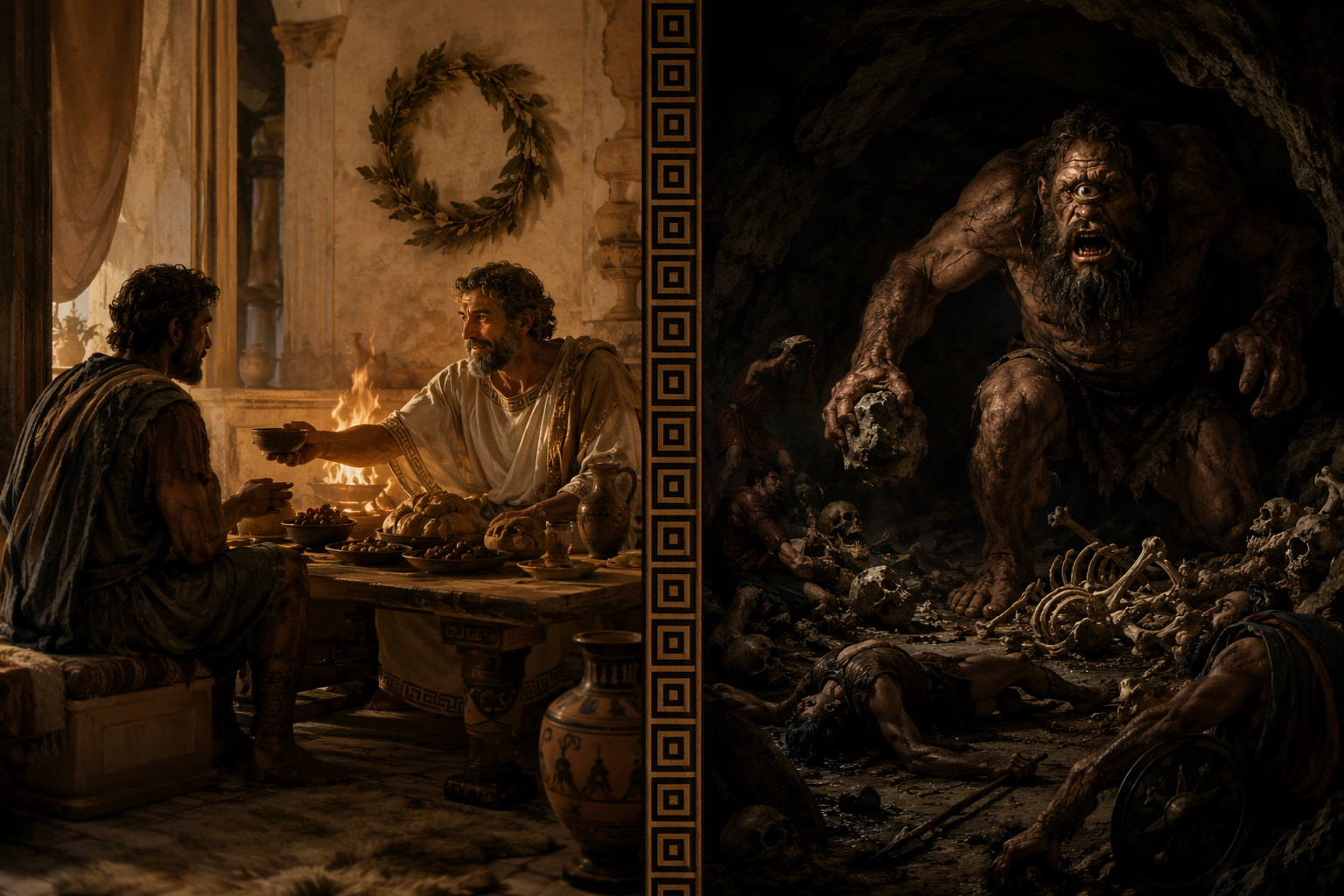
That contrast is useful, but it has limits. If xenia were the poem’s only moral key, the Phaeacians would be safe and Eumaeus would become the real center of reward. Instead, xenia tells us who understands obligation. It does not guarantee that the gods will protect every person who behaves well.
Nostos is restoration, not transportation
Odysseus’s homecoming is not complete when he reaches Ithaca. If anything, the poem makes arrival almost anticlimactic: he comes home asleep, disguised, and unable to announce himself. Nostos has to be rebuilt through recognition, testing, and the recovery of roles. He must become husband, father, and king again, and each role requires someone else’s response.
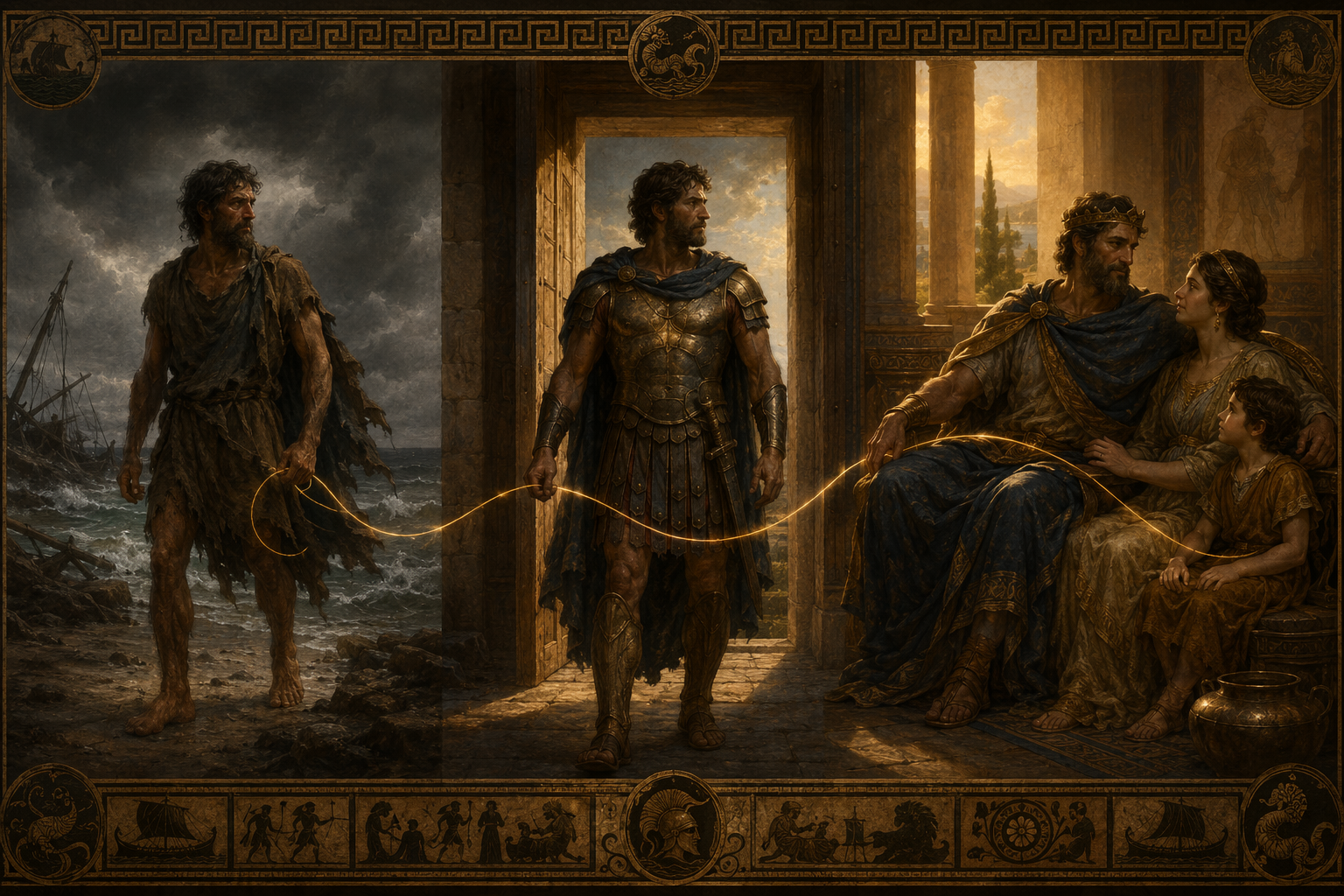
As father, Odysseus must be recognized by Telemachus in Book 16. This scene is not merely sentimental reunion; it changes Telemachus’s position in the household. He is no longer only the young man being instructed by others or humiliated by the suitors. He becomes Odysseus’s ally in the dangerous work of reclaiming Ithaca.[3]
As king, Odysseus must prove that the palace is no longer available for predation. The bow contest and the slaughter of the suitors in Books 21 and 22 are brutal, but structurally they restore public hierarchy: the absent ruler is present, the weapon belongs to him, and the men who treated his house as an open resource discover that delay was not permission.[3][6]
As husband, Odysseus’s restoration depends on Penelope, and the poem is far more interesting when she is not reduced to a reward waiting at the finish line. Her shroud trick, weaving by day and unraveling by night for three years, uses cunning delay against the suitors. That aligns her with Odysseus’s defining intelligence, metis, rather than placing her outside the heroic economy of cleverness.[5][7]
Her final test of the bed matters for the same reason. The olive-tree bed proves more than private memory. It tests whether the man before her is truly the husband whose identity is rooted in their shared house. Penelope does not simply recognize Odysseus; she makes recognition intellectually earned. The homecoming works because she has guarded the meaning of the home while he has been trying to reach it.[3][6]
The poem’s repeated contrast with Agamemnon makes this sharper. Agamemnon’s return from Troy ends in murder by Clytemnestra, while Odysseus’s return succeeds partly because Penelope remains faithful and partly because Odysseus returns cautiously, with disguise and testing rather than open confidence.[3][6]
That comparison can become crude if it turns into “good wife versus bad wife” and stops there. The more useful point is structural: nostos depends on a household surviving absence. Agamemnon’s house does not; Odysseus’s barely does. Penelope’s endurance, Telemachus’s maturation, Eumaeus’s loyalty, and Odysseus’s strategic restraint all have to converge before homecoming becomes real.
Divine justice is real, but not evenly distributed
The Odyssey does not ask readers to ignore justice. The suitors are guilty of sustained violation. Polyphemus is monstrous. Aegisthus, in the moral frame announced by Zeus, is a clear example of a mortal warned against reckless wrongdoing and punished when he ignores that warning.[1]
But the poem’s justice is not a clean system of individual moral accounting. Poseidon’s anger at Odysseus affects the Phaeacians. The suitors die as a group. Amphinomus is especially important here because he is described as blameless in Book 16 and yet is killed alongside the others.[3]
Amphinomus does not overturn the whole moral reading of the slaughter. The suitors as a collective have abused the household, and the poem has spent long enough making that abuse visible. Still, his death prevents the comfortable claim that every punishment lands with perfect proportionality. Collective guilt may explain the scene politically or narratively; it does not erase the ethical discomfort.
That discomfort is part of the poem’s seriousness. Divine justice in The Odyssey is not absent, but it is entangled with divine rivalry, heroic restoration, household survival, and social order. The gods can defend norms. They can also make mortals absorb the consequences of conflicts they did not create.
How to turn this into a stronger essay
A weak thesis usually names a theme and praises it: “The Odyssey shows that hospitality is important.” That is accurate, but it barely has an argument. A stronger thesis makes the theme answerable to another part of the poem: “The Odyssey treats hospitality as a central moral standard, but the punishment of the Phaeacians shows that divine justice does not always protect those who uphold that standard.” Now the essay has something to test.
- If writing about xenia, compare good and bad hosts, but save space for the Phaeacians or Eumaeus; they reveal more than another simple villain example.
- If writing about nostos, do not stop when Odysseus reaches Ithaca; track the restoration of husband, father, and king.
- If writing about Penelope, treat her testing and delay as forms of intelligence, not as passive waiting.
- If writing about divine justice, include at least one uncomfortable case: the Phaeacians, Amphinomus, or the collective killing of the suitors.
- If using adaptation context, such as Study Homer’s Odyssey Through Christopher Nolan’s Film or 10 Ways Nolan’s The Odyssey Diverges, use it to sharpen the poem’s questions rather than replace close reading.
The best essays on The Odyssey do not discard the poem’s moral order. They trust it enough to examine where it bends. Xenia, nostos, and divine justice give the epic its structure, but the Phaeacians, Penelope, Eumaeus, and Amphinomus show what that structure costs when it enters lived human households. The poem is coherent in design and unstable in implication. That is not a problem to solve away; it is where the analysis begins to be worth reading.
References
- SparkNotes Plot Analysis, SparkNotes
- Odyssey, Britannica
- The Odyssey Study Guide, Duke University
- The Odyssey Study Guide, Shmoop
- The Odyssey Themes and Literary Devices, ThoughtCo
- The Odyssey Themes, SparkNotes
- Odysseus, Britannica
Comments
Join the discussion with an anonymous comment.