
Netflix vs. Cable TV in 2026 – Which Saves Students More?
Compare the true costs of Netflix and cable TV in 2026, including hidden fees and student-friendly pricing. Discover why streaming is the better value and how to manage subscriptions smartly.
Updated:
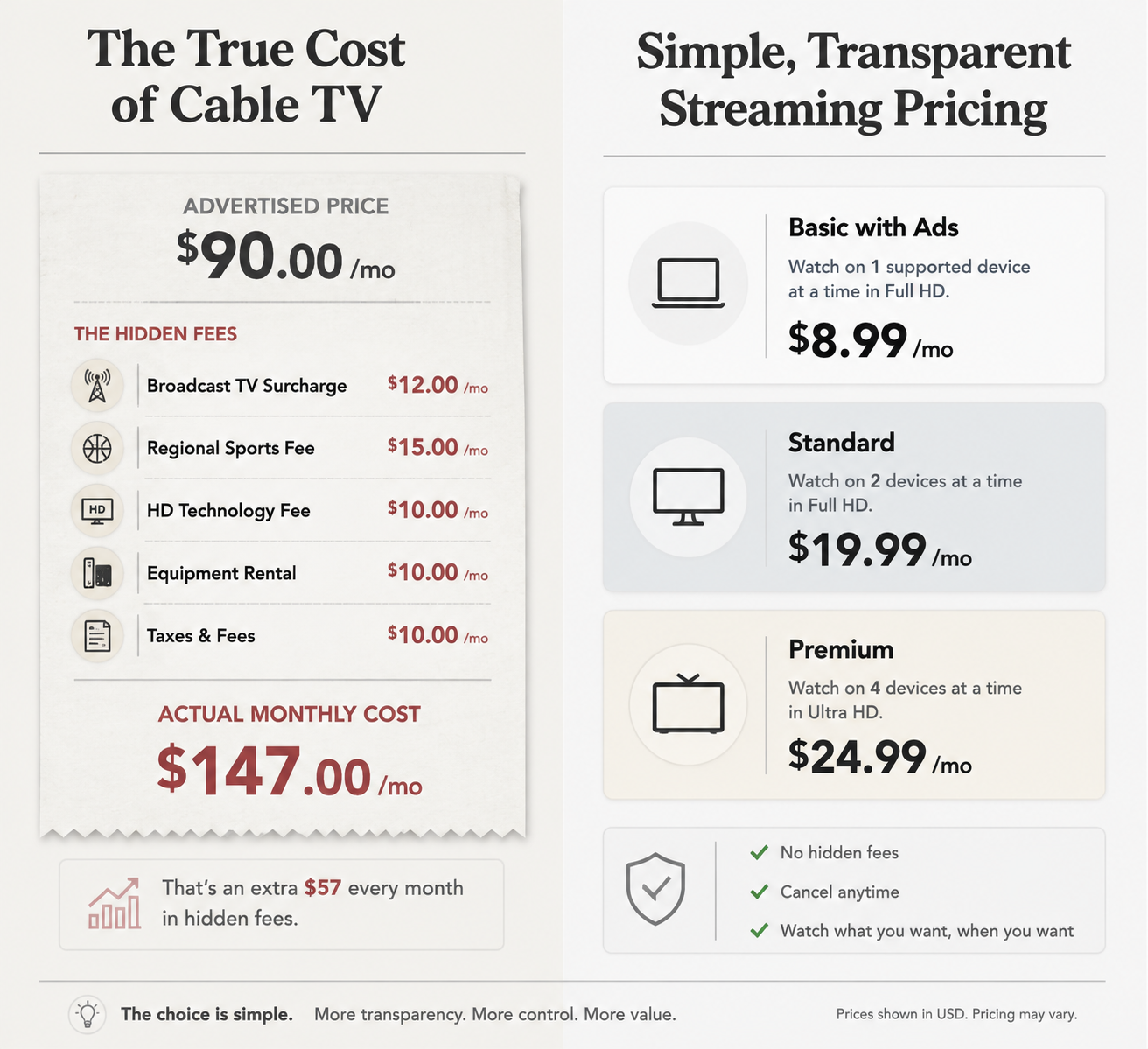
For a student budget, the Netflix vs cable TV comparison in 2026 starts with the bill, not the watchlist. Netflix runs from $8.99 per month with ads to $24.99 per month for Premium 4K, while cable is commonly advertised around $90 to $110 per month and can land closer to $115 to $150 once broadcast surcharges, equipment rental, regional fees, and taxes show up on the bill.[1]
That difference is not small enough to solve with better channel selection. At the low end, Netflix costs less than a campus lunch each month in some cities. At the high end, it still costs less than a single week of groceries for many students. Cable, by contrast, can behave like a second utility bill. CableTV.com’s 2026 survey of 1,000 U.S. adults put the average cable bill at $147 per month and the average household streaming bill at $30 per month.[2]
The Number Students Should Budget Is the Real Bill
Cable pricing is rough on students because the advertised price is rarely the number that matters after the first bill cycle. A student comparing a $99 cable package with a $19.99 Netflix plan may think the gap is about $79 per month. If the real cable bill lands at $130 after fees and equipment, the gap is closer to $110. That is not entertainment trivia; that is a textbook, a transit pass, a lab fee, or part of rent.
The hidden-fee problem also makes cable harder to plan around. Broadcast TV fees and equipment rentals do not feel optional once they are attached to the package. Promotional rates can make the first few months look manageable, then reset when a student is already busy enough to ignore the renewal email. A subscription that quietly jumps during finals week is exactly the kind of budget leak students notice too late.
| Option | 2026 monthly cost to budget around | Student-budget meaning |
|---|---|---|
| Netflix with ads | $8.99 | Lowest paid option; ads are the tradeoff |
| Netflix Standard ad-free | $19.99 | Still far below a typical cable bill |
| Netflix Premium 4K | $24.99 | Useful mainly if the higher quality or extra access is genuinely used |
| Cable TV | $115–$150 after common fees | Large fixed monthly cost before counting other subscriptions |
The table is the practical answer. Netflix wins on price at every tier. Even the Premium plan is far below the true-cost range for cable, and the ad-supported plan leaves enough room for a student to add another service for one month without getting anywhere near a cable bill.
Your Age Group Has Already Made the Default Choice
The cost comparison lines up with actual behavior among young adults. Pew Research Center reported in July 2025 that only 16% of U.S. adults ages 18 to 29 subscribed to cable or satellite TV, while 88% used streaming services.[3] That does not prove every student should subscribe to Netflix, but it does show that cable is no longer the normal baseline for this age group.
This matters because shared habits lower friction. Students are more likely to talk about shows available on streaming platforms, watch on laptops or phones, and cancel or restart services without calling a provider. Cable still has uses for households that want live TV bundles, regional sports, or a familiar channel guide. Those are not usually the reasons a student is trying to protect a monthly budget.
The best student comparison is therefore not “Which service has more channels?” It is “Which bill can I stop, restart, downgrade, or share without creating a financial mess?” Netflix is easier to fit into that kind of month-to-month planning.
Netflix Is Cheaper, but It Is Not Immune to Subscription Creep
The honest pro-Netflix argument has to include the price increases. Netflix’s standard ad-free plan rose from $12.99 in 2020 to $19.99 by March 2026, a 54% increase.[4][5] That is still dramatically cheaper than cable, but it is not nothing. For a student, the danger is not that one Netflix plan becomes cable overnight. The danger is adding Netflix, then another app for one series, then a sports add-on, then a music plan, then forgetting which trial became a paid subscription.
This is where many streaming comparisons get too cheerful. Streaming saves money when it stays flexible. It loses its advantage when a student treats five or six separate services like permanent utilities. The bill may still be lower than cable, but the monthly drag starts to look familiar.
The Student Move Is to Manage Streaming Like a Portfolio
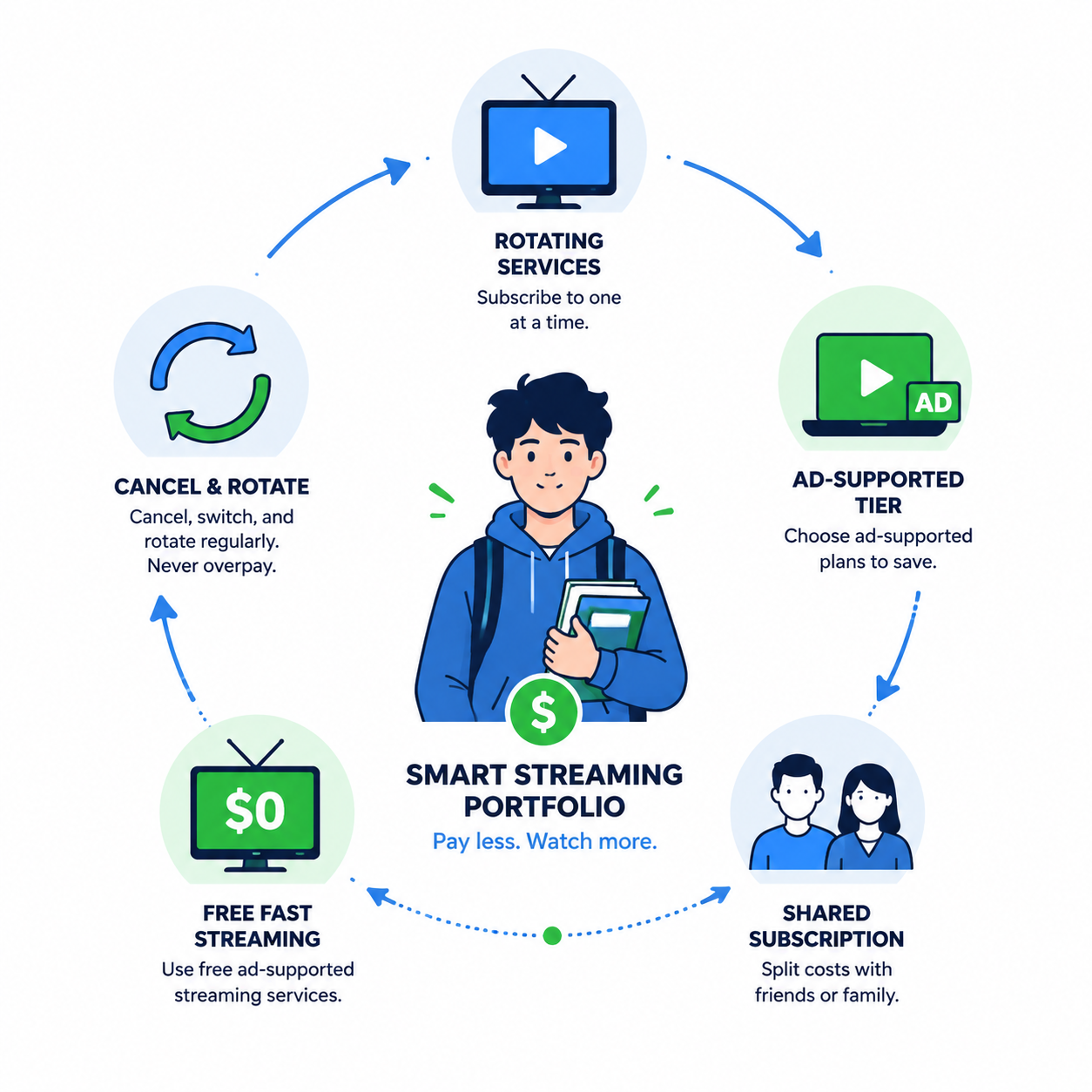
A student does not need a perfect entertainment system. A student needs a setup that survives midterms, rent week, and the months when there is barely time to watch anything. That means choosing streaming deliberately instead of collecting apps.
- Start with the cheapest plan you can tolerate. If ads do not bother you, Netflix at $8.99 is the obvious starting point.
- Rotate services by month. Subscribe for the show, season, or sports window you actually plan to watch, then cancel.
- Share costs only where the service rules allow it. Password-sharing habits are common, but platform enforcement can change the math quickly.
- Use free services as pressure valves. If the paid service is mostly background viewing, a free option may be enough for that month.
- Audit subscriptions before academic crunch periods. If you will be in labs, clinicals, exam prep, or travel for several weeks, cancel before the low-use month starts.
The market is already moving in that direction. Deloitte reported in March 2026 that 68% of streaming subscribers used ad-supported tiers, and Antenna reported that 71% of new subscriber growth came from ad-supported plans in Q2 2025.[6][7] Those figures do not prove ad plans are better for everyone; they show that price-sensitive viewers are increasingly accepting ads to keep the monthly bill lower.
Cost pressure is not hypothetical. CableTV.com reported that 43% of subscribers cancel because of cost.[2] That is the student-budget lesson hiding inside the industry data: cancellation is not failure. It is a normal tool. If a service does not earn its place this month, it can come back later.
Where Free Streaming Fits
Free ad-supported streaming TV, often called FAST, is useful when the alternative is paying for a service out of habit. Tubi announced 100 million monthly active users in May 2025, and Pluto TV has been reported at 80 million monthly active users.[8][1] Those figures come with a caveat: platform counts can reflect company disclosures and may include users beyond U.S. college students. Still, the basic budget point holds. Free options can cover casual viewing while paid subscriptions are reserved for months when they are actually worth it.
Free services will not replace every paid show, and they often mean more ads, older catalogs, or less control over exactly what is available. That is fine. Their job is not to beat Netflix; their job is to stop a bored Thursday night from becoming another recurring charge.
A Simple Monthly Rule
If you are choosing between Netflix and cable TV in 2026, Netflix saves students more money by a wide margin. The only reason to consider cable is if you have a specific live-TV need that is worth budgeting at the real monthly cost, not the advertised one.
For most students, the better rule is this: keep one paid streaming service at a time, choose the lowest tier you can live with, rotate when your viewing changes, and cancel during low-use months. Netflix beats cable decisively, but the biggest savings come from refusing to make any streaming bill permanent.
References
- Streaming vs. Cable Statistics 2026, CableCompare.
- 2026 State of TV Report, CableTV.com.
- 83% of U.S. adults use streaming services, far fewer subscribe to cable or satellite TV, Pew Research Center, July 2025.
- With Netflix at $20, streaming's cable TV tipping point getting closer, CNBC, May 2026.
- Netflix Raises US Prices for Second Time in Less Than Two Years, Variety, 2026.
- Digital Media Trends, Deloitte, March 2026.
- Q2'25 State of Subscriptions Report, Antenna.
- Tubi Surpasses 100 Million Monthly Active Users, Fox Corporation, May 2025.
Comments
Join the discussion with an anonymous comment.