
A Data-Driven Framework for Bird Strike Case Study Analysis
Aviation safety students can use this five-dimensional framework to systematically analyze bird strike accidents, turning FAA database statistics into actionable insights for case studies and assignments.
Updated:
A useful bird strike aviation safety case study does not begin with the most dramatic photograph. It begins with exposure. The FAA National Wildlife Strike Database recorded 313,716 strikes from 1990 through 2024, including 22,372 in 2024 alone; about 7% caused damage, 62% occurred in daytime, 54% occurred from July through October, and 71% of commercial strikes occurred at or below 500 ft AGL, according to a 2025 summary of the FAA serial report.[1] Those numbers are not decoration. They tell a student what must be explained before any accident narrative is allowed to take over.
The first trap is treating frequency and severity as the same thing. They are not. Waterfowl were only the fourth most frequently struck bird category in FAA data summarized through 2021, yet they caused about $300 million in damage, making them the costliest bird group in that period.[1] Above 500 ft AGL, strikes account for 50% of all damaging strikes for general aviation aircraft while representing only 25% of total strikes, according to FAA material summarized by SKYbrary.[2] A high-count hazard and a high-consequence hazard can point in different directions.
That is why a case study needs a framework. A narrative can tell the reader what happened. A framework tells the reader what evidence belongs in the analysis, what remains unknown, and whether the conclusion would still stand if another reader checked it line by line.
Start With the Statistical Frame, Not the Accident Ending
The FAA figures above are best used as a calibration tool. They do not prove why one accident happened. They do, however, warn against lazy emphasis. If a strike occurred in daylight, that is not automatically unusual. If it occurred during July through October, that fits a high-reporting seasonal window. If it occurred below 500 ft AGL during departure or arrival, that places it in the altitude band where commercial exposure is concentrated.[1]
The same frame also prevents understatement. A strike outside the densest frequency band may deserve more attention if damage severity is elevated. For general aviation, damaging strikes above 500 ft AGL are disproportionately important relative to their total count.[2] A good case study therefore asks two different questions: how often does this condition appear, and how much harm does it produce when it appears?
Cost figures need the same discipline. One commonly cited estimate is about $400 million per year in direct damage to U.S. civil aviation; broader global estimates of $900 million to $1.2 billion include indirect costs such as aircraft downtime and schedule disruption.[3] Those are not interchangeable numbers. If a paper cites the larger figure, it must say that the estimate includes more than physical repair costs.
The Five-Dimensional Framework
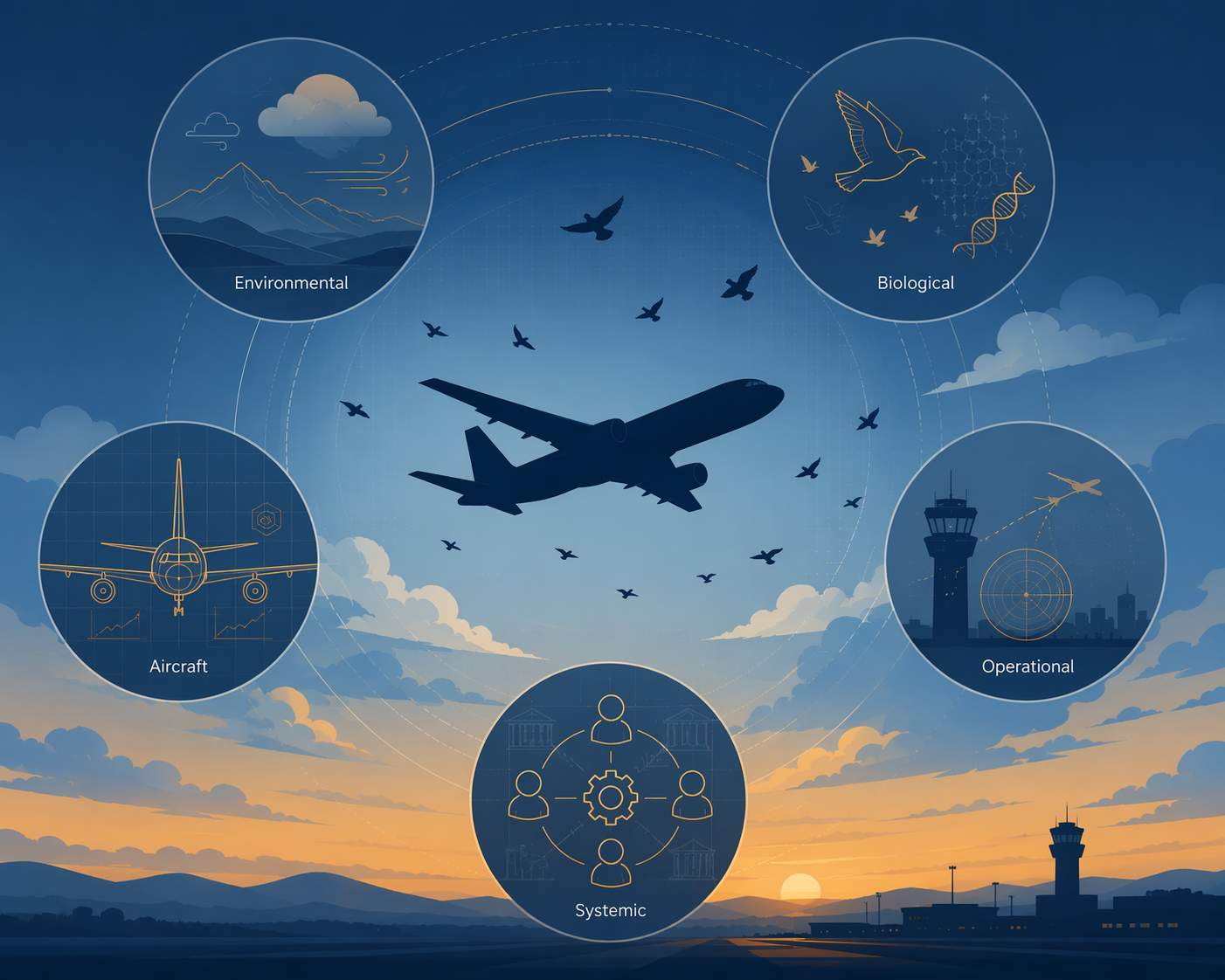
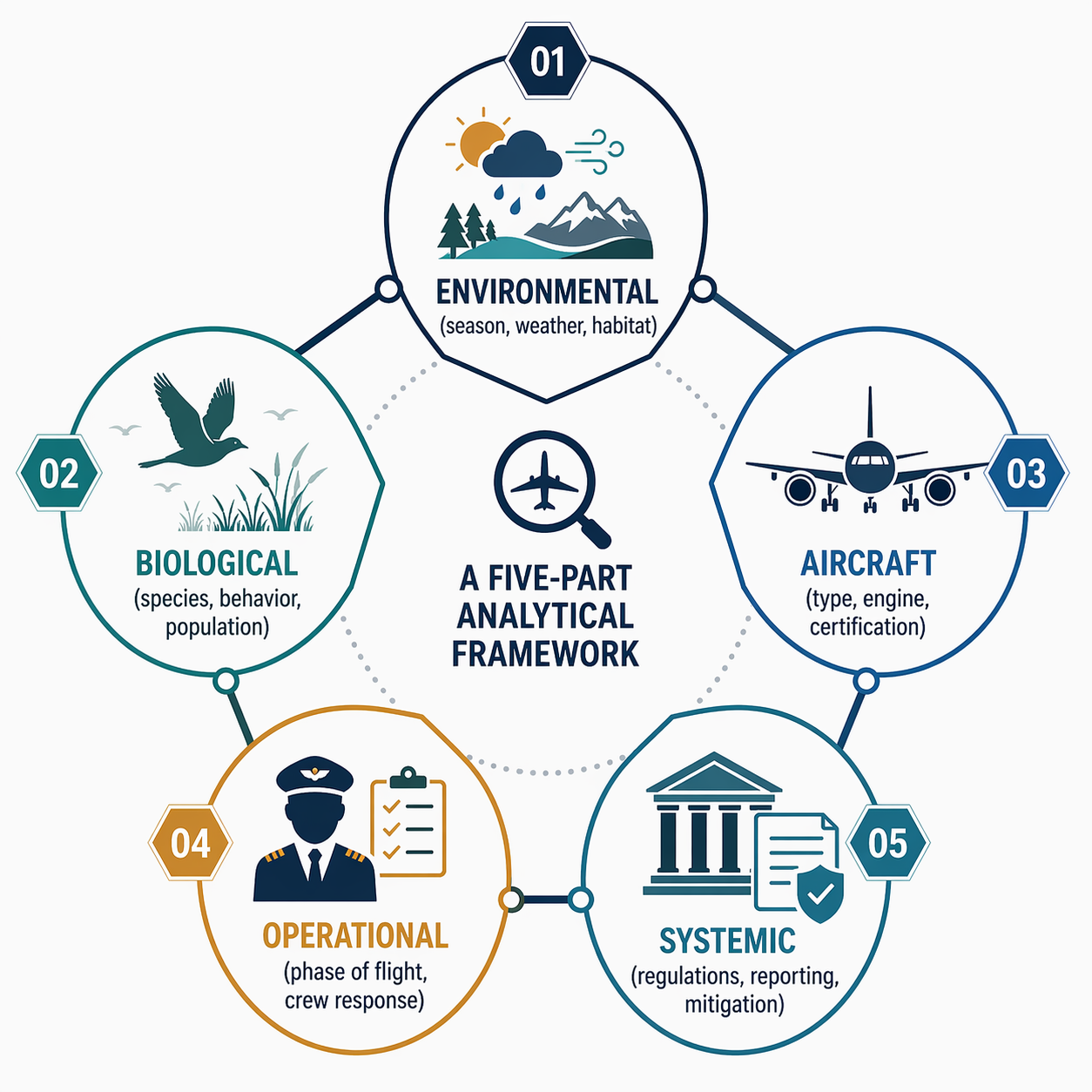
The framework has five dimensions: Environmental, Biological, Aircraft, Operational, and Systemic. These are not five boxes to fill for appearance. They are five lines of questioning. If one line lacks evidence, the case study should say so rather than smuggle in a convenient assumption.
| Dimension | What It Asks | Evidence That Belongs There |
|---|---|---|
| Environmental | Where and when did the strike exposure arise? | Season, time of day, altitude, airport habitat, nearby water or food sources, weather, migration window |
| Biological | What animal hazard was involved, and why did it matter? | Species or group, flocking behavior, body mass, flight pattern, local population, identification certainty |
| Aircraft | How did the aircraft design and configuration receive the impact? | Aircraft type, engine placement, ingestion path, airframe impact point, certification assumptions, damage tolerance |
| Operational | What was the flight doing, and what decisions followed? | Phase of flight, altitude, speed, crew workload, available landing options, checklist use, emergency response |
| Systemic | What conditions outside the cockpit shaped the event? | Wildlife management, reporting quality, airport mitigation, certification rules, regulator action, emergency services |
Environmental: Put the Strike in Its Exposure Window
Environmental analysis is where a student should resist the urge to write “birds were present” and move on. The useful question is narrower: did the timing and location increase exposure in a way that is consistent with known strike patterns?
For commercial operations, the FAA pattern at or below 500 ft AGL matters because it places many strikes near takeoff and landing, when crews have less time and less altitude to trade for troubleshooting.[1] Season and daylight matter because they help distinguish an ordinary exposure condition from a condition that should have been unusual enough to trigger additional attention. If the case record does not identify local habitat or attractants, the analysis should not invent them. It can say that the environmental evidence is incomplete and then explain what data would be needed.
Biological: Species Is Not a Label; It Is a Damage Variable
The biological dimension asks what struck the aircraft and what characteristics made that animal hazardous. A sparrow, a gull, a goose, and a deer do not belong in the same analytical bucket simply because all are wildlife.
The waterfowl example is the cleanest warning. Waterfowl were not the most frequently struck bird group in the FAA data summarized by General Aviation News, but they were the costliest.[1] That tells the student to examine body mass, flocking, and engine-ingestion potential, not merely the strike count. Terrestrial mammals show the same severity problem in a different form: FAA data cited in the research brief reports that deer strikes caused damage 84% of the time, compared with about 6% for birds, with $45.5 million in costs and 24 aircraft destroyed from 1990 through 2014.[1]
Species identification also has to be handled honestly. Confirmed remains, DNA analysis, airport wildlife records, or official investigation findings carry more weight than witness impressions. If a case only supports “large birds” or “duck strike,” that is the wording the paper should use until better evidence appears.
Aircraft: Analyze the Impact Path and the Certification Assumption
Aircraft analysis is not a generic paragraph about the model. It asks how the aircraft encountered the animal hazard: nose, windshield, wing leading edge, landing gear, or engine. Engine ingestion has a different consequence chain from a radome strike. Multiple ingestion has a different consequence chain from a single-bird test condition.
Certification belongs here, but only with care. Certification standards can show what an engine or structure was required to tolerate; they do not prove that a specific accident aircraft failed to meet its standard. SKYbrary’s certification discussion notes the role of bird ingestion requirements and the limits of those requirements for complex real-world encounters.[4] A case study should therefore distinguish between “the aircraft exceeded the design or certification assumption” and “the aircraft was deficient.” Those are not the same claim.
Operational: Time, Altitude, and Crew Options
The operational dimension starts at the phase of flight. Initial climb, approach, cruise, and landing rollout create different margins. The same biological event can be survivable or catastrophic depending on altitude, aircraft energy state, runway availability, and how quickly the crew can diagnose the damage.
This is where many student papers become too confident. If the record does not show exactly what the crew saw, heard, or had displayed on the instruments, do not write as if sitting in the cockpit. Use the confirmed timeline. Identify the decisions that were available. Separate actions taken from options later visible to investigators with more time, more data, and no aircraft to fly.
Systemic: The Parts of the Accident That Were Built Before the Flight
Systemic analysis covers the conditions that shaped exposure and response before the accident aircraft moved. Wildlife management programs, airport habitat control, strike reporting, emergency service readiness, certification criteria, and regulator funding all sit here.
A systemic factor is not automatically a cause. A poorly documented wildlife program may limit what investigators can conclude without proving that the program caused the strike. A certification gap may explain why a rare encounter exceeded assumptions without proving negligence. The standard is evidence: show the pathway from system condition to exposure, vulnerability, or consequence.
How to Turn Raw Case Facts Into a Defensible Analysis
For an assignment or professional portfolio, the framework works best as a sequence of disciplined passes through the evidence rather than as five equal essays. Some dimensions will carry more weight in one accident than another.
- Build a verified event timeline: phase of flight, altitude, strike indication, aircraft response, crew actions, landing or crash sequence.
- Classify each fact under one or more framework dimensions without forcing every fact to support a conclusion.
- Compare the case conditions with database patterns: season, daylight, altitude, aircraft category, and damage severity.
- Identify causal links only where the evidence supports them; mark the rest as contributing conditions, uncertainties, or unresolved questions.
- Separate safety lessons by responsible level: crew procedure, airport wildlife management, aircraft design, certification, reporting, or regulator action.
The point is not to sound cautious for its own sake. The point is to make the paper harder to break. A skeptical reader should be able to see why a factor appears in the analysis, what source supports it, and whether it explains exposure, damage, response, or system weakness.
Worked Example: US Airways Flight 1549

US Airways Flight 1549 is often told as a survival story. For a safety case study, that is only the surface. The analytical value is that the event touches all five dimensions without needing speculation.
The aircraft struck Canada geese at 2,818 ft during initial climb, suffered dual-engine ingestion, and completed a successful water landing with 0 fatalities.[2] The altitude matters because it was above the densest commercial strike band cited in FAA summaries, yet still close enough to departure that the crew had very little time to convert diagnosis into a landing plan.[1][2]
| Framework Dimension | Flight 1549 Application |
|---|---|
| Environmental | Initial climb from a major urban airport environment; limited altitude and time after departure. |
| Biological | Canada geese, a waterfowl hazard group associated with high damage cost in FAA data. |
| Aircraft | Airbus A320 experienced dual-engine ingestion rather than an isolated impact to a noncritical surface. |
| Operational | Crew had to evaluate thrust loss, reject unsuitable return options, and execute a forced water landing. |
| Systemic | The event exposed limits in certification assumptions and helped drive greater wildlife mitigation investment. |
The aircraft dimension is where the case stops being a generic “bird strike” and becomes a certification question. The event revealed that 14 CFR Part 33 bird-ingestion standards required single-bird ingestion capability but did not provide for simultaneous dual-engine ingestion of the kind encountered in this accident.[4] That does not mean certification was meaningless. It means the real encounter exceeded a key assumption.
The systemic dimension continues after the landing. Flight Safety Foundation material links the post-2009 period with more than $400 million in FAA Airport Improvement Program funds allocated for wildlife projects.[5] A student should not overclaim that one accident alone caused every later mitigation decision. The defensible statement is narrower: the accident became a major catalyst in a wider policy and funding response to wildlife strike risk.
The successful outcome also should not be mislabeled as low severity. A no-fatality result can still involve a high-severity failure mode. In this case, dual-engine thrust loss at low altitude created a narrow survival envelope; the outcome reflects crew performance and available ditching conditions, not a harmless strike.
Worked Example: Jeju Air Flight 2216
Jeju Air Flight 2216 requires a different tone because the investigation remains ongoing as of Q3 2026. The case can be analyzed, but it should not be written as if all causal sequences are settled.
The Boeing 737-800 accident in December 2024 involved a duck strike during approach, dual-engine failure, and 179 fatalities; a preliminary report confirmed bird strikes, while the engine shutdown sequence remains under investigation.[6] That is enough to begin a framework analysis, but not enough to close one.
| Framework Dimension | Preliminary Jeju Air 2216 Analysis |
|---|---|
| Environmental | Approach phase placed the aircraft in a low-altitude, high-workload segment where time and energy margins are constrained. |
| Biological | The preliminary identification is a duck strike; further confidence depends on final investigative evidence. |
| Aircraft | Reported dual-engine failure makes engine ingestion and damage sequencing central, but the exact shutdown sequence remains unresolved. |
| Operational | Approach configuration and crew response require timeline-based analysis, not assumption-based reconstruction. |
| Systemic | Airport wildlife management, reporting history, and emergency response should be examined once final evidence is available. |
The temptation in a catastrophic case is to rush toward a single explanation. The better method is slower. Environmental and operational factors can already be framed: approach, low altitude, high workload, limited time. Biological analysis can use the preliminary duck-strike finding but should preserve the level of certainty reported by investigators. Aircraft analysis must wait for a settled account of engine damage and shutdown sequencing before assigning causal weight.
If later reporting suggests a more detailed engine sequence, it can be discussed as preliminary and subject to change. It should not be treated as the final accident cause until the final report supports that conclusion.
What a Strong Student Case Study Should Sound Like
A strong case study does not hide uncertainty. It manages it. It says which database pattern the event fits, which pattern it does not fit, and why that matters. It distinguishes a common strike condition from a severe damage pathway. It avoids using one famous accident as proof of general frequency.
The wording should stay close to the evidence. “The strike occurred during a high-exposure phase of flight” is usually safer than “the airport failed to control birds” unless the record actually supports the airport-management claim. “The aircraft encountered a scenario outside the cited certification assumption” is cleaner than “the engine design was defective” unless the investigation reaches that conclusion.
The same discipline applies to recommendations. If the analysis identifies a species or habitat attractant, recommendations may point toward wildlife management. If it identifies an engine-ingestion vulnerability, recommendations may point toward design assumptions or certification review. If it identifies a reporting gap, recommendations may point toward data quality. Recommendations should follow the causal chain, not the student’s favorite solution.
Sourcing Caveats Students Should State Clearly
Several FAA statistics used in this article are attributed to the FAA 1990–2024 serial report but are cited here through a General Aviation News summary rather than direct extraction from the FAA PDF.[1] That is acceptable if disclosed; it is not acceptable if disguised as direct primary-source analysis.
Students should also keep cost estimates in their proper lanes. Direct U.S. civil aviation damage estimates and broader global economic estimates measure different things.[3] Combining them without explaining methodology makes the number look larger while making the analysis weaker.
Finally, preliminary accident reports are not final reports. Jeju Air Flight 2216 can support a careful preliminary analysis of exposure, bird involvement, and consequence severity. It cannot yet support a settled account of every causal sequence.[6]
Used properly, the five-dimensional framework gives aviation safety students a repeatable way to write stronger bird strike case studies. It turns an accident from a story about catastrophe into a structured analysis of exposure, aircraft vulnerability, crew response, and systemic weakness.
References
- Wildlife strikes up 14% in last year, General Aviation News, 2025-08-22.
- Bird Strike, SKYbrary.
- PMC / Heliyon 2023 academic study, Heliyon, 2023.
- Aircraft Certification for Bird Strike Risk, SKYbrary.
- Bird Strike Mitigation Beyond the Airport, Flight Safety Foundation.
- Bird strikes confirmed in Jeju Air crash preliminary report, Avitrader, 2025-01-27.
Comments
Join the discussion with an anonymous comment.