
How Was the 25th Amendment Created and When Has It Been Used?
Trace the historical crises that led to the 25th Amendment — from John Tyler's disputed succession to JFK's assassination. Then understand each of its four sections and every real-world invocation from Gerald Ford to Kamala Harris.
Updated:
The easiest way to misunderstand the 25th Amendment is to start with the most dramatic part. Section 4 gets the headlines because it imagines a president who cannot or will not say, “I am unable.” But the amendment was not written as a political eject button. It was written because, for more than a century, the United States kept discovering that a modern presidency could be interrupted in several different ways, and the Constitution did not say enough about what the next officer was supposed to do.
That is the useful study frame for the 25th Amendment: first the failures, then the machinery. A president dies. A president lingers near death. A president is hidden from public view. A vice presidency sits empty. A president needs anesthesia for a few hours. Each problem asks the same calm but urgent civics question: who has authority right now, and how does everyone else know?
The amendment began as a string of unfinished answers
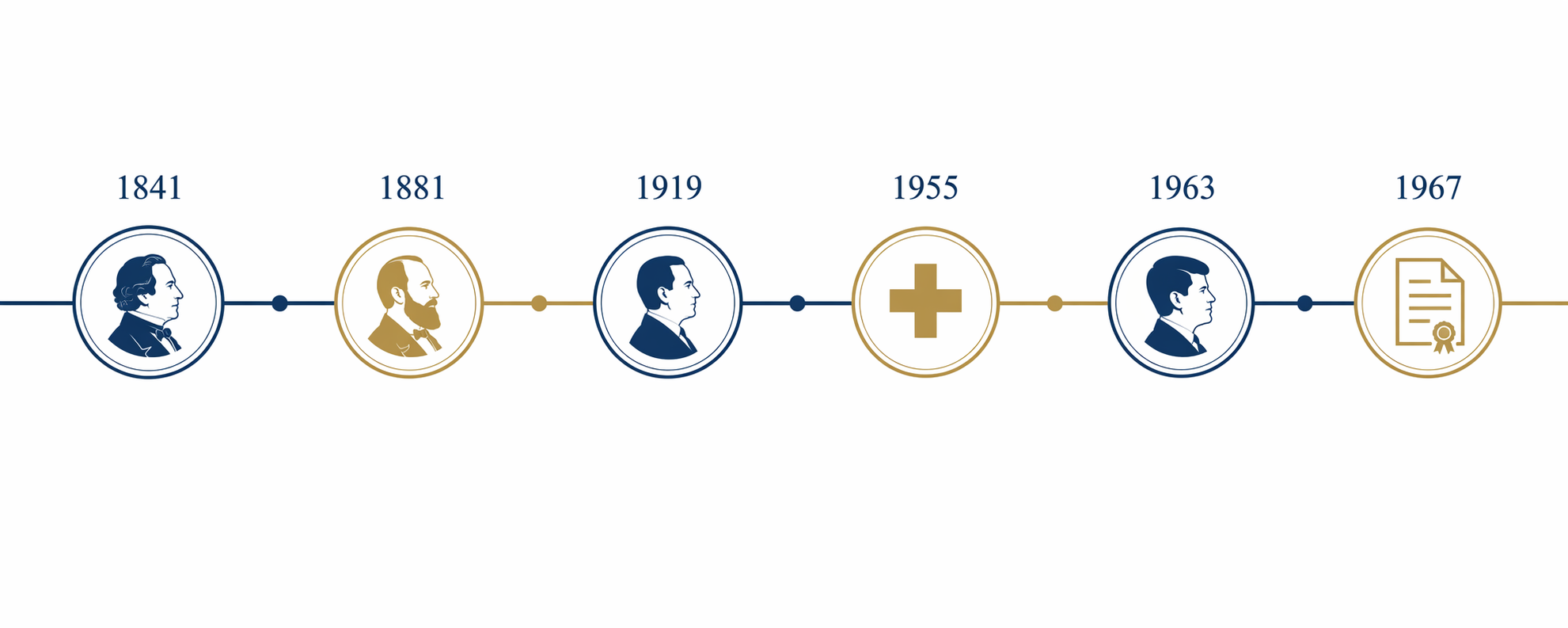
The first answer came from John Tyler in 1841, and it was blunt in the way constitutional practice sometimes has to be. President William Henry Harrison died after only about a month in office. The Constitution said presidential powers and duties would “devolve” on the vice president, but it did not clearly say whether the vice president became president or merely acted as president. Tyler insisted he was the President of the United States, took the oath, moved into the office, and rejected letters addressed to him as “Acting President.” That practice became known as the Tyler Precedent, and it supplied the core answer later written into Section 1: when the president is removed, dies, or resigns, the vice president becomes president.[1]
Tyler solved one problem by force of practice. He did not solve the harder problem of temporary inability. If the president was alive but unable to govern, would the vice president’s assumption of power be temporary or permanent? The distinction sounds technical until the government has to operate through it.
In 1881, President James Garfield was shot and remained incapacitated for 79 days before he died. During that period, Vice President Chester Arthur did not act as president. The country had no settled way to transfer authority temporarily, and any move by Arthur risked looking like a permanent displacement of a wounded president. The result was not elegant restraint; it was paralysis created by uncertainty.[1]
The Woodrow Wilson case was worse because the uncertainty was not only medical. Wilson suffered a stroke in 1919 and, for more than six months, did not meet with his Cabinet while his wife Edith Wilson controlled access to him. The constitutional silence let informal gatekeepers become the working filter between the elected president and the rest of the executive branch.[1]
Dwight Eisenhower’s presidency showed a more careful but still legally incomplete approach. After Eisenhower’s 1955 heart attack, he and Vice President Richard Nixon developed an informal agreement for handling temporary presidential disability. That agreement mattered because it treated inability as a practical problem that could be planned for. It also had no constitutional force. It depended on cooperation, good faith, and the personalities of the people involved.[1]
Then came John F. Kennedy’s assassination in 1963. Kennedy’s death made the succession question immediate, but the broader urgency came from the condition of the whole line of succession. Lyndon B. Johnson had a known heart condition, Speaker of the House John McCormack was 71, and Senate president pro tempore Carl Hayden was 86. The country had just watched a president killed, and the next constitutional arrangements did not look reassuringly sturdy.[2]
Congress responded by turning scattered precedent into constitutional procedure. The amendment was proposed on July 6, 1965, with Sen. Birch Bayh and Rep. Emanuel Celler playing leading roles in the congressional effort. It was ratified on February 10, 1967; Nebraska was the first state to ratify, and Minnesota and Nevada became the 37th and 38th states needed for adoption. President Lyndon B. Johnson certified the amendment.[3]
The four sections answer four different continuity problems
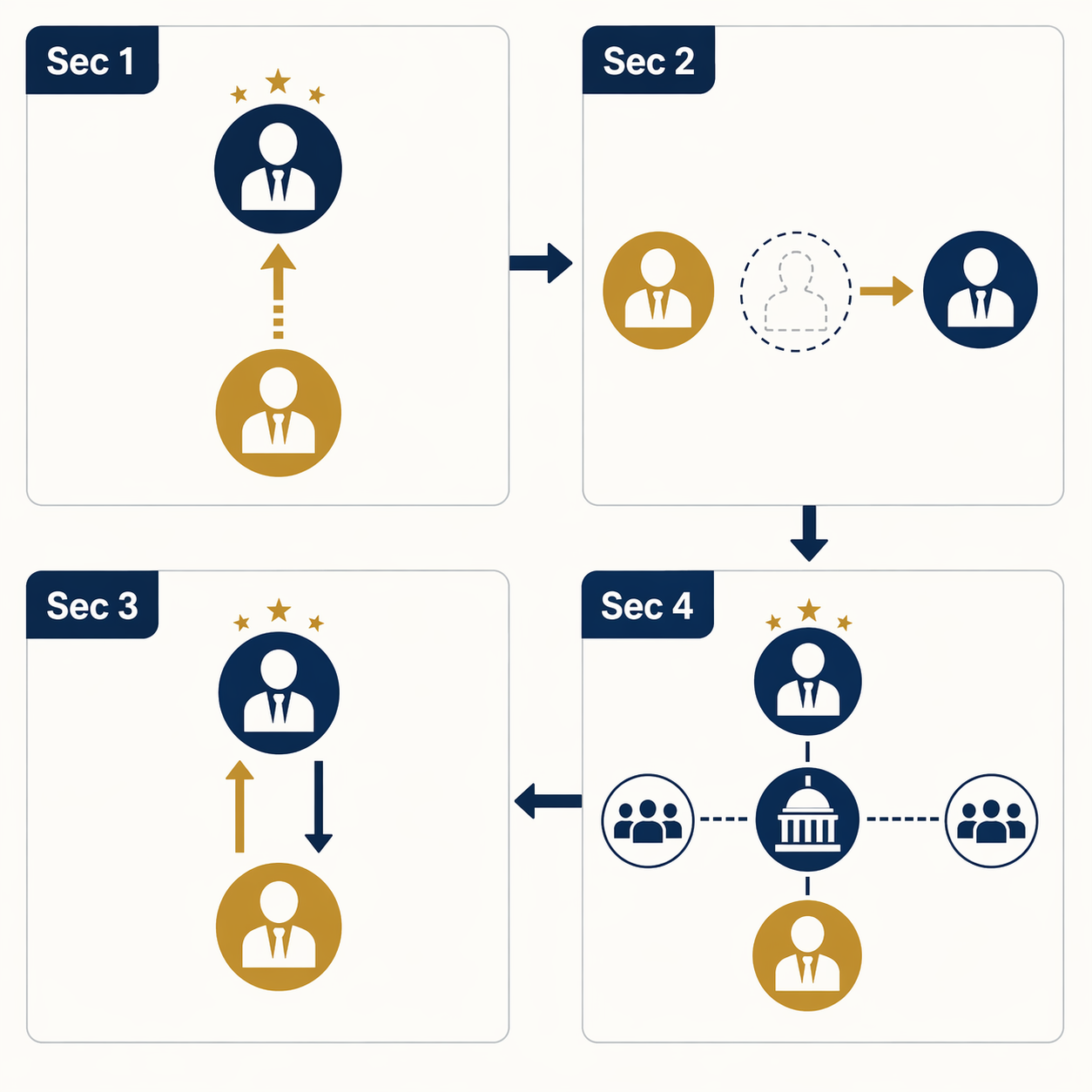
Once the history is visible, the four sections stop looking like a random legal list. They match four distinct situations: a permanent presidential vacancy, a vacant vice presidency, a voluntary temporary transfer, and an involuntary temporary transfer.
| Section | Problem it answers | Basic rule | Real-world status |
|---|---|---|---|
| Section 1 | The presidency becomes permanently vacant | The vice president becomes president | Tested when Gerald Ford became president after Richard Nixon resigned |
| Section 2 | The vice presidency becomes vacant | The president nominates a vice president, confirmed by both houses of Congress | Used for Gerald Ford in 1973 and Nelson Rockefeller in 1974 |
| Section 3 | The president voluntarily declares temporary inability | The vice president becomes acting president until the president declares the ability to resume power | Used in 1985, 2002, 2007, and 2021 |
| Section 4 | The president is unable but does not voluntarily transfer power | The vice president and principal officers, with possible congressional review, can transfer power temporarily | Never fully invoked |
Section 1: the Tyler answer becomes constitutional text
Section 1 is short because Tyler had already supplied the working answer in 1841. If the president is removed from office, dies, or resigns, the vice president becomes president. Not acting president. President.
The first major test came in 1974, when Richard Nixon resigned and Gerald Ford became president. That transition mattered not because it was confusing, but because it was not. The amendment gave the country a settled rule at the exact moment legitimacy mattered most.[4]
Section 2: the empty vice presidency gets a repair mechanism
Before the 25th Amendment, a vice-presidential vacancy usually stayed vacant until the next election. That was not a small gap. If the vice presidency is the office that stabilizes presidential succession, leaving it empty weakens the whole chain.
Section 2 supplies the repair mechanism. When the vice presidency is vacant, the president nominates a new vice president, and that nominee takes office after confirmation by a majority vote in both the House and the Senate. The rule is simple, but the confirmation requirement is important: the president does not refill the succession line alone.[4]
The section was used twice almost immediately. In 1973, after Vice President Spiro Agnew resigned, Nixon nominated Gerald Ford, who was confirmed and became vice president. In 1974, after Ford became president following Nixon’s resignation, Ford nominated Nelson Rockefeller, who was confirmed and became vice president.[4]
Section 3 is the amendment’s ordinary temporary-transfer tool
Section 3 handles the situation Eisenhower and Nixon had tried to manage informally: the president knows a temporary inability is coming or has arrived, and voluntarily transfers power. The president sends a written declaration to the speaker of the House and the president pro tempore of the Senate. The vice president then becomes acting president. When the president sends another written declaration saying the inability has ended, the president resumes the powers and duties of the office.[5]
This is the part students should not overcomplicate. Section 3 does not remove the president. It does not create a new president. It creates a temporary acting president while the elected president is unable to discharge the office.
The first use came in 1985, when Ronald Reagan transferred power to Vice President George H. W. Bush for about eight hours while Reagan underwent colon cancer surgery. The nuance is exam-worthy: Reagan’s letter said he was “mindful of” Section 3 and did not want to set a binding precedent, which created some ambiguity about whether he had formally invoked it. Later interpretations, including a Miller Center commission account and Reagan’s own memoir, treated the episode as a Section 3 invocation.[5]
George W. Bush used Section 3 twice, both times for colonoscopies requiring sedation. In 2002, Vice President Dick Cheney served as acting president for about two hours. In 2007, Cheney again served as acting president for about two hours.[6]
Joe Biden used Section 3 in 2021 during a colonoscopy, transferring power to Vice President Kamala Harris for about 85 minutes. That made Harris the first woman to hold U.S. presidential power, though only as acting president for the temporary period covered by the written declarations.[6]
| Year | President | Acting president | Reason | Approximate duration |
|---|---|---|---|---|
| 1985 | Ronald Reagan | George H. W. Bush | Colon cancer surgery | About 8 hours |
| 2002 | George W. Bush | Dick Cheney | Colonoscopy | About 2 hours |
| 2007 | George W. Bush | Dick Cheney | Colonoscopy | About 2 hours |
| 2021 | Joe Biden | Kamala Harris | Colonoscopy | About 85 minutes |
Section 4 was built to be hard to use
Section 4 is the part people reach for in political emergencies, but its design resists casual use. It applies when the president is unable to discharge the powers and duties of the office and does not voluntarily say so. The vice president and a majority of the principal officers of the executive departments send a written declaration to the speaker of the House and the president pro tempore of the Senate. At that point, the vice president immediately becomes acting president.[7]
That is only the first gate. If the president then sends a written declaration saying no inability exists, the president can resume power unless the vice president and a majority of the principal officers send a second declaration within the constitutional time window. Congress then has to decide the dispute. If Congress is not already in session, it must assemble within 48 hours. It then has 21 days to vote. Keeping the vice president as acting president requires a two-thirds vote of both houses. If that supermajority is not reached, the president resumes the powers and duties of the office.[7]
Two features matter. First, the vice president cannot act alone. Second, Congress cannot keep the president displaced by a bare majority. Section 4 is available, but it is deliberately surrounded by institutional agreement, written declarations, deadlines, and supermajority requirements.
Brian C. Kalt’s analysis in National Affairs emphasizes why this matters: “inability” was left undefined, and the section’s high bar was not an accident. The amendment’s designers were trying to address real incapacity without creating a convenient rival path for ordinary political removal.[7]
The near-misses show the threshold at work
Section 4 has never been fully invoked. That absence is not a blank space in the story; it is evidence of the section’s design. The near-misses are useful because they show the difference between alarm, discussion, preparation, and actual constitutional action.
After Reagan was shot in 1981, Section 4 papers were drafted but never signed. Reagan underwent emergency treatment, and Vice President George H. W. Bush did not become acting president under Section 4. A surgeon later said he had erred and should have declared presidential disability, which underlines the problem Section 4 was meant to solve: during a crisis, the medical and constitutional clocks do not always move at the same speed.[7]
After the January 6, 2021 attack on the Capitol, the House passed a non-binding resolution by a 223-205 vote urging Vice President Mike Pence to invoke Section 4. Pence refused. That episode was constitutionally significant as pressure and debate, not as an invocation. The written declaration required by Section 4 was not sent.[6]
As of July 18, 2026, discussion of Section 4 in connection with the Iran war should be treated as developing current-events context, not settled constitutional history. More than 50 House Democrats called for invocation, but a call for invocation is not the same thing as the vice president and a majority of principal executive officers sending the required written declaration. For study purposes, that distinction is the point.
How to apply the amendment in an exam answer
A strong answer does not begin with “the 25th Amendment removes a president.” That is too broad and, for most sections, wrong. Start by identifying the kind of vacancy or inability.
- If the president has died, resigned, or been removed, use Section 1: the vice president becomes president.
- If the vice presidency is empty, use Section 2: the president nominates a replacement, and both houses of Congress confirm.
- If the president voluntarily declares a temporary inability, use Section 3: the vice president becomes acting president until the president declares the ability to return.
- If the president does not voluntarily transfer power, use Section 4 only if the required officers make the written declaration and, if disputed, Congress satisfies the amendment’s supermajority process.
The history helps keep those categories straight. Tyler explains why Section 1 says the vice president becomes president. Agnew, Ford, and Rockefeller explain why Section 2 exists. Eisenhower’s informal arrangement points toward Section 3. Garfield and Wilson explain why voluntary cooperation is not always enough. Kennedy’s assassination explains why Congress and the states finally converted those lessons into constitutional text.
That is the clean synthesis: the 25th Amendment grew from repeated historical failures, solved succession and vice-presidential vacancy problems through Sections 1 and 2, created a voluntary temporary-transfer process used four times under Section 3, and left Section 4 unused because its design requires a grave and institutionally supported judgment.
References
- 25th Amendment, HISTORY.com, https://www.history.com/articles/25th-amendment
- How JFK’s assassination led to a constitutional amendment, National Constitution Center, https://constitutioncenter.org/blog/how-jfks-assassination-led-to-a-constitutional-amendment-2
- Twenty-Fifth Amendment Timeline, Annenberg Classroom, https://www.annenbergclassroom.org/resource/our-constitution/twenty-fifth-amendment-timeline/
- Establishment and First Uses of the 25th Amendment, Gerald R. Ford Library, https://www.fordlibrarymuseum.gov/digital-research-room/topic-guides/establishment-and-first-uses-25th-amendment
- The 25th Amendment, Section 3 and July 13, 1985, Reagan Library Education Blog, July 24, 2017, https://reagan.blogs.archives.gov/2017/07/24/the-25th-amendment-section-3-and-july-13-1985/
- Twenty-fifth Amendment to the United States Constitution, Wikipedia, https://en.wikipedia.org/wiki/Twenty-fifth_Amendment_to_the_United_States_Constitution
- The Limits of the 25th Amendment, National Affairs, https://www.nationalaffairs.com/publications/detail/the-limits-of-the-25th-amendment
Comments
Join the discussion with an anonymous comment.