

How Altitude Affects Athletic Performance
Altitude reduces endurance through lower oxygen partial pressure, with VO₂max dropping about 6.3% per 1,000 meters. This explainer covers the physiological mechanisms, the adaptation timeline from hours to weeks, and evidence-based strategies like Live High Train Low that athletes actually use.
Updated:
The cleanest starting point for understanding how altitude affects athletic performance is VO₂max. In trained endurance athletes, maximal oxygen uptake falls by about 6.3% for every 1,000 meters of altitude gain above sea level in a controlled hypobaric chamber study.[1] That number is useful because it gives the problem a scale: altitude does not merely “feel harder.” It reduces the amount of oxygen the athlete can take in, transport, and use during hard aerobic work.
That does not mean every race result worsens by exactly 6.3% per 1,000 meters. Running performance at moderate altitude has been described as dropping closer to 6–8%, partly because thinner air also reduces aerodynamic resistance and lowers the oxygen cost of running at a given speed.[2] The same environment is therefore doing two things at once: it makes oxygen delivery harder, while slightly reducing drag. For endurance events, the oxygen problem usually wins.
Why Less Pressure Means Less Oxygen in the Blood
The key change at altitude is not that the atmosphere suddenly contains a different percentage of oxygen. The important change is barometric pressure. As altitude rises, total air pressure falls, so the partial pressure of oxygen also falls. Oxygen still moves from the lungs into the blood by diffusion, but the pressure gradient pushing it across the alveolar membrane is smaller.
That smaller gradient matters most when demand is high. During easy movement, the body may compensate by breathing more and increasing heart rate. During a maximal endurance effort, there is less reserve. Arterial oxygen saturation can fall, the muscles receive less oxygen per unit time, and the athlete reaches the ceiling of aerobic metabolism sooner.
This is why endurance sports provide the clearest example. A 10,000-meter runner, cyclist on a long climb, or cross-country skier depends heavily on sustained aerobic ATP production. If oxygen delivery is constrained, the athlete either slows down or pays a larger anaerobic cost to maintain pace. That cost shows up as earlier fatigue, higher perceived effort, and less room for surges.
Performance Loss Is Not Identical to VO₂max Loss
VO₂max is a strong anchor, but it is not the whole race. Actual performance also depends on running economy, pacing, event duration, heat, terrain, technical skill, and how close the event is to maximal aerobic demand. A shorter endurance event may be damaged less than a longer one if the athlete can tolerate a larger anaerobic contribution. A downhill or tactical race may show a different pattern from a steady time trial.
Air density is the main reason the performance decline can be smaller than the VO₂max decline. At altitude, the athlete pushes through thinner air. For running, Daniels’ discussion of altitude performance notes that reduced air resistance partly offsets the oxygen penalty, which is why moderate-altitude race performance does not map one-to-one onto the fall in VO₂max.[2]
That offset should not be exaggerated. Reduced drag helps, but it does not restore the oxygen pressure gradient. In events where aerobic metabolism sets the ceiling, the loss in oxygen delivery remains the dominant constraint.
The Adaptation Timeline: Hours, Days, Then Weeks
Altitude adaptation is often described as if the body flips a switch. It does not. The early changes are fast and sometimes uncomfortable; the oxygen-carrying changes that athletes usually want take longer. A clearer way to think about the process is to remember the sequence rather than a vague phrase like "the body adapts": first plasma volume changes, then breathing adjusts, then red blood cell production can rise if exposure is long enough.
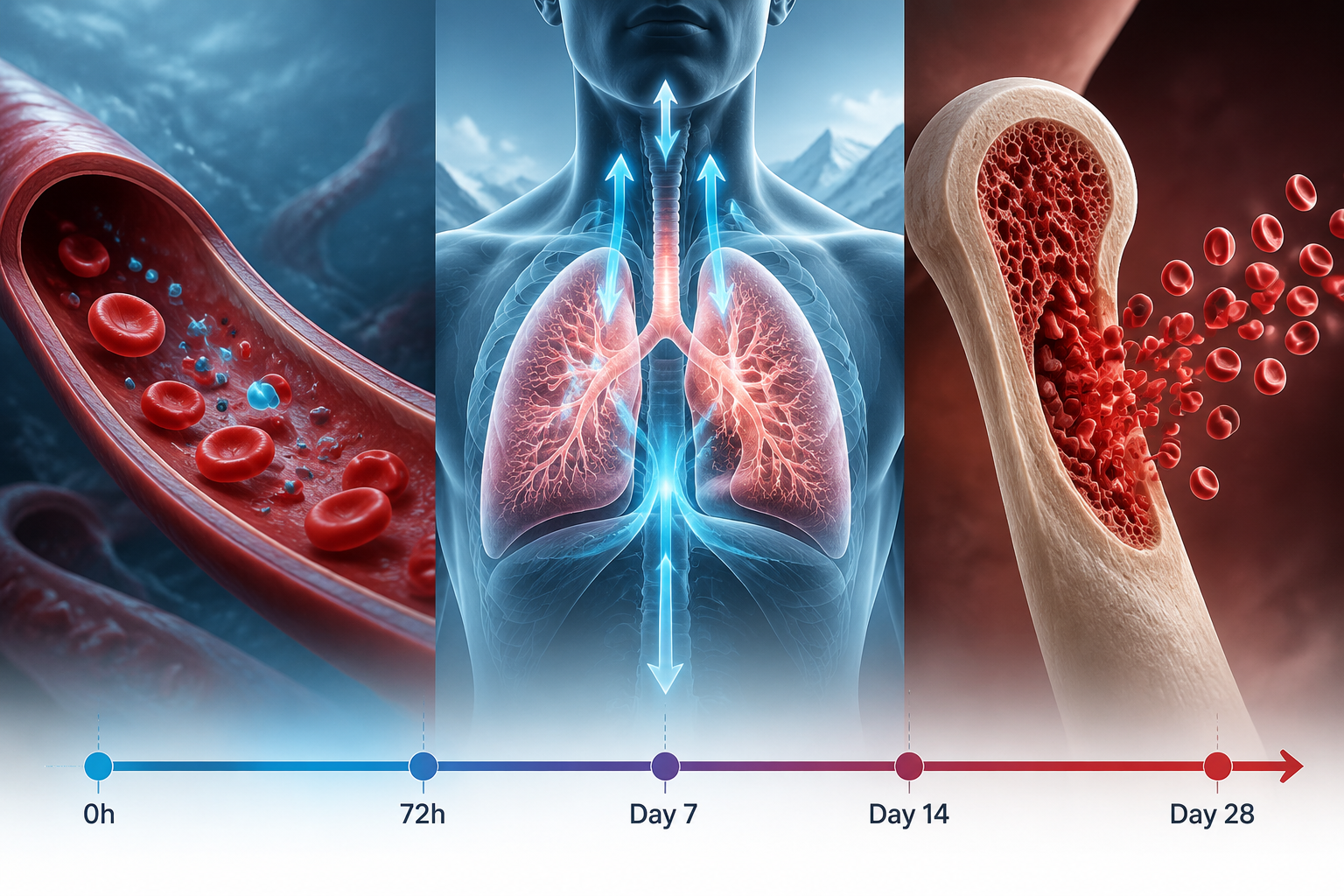
| Time after ascent | Main physiological change | Performance meaning |
|---|---|---|
| 0–72 hours | Plasma volume can fall quickly, contributing to hemoconcentration | Heart rate and perceived effort may rise; the athlete is not yet meaningfully adapted |
| First several days | Ventilation increases as the body tries to defend oxygen uptake | Breathing feels more prominent; sleep and comfort may be disrupted |
| About 2–4 weeks | EPO-driven erythropoiesis can increase hemoglobin mass if exposure and iron status are adequate | Oxygen-carrying capacity may improve, but the size of the response varies |
0–72 hours: plasma volume falls before fitness improves
One early response is a reduction in plasma volume. iRunFar’s review describes plasma volume dropping roughly 10–25% within hours of ascent, a change that concentrates the blood even before the body has produced many new red blood cells.[3] That hemoconcentration can make oxygen content per unit of blood look better, but it is not the same as building a larger red blood cell mass.
This phase is easy to misread. An athlete may see a higher hematocrit and assume adaptation has already happened. The better interpretation is narrower: the fluid portion of the blood has changed quickly, while the slower structural response is still pending. Training hard in this window can be costly because the athlete is simultaneously dealing with lower oxygen pressure, altered fluid balance, and unfamiliar recovery demands.
Days 1–7: ventilation does more of the work
The next major adjustment is ventilatory acclimatization. The body increases breathing to raise alveolar oxygen pressure and remove carbon dioxide. This helps defend oxygen uptake, but it also changes the athlete’s subjective experience: breathing becomes more noticeable at workloads that would feel routine near sea level.
Subjective discomfort is not just imagination. A review on altitude preparation reports that mood disturbances have been observed to peak on day 1 and normalize within about 42–52 hours.[4] That finding is useful mainly as context. It helps explain why the first days at altitude can feel disproportionately rough, but mood is not the central mechanism limiting endurance performance.
Weeks 2–4: erythropoiesis becomes the main target
The adaptation athletes usually mean when they talk about altitude training is erythropoiesis: increased red blood cell production stimulated by erythropoietin, or EPO. This is not an overnight response. A review of preparation for endurance competitions at altitude describes hemoglobin mass increasing by about 1.1% per 100 hours of altitude exposure.[4] That estimate makes the time requirement hard to dodge: meaningful hematological change needs sustained exposure, not a weekend at elevation.
The same review describes submaximal endurance performance at 4,300 meters improving by about 31% by day 9 and about 59% by day 15, with a plateau after day 22.[4] This is a useful demonstration that acclimatization can substantially improve function under severe hypoxic stress. It should not be imported carelessly into every altitude discussion, because 4,300 meters is higher than most ordinary competition or training altitudes.
Iron status is one of the practical limits. Red blood cell production requires iron. The altitude preparation review notes that athletes with low ferritin may fail to increase red blood cell mass even after 4 weeks at altitude.[4] This is why altitude camps that ignore iron availability are biologically incomplete, even if the location and training plan look correct.
Individual variation also matters. Some athletes show stronger hematological responses than others, and the responder-versus-non-responder debate is not settled enough to treat adaptation as guaranteed. The cautious conclusion is that altitude exposure can stimulate useful blood adaptations when dose, duration, recovery, and iron status cooperate.
The Sprint–Endurance Contrast
Altitude is not uniformly bad for all performance. The same lower air density that slightly offsets the aerobic cost of running can help sprinting more directly by reducing aerodynamic drag. In a short sprint, oxygen delivery is not the main immediate limiter in the way it is for a long endurance event. The athlete still experiences the altitude environment, but the event’s energy demands change the consequence.

For a 100-meter sprinter, lower drag can improve speed because the race is brief and heavily dependent on acceleration, power, and anaerobic energy systems. For a marathoner, the reduced drag is present but smaller than the penalty from impaired oxygen delivery over a long duration. The apparent paradox is therefore not a contradiction. It is the same physics filtered through different event demands.
What Athletes Do With This Physiology
The applied problem is simple to state and hard to execute: athletes want the adaptation signal of altitude without sacrificing too much training quality. If every hard session is performed in hypoxia, pace and power can drop. The athlete may gain exposure but lose the mechanical and metabolic specificity needed for racing fast.
That is the logic behind Live High Train Low. The common model is to live high enough to receive a hypoxic stimulus, traditionally around 2,100–2,500 meters, while training lower, often below about 1,250 meters, so intensity can be maintained.[5] The method treats altitude as a dose rather than a badge: enough hypoxia to stimulate adaptation, enough oxygen during workouts to preserve quality.
The minimum effective altitude is not perfectly fixed. Traditional guidance often points to about 2,100–2,500 meters for EPO stimulation, while iRunFar notes that 21 days at 1,800 meters may also be sufficient in some contexts.[3] The practical lesson is not that any elevation works. It is that duration, altitude, and individual response interact.
- For hematological adaptation, plan in weeks rather than days; the commonly discussed useful window is at least about 2 weeks, with 2–4 weeks more consistent with the biology.
- Protect training intensity by doing key sessions low enough that pace, power, and technique do not collapse.
- Check iron status before and during altitude exposure, because low ferritin can limit red blood cell production.
- Separate altitude effects from camp effects such as better sleep, fewer distractions, cooler weather, and improved nutrition; those factors can improve performance without being hypoxic adaptations.
For students, this is also where note-taking can become messy. Do not file every fact under a broad heading like “altitude helps.” Keep mechanism, timeline, and application separate. If you are building exam notes, use active recall on the few numbers that organize the topic: 6.3% VO₂max loss per 1,000 meters, the 0–72 hour plasma-volume window, and the 2–4 week hematological window. A structured study guide from a syllabus can keep those ideas from blending into one vague adaptation story.
Race-Day Timing Depends on the Constraint
Race-day altitude strategy depends on whether the athlete is trying to avoid the rough early acclimatization period or arrive with enough time to adapt. If the event is at altitude and the athlete cannot complete a proper acclimatization block, arriving very close to competition may reduce the time spent feeling the worst of the early transition. If the athlete can arrive well in advance, the goal shifts toward allowing ventilatory and hematological changes to develop.
The middle option is often the awkward one: enough time to feel the disruption, not enough time to gain the slower benefits. That is why the timeline matters more than motivational language. A race at altitude asks a specific physiological question: has the athlete had enough exposure to adapt, or are they simply competing while oxygen delivery is reduced?
Altitude impairs endurance because the oxygen partial pressure gradient falls. The body responds first with rapid fluid and breathing adjustments, then more slowly with possible increases in red blood cell mass. Sprinting is a special case because lower air density can reduce drag enough to help brief, high-speed events. Training benefits depend on dose, duration, iron availability, and individual response. Altitude is not magic, not purely harmful, and not uniformly beneficial; it is a constraint athletes manage by respecting time, dose, and mechanism.
References
- Linear decrease in VO₂max and performance with increasing altitude in endurance athletes — PubMed
- The effects of altitude on performance — Human Kinetics
- Into Thin Air: The Science of Altitude Acclimation — iRunFar
- Preparation for Endurance Competitions at Altitude — Frontiers in Physiology
- Altitude training — Wikipedia
Comments
Join the discussion with an anonymous comment.