

Comparing Carter and Trump Through a Political Science Lens
This study guide explains how political scientists evaluate presidential legacies across institutional impact, democratic norms, and post-presidential reputation, using Jimmy Carter and Donald Trump as contrasting cases to demonstrate the framework for exam essays and analysis.
Updated:
The easy comparison between Jimmy Carter and Donald Trump starts with the word outsider. Both ran against Washington habits. Both irritated party elites. Both treated the press as part of the political battlefield. Both were judged harshly while in office. That is a useful opening for a political science comparison of Carter and Trump, but it is a poor destination. “Outsider” tells us how a president entered the system. It does not tell us what he did to the system once he had power.
Political scientists usually need a wider lens than popularity, ideology, or personal style. A defensible comparison asks at least three questions: what institutional or structural changes did the president leave behind; how did he treat democratic norms while governing; and how did his reputation change after leaving office? Carter and Trump become a useful pair precisely because the first label is similar and the later answers diverge.
Start With Approval, But Do Not Stop There
Gallup’s presidential approval data gives the comparison a concrete baseline. Carter’s average job approval across his presidency was 45.5%, while Trump’s first-term average was 41.1%, the two lowest post-World War II averages in Gallup’s presidential series.[1] That fact matters because it prevents a lazy rescue operation: Carter was not secretly beloved in office, and Trump was not merely disliked by a narrow elite circle. Both governed under unusually weak public approval.
The more interesting number is the distance between approval in office and later judgment. Carter’s retrospective approval stood at 57%, 11.5 points above his term average, while Trump’s retrospective figure was 46%, only 4.9 points above his first-term average.[1][2] Carter, in other words, shows the classic rehabilitation problem: a president can be judged poorly during his term and more generously after voters, scholars, and institutions have had time to separate administrative weakness from long-run conduct. Trump shows a much smaller version of that effect, and his full second-term approval record remained incomplete as of July 2026.
This is where students often make the wrong move. A later improvement in reputation does not prove the original criticism was mistaken. It means the unit of analysis has changed. Job approval measures a president under current economic, diplomatic, and political pressure. Retrospective judgment asks what endured, what looked different after later events, and what moral or institutional meaning the presidency acquired over time.
| Measure | Carter | Trump | What It Can and Cannot Prove |
|---|---|---|---|
| Gallup term average | 45.5% | 41.1% first-term average | Shows weak approval while governing, not the whole legacy |
| Retrospective approval | 57% | 46% | Shows later reputational movement, not automatic vindication |
| Change from governing average | +11.5 points | +4.9 points | Suggests stronger post-presidential rehabilitation for Carter |
A Three-Part Legacy Test
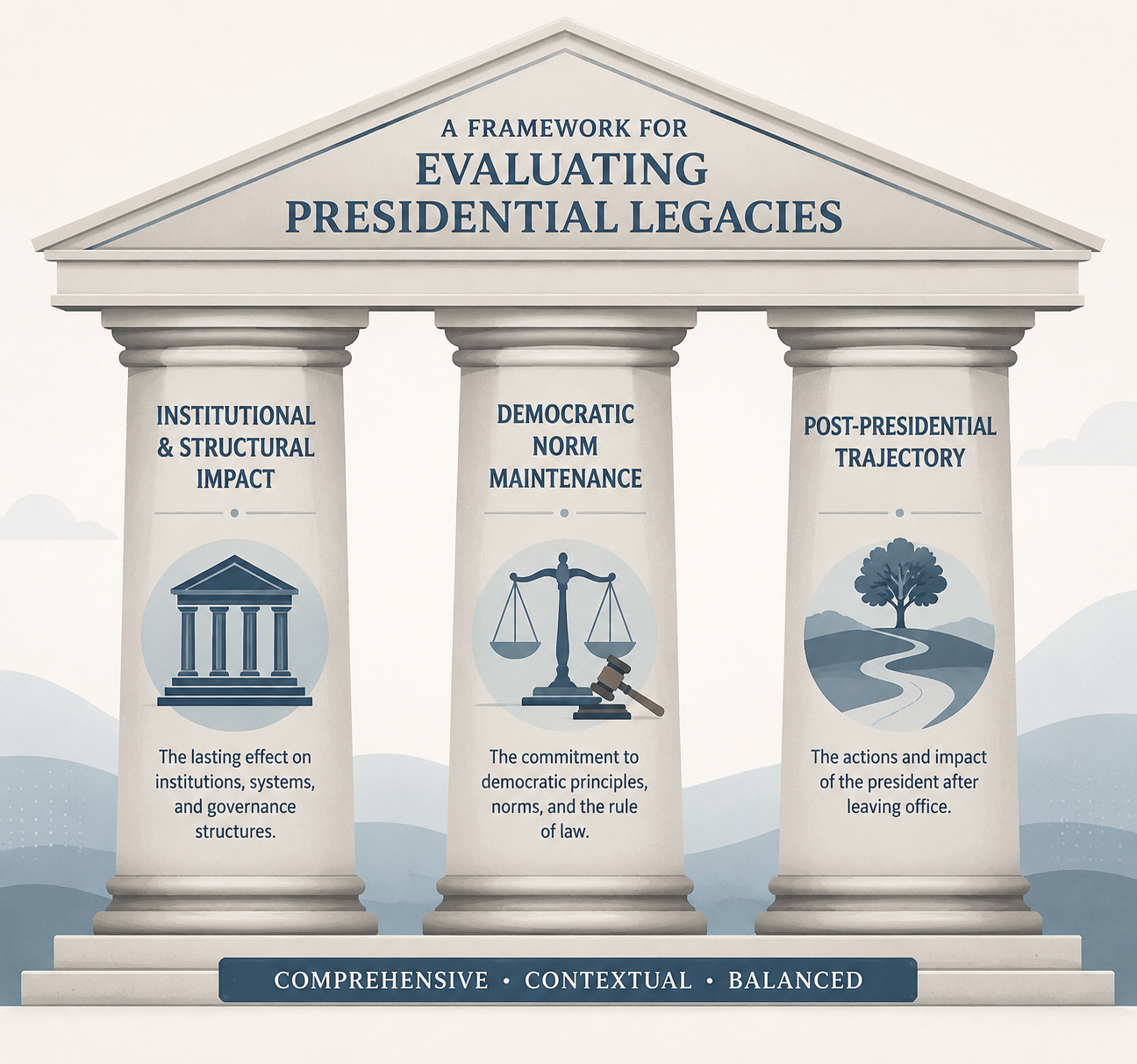
A cleaner framework has three parts. The first is institutional and structural impact: did the president alter party coalitions, executive power, policy regimes, or governing expectations? The second is democratic norm maintenance: did the president accept constraints, lawful opposition, electoral defeat, and the legitimacy of institutions outside his control? The third is post-presidential trajectory: did later conduct clarify, repair, or deepen the original judgment?
The democratic-norm part is not ornamental. A 2018 Perspectives on Politics analysis of the Trump presidency identified three interacting streams that threatened American democracy: polarized presidentialism, racialized disputes over membership, and eroded norms. It argued that Trump’s presidency produced a configuration without modern precedent, while also noting that the article appeared before January 6, 2021, Trump’s second term, and later implementation debates.[3] That timing caveat matters. The source is strongest for diagnosing early democratic stress, not for covering the full later sequence.
For exam writing, this framework is useful because it keeps separate questions separate. A president may be electorally weak but normatively careful. A president may be electorally durable while damaging institutional guardrails. A president may leave office unpopular and still become easier to defend in retrospect. The Carter-Trump comparison tests exactly those distinctions.
Carter: Weak in Office, More Legible in Retrospect
Carter is not hard to criticize as a president. The Gallup average already shows the scale of his public weakness. He also governed at an awkward point in the late twentieth-century party system. The Miller Center describes him as a “transitional president” between liberal and conservative eras, a formulation that is more precise than calling him simply ineffective or unlucky.[4] Transitional presidents often look worse in real time because they are trying to govern while older coalitions are losing force and newer ones are not yet fully settled.
That does not turn Carter’s presidency into an underrated triumph. It does make the early verdict incomplete. Carter’s case forces the analyst to ask what kind of failure is being described. Electoral weakness, administrative frustration, and public impatience are one kind of evidence. Conduct within constitutional boundaries is another. Carter’s later reputation improved partly because he did not spend his post-presidency trying to delegitimize the institutions that had constrained or defeated him.
The post-presidential record is unusually important here. Brookings’ assessment describes Carter’s post-presidency, including the Carter Center and his 2002 Nobel Peace Prize, as “exemplary and influential” in William Galston’s phrasing.[5] That is not a retroactive policy win for the Carter administration. It is a reputational fact that changes how the whole public career is read: Carter’s defeat did not become a campaign against the legitimacy of the system; it became the preface to a long civic and humanitarian role.
This is why Carter is a good warning against one-number legacy writing. His 45.5% approval average belongs in the essay, but it cannot be the essay. The later 57% retrospective approval does not erase the failures of the presidency; it shows that reputation can be rebuilt when later conduct confirms restraint, public service, and acceptance of democratic limits.[1][2]
Trump: The Outsider Who Reorganized the System Around Himself
Trump also entered as an outsider, but his institutional impact is of a different kind. The Miller Center’s legacy analysis frames him as reshaping the Republican Party into “the Party of Trump” and as exposing how much American democratic practice depends on unwritten norms rather than formal rules alone.[6] That is a structural claim, not a complaint about tone. A party can survive ideological change; democratic institutions face a different problem when party loyalty becomes attached to one leader’s personal claims about truth, defeat, and legitimacy.
The approval data again gives the floor, not the ceiling. Trump’s 41.1% first-term average was historically low in the postwar Gallup series, but a low average by itself would not justify the strongest political science criticism.[1] The deeper issue is the relationship between presidential power and democratic constraints. The Cambridge analysis is useful because it does not reduce the problem to personality; it links Trump’s presidency to polarization, membership conflict, and norm erosion as interacting democratic pressures.[3]
That distinction matters in a classroom answer. “Divisive” is too vague. Many presidents are divisive. The sharper claim is that Trump’s legacy is inseparable from the stress he placed on democratic norms: attacking institutional referees, treating opposition as illegitimate, and making acceptance of electoral loss a central test rather than a routine expectation. The research materials support that narrower, more disciplined conclusion better than a broad claim that Trump alone caused all contemporary democratic strain.
His post-presidential trajectory also differs from Carter’s. Brookings’ Carter comparison emphasizes Carter’s civic post-presidency. Trump’s post-presidency, by contrast, was defined by the unprecedented project of reclaiming the White House after a contested defeat.[5] That fact changes how reputational recovery works. Carter’s later life softened the original judgment because it displayed public service after defeat. Trump’s later role kept the dispute over defeat, legitimacy, and institutional authority inside the center of his legacy.
The Outsider Similarity Is Real, But Thin
The outsider comparison should not be dismissed; it should be contained. An Associated Press comparison published by Fortune noted that both Carter and Trump defied conventional ideological labels and challenged the political establishment and media.[7] That is useful color for an introduction. It explains why the pairing is tempting and why both men could appeal to voters who disliked the regular political class.
But shared anti-establishment style does not create shared institutional meaning. The same Fortune/AP piece contrasts Carter’s “I will never lie to you” ethos with Trump’s record of more than 33,000 documented falsehoods during his first term.[7] That comparison should be handled carefully: it does not mean every Carter claim was pure or every Trump supporter cared only about misinformation. It does show that ethical self-presentation and truthfulness became opposite kinds of political currency in the two presidencies.
A regional academic assessment from Southern Illinois University Carbondale similarly argued that history would treat Carter kindly, reinforcing the broader point that his reputation moved upward after office.[8] That kind of perspective is useful as supporting evidence, not as the main proof. The main proof remains the observable divergence between Carter’s post-presidential rehabilitation and Trump’s unresolved institutional conflict.
How to Use This Comparison in an Essay
A strong essay should not say, “Carter was good and Trump was bad,” then collect examples. It should define the criteria first, then let the evidence sort the cases. One workable approach is simple:
- Begin with the shared outsider status, but identify it as an entry point rather than the standard of judgment.
- Use approval data to establish that both presidents faced unusually weak public evaluations while governing.
- Separate institutional impact from democratic norm maintenance.
- Compare post-presidential trajectories instead of assuming all reputations recover in the same way.
- Conclude with a disciplined judgment about the criteria, not a personality ranking.
The most common weak version of this essay overweights vibes: Carter as decent but hapless, Trump as chaotic but strong, or both as anti-establishment victims. None of those labels does enough analytical work. A political science answer should ask what each man did to institutions and norms when those institutions and norms became inconvenient.
That produces a cleaner conclusion. Carter’s legacy can be revised upward without pretending his presidency was successful by every measure. His conduct remained inside democratic bounds, and his post-presidency gave later observers reasons to distinguish governing weakness from civic failure. Trump’s legacy remains harsher not merely because he was polarizing, but because the damage runs through the very criteria political scientists use to judge a presidency: institutional restraint, acceptance of democratic limits, and the president’s effect on the system after personal defeat.
References
- Gallup Presidential Job Approval Center, Gallup
- Jimmy Carter Retrospective, Gallup
- The Trump Presidency and American Democracy: A Historical and Comparative Analysis, Perspectives on Politics, Cambridge University Press
- Jimmy Carter: Impact and Legacy, Miller Center
- How will we remember Jimmy Carter's presidential legacy?, Brookings
- Donald Trump: Impact and Legacy, Miller Center
- Donald Trump and Jimmy Carter had similarities as outsider presidents who disliked Washington's elite, Fortune
- SIU political experts: History will treat Jimmy Carter kindly, Southern Illinois University Carbondale, January 2, 2025
Comments
Join the discussion with an anonymous comment.