
Study Cyclospora for Food Safety Exams Using the 2026 Outbreak
A consolidated study resource for public health, epidemiology, and food safety exams covering Cyclospora cayetanensis biology, transmission, outbreak history, detection methods, treatment, surveillance, and prevention — anchored by the 2026 multi-state iceberg lettuce outbreak.
Updated:
As of July 14, 2026, CDC counted 1,645 confirmed cyclosporiasis cases across 34 states, compared with 249 cases during the same period in 2025. The investigation linked a multistate cluster to shredded iceberg lettuce from a single Mexican supplier, with Taco Bell distribution records helping investigators connect affected restaurants in Indiana, Kentucky, Michigan, Ohio, and West Virginia.[1][2]
That is the useful starting point for studying Cyclospora in food safety, not because lettuce is surprising, but because the case forces the exam distinctions into the open. Cyclospora cayetanensis does not behave like Salmonella in traceback, like Giardia in direct transmission, or like a parasite that reliably appears on a routine ova-and-parasite exam. If a question stem gives you produce, delayed illness, negative routine O&P, and no clean PulseNet-style match, it is testing more than recall of a pathogen name.
Why the 2026 Lettuce Outbreak Is an Exam Case, Not Just a News Case
The 2026 outbreak gives students a compact way to connect exposure, biology, diagnosis, surveillance, and prevention. The vehicle was shredded iceberg lettuce. The linked supplier was in Mexico. The restaurant distribution clue came from Taco Bell records. The public advisory arrived after cases had already been appearing for more than two months, a delay that CIDRAP reported with Michael Osterholm calling it “terribly unfortunate.”[1][2][3]
Those details matter because Cyclospora investigations often do not give local health departments the tools they may expect from bacterial outbreak work. There is no standard culture system for the organism, no PulseNet equivalent for routine high-resolution matching, and only partial genotyping through CDC’s CYCLONE system.[3][4]
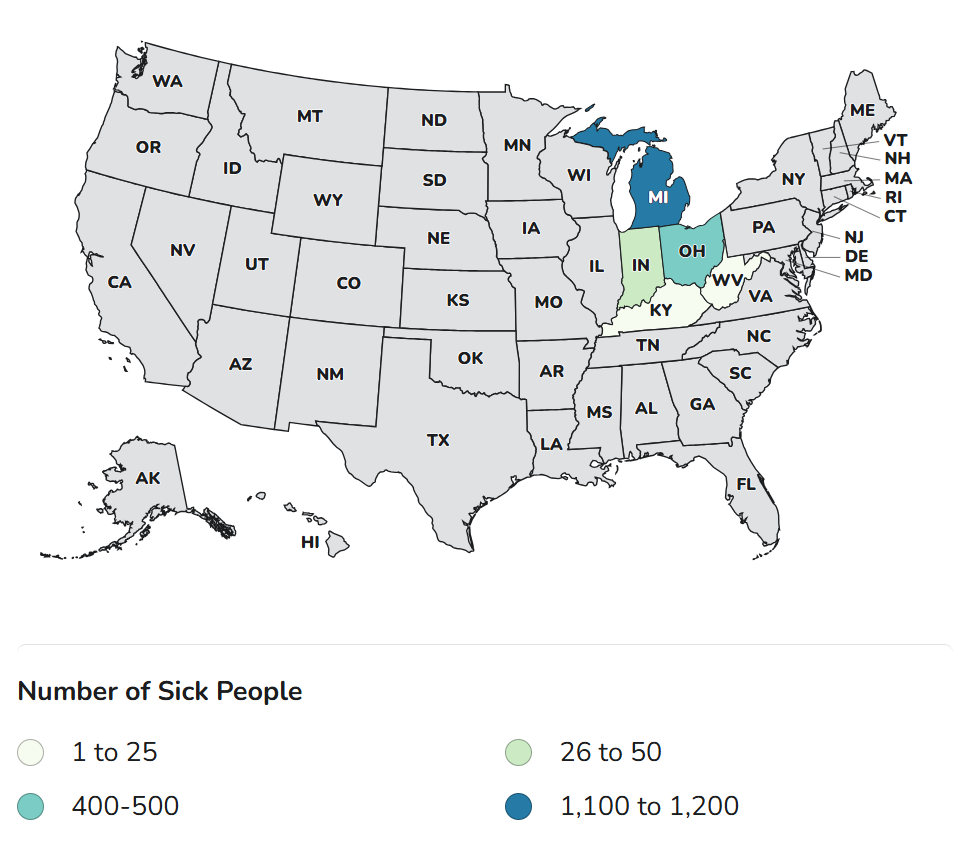
Be careful with counts in this outbreak. CDC’s 1,645 figure was a confirmed-case count as of July 14, 2026. State tallies may include probable cases or use different update schedules, so an exam answer should identify the agency definition when a number is attached to a date.[1]
The Biology That Explains the Epidemiology
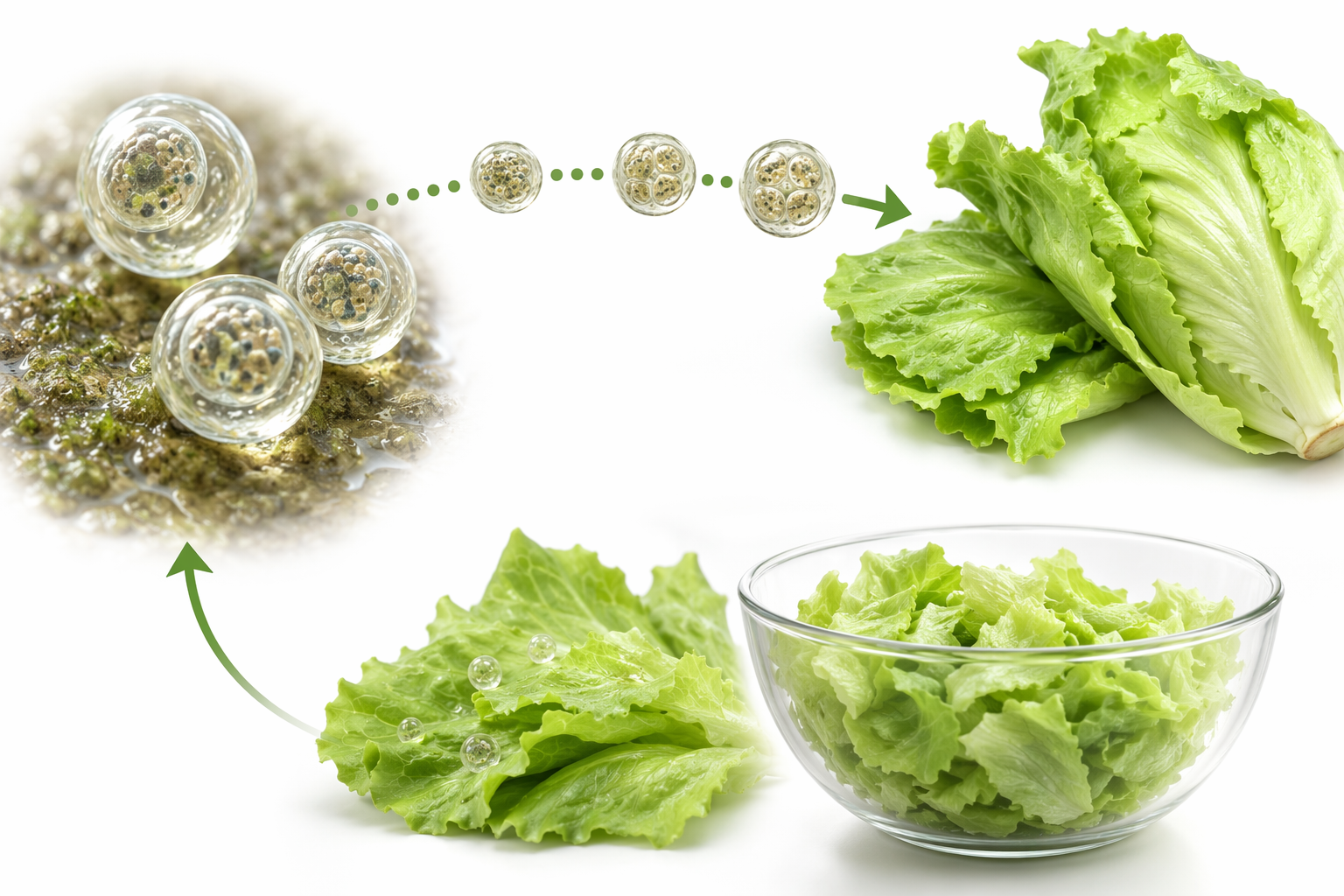
Cyclospora cayetanensis is a coccidian parasite, but the highest-yield fact is not the label. The oocysts are shed in stool in a noninfectious form and generally require 7 to 14 days outside the host to sporulate and become infectious.[5][6]
That single timing rule changes the expected transmission pattern. Direct person-to-person spread is not expected, even when infected people are shedding oocysts, because freshly passed oocysts have not yet become infectious.[5][6] In exam terms, a daycare-style immediate fecal-oral chain should push you away from Cyclospora unless the question gives an environmental or food vehicle that allows time outside the body.
| Exam cue | Cyclospora answer |
|---|---|
| Fresh stool from a symptomatic person immediately infects a contact | Not the usual Cyclospora pattern; oocysts need environmental sporulation |
| Produce vehicle with delayed recognition | Fits Cyclospora, especially when leafy greens, herbs, or berries are involved |
| Routine O&P reported as negative | Does not rule out Cyclospora |
| PulseNet-style bacterial subtype match expected | Wrong surveillance shortcut; Cyclospora lacks a PulseNet equivalent |
| Standard treatment asked | TMP-SMX for 7-10 days |
The seasonality question deserves a narrower answer than many review notes give it. Almeria and colleagues discuss a hypobiosis hypothesis as one possible explanation for patterns in Cyclospora seasonality, but that remains emerging research, not settled doctrine.[7] For most exams, the safer point is that cyclosporiasis in the United States has often been associated with spring and summer produce-linked outbreaks, while the exact biological drivers are still being studied.
Diagnosis: Routine O&P Is the Trap
A routine ova-and-parasite exam can miss Cyclospora. CDC’s 2026 health advisory emphasizes that clinicians should specifically request testing for Cyclospora, and the usual diagnostic routes are modified acid-fast staining or molecular testing such as PCR.[5] Almeria and colleagues likewise describe the need for specialized diagnostic approaches rather than assuming routine parasitology will detect it.[7]
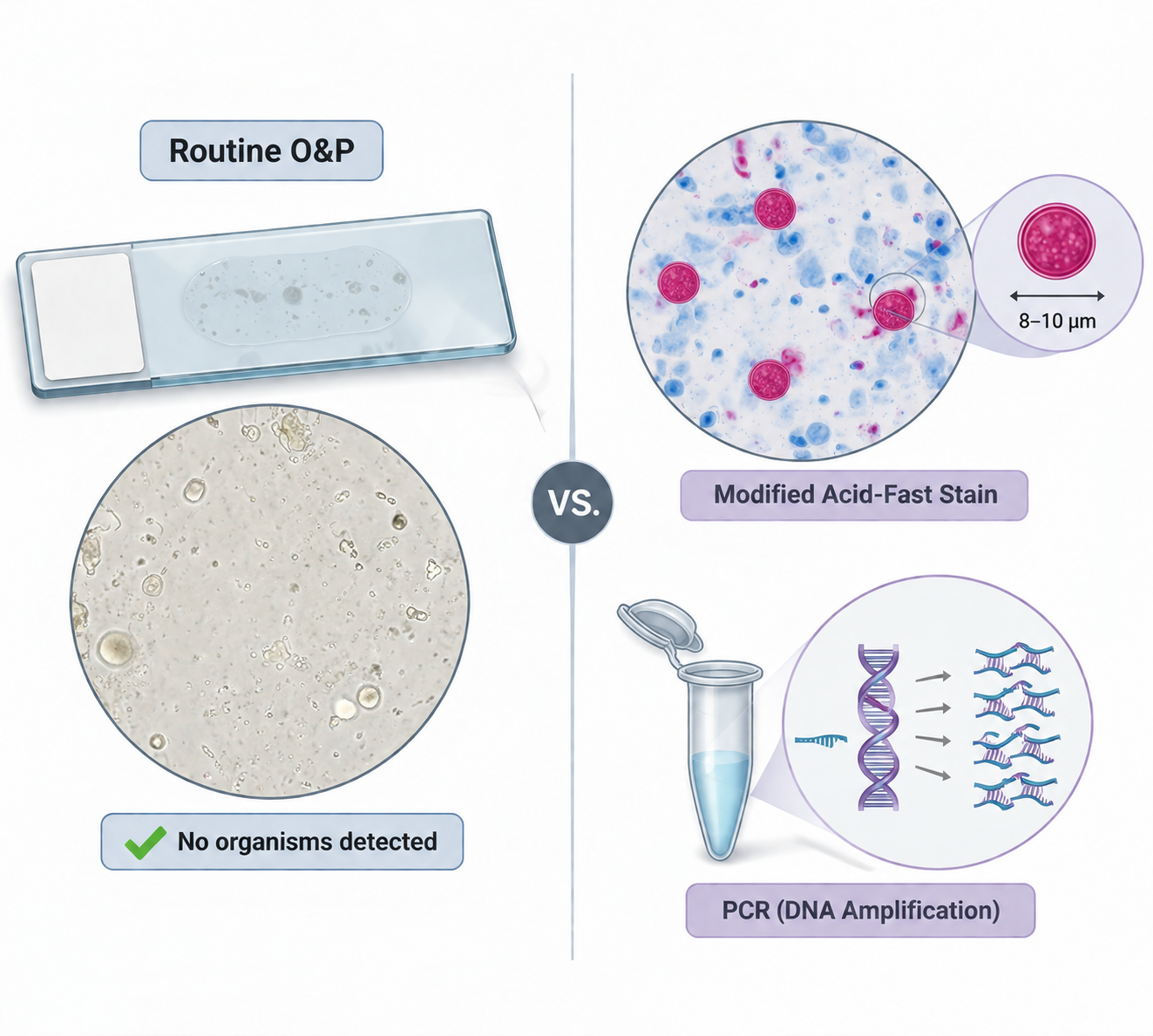
This is where good students lose easy points. A question may say that the patient had prolonged watery diarrhea after eating fresh produce and that the initial stool exam was negative. That negative result is not a strong exclusion if Cyclospora testing was not ordered. The test mismatch is part of the disease profile.
Treatment is more straightforward than detection. CDC identifies trimethoprim-sulfamethoxazole, commonly abbreviated TMP-SMX, for 7 to 10 days as standard treatment.[5] On exams, that helps separate Cyclospora from organisms where treatment is often supportive only, from Giardia regimens, and from bacterial gastroenteritis questions where antibiotic choice depends on severity, host risk, and resistance concerns.
Surveillance Moves Slower When the Lab Tools Are Weaker
Students who learn outbreak investigation through bacterial examples often expect rapid clustering by molecular fingerprinting. Cyclospora resists that habit. Investigators cannot culture it in a standard system, cannot rely on a PulseNet equivalent, and have only partial genotyping support through CYCLONE.[3][4]
That limitation does not mean investigators are passive. It means the weight shifts toward interviews, exposure histories, purchase and distribution records, environmental assessment, and specialized laboratory testing. In the 2026 outbreak, Taco Bell distribution records helped connect shredded iceberg lettuce served in several states to a single Mexican supplier.[2]
The July 2026 advisory lag is therefore not just an administrative footnote. It illustrates why Cyclospora is harder to convert into a clean public alert than many bacterial outbreaks: cases are recognized through clinical suspicion and specialized testing, food exposures may be short-lived, produce supply chains move quickly, and the organism does not slot neatly into the surveillance architecture students may know from Salmonella or E. coli.
How the Produce Pattern Has Built Over Time
The historical pattern is worth learning as a sequence, not as a list of trivia. Major U.S. Cyclospora outbreak investigations have included raspberries from Guatemala in 1996, cilantro and romaine-linked investigations in 2013, domestically grown vegetables traced in 2018, bagged salad mix in 2020, leafy greens in 2022, and shredded iceberg lettuce in 2026.[7][8][9]
The exam point is not that every leafy green outbreak is Cyclospora. It is that Cyclospora belongs in the differential when the stem combines fresh produce, prolonged gastrointestinal illness, specialized testing, and traceback difficulty. In 2023, FDA records listed Cyclospora in 4 of 24 major foodborne illness investigations, or 17%, which is enough to justify attention without implying that it dominates all produce-associated outbreaks.[10]
Food and Environmental Detection: PCR Helps, but Sampling Is Still Hard
Food testing for Cyclospora is not the same as stool diagnosis, and it is not as simple as swabbing a product and expecting an answer. FDA’s Bacteriological Analytical Manual includes PCR-based chapters for Cyclospora detection in produce and agricultural water, reflecting how molecular methods have become central to food and environmental testing for this parasite.[11]
The newer Mit1C qPCR method, validated in 2023, was reported to detect as few as 5 oocysts.[12] That is an important technical advance, but it should not be turned into an overconfident surveillance claim. Detecting a few oocysts in a validated method is not the same as guaranteeing that an outbreak source will be found in a real, unevenly contaminated field, packing environment, water source, or finished product lot.
Kniel and colleagues’ December 2025 review, as available through abstract and press-release material, discusses UV inhibition of sporulation and surrogate research using Eimeria.[12] Those are promising research directions, but they should be cited cautiously: surrogate findings and laboratory conditions do not automatically establish field-level control for Cyclospora cayetanensis.
The same caution applies to disinfection. The reviewed material states that no EPA-registered disinfectant has been proven effective against Cyclospora.[12] For food safety exams, that makes a simple “sanitize it away” answer too thin; prevention has to include agricultural water, worker hygiene, field practices, sanitation programs, and traceback readiness rather than relying on a single kill step.
FDA’s Action Plan Fits the Gaps
FDA’s Cyclospora Action Plan is organized around three broad needs: prevention, response, and filling knowledge gaps. The plan includes grower education and rapid test kits under prevention, dead-end ultrafiltration water sampling and farm investigation questionnaires under response, and work on genotyping and wastewater detection under knowledge gaps.[13]
That structure is more useful than a generic consumer message because it follows the actual weak points. Cyclospora has to be prevented before contaminated produce reaches consumers; once illness appears, investigators need better ways to collect comparable field data and environmental samples; and the science still needs stronger tools for linking cases, foods, farms, and water sources.
Fast Comparisons for Exam Pressure
| Pathogen or group | Common exam shortcut | Cyclospora distinction |
|---|---|---|
| Giardia | Protozoan diarrhea with fecal-oral spread | Cyclospora requires environmental sporulation; direct person-to-person spread is not expected |
| Cryptosporidium | Acid-fast oocysts and waterborne concern | Cyclospora is also acid-fast on modified staining, but the 7-14 day sporulation requirement is the key transmission distinction |
| Salmonella | Culture and molecular clustering are familiar outbreak tools | Cyclospora lacks a standard culture system and PulseNet equivalent |
| STEC or other bacterial produce outbreaks | Rapid subtyping may help link cases | Cyclospora traceback leans more heavily on exposure data, records, and specialized testing |
| Routine parasite workup | O&P may be treated as a broad screen | Routine O&P can miss Cyclospora unless specific testing is requested |
A compact exam answer can therefore move in this order: identify the produce-associated exposure, state that oocysts require 7 to 14 days in the environment before becoming infectious, reject immediate person-to-person transmission, request modified acid-fast staining or PCR rather than relying on routine O&P, treat with TMP-SMX when treatment is indicated, and explain why traceback may be slower than a bacterial outbreak investigation.
The 2026 shredded iceberg lettuce outbreak is useful because it holds all of that in one case. The confirmed case count shows public health scale. The lettuce vehicle and Mexican supplier show produce traceback. The Taco Bell distribution records show how investigators may build links without a clean PulseNet-style system. The advisory delay shows the surveillance consequences. The biology explains why the outbreak did not behave like a simple person-to-person gastrointestinal cluster.
Cyclospora is memorable because its biology creates its epidemiology, its diagnostic blind spots, and its surveillance delays. In an exam stem, the parasite is rarely testing one isolated fact. It is testing whether you can see how the 7- to 14-day sporulation requirement, specialized diagnosis, limited subtyping, produce exposure, and prevention challenges fit together.
References
- CDC 2026 Cyclospora Outbreak Page, Centers for Disease Control and Prevention, July 14, 2026.
- FDA Investigation Page for July 2026 Cyclospora Outbreak Linked to Shredded Iceberg Lettuce, U.S. Food and Drug Administration, July 2026.
- CDC HAN-00531, Centers for Disease Control and Prevention, July 2026.
- Medscape Coverage of July 2026 Cyclospora Outbreak, Medscape, July 2026.
- About Cyclosporiasis, Centers for Disease Control and Prevention.
- Cyclospora cayetanensis, Centers for Disease Control and Prevention.
- Cyclospora cayetanensis and Cyclosporiasis: An Update, Microorganisms, 2023.
- CDC Cyclospora Outbreak Archives, Centers for Disease Control and Prevention.
- Cyclospora Outbreak Timeline, genomicEpi.com.
- FDA Investigation Records for 2023 Foodborne Illness Investigations, U.S. Food and Drug Administration, 2023.
- Bacteriological Analytical Manual Chapter 19b and Chapter 19c, U.S. Food and Drug Administration.
- Cyclospora cayetanensis Review, PMID 41347294, December 2025.
- Cyclospora Prevention, Response and Research Action Plan, U.S. Food and Drug Administration, 2021.
Comments
Join the discussion with an anonymous comment.