
Cuba's International Alliances Study Guide for IR Students
This study guide traces Cuba's international alliances from Soviet alignment during the Cold War through the 2026 multipolar crisis, covering the Venezuela lifeline collapse, China and Russia's limited support, and key concepts for exams. Perfect for IR and Latin American studies students.
Updated:
Start With the 2026 Stress Test
A useful study of Cuba’s international alliances does not begin with a flag, a slogan, or a biography of Fidel Castro. It begins with a material question: when the oil stops arriving, who can actually replace it?
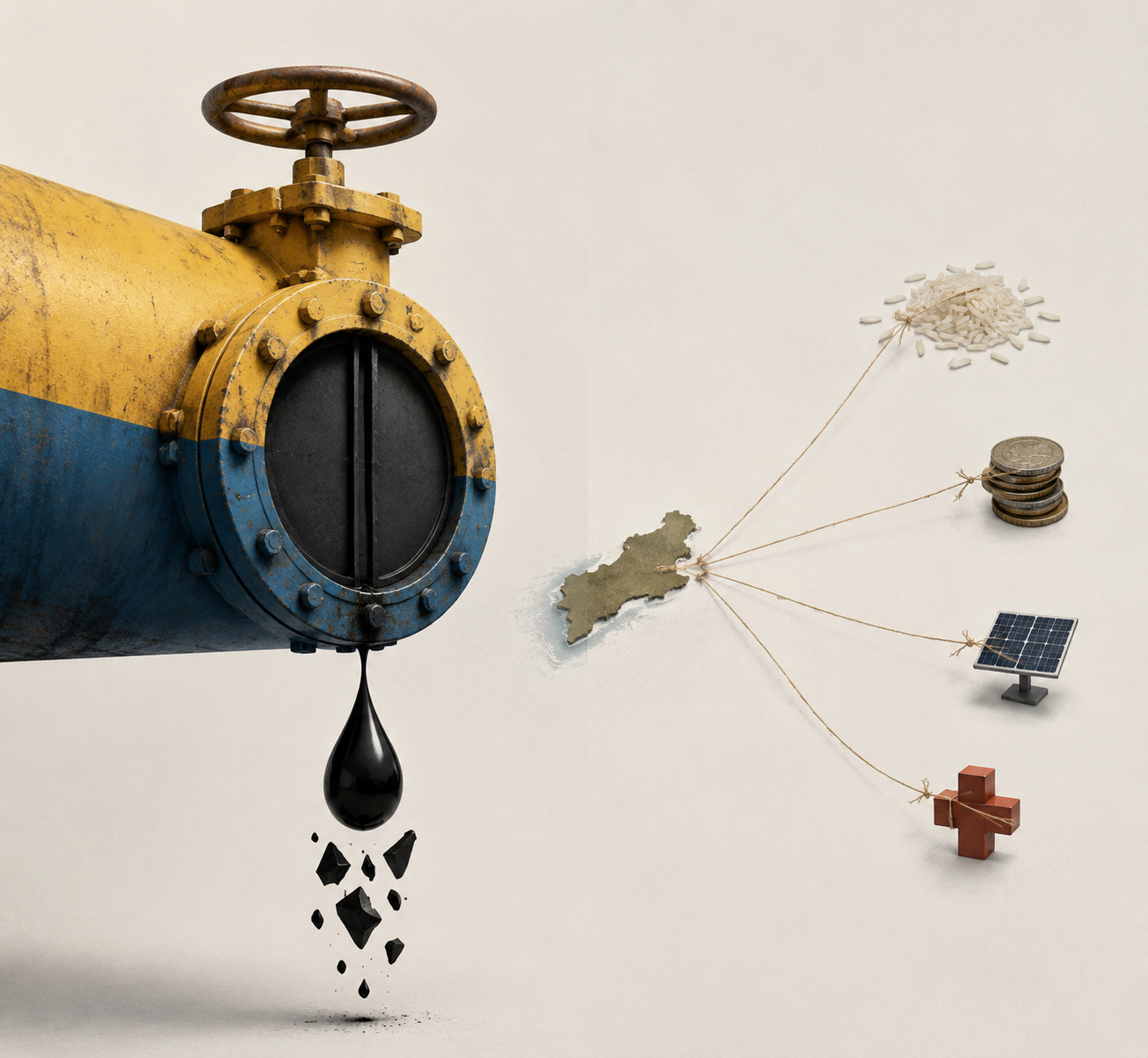
By early 2026, that question had become unavoidable. Venezuela had been supplying Cuba with roughly 27,000 barrels of oil per day, part of a wider exchange often valued at up to $2 billion a year in subsidies, with Cuban medical personnel serving in return. After Nicolás Maduro was captured on January 3, 2026, the Trump administration’s “zero oil” policy intensified pressure on that lifeline.[1]
China responded with 60,000 tons of rice and $80 million in aid in January 2026, and Russia sent officials to Havana on January 21. But the Russian side also acknowledged the central problem: it could not increase oil supplies because of cost and logistics.[2] Food aid, credit, diplomatic support, and infrastructure projects matter. They are not the same thing as a steady oil-for-services arrangement.
The domestic indicators explain why this is not an abstract alliance puzzle. BTI 2026 reports that around 30% of Cuba’s population lives in extreme poverty, state salaries are roughly $17 per month at informal exchange rates, GDP contracted by 1.9% in 2023 and continued declining in 2024, and industrial production in several areas was down 61% to 90% compared with 2019.[3] In an exam answer, those figures should not be used to decorate a paragraph about “hardship.” They show why external supply relationships shape domestic survival.
The Four-Phase Map
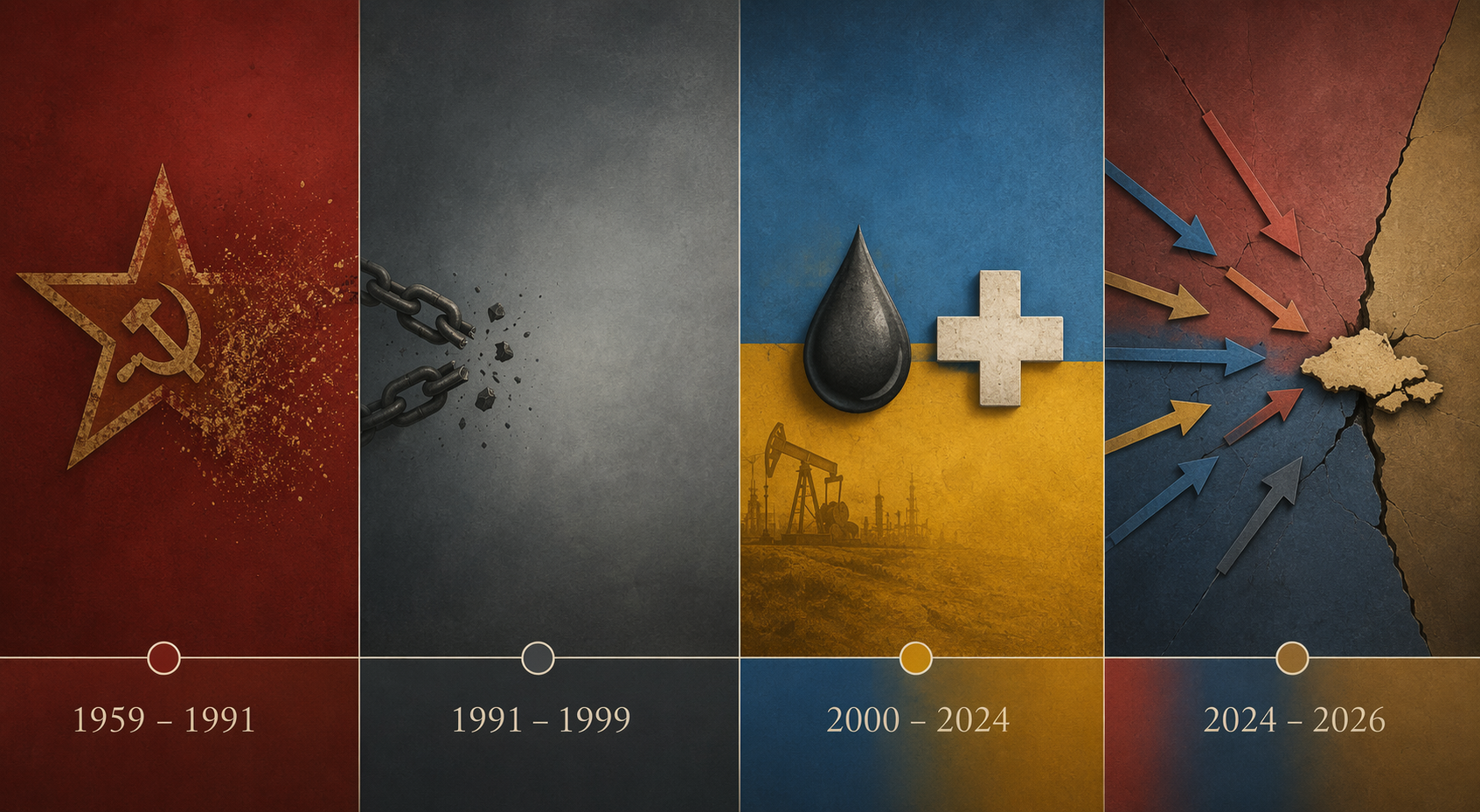
For exam purposes, Cuba’s alliance trajectory is clearest when divided into four phases. The point is not that every year fits neatly into a box. The point is that each phase had a different answer to four questions: what Cuba needed, who supplied it, what Cuba offered in return, and what vulnerability the arrangement created.
| Phase | Main Pattern | What Cuba Needed | Main Vulnerability |
|---|---|---|---|
| 1959–1991: Soviet alignment | Ideological, military, and economic patronage | Security, subsidies, trade, oil, diplomatic backing | High dependence on one superpower patron |
| 1991–1999: Special Period isolation | Patron collapse and emergency adjustment | Energy, food, trade alternatives, foreign currency | No equivalent replacement after the Soviet collapse |
| 2000–2024: Bolivarian axis with Venezuela | Oil-for-medical-personnel and political alignment | Energy supply, concessional terms, regional cover | Dependence shifted from Moscow to Caracas |
| 2024–2026: Multipolar rebalancing under duress | Fragmented support from China, Russia, EU ties, BRICS+, and medical diplomacy | Food, aid, credit, energy projects, diplomatic space | No partner fully replaces Venezuelan oil |
That table is the spine of the answer. It also prevents a common weak essay: “Cuba allied with the USSR, then Venezuela, now China and Russia.” A sequence is not an explanation. The explanation lies in the mechanism of patron-client relations and the recurring danger of asymmetric dependence.
Phase One: Soviet Alignment, 1959–1991
The Soviet phase was the strongest version of Cuba’s patronage model. Cuba needed security against U.S. pressure, fuel, guaranteed markets, military equipment, development support, and diplomatic cover. The Soviet Union supplied those resources at a scale no later partner has matched.
The economic scale matters. Soviet subsidies to Cuba during the Cold War are commonly estimated at $4 billion to $6 billion per year.[4] That figure should do real work in an answer: it shows that Cuba’s revolutionary independence was partly sustained by a deeply dependent external economic structure.
Cuba also offered something back. It gave Moscow a strategic foothold in the Western Hemisphere, ideological legitimacy in the Global South, and military activism beyond the Caribbean. Cuban deployments in Africa exceeded 300,000 troops over time, making Havana more than a passive client.[4] In patron-client terms, the relationship was asymmetric, but not empty on the Cuban side.
This is where ideological alignment and material support need to be separated. Cuba and the USSR shared Marxist-Leninist language and anti-U.S. positioning, but the durability of the relationship depended on oil, subsidies, trade arrangements, weapons, and diplomatic protection. If an essay explains the alliance only through ideology, it misses why the Soviet collapse caused such severe economic damage.
Exam Use
Use this phase to define asymmetric dependence: a smaller state gains survival resources from a stronger patron, but its economy and security become exposed to the patron’s decisions and durability. Cuba gained room to resist Washington. It also built a system that could not easily absorb the disappearance of Moscow.
Phase Two: The Special Period and the First Patron Collapse
When the Soviet Union collapsed, Cuba did not simply lose a friend. It lost the organizing structure of its external economy. Foreign trade fell by about 80% after the Soviet collapse.[4] That is the number students should attach to the Special Period because it captures the alliance shock more sharply than a general description of scarcity.
This phase is best understood as forced adjustment rather than successful rebalancing. Cuba sought tourism revenue, limited foreign investment, remittances, and new diplomatic openings, but none of these immediately recreated the old patron-client package. The state survived, but survival is not the same as strategic comfort.
The Special Period also helps explain why later Venezuelan support became so important. It did not arrive in a normal policy environment. It arrived after Cuba had already experienced what happens when a primary patron disappears.
Phase Three: Venezuela and the Bolivarian Replacement
The Venezuela phase is the bridge between Cold War dependency and the 2026 crisis. It was not a Soviet restoration, but it solved one of Cuba’s most urgent problems: energy supply. Under Hugo Chávez and then Nicolás Maduro, Venezuela sent subsidized oil while Cuba supplied medical personnel and political support.[5]
This arrangement worked because each side had something the other could use. Venezuela had oil and a regional project that benefited from Cuban administrative, intelligence, and medical expertise. Cuba had trained professionals, revolutionary prestige, and experience turning international service into diplomatic capital. The exchange was material, ideological, and institutional at the same time.
Medical diplomacy is the key concept here. Cuba has sent more than 52,000 medical workers abroad since 1959 across 94 countries, with around 20,000 serving in 68 countries according to BTI 2026.[3] That is not just humanitarian branding, although it has humanitarian effects. It is a foreign-policy instrument that converts professional labor into influence, revenue, legitimacy, and bilateral leverage.
The Venezuela alliance therefore gave Cuba a partial functional replacement for Soviet support. It did not reproduce Soviet military reach or global superpower protection, but it did provide the energy terms and political partnership needed to stabilize the post-Soviet order. For a study guide, the right comparison is not “USSR equals Venezuela.” The right comparison is: which dependency problem did each patron solve?
Its weakness was built into its success. Cuba had escaped total isolation, but it had again concentrated a vital need around one primary partner. When Venezuela’s own economy and political system came under strain, Cuba’s exposure increased. By 2026, the old lesson from 1991 had returned in a different form.
Phase Four: Multipolar Rebalancing Without a Full Substitute
The current phase is tempting to overstate. Cuba has relations with China and Russia, remains active diplomatically, participates in wider Global South forums, and has pursued BRICS+ ties. But the evidence supports a narrower conclusion: Cuba is diversifying under severe pressure, not replacing Venezuela with a single new patron.
China’s January 2026 support illustrates the distinction. Sixty thousand tons of rice and $80 million in aid can relieve food and fiscal pressure, and Chinese-linked renewable energy projects matter for the longer term.[2] BTI 2026 reports plans for 92 solar parks by 2028, with more than 2,000 megawatts of capacity supported through Chinese, Algerian, and OPEC-related funding.[3] But rice and solar parks do not immediately replace daily oil flows.
Russia’s role is also real but limited. Diplomatic visits, symbolic backing, and anti-U.S. alignment keep Moscow relevant in Havana’s calculations. Yet the admission that Russia could not increase oil supplies in January 2026 is exactly the kind of fact that should discipline an exam answer.[2] Symbolic alignment is not the same as logistical capacity.
The European Union belongs in this phase too, but not as a dramatic rescue actor. Through the Political Dialogue and Cooperation Agreement, the EU has become an important development and diplomatic partner, and BTI 2026 identifies it as Cuba’s largest single donor.[3][6] That gives Cuba room, contacts, and resources. It does not erase sanctions pressure or solve the energy shortage.
U.S. pressure remains part of the structure. The embargo and wider sanctions framework constrain Cuba’s trade, finance, and access to external resources, even when Havana has other partners.[7] That does not mean every Cuban economic problem can be reduced to Washington. It means alliance choices occur inside a coercive regional environment.
Cuba Is Dependent, but Not Passive
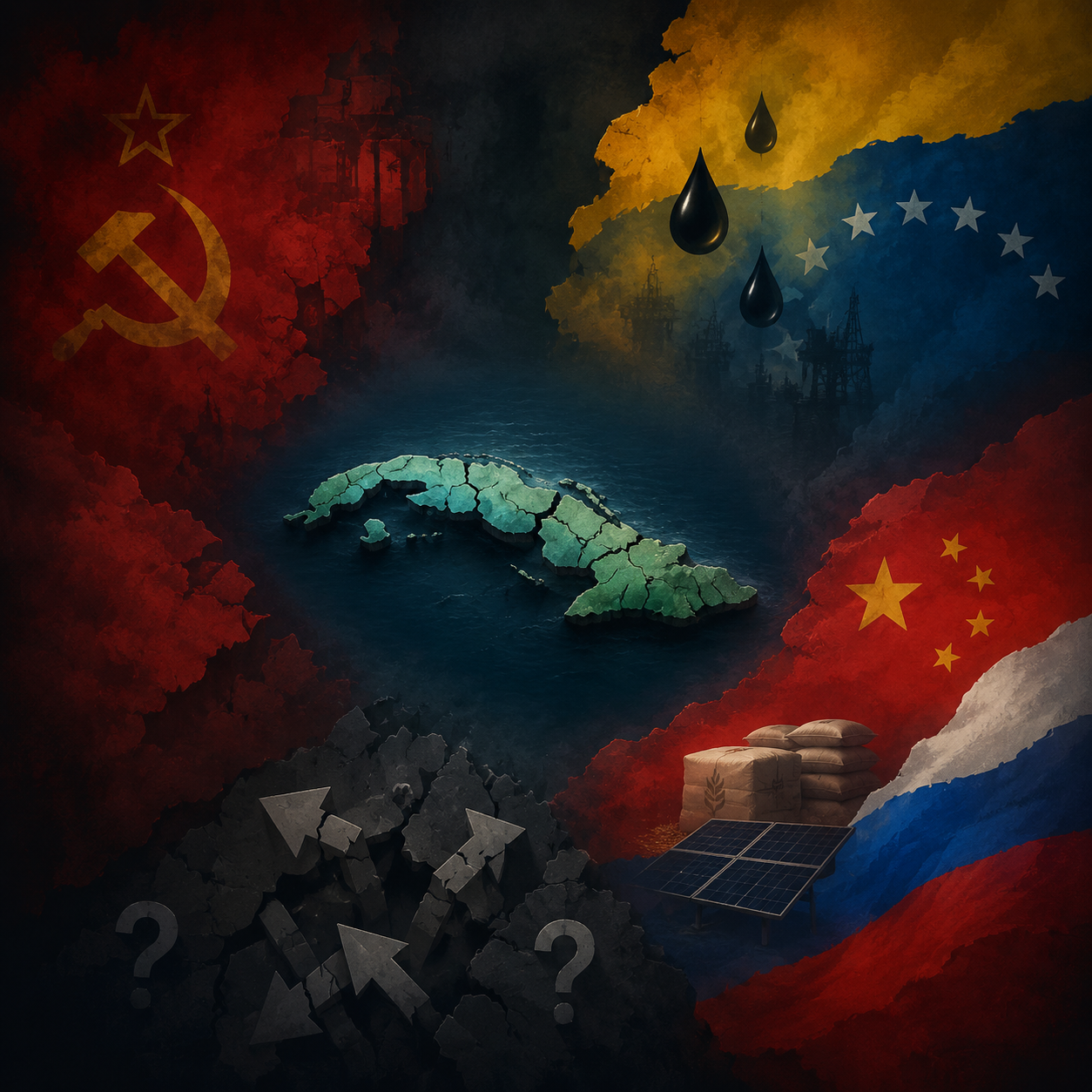
A bad answer makes Cuba sound like an object passed between patrons. That misses an important part of the record. Cuba maintains diplomatic relations with 191 countries and has one of the largest embassy networks in Latin America.[4] Those facts do not cancel dependency, but they do show agency.
Medical diplomacy is the strongest example. Cuban doctors, nurses, and technicians have served abroad in large numbers, often in places where wealthier states send fewer personnel. This creates goodwill, revenue, and political relationships. It also places Cuban workers inside the consequences of foreign policy: when an alliance becomes unstable, they are among the people whose assignments, income, and safety can be affected.
The balance is important. Cuba is not simply isolated. It has diplomatic reach, a recognizable international brand, professional exports, EU channels, Chinese aid, Russian support, and multilateral openings. It is also not securely rebalanced, because the missing oil lifeline exposes the limits of those assets.
How to Turn This Into an Exam Answer
If the exam question asks how Cuba navigated international alliances, avoid writing a chronological list. Build the answer around changing patron-client mechanisms. Each phase should show a trade-off between survival and vulnerability.
- Start with the 2026 crisis: Venezuela’s oil lifeline weakened, while China and Russia offered limited or non-equivalent support.
- Define the Soviet phase as high-capacity patronage: subsidies, security, trade, military cooperation, and ideological alignment.
- Use the Special Period to show what happens when a patronage system collapses suddenly.
- Treat Venezuela as a functional but narrower replacement centered on oil and medical diplomacy.
- End with multipolar rebalancing as fragmented diversification, not a completed replacement.
For students building this into a longer revision file, a method resource such as creating a study guide from your syllabus can help turn lecture notes into the same kind of phase-based structure.
Compact Glossary
- Small-state survival: the strategies weaker states use to preserve autonomy under pressure from stronger powers.
- Patron-client relations: an unequal exchange in which a stronger state supplies protection, resources, or access while the weaker state offers loyalty, strategic position, services, or legitimacy.
- Asymmetric dependence: a relationship where both sides benefit, but one side would suffer far more if the relationship breaks.
- Medical diplomacy: the use of health personnel and medical missions as tools of foreign policy, influence, and revenue.
- Multipolarity: an international order with several important power centers rather than one dominant pole or two rival blocs.
- Symbolic alignment: public diplomatic or ideological support that may not include enough material capacity to solve concrete shortages.
Likely Exam Questions
- Explain how Cuba’s alliance system changed from the Soviet period to the 2026 crisis.
- Was Venezuela a replacement for the Soviet Union in Cuba’s foreign policy? Discuss with evidence.
- How does Cuba illustrate the strengths and risks of small-state survival strategies?
- Assess whether China and Russia can replace Venezuela as Cuba’s main external supporters.
- What does Cuban medical diplomacy show about agency in an asymmetric international system?
For memorization, do not just reread the table. Convert each question into a blank-page answer and check whether you can reproduce the phase logic and evidence without looking. That is closer to retrieval practice than note review, and it exposes weak links before the exam.
Model Answer Prompts
A strong short answer might begin: “Cuba’s alliances since 1959 show a recurring pattern of small-state agency inside asymmetric dependence. The Soviet Union supplied the most complete patronage package, Venezuela later supplied a narrower oil-centered replacement, and the 2026 crisis shows that China, Russia, the EU, and multilateral ties provide diversification but not a full substitute.”
A stronger essay would then add evidence: $4 billion to $6 billion in annual Soviet subsidies, an 80% trade collapse after the Soviet fall, Venezuela’s roughly 27,000 barrels per day oil lifeline, China’s 60,000 tons of rice and $80 million in aid, and Russia’s inability to increase oil deliveries.[1][2][4] Those facts support the argument because each one measures the capacity or failure of a patron relationship.
Final Synthesis
Cuba’s international alliances are best studied as four phases: Soviet alignment, Special Period isolation, Bolivarian partnership with Venezuela, and multipolar rebalancing under duress. The pattern is not simple dependence and not heroic self-sufficiency. Cuba repeatedly used diplomacy, military activism, medical missions, and ideological alignment to widen its room for maneuver. It also repeatedly attached vital domestic needs to one dominant external supplier.
The 2026 crisis matters because it reveals the difference between having many relationships and having a replacement patron. Cuba has diplomatic reach, aid channels, medical soft power, and partners outside the U.S.-led order. What it lacks, at least on the evidence available in Q3 2026, is a new arrangement equivalent to the Venezuelan oil-for-medical-personnel lifeline. That is the IR lesson: diversification can reduce isolation without eliminating asymmetric dependence.
References
- Cuba's alliances are crumbling in Trump's world, EL PAÍS, 2026
- China and Russia reaffirm commitment to Cuba, Peoples Dispatch, 2026
- Cuba Country Report, BTI 2026
- Foreign relations of Cuba, Wikipedia
- The Cuba-Venezuela Alliance: The Beginning of the End?, Brookings
- Cuba in the Multipolar World Order, Springer, 2024
- U.S.-Cuba Relations Explained, Council on Foreign Relations
Comments
Join the discussion with an anonymous comment.